 126
Intel Panther Lake Technical Deep Dive
AI & Media Engines »Wireless Connectivity


Panther Lake's platform focuses on improving link efficiency between tiles and to the outside world. The SoC supports next-generation wired and wireless standards, with a particular focus on reducing latency and platform power overhead during connected standby or media streaming. The platform controller tile (PCT) handles most external interfaces, separating them from the compute tile to allow better power gating and thermal isolation.
The platform controller tile integrates PCIe Gen 5, USB4, and Thunderbolt 5 connectivity. Each link can dynamically downshift to lower speeds when not in use, helping conserve power in mobile devices. The PCT also manages the storage subsystem, supporting both PCIe Gen 5 NVMe and backward-compatible Gen 4 operation. Separating these interfaces onto their own tile simplifies board layout and lets Intel pair the same compute tile with different IO configurations across product tiers. Thunderbolt 5 is supported via an optional discrete controller, giving OEMs the choice between TB4 and TB5 based on price/performance.
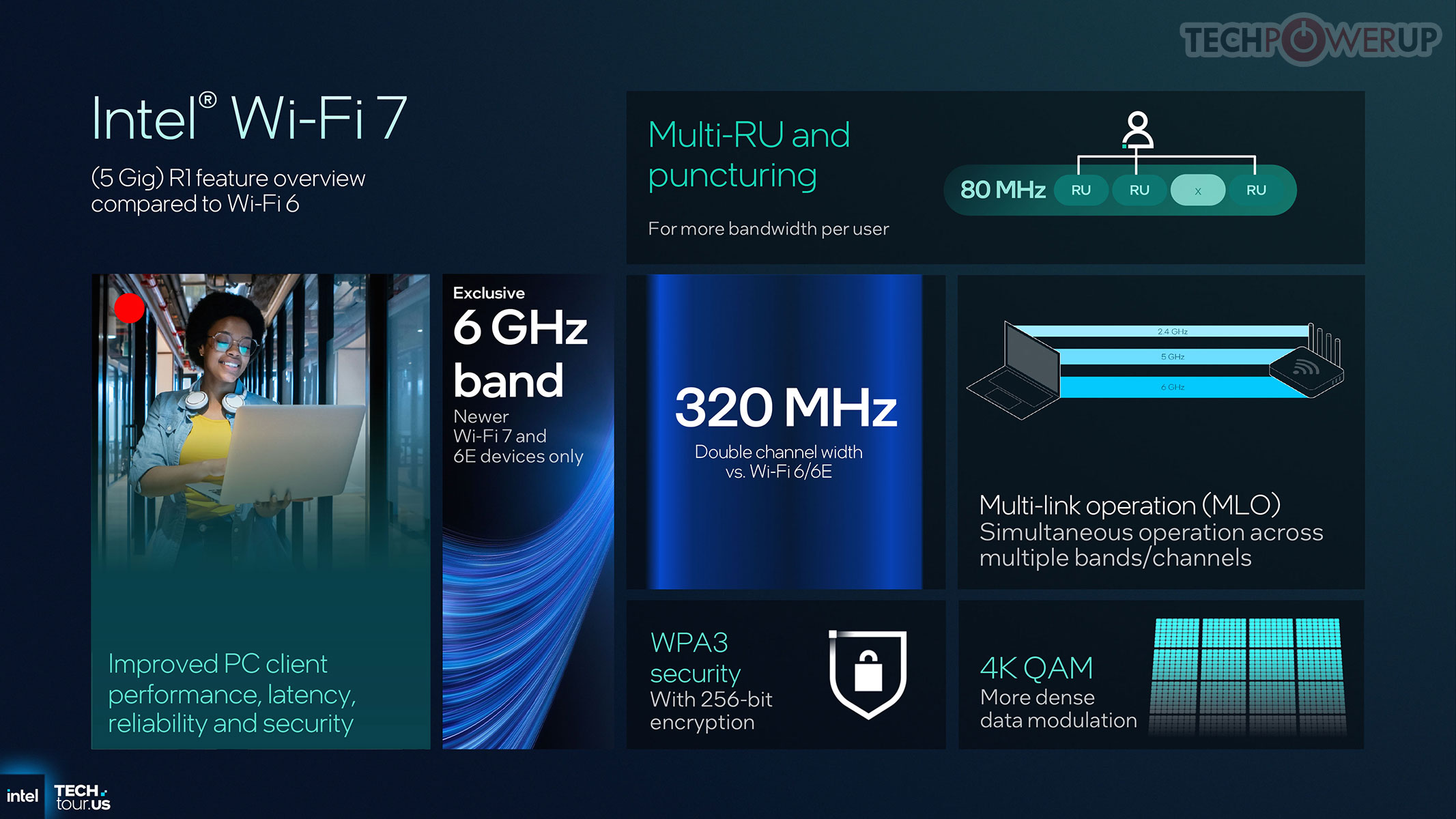
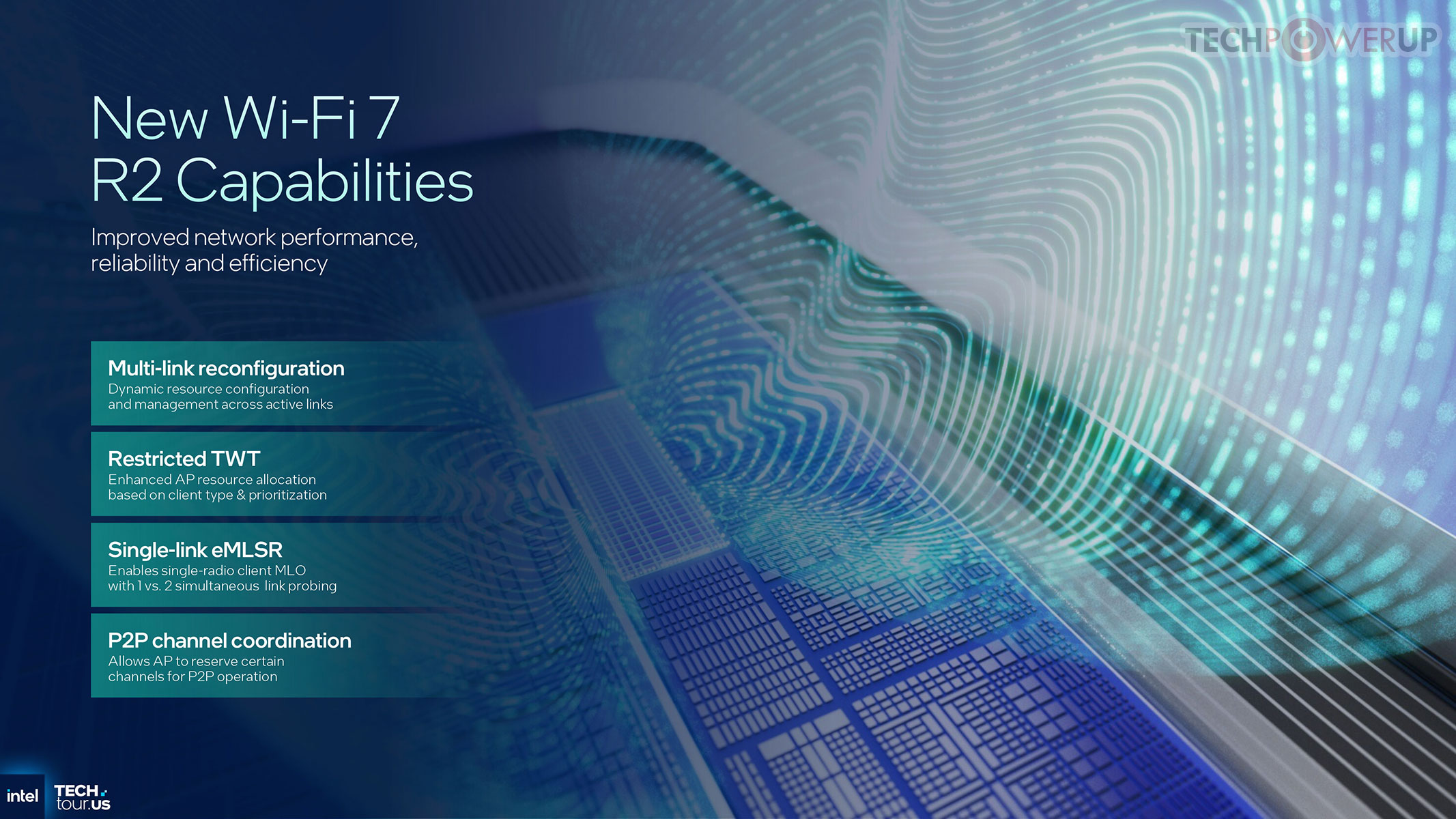
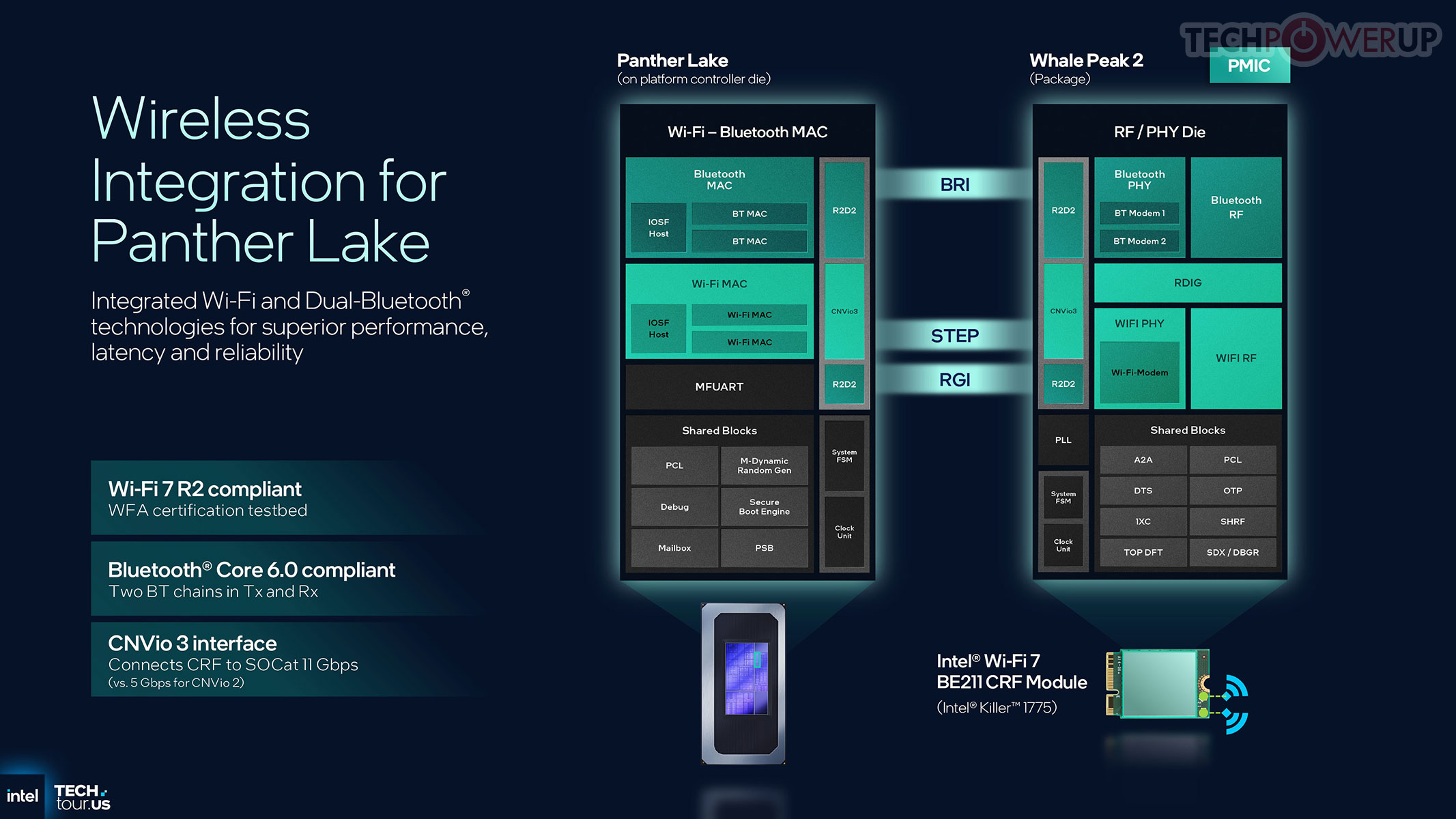
Wireless networking moves to a fully integrated Wi-Fi 7 (802.11be) solution with multi-link operation and support for up to 5 Gbps theoretical throughput. The RF front end supports concurrent dual-band and tri-band configurations, allowing low-latency connections across 2.4 GHz, 5 GHz, and 6 GHz simultaneously. Bluetooth 6 is also built into the same module, reducing board space and power draw compared with previous two-chip designs. These improvements help maintain stable wireless links even in congested environments, while latency-sensitive tasks such as game streaming benefit from reduced packet delay.
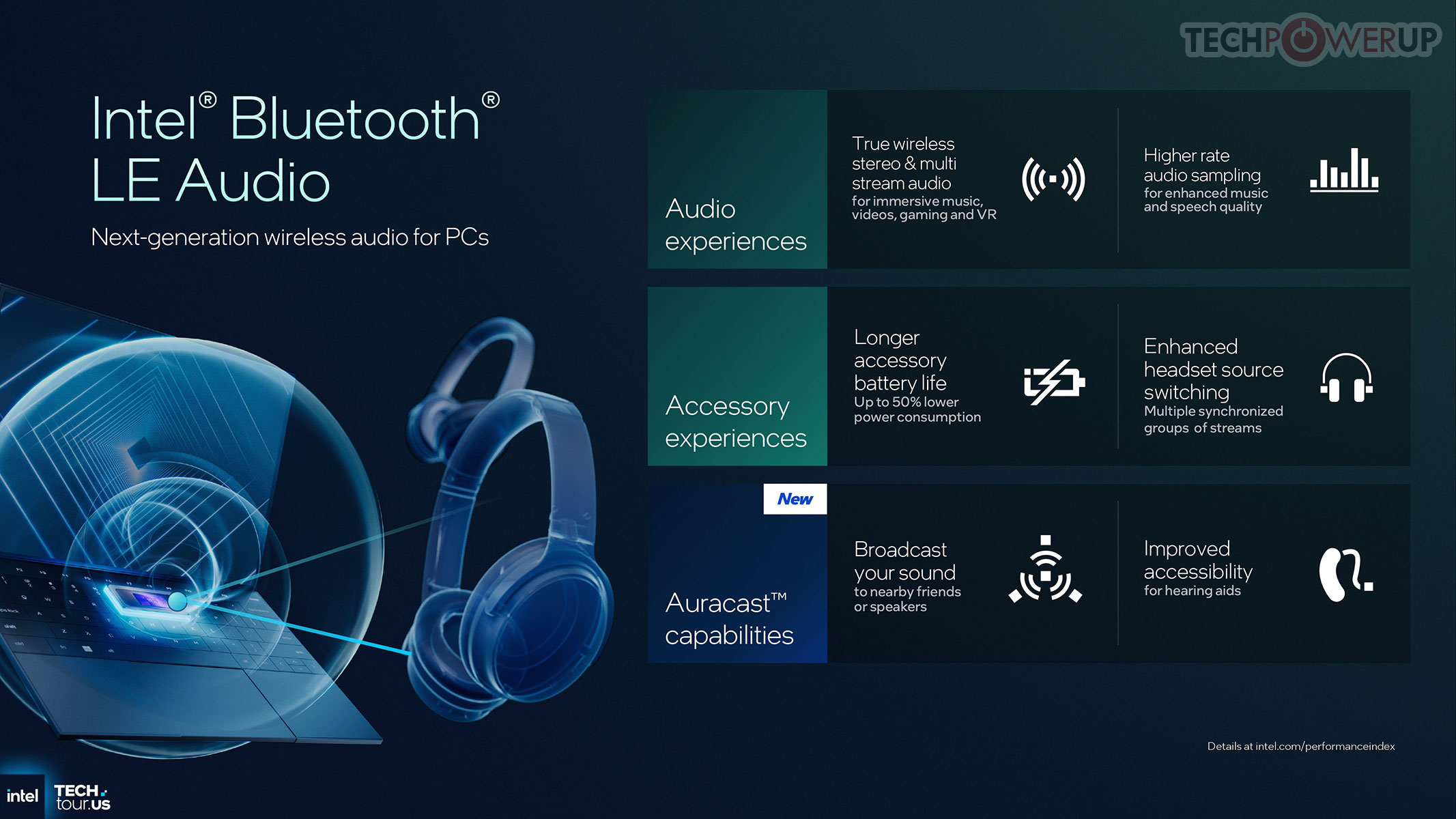
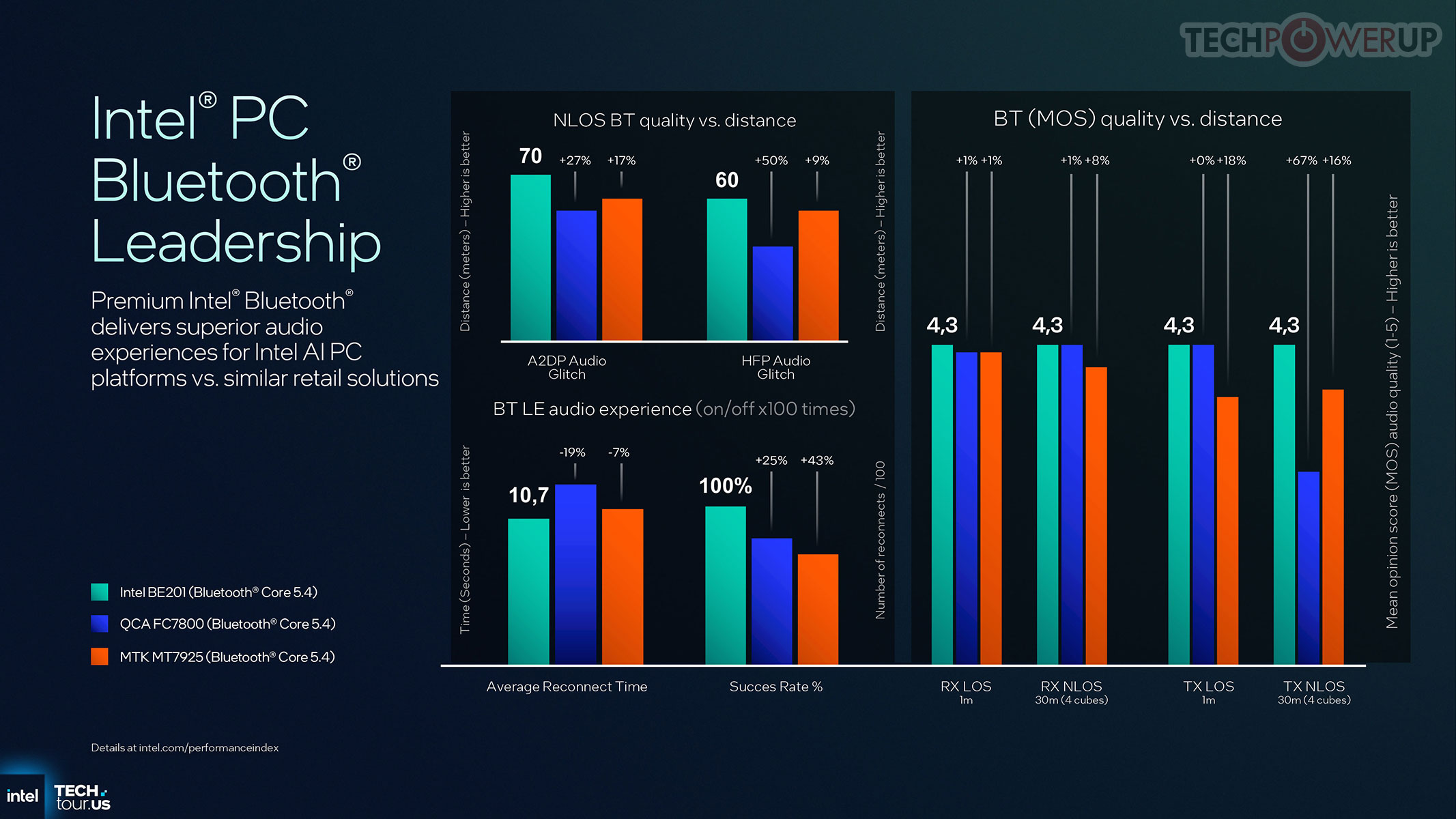
Panther Lake includes native support for Bluetooth Low Energy (LE) Audio. This feature allows for multi-stream audio and true wireless stereo, providing more consistent sound quality and easier switching between audio devices such as headsets or speakers. LE Audio also enables more efficient power use, which benefits battery-operated devices.
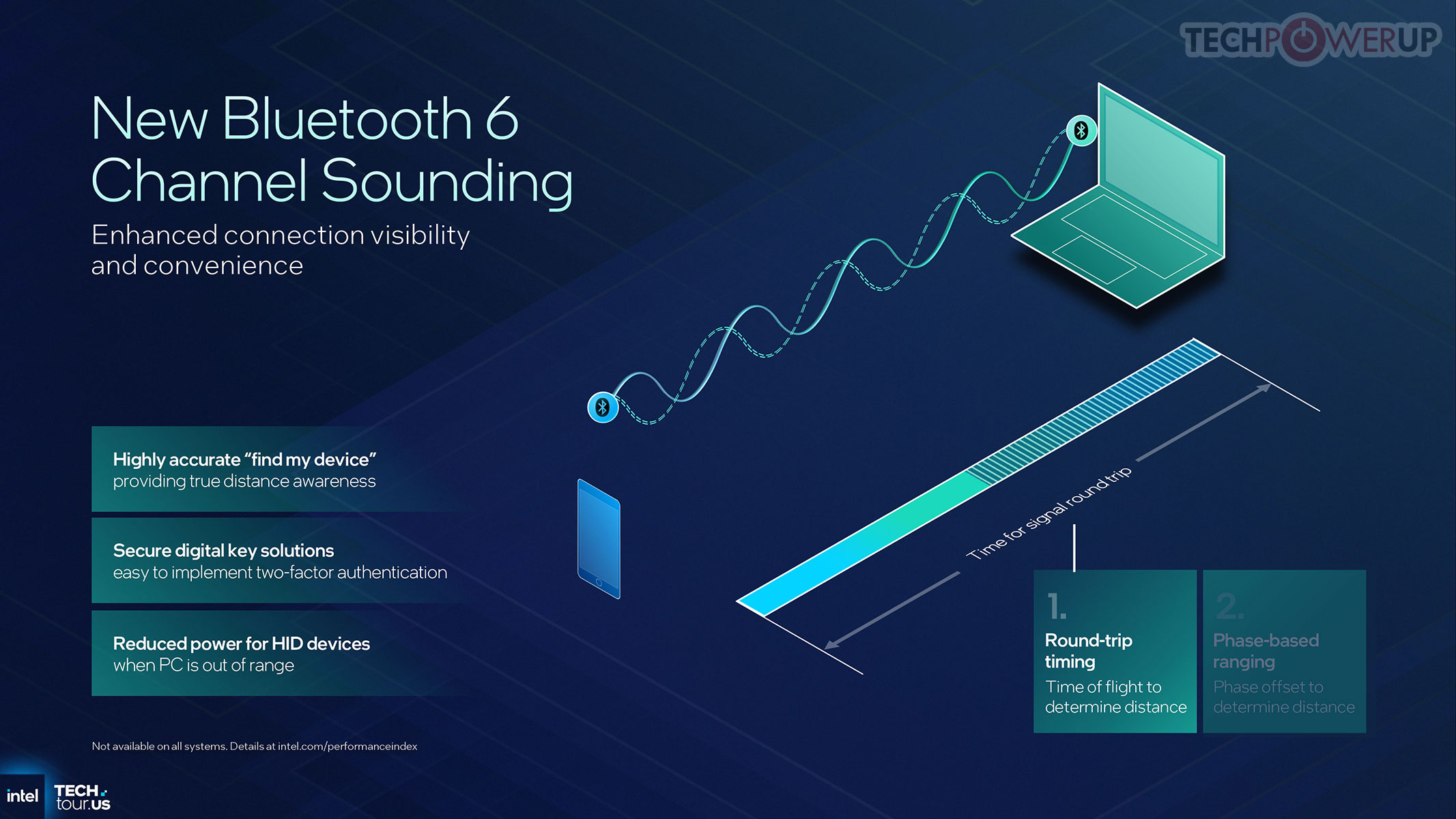
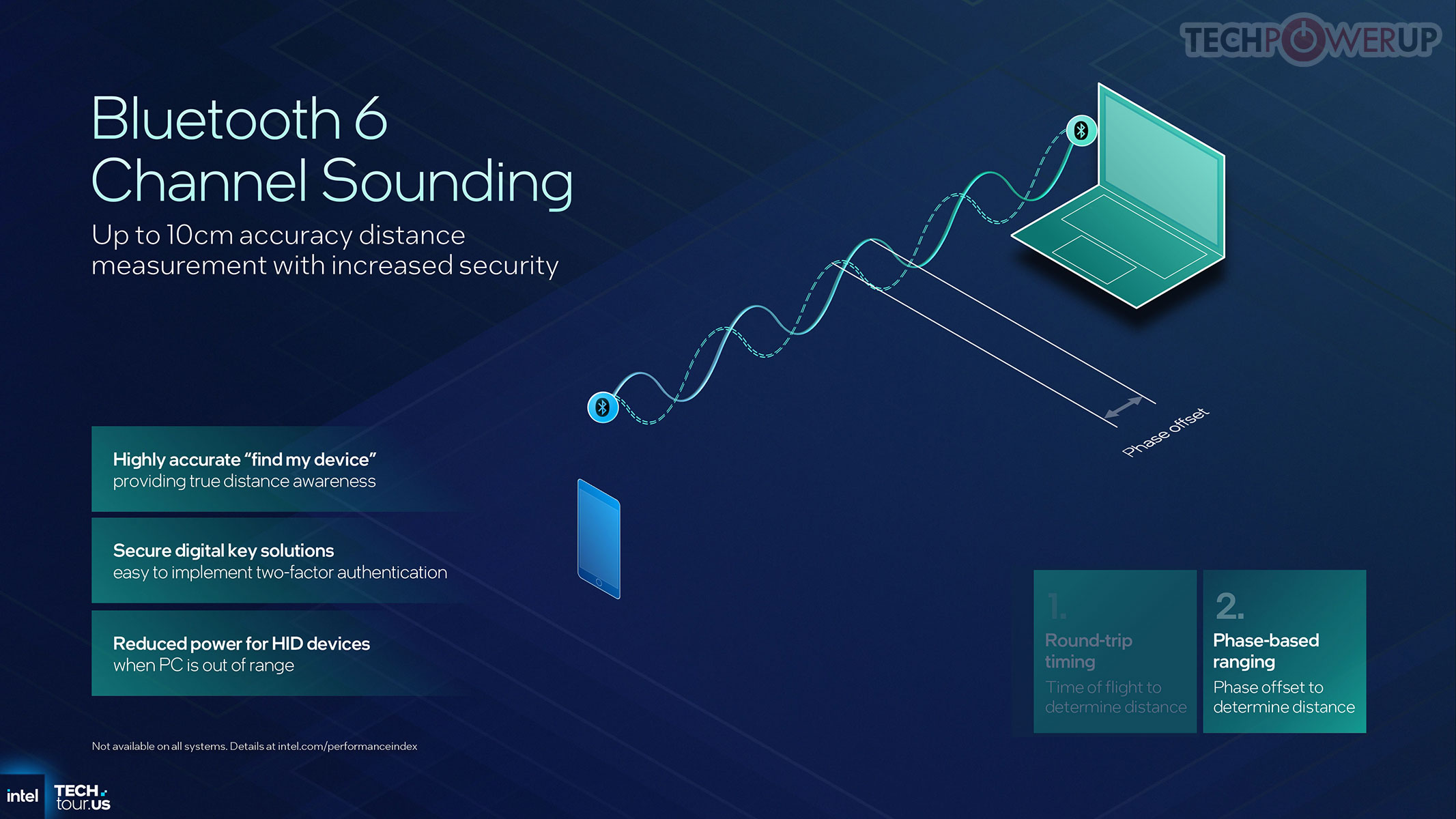
Panther Lake introduces Bluetooth 6 channel sounding, a feature that allows precise distance measurement between Bluetooth devices. It operates using two methods: round-trip time, which measures how long a signal takes to travel to another device and back, and phase-based ranging, which analyzes the phase difference between transmitted and received signals. By combining these techniques, accuracy of roughly ten centimeters can be reached. This enables proximity-based functions such as automatic device locking or unlocking when a user approaches or leaves their PC.
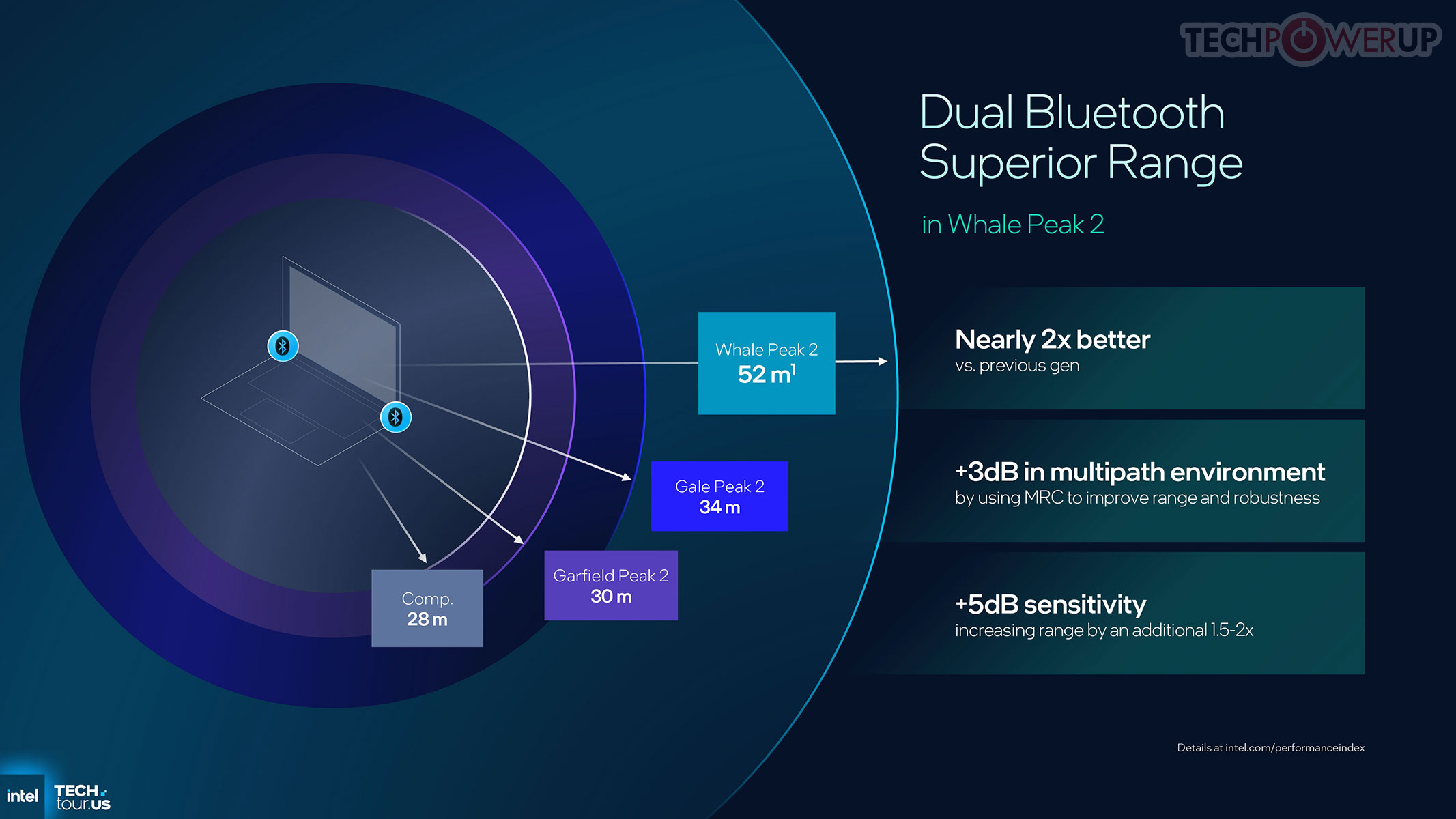
The Whale Peak 2 module introduces Dual Bluetooth, using two antennas instead of one to nearly double range and improve connection reliability. This design delivers about a 3 dB signal gain and stronger sensitivity, offering more stable performance than previous Intel modules and competing solutions.
Nov 23rd, 2026 03:49 CST
change timezone
Latest GPU Drivers
New Forum Posts
- Your PC ATM (36461)
- repair an NVIDIA Quadro M4000 (3)
- GTA VI (23)
- Honestly, do you care about GTA VI? (272)
- Youtube channel video downloader, not playlist. (2)
- Can you guess Which game it is? (347)
- Increasing Power Limit? (10)
- Last game you purchased? (1416)
- Anker SOLIX C2000 Gen 2 + PS400 Solarpanel (1)
- What are you playing? (26241)
Popular Reviews
- Microsoft Surface Laptop Ultra Review - The Next-gen Arm Laptop
- Corsair RM1200e (Second Generation) Review
- Upcoming Hardware Launches 2027 (Updated Nov 2026)
- Pulsar Office Tour & First Look at P1 Dual-Sensor Mouse
- Ugreen NASync DXP4800 GT Review
- AMD Ryzen 7 9800X3D Review - The Best Gaming Processor
- AMD Zen 6 Technical Deep Dive
- Phantom Blade Zero Performance Benchmark Review - 35 GPUs Tested
- AMD Ryzen 7 5800X3D 10th Anniversary Review
- Biwin Black Opal NV7400 2 TB Review
TPU on YouTube
Controversial News Posts
- NVIDIA Co-Founder and CEO Jensen Huang Officially Resigns (492)
- Report: Jensen Huang Eyes NVIDIA Comeback (266)
- Open Letter Asking NVIDIA to Reinstate Jensen Huang Passes 115,000 Signatures (184)
- OpenAI CEO Argues Home PCs Waste the World's Limited DRAM Supply (152)
- NVIDIA Launches Investigation Into Jensen Huang's Relationship With Suspected Chinese Spy (136)
- Intel "Raptor Lake Next" 16-Core and 20-Core CPUs Surface (130)
- NVIDIA GeForce RTX 50-Series Scheduled for up to $500 Price Hike This Week (89)
- Intel Razor Lake Gets a 12 P-Core bLLC Chip With No E-Cores, Per Leak (86)