 34
MSI GeForce RTX 5070 Ti Ventus 3X PZ Review - Well-Hidden 16-Pin Power
Pictures & Teardown »Introduction

MSI GeForce RTX 5070 Ti Ventus 3X PZ is a rather recent addition to the company's custom RTX 50-series graphics card lineup. It is part of the MSI Project Zero ecosystem of motherboards and graphics cards with concealed cabling for a cleaner look with today's panoramic, pillarless cases. MSI Project Zero is the company's answer to ASUS BTF, the motherboards in the series feature key connectors and headers on the reverse side of the PCB. Compatible cases with large enough cutouts and spaces behind the motherboard tray ensure you route your cables out of sight.
MSI Project Zero has a very different approach to graphics card power compared to ASUS BTF. ASUS innovated the GC-HPWR power-delivery slot that's located in line with the PCIe slot, VLB style. This power delivery slot is wired to a regular 12V-2x6 connector on the reverse side of the PCB. All fine and dandy, except in cases where the crawl-space behind the motherboard tray is tight, and you have to bend the 12V-2x6 cable a little tighter than that's required by the connector's specification, which calls for at least 10 cm of straight clearance for the cable before it is bent, to reduce mechanical strain of the contacts in the connector.
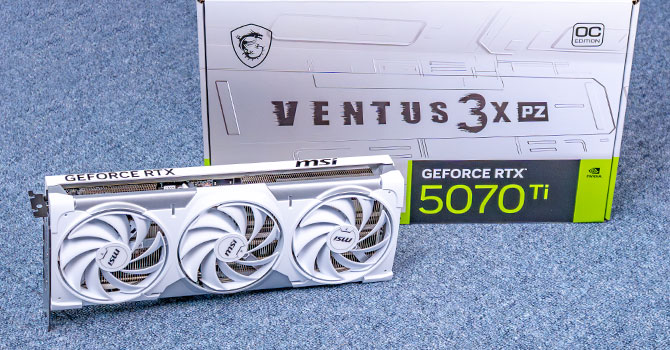
MSI's approach is different. It does not use a special power delivery slot, but rather repositions the 12V-2x6 input on the graphics card itself, such that it is facing downwards (towards the motherboard PCB), and you route your regular 12V-2x6 cable from your PSU, and it remains out of sight. This approach isn't all that different from Sapphire's, with its original RX 9070 XT NITRO+, which had a similar concealed 12V-2x6 input. MSI's approach ensures cable concealment while satisfying cable bend tolerances. With the cable in place, a magnetic backplate stub covers up that area of the backplate. This unique Project Zero innovation aside, the new RTX 5070 Ti Ventus 3X PZ features a slick two-tone white and silver color scheme that MSI introduced with its RTX 50-series Ventus family.
The GeForce RTX 5070 Ti is built on the Blackwell graphics architecture. Blackwell introduces a potentially revolutionary concept called Neural Rendering, where a generative AI model works alongside the game's rendering pipeline to create richly detailed objects, which are then composited with traditional rasterized 3D content in the same way as ray-traced elements. Given how far generative AI has advanced, well past the uncanny valley, you can imagine the creative potential Neural Rendering unlocks. Blackwell also adds hardware groundwork for ray tracing Mega Geometry, enabling real-time ray-traced objects with far higher geometric complexity, with all that detail fully interacting with light.
The new Blackwell streaming multiprocessor (SM) supports concurrent FP32 and INT32 math across all CUDA cores, whereas the older Ada Lovelace SM offered INT32 capability on only half of them. The shader execution reordering engine is now aware of neural shaders and neural objects, allowing these workloads to be scheduled on the Tensor cores. The new 5th Gen Tensor Core adds FP4 data format support to boost throughput by trading precision. Meanwhile, the 4th Gen RT Core integrates additional specialized hardware, including blocks that enable Mega Geometry—allowing ray-traced objects to use exponentially higher triangle counts, with rays interacting with all that added detail.
The GeForce RTX 5070 Ti uses the same GB203 silicon as the RTX 5080. While the RTX 5080 fully enables all 84 streaming multiprocessors (SMs) and the complete 64 MB L2 cache on the die, the RTX 5070 Ti is configured with 70 SMs and 48 MB of L2 cache. This configuration delivers 8,960 CUDA cores, 280 Tensor cores, 70 RT cores, 280 TMUs, and 96 ROPs. The reduced ROP count is the result of an entire GPC being disabled to scale back the SM count. The memory subsystem represents a major upgrade over the previous-generation RTX 4070 Ti, offering 16 GB of memory on a wider 256-bit GDDR7 interface. With memory speeds of 28 Gbps, total bandwidth reaches 896 GB/s, an impressive 77% increase compared to the RTX 4070 Ti.
NVIDIA recently announced the DLSS 4.5 feature-set, which updates the super-resolution component with a second generation Transformer based model that's been trained on a wider dataset than the original DLSS 4 that the GeForce RTX 50-series debuted with. Transformer-based upscalers offer significant increases in image quality over the older convoluted neural networks (CNN) based upscalers. With DLSS 4.5, NVIDIA also introduced 6x multi frame generation, which draws up to five frames following every conventionally rendered frame completely using AI, effectively multiplying framerate by 6x.
Perhaps the best aspect of MSI's RTX 5070 Ti Ventus 3X PZ is that you don't need an MSI Project Zero motherboard, or any special backside connectivity board for that matter. Besides its new PCB and concealed power design, the MSI RTX 5070 Ti Ventus 3X PZ remains a part of the company's value custom-design graphics card series, with its Tri Frozr cooler that uses the company's latest TorX 5.0 fans with webbed impellers that ensure axial airflow. MSI is pricing the card at $830.
| Price | Cores | ROPs | Core Clock | Boost Clock | Memory Clock | GPU | Transistors | Memory | |
|---|---|---|---|---|---|---|---|---|---|
| RTX 4070 | $500 | 5888 | 64 | 1920 MHz | 2475 MHz | 1313 MHz | AD104 | 35800M | 12 GB, GDDR6X, 192-bit |
| RX 7800 XT | $470 | 3840 | 96 | 2124 MHz | 2430 MHz | 2425 MHz | Navi 32 | 28100M | 16 GB, GDDR6, 256-bit |
| RTX 4070 Super | $600 | 7168 | 80 | 1980 MHz | 2475 MHz | 1313 MHz | AD104 | 35800M | 12 GB, GDDR6X, 192-bit |
| RX 7900 GRE | $550 | 5120 | 160 | 1880 MHz | 2245 MHz | 2250 MHz | Navi 31 | 57700M | 16 GB, GDDR6, 256-bit |
| RTX 4070 Ti | $700 | 7680 | 80 | 2310 MHz | 2610 MHz | 1313 MHz | AD104 | 35800M | 12 GB, GDDR6X, 192-bit |
| RTX 5070 | $550 | 6144 | 80 | 2325 MHz | 2512 MHz | 1750 MHz | GB205 | 31100M | 12 GB, GDDR7, 192-bit |
| RTX 4070 Ti Super | $900 | 8448 | 96 | 2340 MHz | 2610 MHz | 1313 MHz | AD103 | 45900M | 16 GB, GDDR6X, 256-bit |
| RX 7900 XT | $620 | 5376 | 192 | 2000 MHz | 2400 MHz | 2500 MHz | Navi 31 | 57700M | 20 GB, GDDR6, 320-bit |
| RX 9070 | $560 | 3584 | 128 | 2070 MHz | 2520 MHz | 2518 MHz | Navi 48 | 53900M | 16 GB, GDDR6, 256-bit |
| RX 9070 XT | $720 | 4096 | 128 | 2400 MHz | 2970 MHz | 2518 MHz | Navi 48 | 53900M | 16 GB, GDDR6, 256-bit |
| RTX 5070 Ti | $830 | 8960 | 96 | 2295 MHz | 2452 MHz | 1750 MHz | GB203 | 45600M | 16 GB, GDDR7, 256-bit |
| MSI RTX 5070 Ti Ventus PZ | $830 | 8960 | 96 | 2295 MHz | 2482 MHz | 1750 MHz | GB203 | 45600M | 16 GB, GDDR7, 256-bit |
| RX 7900 XTX | $750 | 6144 | 192 | 2300 MHz | 2500 MHz | 2500 MHz | Navi 31 | 57700M | 24 GB, GDDR6, 384-bit |
| RTX 4080 | $1200 | 9728 | 112 | 2205 MHz | 2505 MHz | 1400 MHz | AD103 | 45900M | 16 GB, GDDR6X, 256-bit |
| RTX 4080 Super | $1300 | 10240 | 112 | 2295 MHz | 2550 MHz | 1438 MHz | AD103 | 45900M | 16 GB, GDDR6X, 256-bit |
| RTX 5080 | $1150 | 10752 | 112 | 2295 MHz | 2617 MHz | 1875 MHz | GB203 | 45600M | 16 GB, GDDR7, 256-bit |
| RTX 4090 | $2000 | 16384 | 176 | 2235 MHz | 2520 MHz | 1313 MHz | AD102 | 76300M | 24 GB, GDDR6X, 384-bit |
| RTX 5090 | $2900 | 21760 | 176 | 2017 MHz | 2407 MHz | 1750 MHz | GB202 | 92200M | 32 GB, GDDR7, 512-bit |
Nov 26th, 2026 09:34 CST
change timezone
Latest GPU Drivers
New Forum Posts
- Making a game in Godot engine (20)
- What's your main Black Friday / Cyber Monday purchase? (17)
- X79 and/or rampage IV OC'ing thread for those of us still left.... (2459)
- Exploring Local LLMs: Models, Hardware and Setup Experiences (4)
- Linpack Xtreme Released (513)
- Wireless Internet sharing between PC and router both-ways, is it possible? (22)
- Claude credits purchased on or after Dec. 7 now have an expiry date (20)
- Acer TravelMate P414-51 (i5-1135G7): CPU stuck at x4 / ~200 MHz effective under 100% load, no throttle flags. How to find who's clamping it? (1)
- AMD ULL settings tinkering thread - post settings and Zen pics (91)
- Strange PC issues with Z690 setup (6)
Popular Reviews
- ASRock X870E Challenger Wi-Fi White Review
- VZMORE AX9 Max Review
- Upcoming Hardware Launches 2027 (Updated Nov 2026)
- Microsoft Surface Laptop Ultra Review - The Next-gen Arm Laptop
- AMD Ryzen 7 9800X3D Review - The Best Gaming Processor
- AMD Zen 6 Technical Deep Dive
- Corsair RM1200e (Second Generation) Review
- Phantom Blade Zero Performance Benchmark Review - 35 GPUs Tested
- Montech CyberFlow ARGB 360 Review
- Pulsar Office Tour & First Look at P1 Dual-Sensor Mouse
TPU on YouTube
Controversial News Posts
- Jensen Huang Reinstated as CEO of NVIDIA (585)
- NVIDIA Co-Founder and CEO Jensen Huang Officially Resigns (492)
- Report: Jensen Huang Eyes NVIDIA Comeback (281)
- Open Letter Asking NVIDIA to Reinstate Jensen Huang Passes 115,000 Signatures (184)
- OpenAI CEO Argues Home PCs Waste the World's Limited DRAM Supply (152)
- NVIDIA Launches Investigation Into Jensen Huang's Relationship With Suspected Chinese Spy (136)
- Intel "Raptor Lake Next" 16-Core and 20-Core CPUs Surface (130)
- Intel Razor Lake Gets a 12 P-Core bLLC Chip With No E-Cores, Per Leak (94)