 14
NVIDIA Blueprints & NIMs to Build 3D Guided Artwork - From Prompts to Pixels
NVIDIA NIMs & Blueprints Explained »Introduction

Generative AI has rapidly moved from research labs into the hands of developers, artists, and product teams—enabling new forms of content creation for many industries, with the promise of greatly improved efficiency. But it's not so easy to get up and running, there are a lot of practical challenges: deploying large models efficiently, managing ever-changing dependencies, keeping up with hardware requirements, and maintaining reliable performance across environments.
While services like ChatGPT can make all this look very easy, doing AI work locally is complex. It will take weeks or months of setup—even for technical teams—to build a real-world application that uses modern AI models. Things commonly encountered are the massive model sizes, resolving compatibility issues with PyTorch, TensorFlow, ONNX, and CUDA, tuning for different GPU architectures, or writing custom inference code just to make a basic API call work in production.
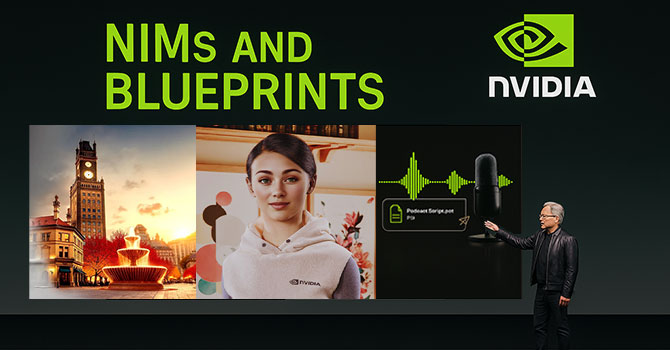
NVIDIA Inference Microservices (NIMs) were developed to streamline and standardize the deployment workflow. These prepackaged, containerized AI models come with high-performance APIs optimized for NVIDIA hardware, and are ready for enterprise or edge deployment. Whether managing an image generation pipeline or a multimodal retrieval model, NIMs remove the burden of model serving, GPU acceleration, and scaling. They also include built-in monitoring and access control features, essential for ensuring everything runs smoothly in production environments.
In this article, we'll use a generative AI workflow powered by NIMs: we use a very basic 3D scene built in Blender that provides hints to several AI models in order to turn structured input into great-looking, stylized results. We'll cover setup, what this pipeline can and can't do, how to write effective prompts, performance benchmarks, and hardware compatibility.
Nov 22nd, 2026 17:16 CST
change timezone
Latest GPU Drivers
New Forum Posts
- UPS what one to get? (49)
- Honestly, do you care about GTA VI? (265)
- Your PC ATM (36458)
- Gacha Games - Discussions, Pulls, Updates, etc. (1157)
- Last game you purchased? (1414)
- Making a game in Godot engine (19)
- Intel D270 (5)
- X870E AORUS ELITE WIFI7 thread with setting and OC (69)
- Gigabyte Aorus Master X570 settings / 7900XTX / 5950x /32GB Samsung B-die (13)
- Asus TUF Gaming X870-PLUS WIFI Optimization (2)
Popular Reviews
- Microsoft Surface Laptop Ultra Review - The Next-gen Arm Laptop
- Corsair RM1200e (Second Generation) Review
- Pulsar Office Tour & First Look at P1 Dual-Sensor Mouse
- Upcoming Hardware Launches 2027 (Updated Nov 2026)
- Ugreen NASync DXP4800 GT Review
- AMD Ryzen 7 9800X3D Review - The Best Gaming Processor
- Biwin Black Opal NV7400 2 TB Review
- AMD Zen 6 Technical Deep Dive
- Phantom Blade Zero Performance Benchmark Review - 35 GPUs Tested
- AMD Ryzen 7 5800X3D 10th Anniversary Review
TPU on YouTube
Controversial News Posts
- NVIDIA Co-Founder and CEO Jensen Huang Officially Resigns (492)
- Report: Jensen Huang Eyes NVIDIA Comeback (266)
- Open Letter Asking NVIDIA to Reinstate Jensen Huang Passes 115,000 Signatures (184)
- OpenAI CEO Argues Home PCs Waste the World's Limited DRAM Supply (152)
- NVIDIA Launches Investigation Into Jensen Huang's Relationship With Suspected Chinese Spy (136)
- Intel "Raptor Lake Next" 16-Core and 20-Core CPUs Surface (130)
- NVIDIA GeForce RTX 50-Series Scheduled for up to $500 Price Hike This Week (89)
- Intel Razor Lake Gets a 12 P-Core bLLC Chip With No E-Cores, Per Leak (86)