 141
NVIDIA GeForce GTX 1080 Ti Founders Edition 11 GB Review
(141 Comments) »Introduction

After weeks of rumors and some less-than-subtle hints from NVIDIA themselves, the GTX 1080 Ti was announced at GDC less than two weeks ago. We all knew this was coming, with a convenient media event scheduled for the same day as the competition, but we got more concrete information from the green camp this time around, including pricing and availability of the GTX 1080 Ti.

The flagship Ti moniker has served NVIDIA well these past three generations, with the GTX 780 Ti based on the full GK110 die and offering higher single precision performance than the original Titan to the point where a new Titan Black was released based off the same die and architecture.
The GTX 1080 Ti is a similar story - take the GP102 with a disabled SM as with the current Titan X Pascal, include one less GB of VRAM, and increase stock frequencies for both memory and GPU and we essentially have a GeForce flagship that aims to offer Titan X performance at less than 60% the price point. It was a long time coming with the Titan X announced over seven months ago, but for those who felt the $1200 price point was not reasonable, we have with us a new option from NVIDIA. No FP64 benefits to the Titan SKU this time around means that gamers, programmers, and developers alike will find this GTX 1080 Ti review well worth the read.

The Pascal architecture, used by all GeForce 10 cards, obviously hasn't changed. Compared to the Titan X Pascal, which has 12 GB, the GTX 1080 Ti comes with 11 GB, which means one physical memory chip less on the board (11 chips vs. 12 chips). This changes memory bus width, which has gone down to 352-bit. Less memory bus width also means fewer ROPs, which are at 88 now. The number of shader units has been untouched and stays at 3584.
Today's review is of the NVIDIA GTX 1080 Ti Founders Edition, a version designed and produced by NVIDIA. It comes with the stunning-looking NVIDIA reference cooler design and a price point of $700. Board partners are already hard at work creating their own custom designs for the GTX 1080 Ti, which will be released from next month onward.
| GeForce GTX 980 Ti | Radeon R9 Fury X | GeForce GTX 1070 | GeForce GTX 1080 | GeForce GTX 1080 Ti | GeForce Titan XP | |
|---|---|---|---|---|---|---|
| Shader Units | 2816 | 4096 | 1920 | 2560 | 3584 | 3584 |
| ROPs | 96 | 64 | 64 | 64 | 88 | 96 |
| Graphics Processor | GM200 | Fiji | GP104 | GP104 | GP102 | GP102 |
| Transistors | 8000M | 8900M | 7200M | 7200M | 12000M | 12000M |
| Memory Size | 6 GB | 4 GB | 8 GB | 8 GB | 11 GB | 12 GB |
| Memory Type | GDDR5 | HBM | GDDR5 | GDDR5X | GDDR5X | GDDR5X |
| Memory Bus Width | 384 bit | 4096 bit | 256 bit | 256 bit | 352 bit | 384 bit |
| Core Clock | 1000 MHz+ | 1050 MHz | 1506 MHz+ | 1607 MHz+ | 1481 MHz+ | 1418 MHz+ |
| Memory Clock | 1750 MHz | 500 MHz | 2002 MHz | 1251 MHz | 1376 MHz | 1251 MHz |
| Price | $390 | $380 | $350 | $500 | $700 | $1200 |
Packaging


You will receive:
- Graphics card
- Driver CD
- Documentation
- NVIDA case badge
- DP-to-DVI adapter
The Card


NVIDIA's GTX 1080 Ti cooler design is identical to that of the GeForce GTX 1080 Founders Edition. The side has an illuminated "GeForce GTX" logo. On the back, you will find the same backplate as on the GTX 1080, which can be partially removed to improve airflow for SLI. Dimensions of the card are 27 cm x 11 cm.

Installation requires two slots in your system.

Display connectivity options include an HDMI port and three DisplayPorts. The DVI port has been removed completely, but NVIDIA includes a DisplayPort to DVI adapter in the package. With Pascal, NVIDIA also updated DisplayPort to be 1.2 certified and 1.3/1.4 ready, which enables support for 4K @ 120 Hz and 5K @ 60 Hz or 8K @ 60 Hz with two cables.
The GPU also comes with an HDMI sound device. It is HDMI 2.0b compatible, which supports HD audio and Blu-ray 3D movies. The GPU video encoding unit has been updated to support HEVC at 10-bit and 12-bit.

With Pascal, NVIDIA made some changes to how SLI works. In a nutshell, for 4K at 60 Hz and above, NVIDIA recommends new high-bandwidth SLI bridges it dubbed "SLI HB." These bridges occupy both SLI fingers. Traditional triple- and quad-SLI setups are gone as well. Only certain benchmarks can run more than the dual-SLI setup to which all games are limited.


Pictured above are the front and back, showing the disassembled board. High-res versions are also available (front, back).
A Closer Look


NVIDIA's thermal solution looks very similar to that of the Titan X Pascal. The company has removed the DVI port on the 1080 Ti though, so there is more airflow available to cool the card.

As mentioned before, NVIDIA has updated their backplate design for Pascal to be thinner than ever, providing more airflow to the second card in an SLI configuration. Should you want to improve airflow even more, the backplate is now made up of two separately removable pieces, and you will not have to remove the main cooler. The pictures above show the removal of the backpiece. The backplate on top of the GPU has a thermal pad that covers the voltage controller.

The screws are the same special "NVIDIA" screws that can only be reliably removed with the proper tools.

NVIDIA is using a 6+8 power input configuration. With bus power, this setup is good for 300 W of power draw.
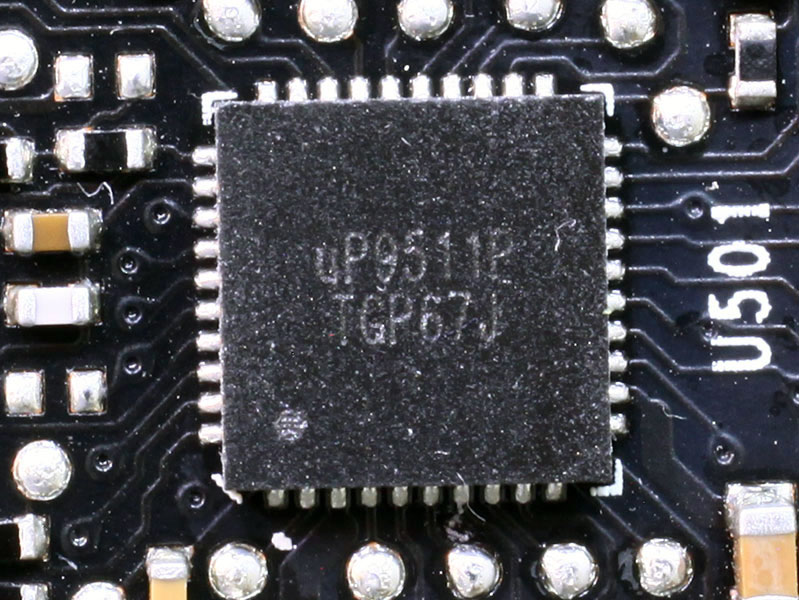
The uPI uP9511P is the same voltage controller as on the GTX 1080 and GTX 1070.

The GDDR5X memory chips are made by Micron and are marked with "D9VRL," which decodes to MT58K256M321JA-110. They are specified to run at 1375 MHz (11,000 MHz GDDR5X effective).

NVIDIA's GP102 graphics processor is the company's second-largest chip using the Pascal architecture. It is produced on a 16 nm process at TSMC, Taiwan, with a transistor count of 12 billion and a die size of 471 mm².
Our Patreon Silver Supporters can read articles in single-page format.
Nov 11th, 2026 17:19 CST
change timezone
New Forum Posts
- WarpCoreBench scores! (13)
- Warning for Windows 10 and 11 users running newer AMD GPU drivers (49)
- Bought MAX-P495 - Which model? (29)
- GeekMagic Ultra Smart WiFi Weather Station (3)
- DTS DCH Driver for Realtek HDA [DTS:X APO4 + DTS Interactive] (2809)
- Rare GPUs / Unreleased GPUs (2271)
- Samsung 870 EVO - Beware, certain batches prone to failure! (1486)
- Windows new update 26H2 - Throttlestop (10)
- When you could finally run Crysis maxed out? (42)
- TPU's F@H Team (20569)
Popular Reviews
- AMD Zen 6 Technical Deep Dive
- Upcoming Hardware Launches 2027 (Updated Nov 2026)
- Gigabyte Z890I Aorus Ultra Review
- XPG NIMBUS PLUS Review - Mid-range Chair With Strong Competitors
- INNOCN 45C1R Review - Two QHD Screens, Zero Bezels
- NZXT H7 RGB+ Review
- Phantom Blade Zero Performance Benchmark Review - 35 GPUs Tested
- Gears of War: E-Day Performance Benchmark Review - 35 GPUs Tested
- NZXT H5 Review
- be quiet! Light Mount TKL Keyboard Review
TPU on YouTube
Controversial News Posts
- OpenAI CEO Argues Home PCs Waste the World's Limited DRAM Supply (152)
- NVIDIA Launches Investigation Into Jensen Huang's Relationship With Suspected Chinese Spy (136)
- Intel "Raptor Lake Next" 16-Core and 20-Core CPUs Surface (130)
- Legendary Game Studio BioWare Shuts Down Following EA Layoffs (104)
- Dell CEO Says the Memory Shortage Will Get Worse in 2027 (95)
- NVIDIA GeForce RTX 50-Series Scheduled for up to $500 Price Hike This Week (89)
- Modder Fits RTX 5090 With Four 8-Pin Connectors, Halving Current per Wire (80)
- AMD Radeon Owners Can Now Run Nearly Every DLSS Feature Through Fan-Made Mod (80)