 10
OXS Thunder Duo X Review - Surround Sound Around Your Neck
Software »Closer Examination and Build Quality


OXS describes the look of the Thunder Duo X (Thunder Duo, rather) as spacecraft-inspired, and the angular, curvy housings do stand out next to a glass PC case. The enclosures are plastic, though, and the whole product carries a plastic aesthetic that younger buyers may warm to, but that will put off a more serious audience. The same goes for the lighting effects wrapped around all three units. The good news is that the RGB can be switched off entirely, either by holding the touch lighting control on the right speaker or the corresponding button on the remote. Each main speaker measures 178 × 215 × 276 mm (7" × 8.5" × 10.9").
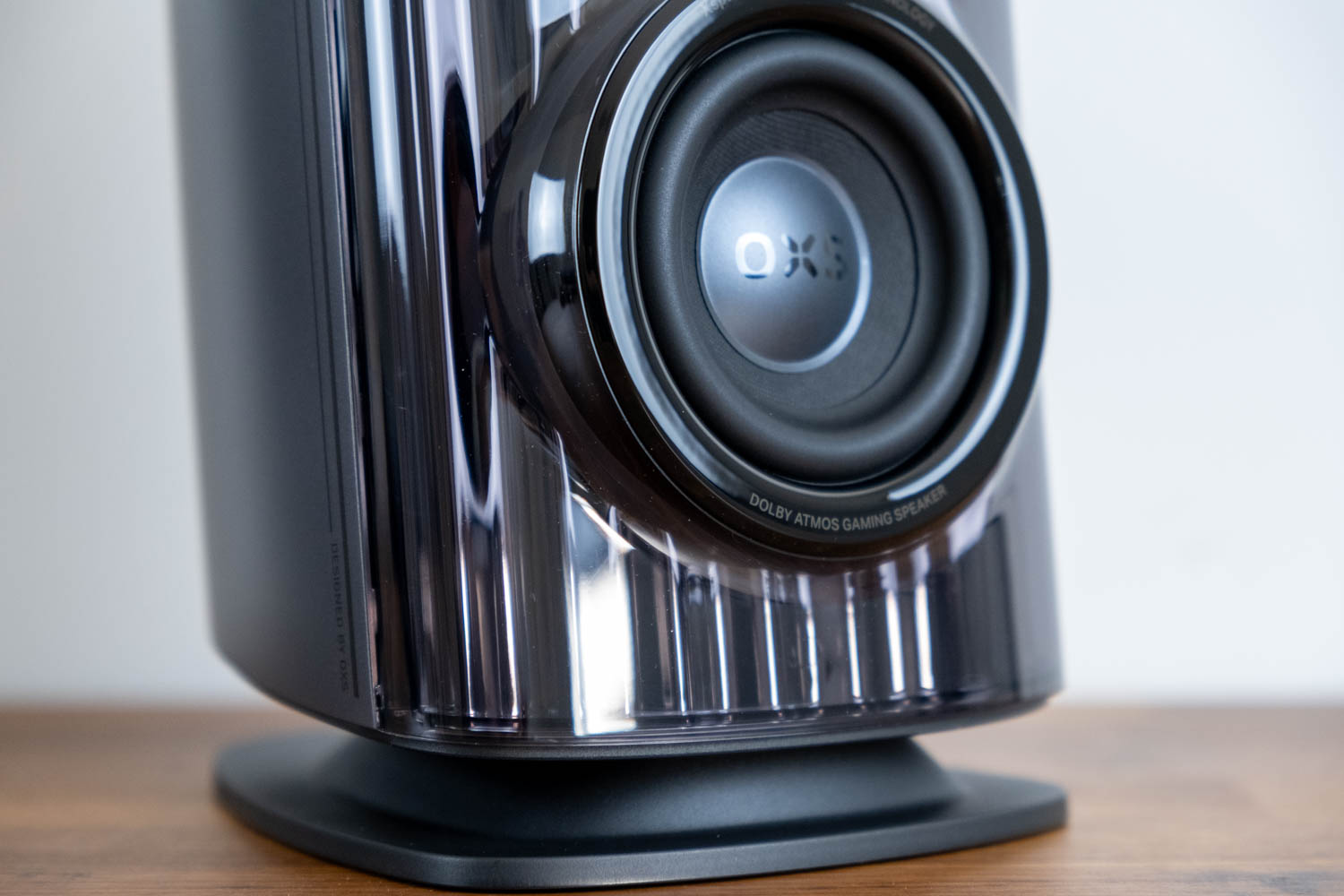
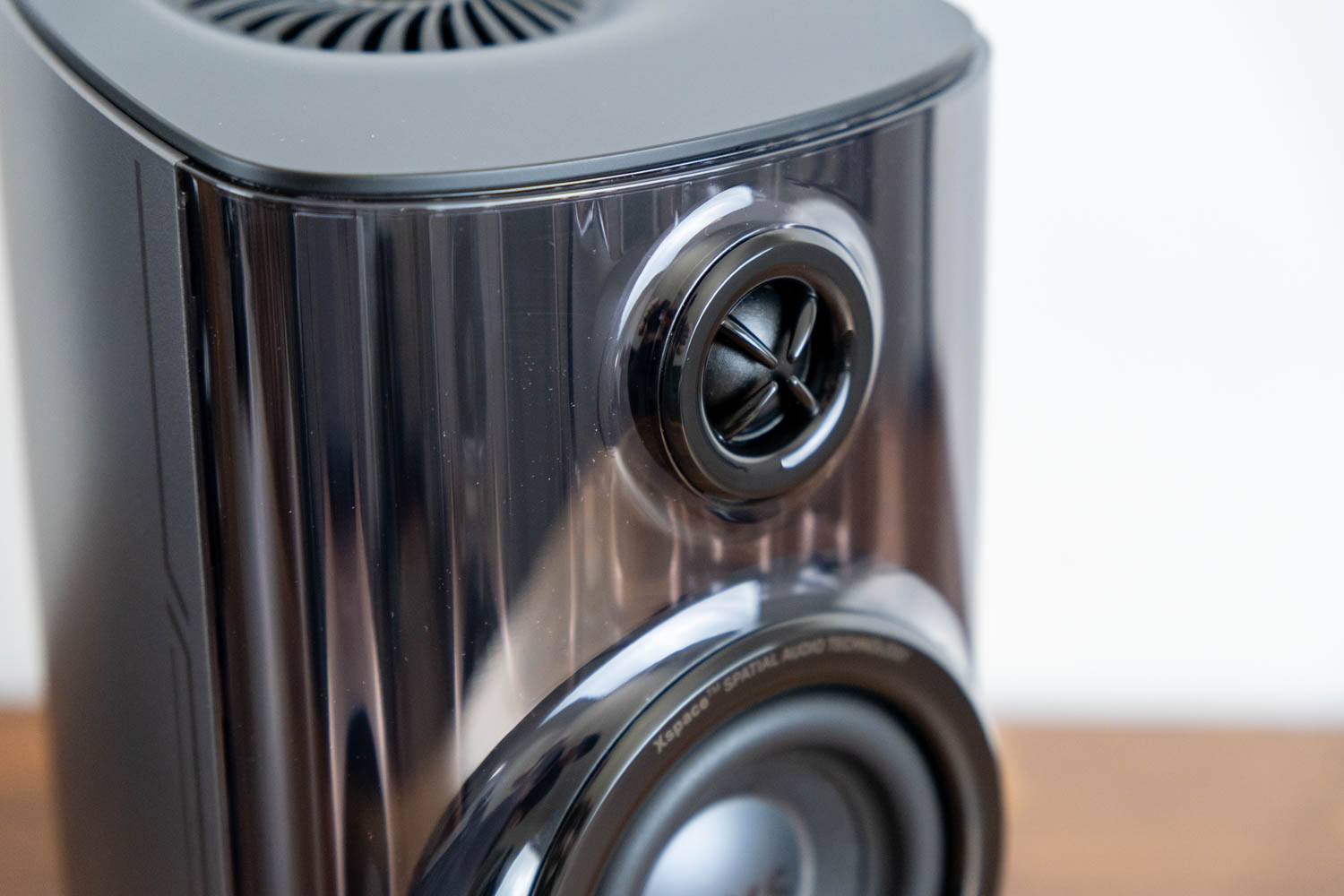

A chunk of the front is taken up by the 3.5-inch woofer, its dust cap stamped with the OXS logo and the surround ring reading "Dolby Atmos Gaming Speaker," the whole speaker sitting on a matte angled base that tilts it by 8° upward. Above the woofer is the 20 mm tweeter, recessed behind an X-shaped phase plug that doubles as an OXS styling motif, with the "Xspace Spatial Audio Technology" label running along the woofer ring just beneath it. The third driver, the up-firing 1.5-inch Sky channel, lives on the matte top surface under a swirled radial grille and fires at the ceiling for the height effect.
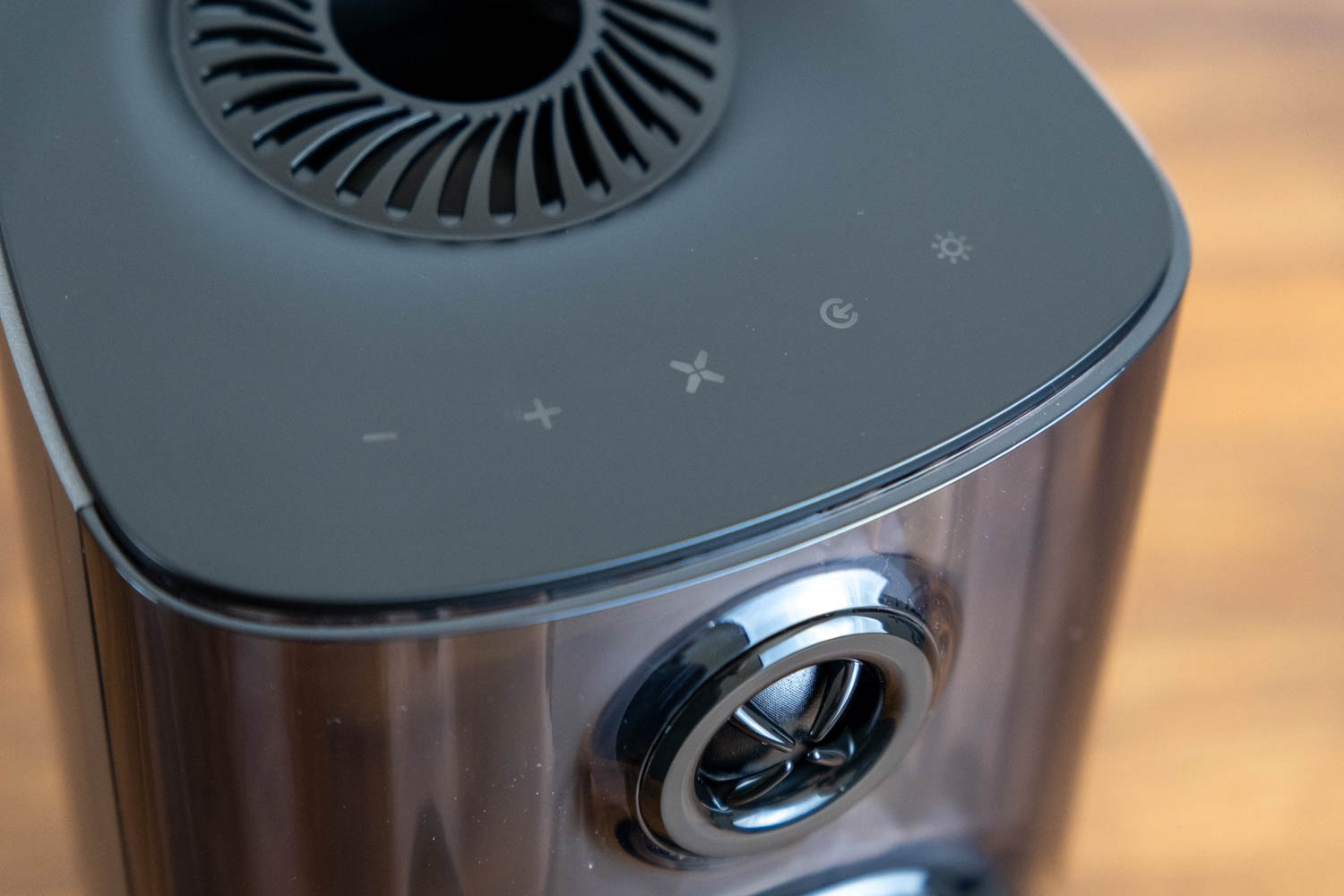

The right speaker is the active unit. It carries a set of capacitive touch icons on its matte top surface: volume, EQ profile switch, input selection and a lighting button. Holding that lighting icon is one of the two ways to kill the RGB completely. The remote is small enough to vanish in one hand and covers everything: mute and volume, track skip and play/pause, an EQ cycle, a source selector and a power key up top, dedicated Motion and Color keys plus a brightness button for the RGB, and three plus/minus pairs for Bass, Treble and Top (the Sky channel) along the bottom. It's fairly basic with no backlight, but it does the job.
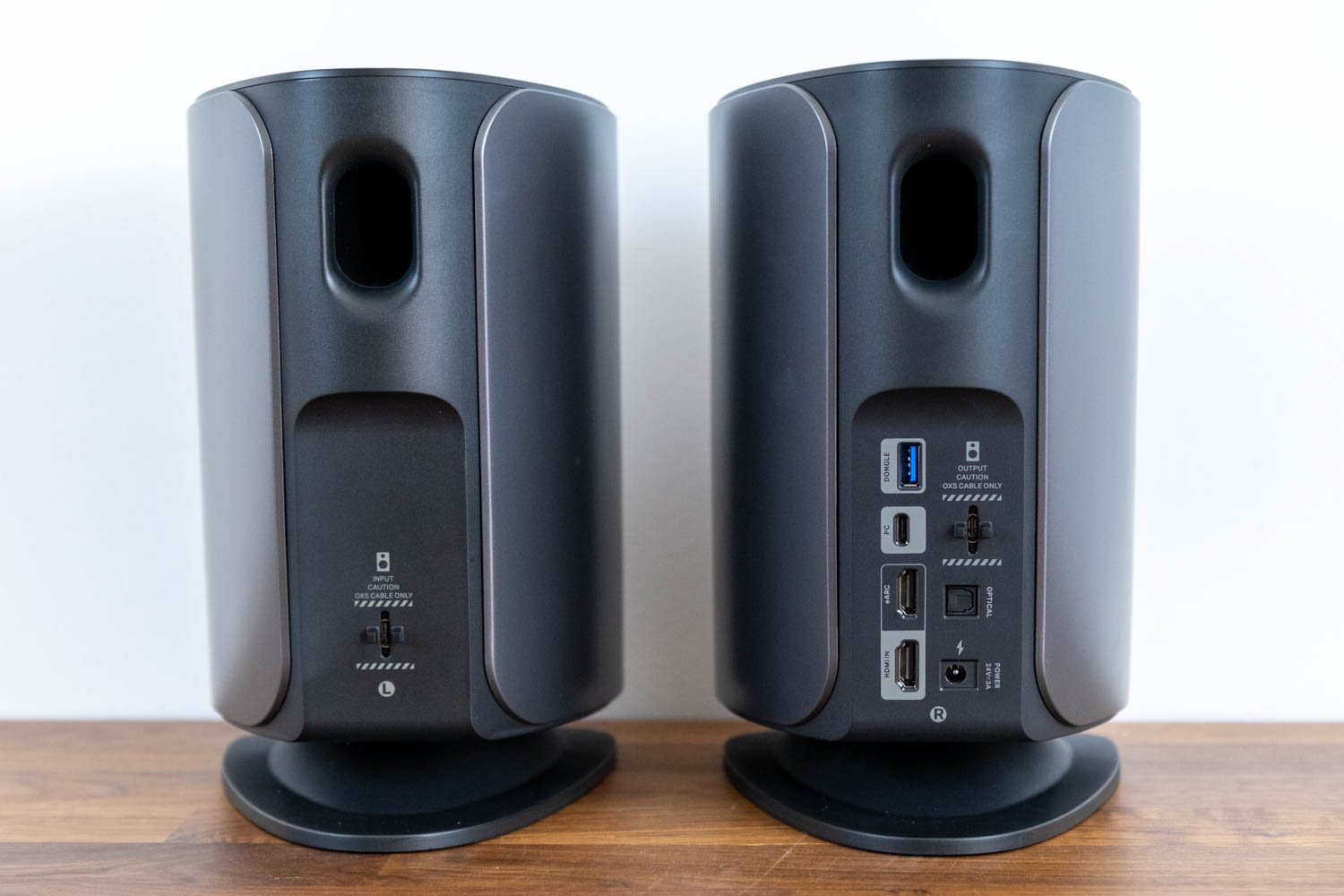
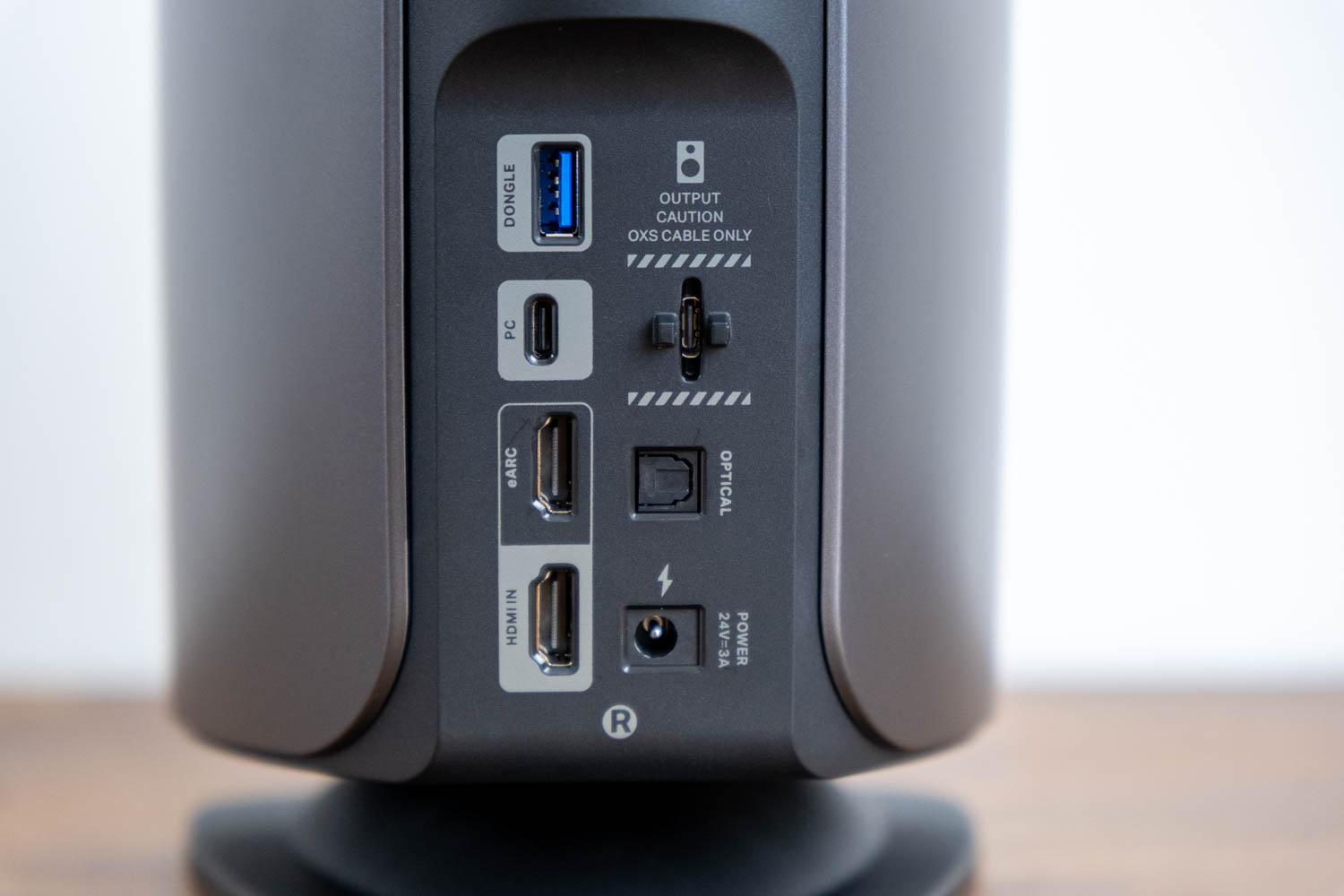
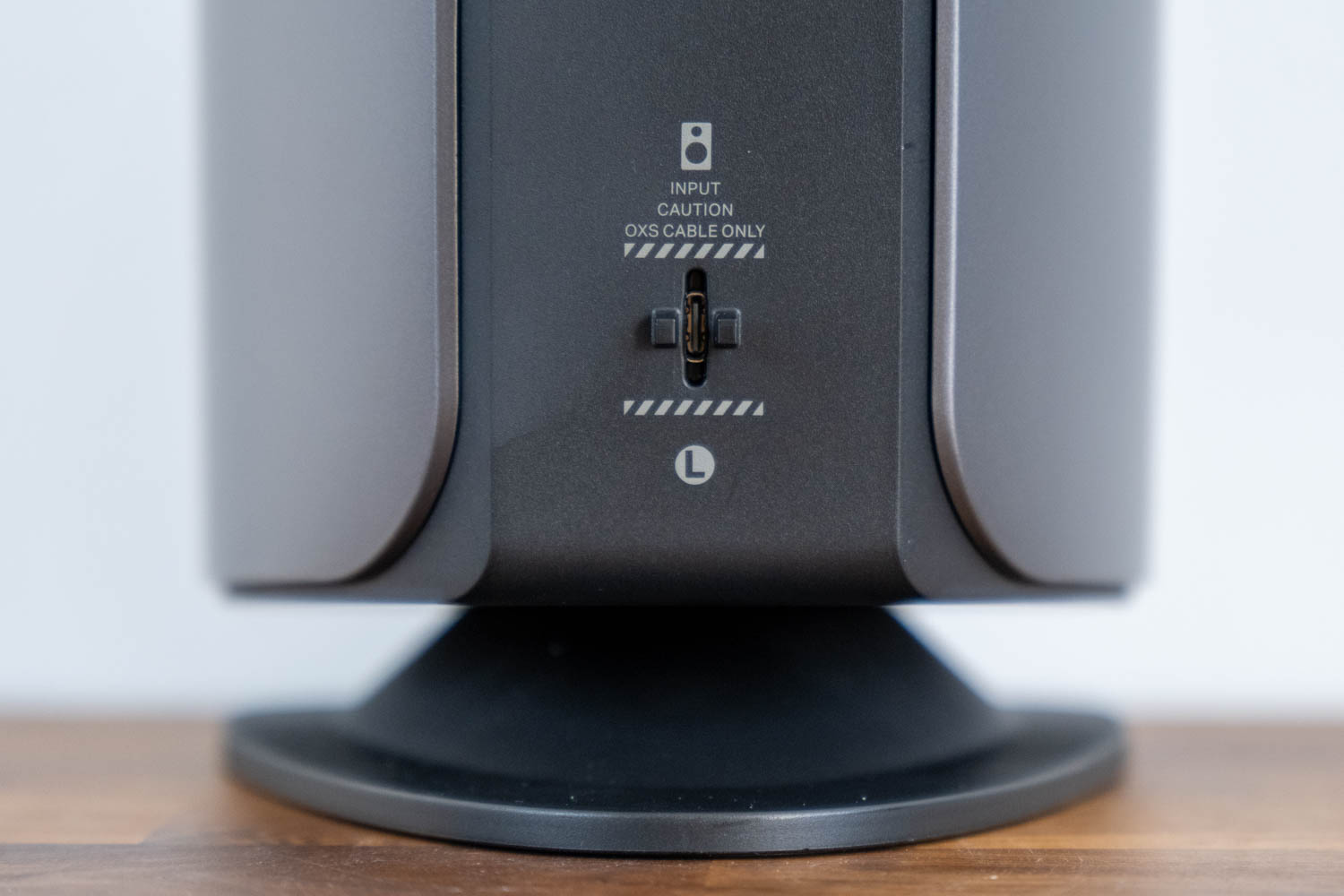
All of the connectivity lives on the right speaker, which acts as the brain of the system. Its rear panel carries a blue USB-A port labeled "Dongle" for the 5.8 GHz wireless link, a USB-C "PC" input, an HDMI eARC port for a TV, an optical input, an HDMI IN for a PC or console, and a 24 V/3 A DC barrel jack for power. Above them sits a connector marked "OXS Cable Only", which is where the USB-C interconnect runs across to the left speaker. The left speaker is essentially passive. There is nothing on its back but the matching "Input/OXS Cable Only" connector and an L marking, fed entirely by that single cable from the right unit. The interconnect uses a proprietary OXS fitting rather than a standard USB-C cable, so the link between the two speakers cannot be swapped for a longer third-party run. That is what turns the supplied cable being too short to comfortably flank a large TV from a minor gripe into a real limitation, since you are stuck with whatever length OXS puts in the box. Third-party USB-C cables don't fit; I've tried several from my collection. Both cabinets have an oval bass-reflex port molded into the rear.
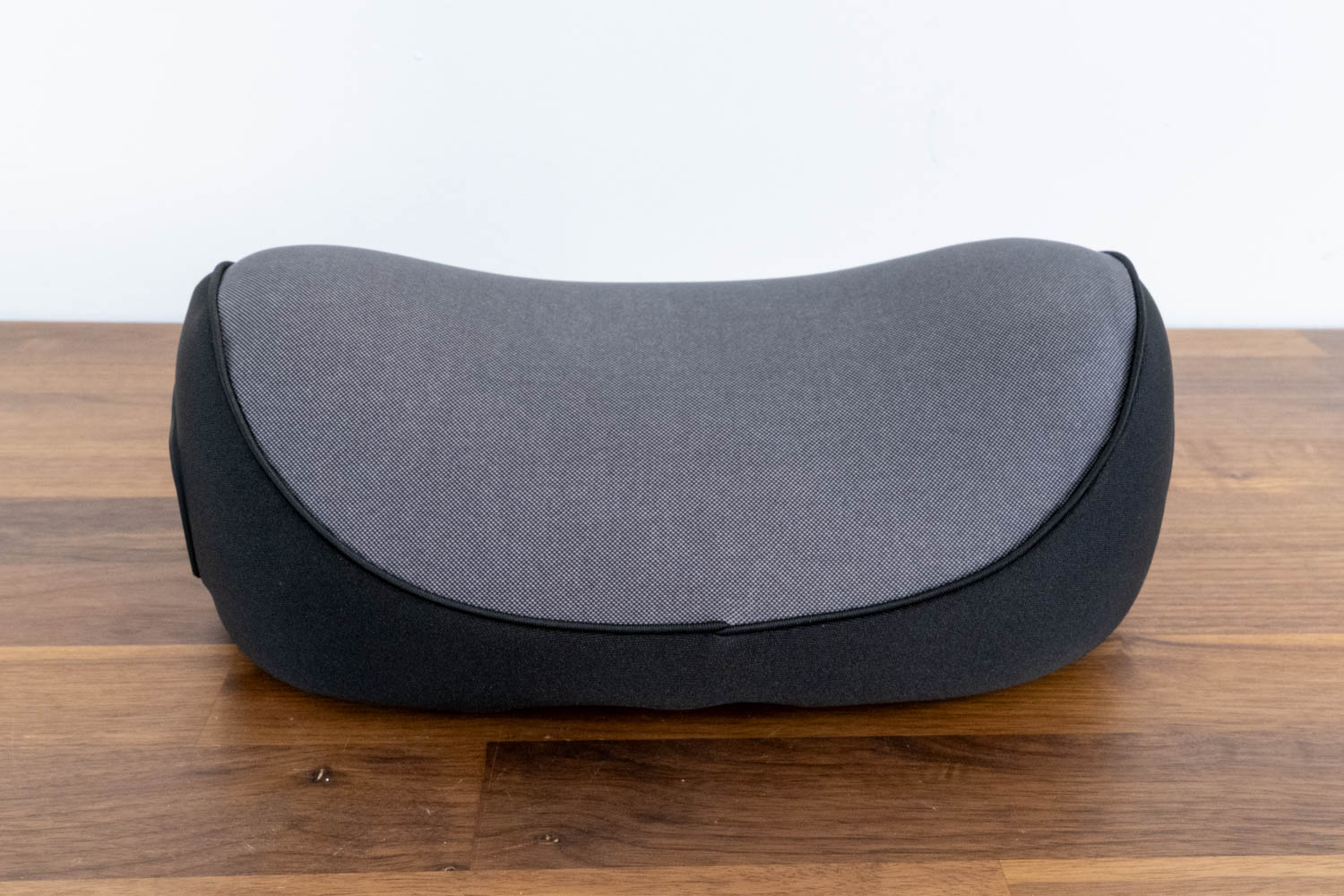
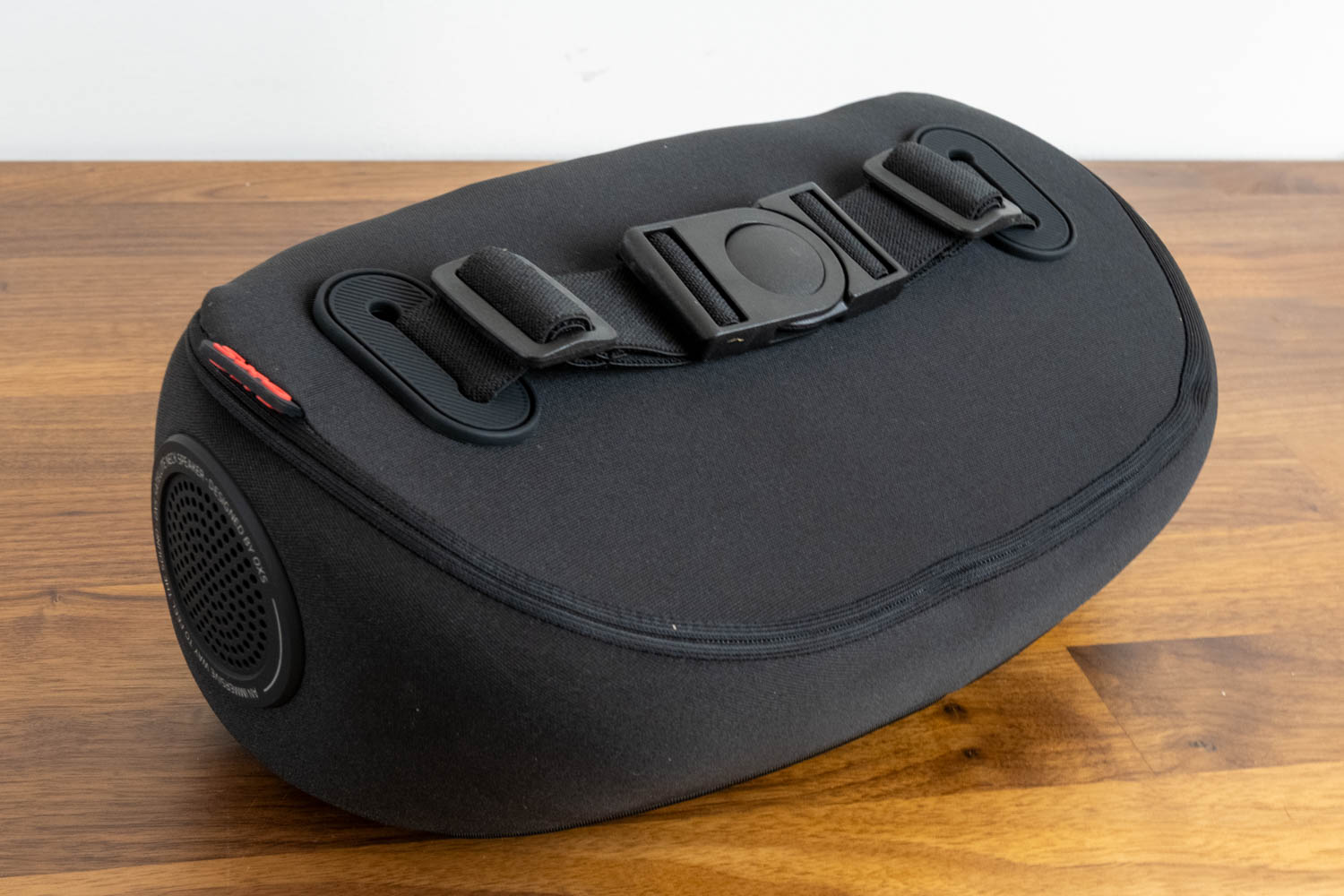
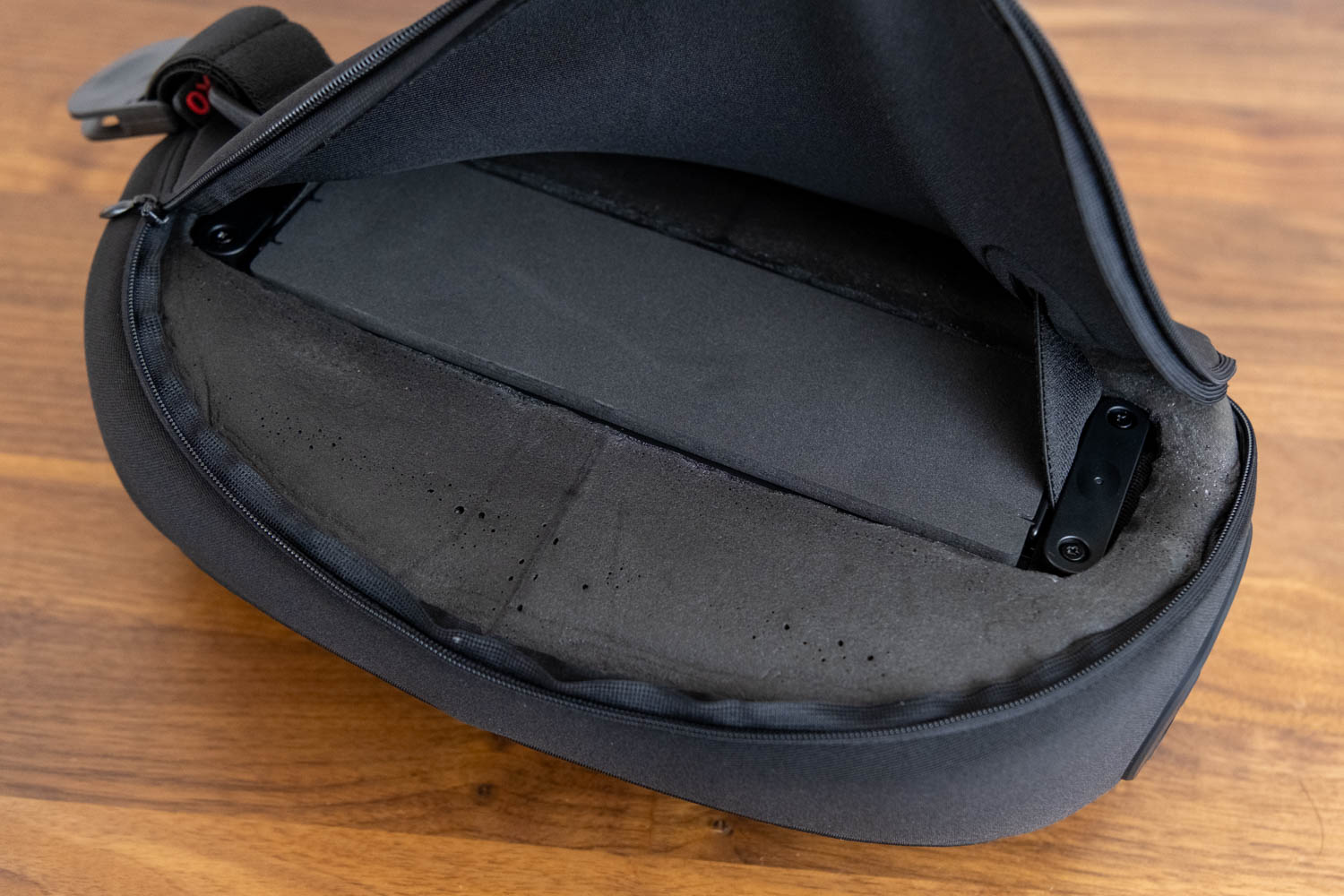
Then there is the neck speaker, the whole reason the X exists, and it is a genuinely strange addition. Part of that is the concept itself, sound arriving from behind your head, and part of it is the execution. Physically it looks and feels like a padded travel pillow: a curved, kidney-shaped cushion wrapped in fabric, grey on the face that meets your neck and black around the shell, with a driver grille set into the end and "An immersive way to feel the sound" printed around it. A zip runs around the body, and opening it reveals the foam padding and the internal battery underneath, which is simple enough but also makes clear how much of the bulk is just cushion. Two 1.5-inch drivers fire toward your ears.
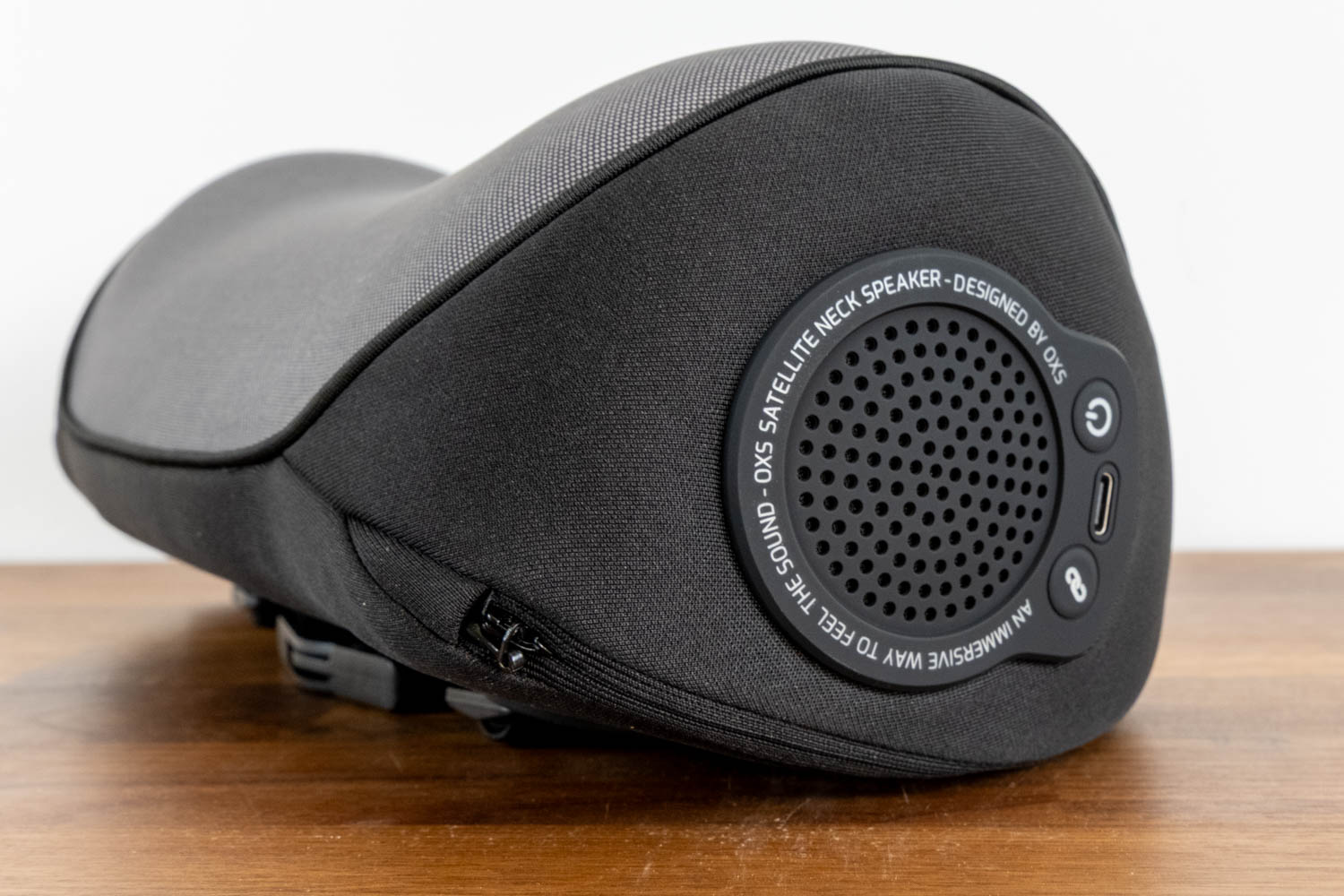
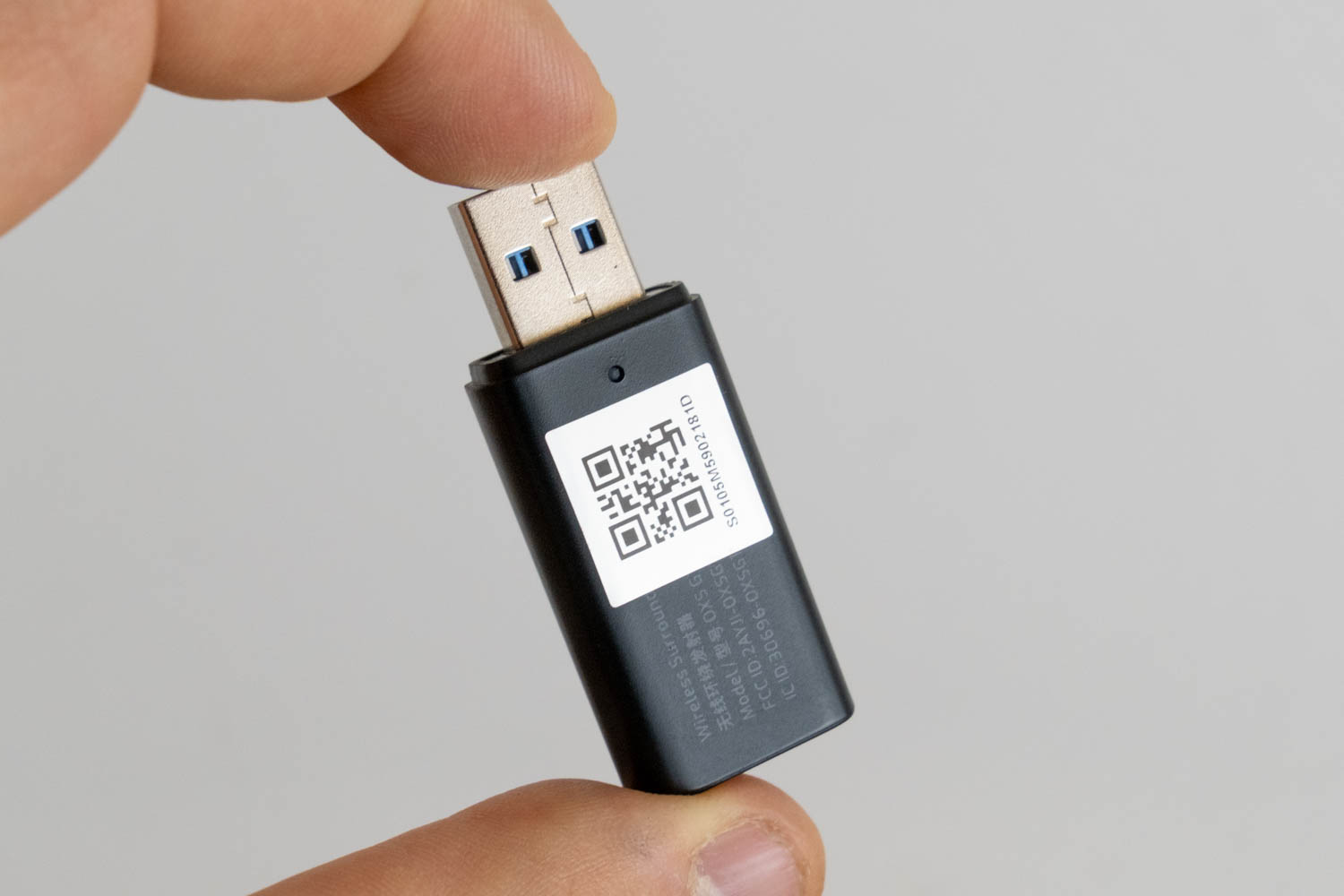
The controls sit on one end cap: a power button, a USB-C charging port and a pairing button. The unit uses two 1.5-inch drivers for a combined 20 W, runs off a 2400 mAh battery rated at roughly 12 hours at half volume (about two hours to charge, with a 10-minute quick charge good for two hours), and can be used while plugged in. The wireless link runs over a small 5.8 GHz USB-A dongle that plugs into the right speaker, and latency is not noticeable, so at least that part just works.
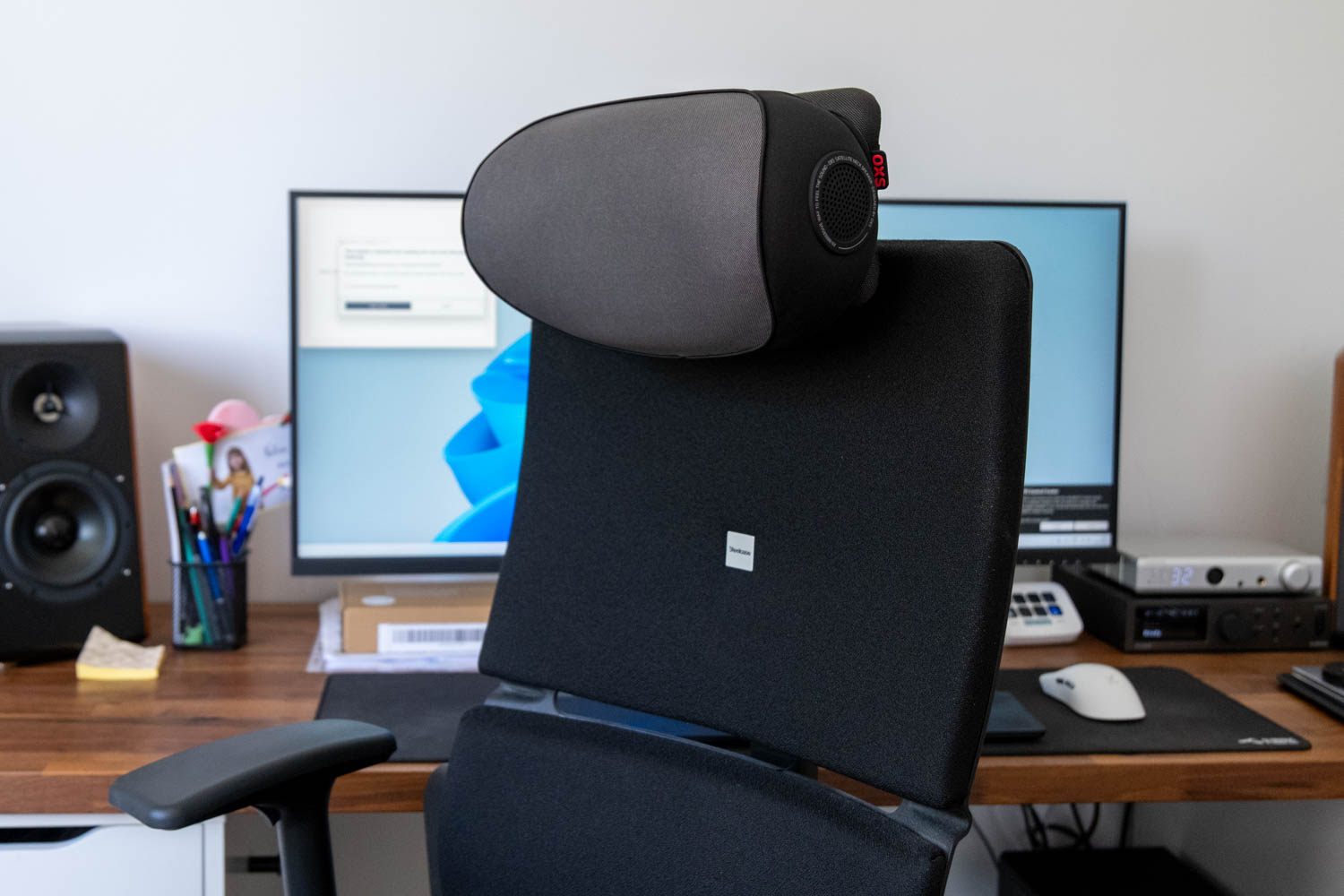
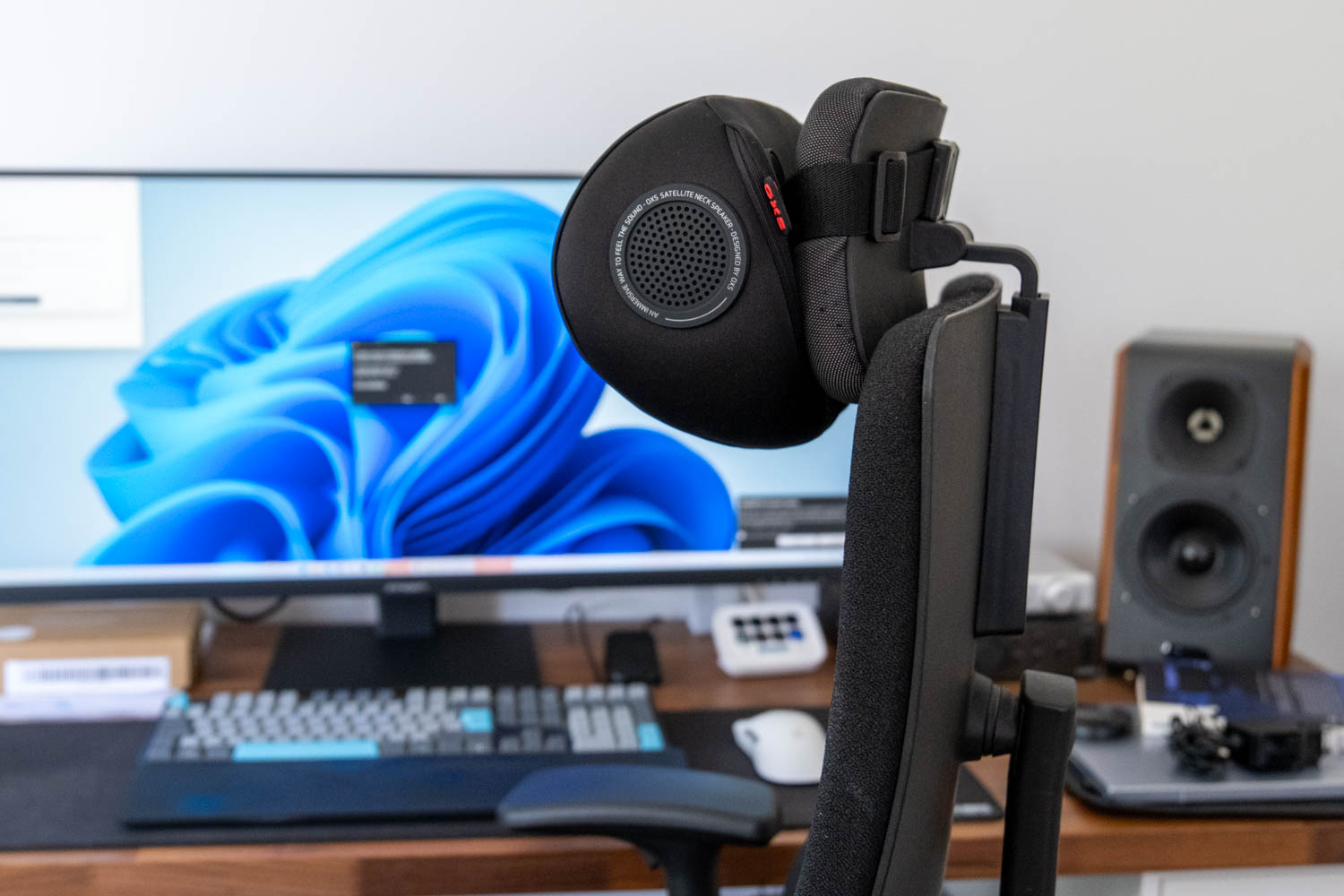
Setup is where it gets fiddly. OXS did what it could, fitting stretchy straps with a quick-release buckle to anchor the unit to a chair's backrest, but the accessory is unusable on any chair with a lower backrest, and on chairs that already have a headrest. In my case it did not properly fit either of my chairs (a Herman Miller Embody and a Steelcase Please), so I had to borrow an office chair from a neighbor just to use it as intended. The photos here show it on the Steelcase Please, a chair that already has its own headrest, which is exactly the problem: instead of sitting flush behind your neck, it ends up perched on top of the existing headrest. The aesthetics don't help either; the grey pad won't blend into every room or setup, black would have made more sense, though perhaps then people wouldn't know where to rest their head. Once everything is in place it is comfortable, the cushion is soft and sits naturally against the neck, but it is a lot of fiddling for what it is, and the recurring battery charging is something I suspect most owners will quickly tire of. All told, I'd seriously consider the cheaper plain Thunder Duo and skipping the neck speaker entirely. More on that in the performance section of this review.
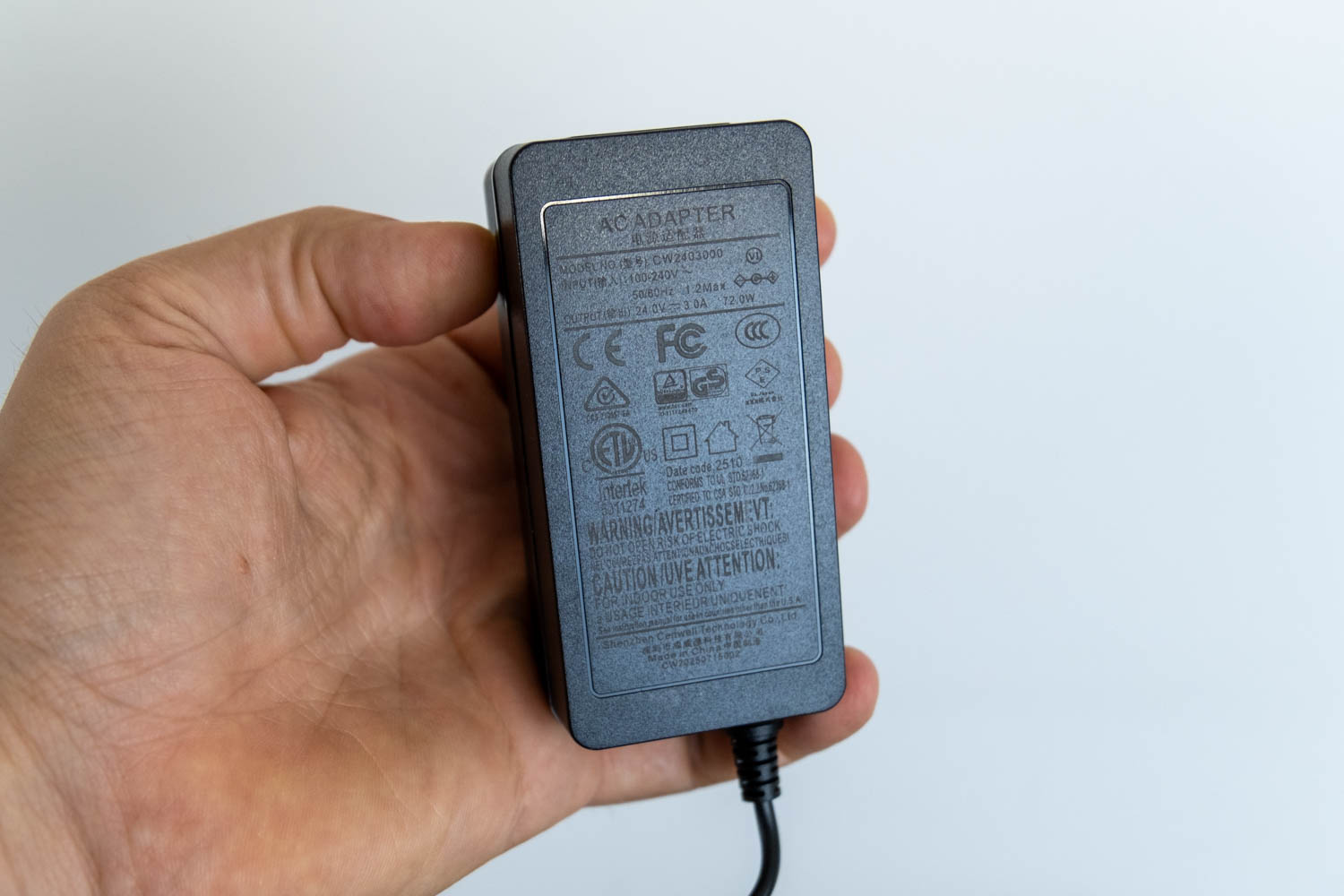
Power comes from an external brick rather than an internal supply. The label rates it at 24 V and 3 A for 72 W of output. It is a third-party OEM unit (made by Shenzhen Certwell Technology) that connects to the right speaker through the DC barrel jack seen on the rear panel. It is reasonably compact for a 72 W supply, but it is still an external brick you will need to find room for on or under the desk, and not something that hides easily. The neck speaker runs on its own battery, so this brick only feeds the two main speakers, which OXS rates at 110 W RMS. A 72 W supply cannot continuously deliver 110 W to the amplifiers, let alone after conversion losses, so the headline power figures are best read as short-term peaks rather than sustained output. There is still a ton of volume on tap in practice, as the listening notes make clear, but the numbers on the box deserve a pinch of salt.
The speakers boast three lighting zones and eight motion effects. This is what they look like in action.
Nov 21st, 2026 04:53 PST
change timezone
Latest GPU Drivers
New Forum Posts
- Anthrophics IPO (29)
- WarpCoreBench scores! (88)
- What's your latest tech Freebie? (86)
- TPU's Nostalgic Hardware Club (22179)
- [Poll] 12V-2x6 Connector Protection: What Are You Using? (WireView / Ampinel / Equalizer / Other / Nothing) (50)
- UPS what one to get? (1)
- RX 9000 series GPU Owners Club (2252)
- Windows 11 General Discussion (7743)
- Without Jensen, PC gaming will be (52)
- Zen 3 IF/IMC degradation (242)
Popular Reviews
- Microsoft Surface Laptop Ultra Review - The Next-gen Arm Laptop
- Ugreen NASync DXP4800 GT Review
- Corsair RM1200e (Second Generation) Review
- Pulsar Office Tour & First Look at P1 Dual-Sensor Mouse
- Upcoming Hardware Launches 2027 (Updated Nov 2026)
- Acemagic Retro X3 Review
- Biwin Black Opal NV7400 2 TB Review
- AMD Ryzen 7 9800X3D Review - The Best Gaming Processor
- AMD Zen 6 Technical Deep Dive
- Chieftec Iceberg PRO 360 DARK Review
TPU on YouTube
Controversial News Posts
- NVIDIA Co-Founder and CEO Jensen Huang Officially Resigns (491)
- Report: Jensen Huang Eyes NVIDIA Comeback (257)
- Open Letter Asking NVIDIA to Reinstate Jensen Huang Passes 115,000 Signatures (184)
- OpenAI CEO Argues Home PCs Waste the World's Limited DRAM Supply (152)
- NVIDIA Launches Investigation Into Jensen Huang's Relationship With Suspected Chinese Spy (136)
- Intel "Raptor Lake Next" 16-Core and 20-Core CPUs Surface (130)
- Legendary Game Studio BioWare Shuts Down Following EA Layoffs (104)
- NVIDIA GeForce RTX 50-Series Scheduled for up to $500 Price Hike This Week (89)