 14
Patriot Viper Elite 5 Ultra RGB DDR5-8000 48 GB CL36 Review
Memory Average FPS »Relative Performance
1920×1080 Relative Performance
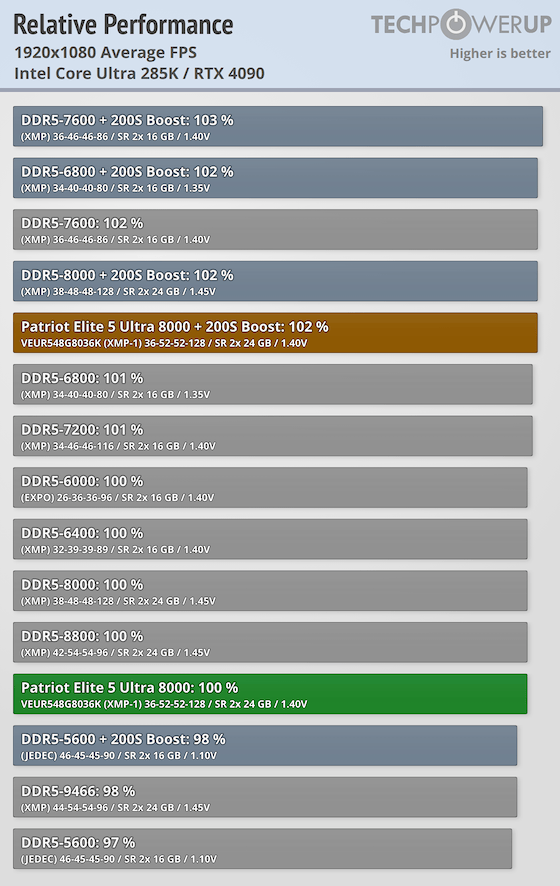
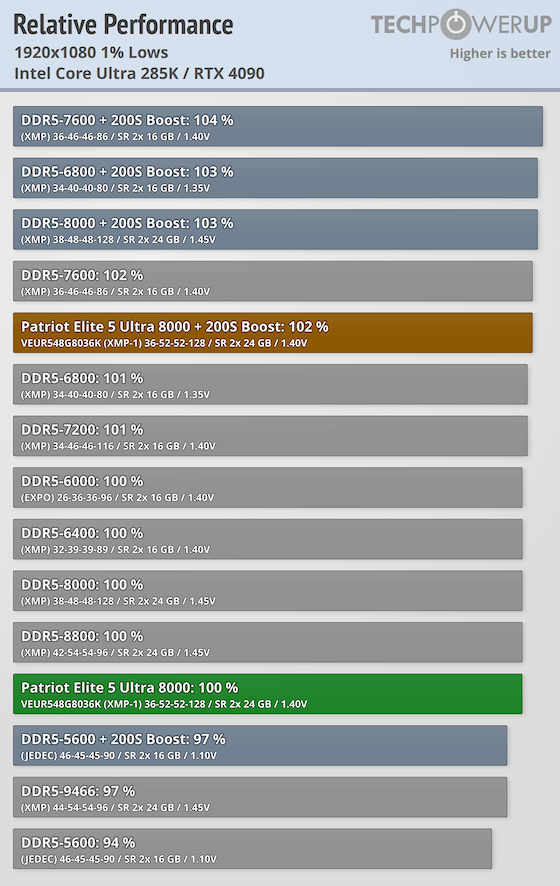
Looking at both the Average FPS and 1% Lows charts for Intel Core Ultra 285K, the Patriot Elite 5 Ultra 8000 MT/s serves as the baseline at 100% in both metrics. When the 200S Boost profile is applied to the same kit, it jumps to 102% in both Average FPS and 1% Lows a modest but consistent 2% uplift across the board, placing it solidly in the upper tier of the chart alongside DDR5-7600 XMP and DDR5-6800 with 200S Boost. Without the boost, the stock 8000 kit performs on par with several other configurations including DDR5-6000, DDR5-6400 XMP, DDR5-8000, and DDR5-8800 all clustering around that 100% baseline. This means that raw speed rating alone doesn't guarantee a performance lead as Intel Arrow Lake CPUs greatly benefit from higher Die-2-Die Ratios from either enabling 32X through the optional 200S Boost profile in the BIOS or use an Arrow Lake refresh (Plus) CPU which comes with a default 30X. The takeaway is that the 200S Boost profile meaningfully unlocks additional performance from the Patriot Elite 5 Ultra 8000 memory kit, elevating it from a mid-pack performer into genuine contender territory, just shy of the very best results on the chart.
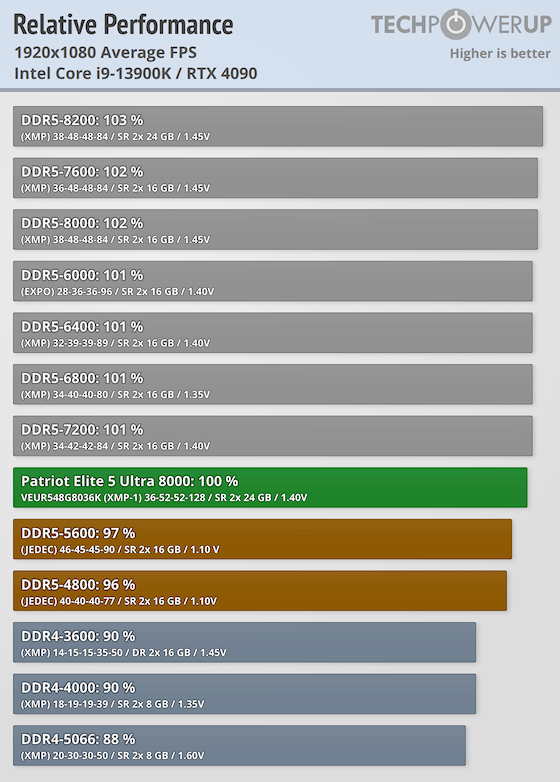
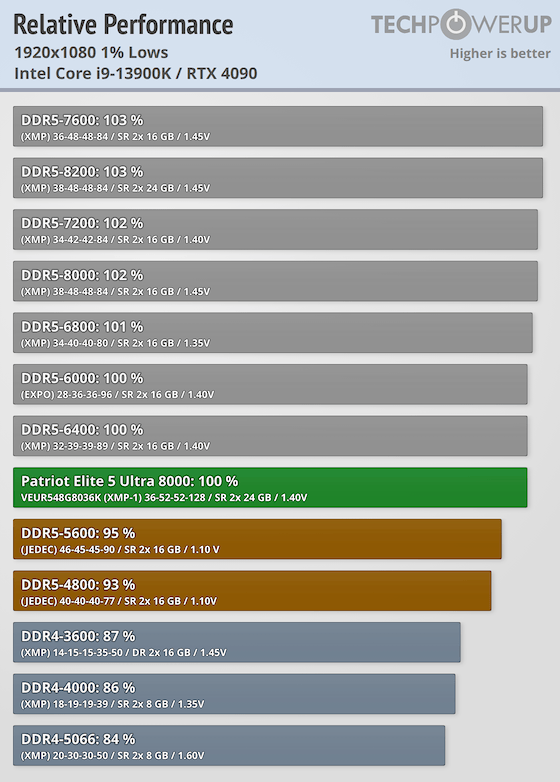
On the Intel Core i9-13900K platform, the Patriot Elite 5 Ultra 8000 sits at the 100% baseline in both Average FPS and 1% Lows, which places it right at the middle of the DDR5 pack, ahead of all DDR4 configurations and JEDEC DDR5 kits, but trailing the faster-clocked DDR5 options above it. In Average FPS, it falls just behind DDR5-6000 through DDR5-7200 (all at 101%) and the DDR5-7600 and DDR5-8000 XMP kits at 102%, with DDR5-8200 leading the chart at 103%. The 1% Lows tell a similar story, with the Patriot kit matching DDR5-6000 and DDR5-6400 at 100% while DDR5-6800 through DDR5-8200 pull slightly ahead. The key reason the Patriot Elite 5 Ultra 8000 doesn't match the 32 GB DDR5-8000 XMP kit, despite running at the same 8000 MT/s frequency and slightly better CAS (36 vs 38), comes down to the higher default tRFC (refresh cycle time) penalty inherent to 24 GB DIMMs. Because 24 GB modules use higher-density DRAM dies, they require a longer refresh interval than the 16 GB DIMMs used in the competing DDR5-8000 XMP kit, and this added latency overhead eats into the bandwidth advantage that the higher frequency would otherwise provide. In essence, the Patriot kit is fighting its own density-induced timing penalty, which keeps it competitive but prevents it from fully capitalizing on its 8000 MT/s speed rating on this particular platform.
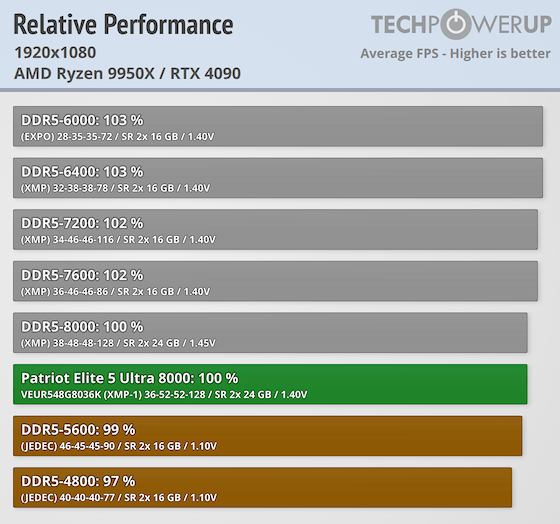
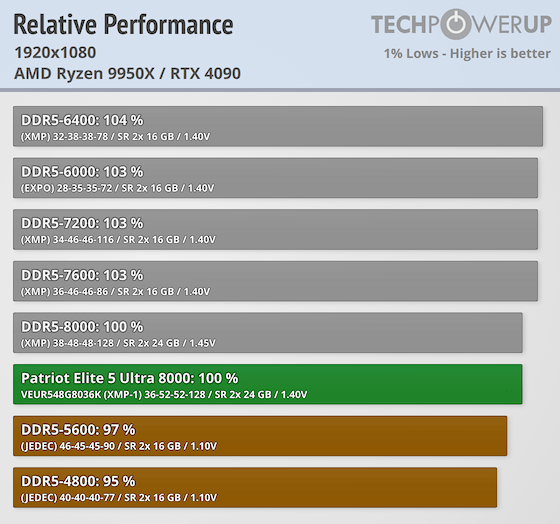
On the AMD Ryzen 9950X platform, the Patriot Elite 5 Ultra 8000 lands at the 100% baseline in both Average FPS and 1% Lows, tied with our 32 GB DDR5-8000 XMP kit but trailing the lower-frequency DDR5-6000 through DDR5-7600 configurations that sit 2–3% ahead. This counterintuitive result is a direct consequence of AMD's memory architecture. On Ryzen 9000 series processors, memory running above roughly 6400 MT/s forces the Infinity Fabric into a 2:1 UCLK:MCLK ratio, meaning the memory controller runs at half the memory clock speed. This introduces a latency penalty that can be partially negated by the raw bandwidth advantage of higher-frequency kits. However, this is why DDR5-6000 and DDR5-6400 XMP sit at the top of the chart at 103–104% in 1% Lows. They represent AMD's well-known "sweet spot" where the Infinity Fabric can still run fully synchronously in a 1:1 ratio, delivering the best combination of bandwidth and latency. The Patriot Elite 5 Ultra 8000 at 8000 MT/s is firmly in the 2:1 penalty zone, which keeps its real-world performance level with far slower kits. To actually overcome this architectural handicap and see a genuine performance advantage from ultra-fast DDR5 on Ryzen, memory speeds of approximately 8400 MT/s and above are generally needed to generate enough raw bandwidth to finally pull ahead of the 6000–6400 MT/s sweet spot, making the 8000 MT/s range something of a no-man's land on the AMD platform without additional tuning or platform improvements.
3840×2160 Relative Performance
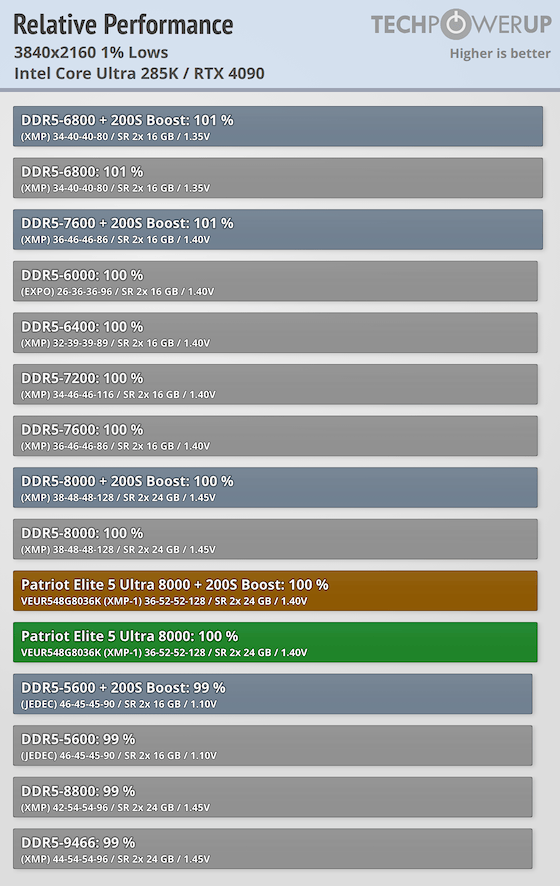
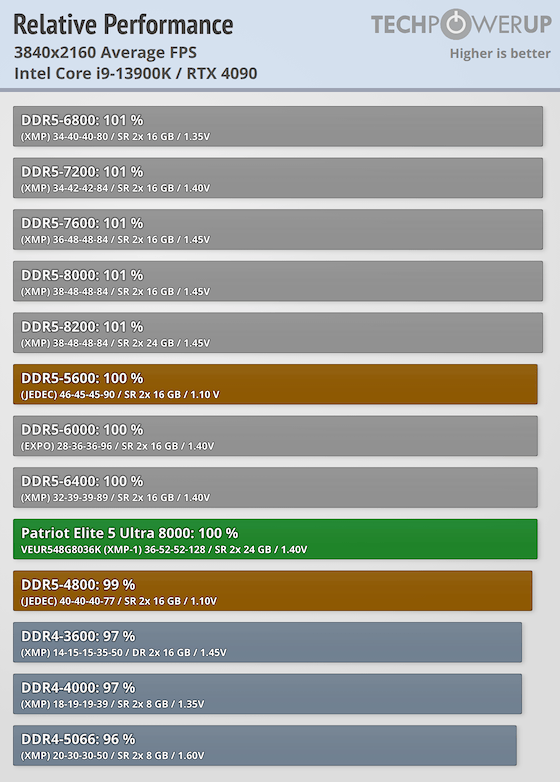
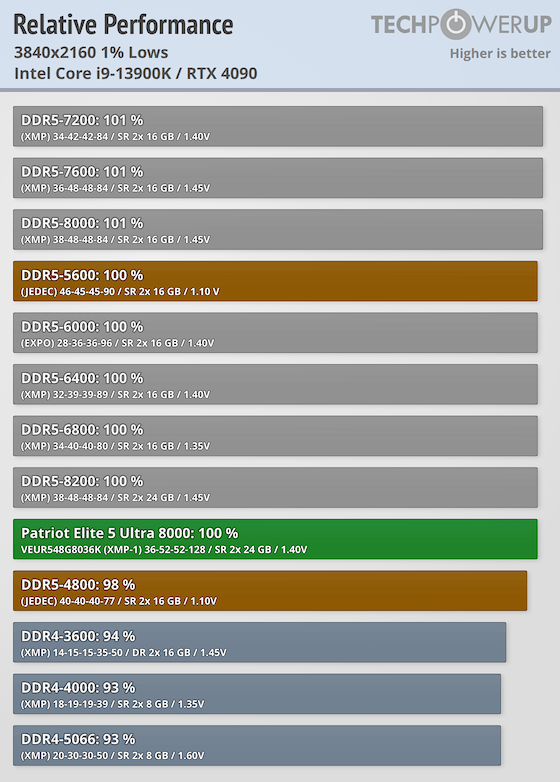
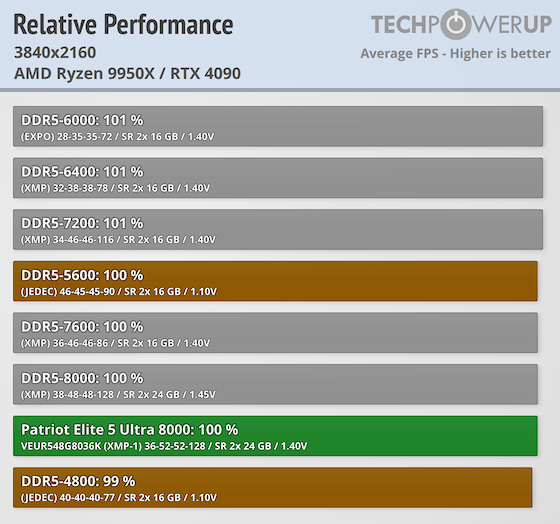
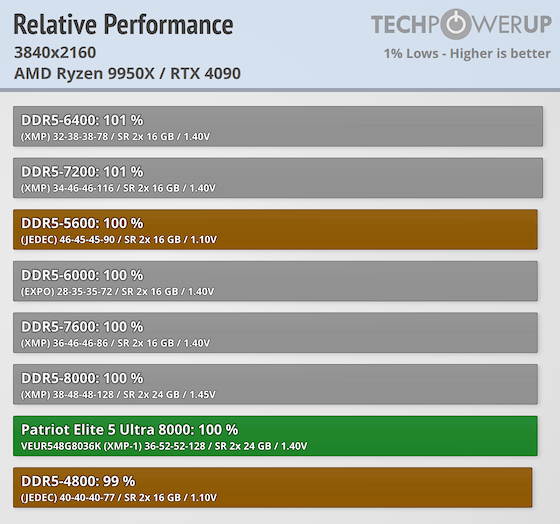
At 4K (3840×2160), the memory performance landscape shifts significantly across all three platforms, highlighting a fundamental aspect of how resolution influences the CPU-memory relationship. In our tests with the Intel Core Ultra 285K, Intel Core i9-13900K, and AMD Ryzen 9950X, the Patriot Elite 5 Ultra 8000 maintains a steady 100% performance level. However, this is a common trait shared by nearly all configurations tested. The performance chart tightens into a narrow 1–2% range across virtually all DDR5 setups, and the distinctions that were apparent at 1080p between JEDEC, XMP, and high-frequency kits essentially vanish. This is because, at 4K, the GPU becomes the primary bottleneck. The RTX 4090 is heavily engaged with the massive pixel workload each frame demands, leaving the CPU and memory waiting on the GPU rather than the reverse. In this GPU-bound scenario, whether your memory operates at 4800 MT/s or 8000 MT/s makes little difference, as the frame rate is capped by the GPU's rendering capabilities. The advantages of the Patriot Elite 5 Ultra 8000, along with platform-specific quirks like AMD's 2:1 UCLK penalty or the tRFC penalty of 24 GB DIMMs, become statistically insignificant at this resolution. This reinforces the well-known principle that memory speed is most impactful at lower resolutions, where the CPU and memory subsystem are more likely to be the limiting factors.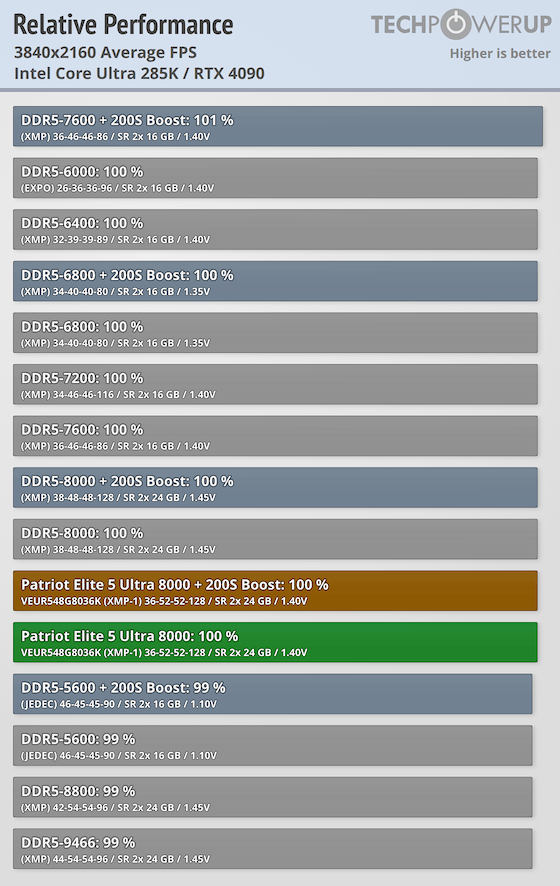
Nov 22nd, 2026 21:33 CST
change timezone
Latest GPU Drivers
New Forum Posts
- Increasing Power Limit? (9)
- DTS DCH Driver for Realtek HDA [DTS:X APO4 + DTS Interactive] (2818)
- Honestly, do you care about GTA VI? (266)
- What are you playing? (26240)
- UPS what one to get? (48)
- Your PC ATM (36458)
- Gacha Games - Discussions, Pulls, Updates, etc. (1157)
- Last game you purchased? (1414)
- Making a game in Godot engine (19)
- Intel D270 (5)
Popular Reviews
- Microsoft Surface Laptop Ultra Review - The Next-gen Arm Laptop
- Corsair RM1200e (Second Generation) Review
- Upcoming Hardware Launches 2027 (Updated Nov 2026)
- Pulsar Office Tour & First Look at P1 Dual-Sensor Mouse
- Ugreen NASync DXP4800 GT Review
- AMD Ryzen 7 9800X3D Review - The Best Gaming Processor
- AMD Zen 6 Technical Deep Dive
- AMD Ryzen 7 5800X3D 10th Anniversary Review
- Phantom Blade Zero Performance Benchmark Review - 35 GPUs Tested
- Biwin Black Opal NV7400 2 TB Review
TPU on YouTube
Controversial News Posts
- NVIDIA Co-Founder and CEO Jensen Huang Officially Resigns (492)
- Report: Jensen Huang Eyes NVIDIA Comeback (266)
- Open Letter Asking NVIDIA to Reinstate Jensen Huang Passes 115,000 Signatures (184)
- OpenAI CEO Argues Home PCs Waste the World's Limited DRAM Supply (152)
- NVIDIA Launches Investigation Into Jensen Huang's Relationship With Suspected Chinese Spy (136)
- Intel "Raptor Lake Next" 16-Core and 20-Core CPUs Surface (130)
- NVIDIA GeForce RTX 50-Series Scheduled for up to $500 Price Hike This Week (89)
- Intel Razor Lake Gets a 12 P-Core bLLC Chip With No E-Cores, Per Leak (86)