 12
PELADN WO4 Review
Value & Conclusion »Power and Noise Levels
Power and efficiency are just as important as raw performance in a compact system, so I measured how much the PELADN WO4 draws at idle, under CPU stress, during GPU-heavy tests, and while gaming. These measurements were captured using a Shelly smart power relay, taking advantage of its API-based logging to track real-time wattage and build accurate per-second consumption profiles. I also monitored the system's noise levels while idle and when under sustained load.Idle Power Draw
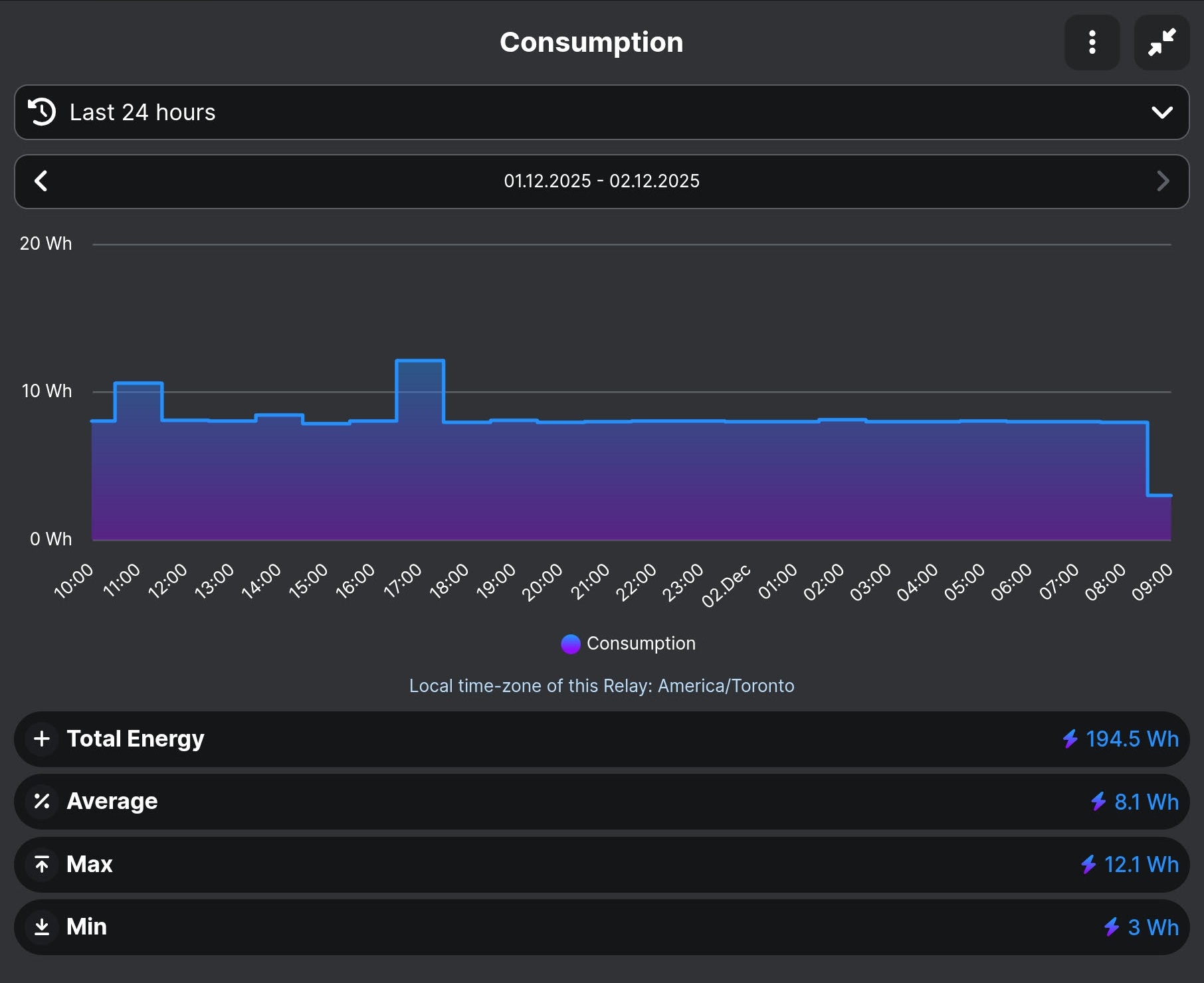
Over a 24-hour idle monitoring period, the WO4 consumed 0.1945 kWh, averaging 0.0081 kWh per hour (8.1 W), with a maximum of 0.0121 kWh (12.1 W) and a minimum of 0.003 kWh (3 W). Power use remained very steady across the full window, with only small bumps tied to background services and short-lived Windows housekeeping tasks.
At this rate, leaving the system on 24/7 works out to about 71 kWh per year, or roughly $10–11 USD annually at typical North American electricity rates. This is excellent for a compact Ryzen-based mini PC and makes the WO4 inexpensive to run around the clock.
CPU and GPU Power Draw
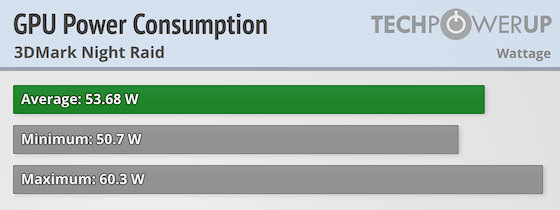
We also tested three real-world power-load scenarios: an esports gaming pass with Dota 2, which gives a good view of mid-load stability and clock consistency; a GPU-oriented run using Night Raid, which exposes how the APU reacts to scene changes and mixed rendering workloads; and a heavy Cinebench multicore pass that stresses all CPU cores simultaneously to show long-term power delivery.
Cinebench Multicore
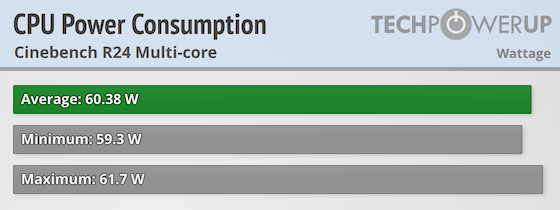
The WO4 maintained a stable draw during Cinebench, averaging 60.38 W, with a minimum of 59.3 W and a maximum of 61.7 W. This is exactly what we expect from the Ryzen 5 5600H at its sustained limit, showing a fixed power target with no thermal sag or erratic boost drops.
eSports gaming (Dota 2)
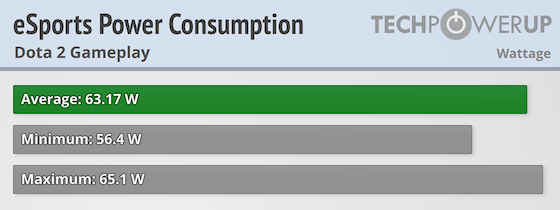
Dota 2 averaged 63.17 W, dipping briefly to 56.4 W during calmer scenes and spiking to 65.1 W during heavy action. These numbers are normal for a 5600H iGPU and point toward consistent clocks and predictable thermals throughout extended gameplay.
3DMark Night Raid
Night Raid settled at 53.68 W on average, with a low of 50.7 W and a peak of 60.3 W. The variation lines up perfectly with the benchmark's rapid scene transitions and mixed CPU/GPU workload, and nothing suggests instability or throttling.
Here's a full view of the WO4's power draw across all three profiles:
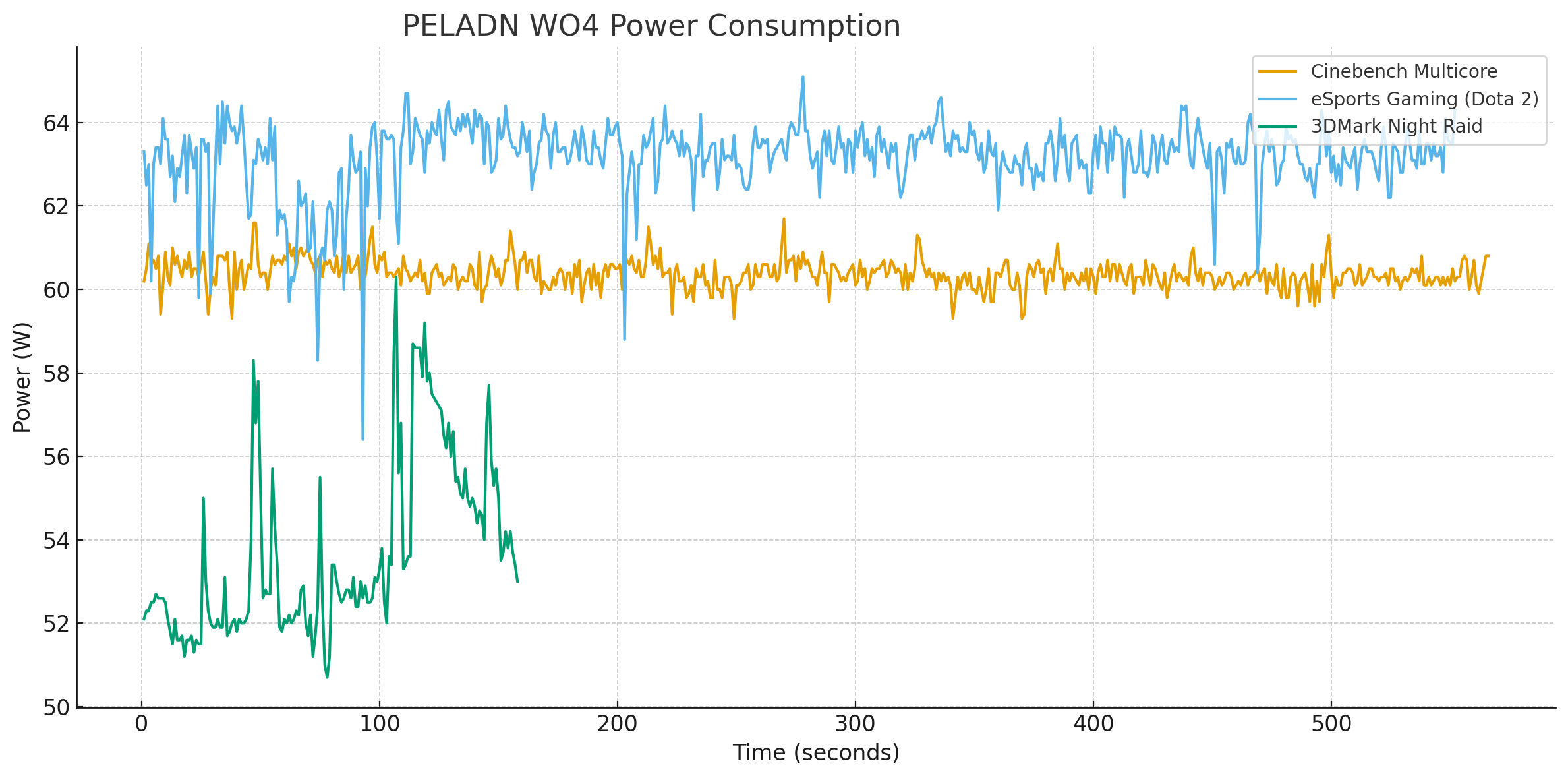
Overall, the WO4 shows a steady and well-controlled power profile across all test scenarios. Its draw remains modest for a compact system, and the consistency across long runs highlights how efficiently it manages day-to-day operation without unexpected spikes or drops.
Noise Levels
I measured fan noise using a digital sound level meter placed 30 cm from the front of the system. During heavier workloads, the WO4 settled around 40 dB, which is consistent with what you would expect from a compact mini PC built around the Ryzen 5 5600H. The fan ramps quickly once the CPU warms up, but the tone stays steady and does not have any high-pitched whine. At a normal sitting distance, the noise fades into the background and never becomes distracting.
Nov 26th, 2026 11:49 CST
change timezone
Latest GPU Drivers
New Forum Posts
- TPU's WCG/BOINC Team (34806)
- ASUS Prime 5060 ti 16gb x4 instead of x8 PCIe (1)
- What's your main Black Friday / Cyber Monday purchase? (22)
- WarpCoreBench scores! (108)
- Radeon driver death (5)
- Making a game in Godot engine (22)
- Current Sales, Bundles, Giveaways (10452)
- Can you guess Which game it is? (368)
- Free Games Thread (5385)
- Post your CrystalDiskMark speeds (659)
Popular Reviews
- ASRock X870E Challenger Wi-Fi White Review
- VZMORE AX9 Max Review
- Upcoming Hardware Launches 2027 (Updated Nov 2026)
- Microsoft Surface Laptop Ultra Review - The Next-gen Arm Laptop
- AMD Ryzen 7 9800X3D Review - The Best Gaming Processor
- AMD Zen 6 Technical Deep Dive
- Corsair RM1200e (Second Generation) Review
- Phantom Blade Zero Performance Benchmark Review - 35 GPUs Tested
- Montech CyberFlow ARGB 360 Review
- Pulsar Office Tour & First Look at P1 Dual-Sensor Mouse
TPU on YouTube
Controversial News Posts
- Jensen Huang Reinstated as CEO of NVIDIA (596)
- NVIDIA Co-Founder and CEO Jensen Huang Officially Resigns (492)
- Report: Jensen Huang Eyes NVIDIA Comeback (281)
- Open Letter Asking NVIDIA to Reinstate Jensen Huang Passes 115,000 Signatures (184)
- OpenAI CEO Argues Home PCs Waste the World's Limited DRAM Supply (152)
- NVIDIA Launches Investigation Into Jensen Huang's Relationship With Suspected Chinese Spy (136)
- Intel "Raptor Lake Next" 16-Core and 20-Core CPUs Surface (130)
- Intel Razor Lake Gets a 12 P-Core bLLC Chip With No E-Cores, Per Leak (94)