 49
PNY RTX 5080 Slim OC Review
Pictures & Teardown »Introduction

PNY GeForce RTX 5080 Slim OC is one of the most compelling custom-design RTX 5080 graphics cards on the market, as it is the only dual-slot, dual-fan RTX 50-series card from an add-in card partner. While the NVIDIA Founders Edition also uses a dual-slot, dual-fan design, PNY's Slim OC is the sole AIC alternative for users who need a compact dual-slot form factor. Built on NVIDIA's reference PCB design using NVIDIA-approved components, the card features PNY's own custom thermal solution that promises competitive cooling in a significantly smaller package than the typical triple-fan, 2.5 to 3-slot RTX 5080 cards on the market. Its dual-slot design also makes it compatible with NVIDIA's SFF-Ready enthusiast GeForce guidelines, and ideal for compact builds, multi-GPU AI workstation setups, or systems where PCIe slot spacing is at a premium.
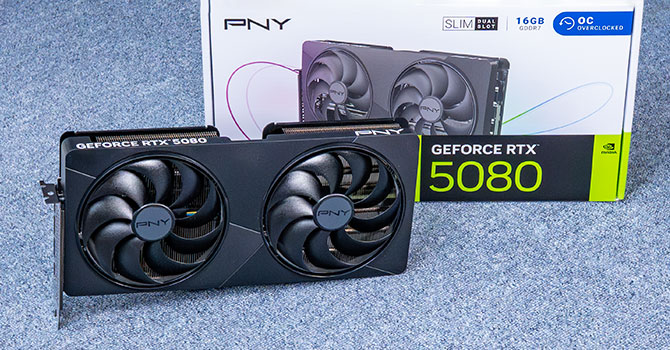
PNY's cooling solution on the Slim OC is an impressive feat of engineering, packing competitive thermal performance into a 40 mm thick, dual-slot form factor. The cooler uses a vapor chamber baseplate, with six heatpipes to spread heat across the aluminium fin stack. Despite having 30% less module volume and 35% less fin surface area compared to PNY's own triple-fan RTX 5080, the Slim OC compensates with dual 120 mm fans that generate 10% more airflow at the same RPM, and a heavily ventilated backplate with 150% more opening area that lets hot air escape efficiently. PNY also gave the card curved edges on the shroud, which the company claims reduces airflow turbulence compared to the sharp 90-degree edges found on most competing cards, and an enlarged power connector clearance zone to make cable installation easier and reduce connector stress.
The GeForce RTX 5080 is a powerful enthusiast-segment GPU that's second only to the flagship RTX 5090. It is designed for maxed out gameplay at 4K Ultra HD resolution, including with ray tracing, and the new DLSS 4 with Multi Frame Generation enabling newer experiences, such as 4K high refresh-rate. The RTX 5080 is powered by the Blackwell graphics architecture, which introduces Neural Rendering, a potentially revolutionary concept in consumer 3D graphics, which leverages generative AI models to create photorealistic objects that are combined with raster 3D graphics the same way ray traced objects are. DLSS 4 sees NVIDIA replace the convoluted neural network (CNN) based AI models driving the upscaling, ray-reconstruction, and frame-generation features with newer transformer based models that are more accurate and improve image quality at every performance tier. Multi Frame Generation lets up to 5 frames following every conventionally rendered frame to be drawn by AI, effectively multiplying frame-rates and reducing CPU requirements of high refresh rate gaming. NVIDIA's new Dynamic MFG allows a sort of "gearbox," where the needed multiplier between 2x and 6x FG is automatically set to maintain a target FPS, while minimizing latency.
The GeForce RTX 5080 is based on the GB203 silicon, which it maxes out, enabling all 84 streaming multiprocessors (SM) physically present on the chip. It also comes with 16 GB of 30 Gbps GDDR7 memory across the chip's full 256-bit wide memory bus, for 960 GB/s of memory bandwidth. With 84 SM, the RTX 5080 gets 10,752 CUDA cores, 336 Tensor cores, 84 RT cores, 336 TMU, and the chip's full complement of 112 ROPs. NVIDIA also took the opportunity to modernize the display controllers of the GPU to support the latest DisplayPort 2.1 with UHBR20 and HDMI 2.1 standards; and updated the video encode and decode acceleration engines.
PNY has given the RTX 5080 Slim OC factory overclocked speeds of 2730 MHz boost compared to the 2617 MHz reference, which is one of the higher boost clocks among RTX 5080 cards. The card is priced at US$1399, which is a notable premium over the $999 MSRP, but of course it's impossible right now to find a RTX 5080 at that price—more realistic is $1200, but what's on offer is a unique dual-slot form factor with competitive cooling that no other AIC card can match.
| Price | Cores | ROPs | Core Clock | Boost Clock | Memory Clock | GPU | Transistors | Memory | |
|---|---|---|---|---|---|---|---|---|---|
| RTX 4070 Super | $600 | 7168 | 80 | 1980 MHz | 2475 MHz | 1313 MHz | AD104 | 35800M | 12 GB, GDDR6X, 192-bit |
| RX 7900 GRE | $550 | 5120 | 160 | 1880 MHz | 2245 MHz | 2250 MHz | Navi 31 | 57700M | 16 GB, GDDR6, 256-bit |
| RTX 4070 Ti | $700 | 7680 | 80 | 2310 MHz | 2610 MHz | 1313 MHz | AD104 | 35800M | 12 GB, GDDR6X, 192-bit |
| RTX 5070 | $630 | 6144 | 80 | 2325 MHz | 2512 MHz | 1750 MHz | GB205 | 31100M | 12 GB, GDDR7, 192-bit |
| RTX 4070 Ti Super | $900 | 8448 | 96 | 2340 MHz | 2610 MHz | 1313 MHz | AD103 | 45900M | 16 GB, GDDR6X, 256-bit |
| RX 7900 XT | $670 | 5376 | 192 | 2000 MHz | 2400 MHz | 2500 MHz | Navi 31 | 57700M | 20 GB, GDDR6, 320-bit |
| RX 9070 | $550 | 3584 | 128 | 2070 MHz | 2520 MHz | 2518 MHz | Navi 48 | 53900M | 16 GB, GDDR6, 256-bit |
| RX 9070 XT | $620 | 4096 | 128 | 2400 MHz | 2970 MHz | 2518 MHz | Navi 48 | 53900M | 16 GB, GDDR6, 256-bit |
| RTX 5070 Ti | $900 | 8960 | 96 | 2295 MHz | 2452 MHz | 1750 MHz | GB203 | 45600M | 16 GB, GDDR7, 256-bit |
| RX 7900 XTX | $860 | 6144 | 192 | 2300 MHz | 2500 MHz | 2500 MHz | Navi 31 | 57700M | 24 GB, GDDR6, 384-bit |
| RTX 4080 | $1200 | 9728 | 112 | 2205 MHz | 2505 MHz | 1400 MHz | AD103 | 45900M | 16 GB, GDDR6X, 256-bit |
| RTX 4080 Super | $1300 | 10240 | 112 | 2295 MHz | 2550 MHz | 1438 MHz | AD103 | 45900M | 16 GB, GDDR6X, 256-bit |
| RTX 5080 | $1200 | 10752 | 112 | 2295 MHz | 2617 MHz | 1875 MHz | GB203 | 45600M | 16 GB, GDDR7, 256-bit |
| PNY RTX 5080 Slim OC | $1400 | 10752 | 112 | 2295 MHz | 2730 MHz | 1875 MHz | GB203 | 45600M | 16 GB, GDDR7, 256-bit |
| RTX 4090 | $2000 | 16384 | 176 | 2235 MHz | 2520 MHz | 1313 MHz | AD102 | 76300M | 24 GB, GDDR6X, 384-bit |
| RTX 5090 | $3300 | 21760 | 176 | 2017 MHz | 2407 MHz | 1750 MHz | GB202 | 92200M | 32 GB, GDDR7, 512-bit |
Nov 25th, 2026 02:12 CST
change timezone
Latest GPU Drivers
New Forum Posts
- GTA VI (41)
- Ryzen Owners Zen Garden (8563)
- Asus Rog Maximus Z890 Extreme. (Various questions). (37)
- X79 and/or rampage IV OC'ing thread for those of us still left.... (2454)
- WarpCoreBench scores! (100)
- Which ryzen am5 cpu ? (211)
- The time has come to upgrade...my desktop (15)
- AMD ULL settings tinkering thread - post settings and Zen pics (90)
- TPU's F@H Team (20570)
- Can you guess Which game it is? (352)
Popular Reviews
- ASRock X870E Challenger Wi-Fi White Review
- Microsoft Surface Laptop Ultra Review - The Next-gen Arm Laptop
- Upcoming Hardware Launches 2027 (Updated Nov 2026)
- VZMORE AX9 Max Review
- AMD Ryzen 7 9800X3D Review - The Best Gaming Processor
- Corsair RM1200e (Second Generation) Review
- AMD Zen 6 Technical Deep Dive
- Phantom Blade Zero Performance Benchmark Review - 35 GPUs Tested
- Pulsar Office Tour & First Look at P1 Dual-Sensor Mouse
- Ocypus lota P1000 Review
TPU on YouTube
Controversial News Posts
- Jensen Huang Reinstated as CEO of NVIDIA (541)
- NVIDIA Co-Founder and CEO Jensen Huang Officially Resigns (492)
- Report: Jensen Huang Eyes NVIDIA Comeback (281)
- Open Letter Asking NVIDIA to Reinstate Jensen Huang Passes 115,000 Signatures (184)
- OpenAI CEO Argues Home PCs Waste the World's Limited DRAM Supply (152)
- NVIDIA Launches Investigation Into Jensen Huang's Relationship With Suspected Chinese Spy (136)
- Intel "Raptor Lake Next" 16-Core and 20-Core CPUs Surface (130)
- Intel Razor Lake Gets a 12 P-Core bLLC Chip With No E-Cores, Per Leak (94)