 1
Pulsar Office Tour & First Look at P1 Dual-Sensor Mouse
Pulsar P1: In Practice »Pulsar P1: The Concept
The Problem
The basic issue addressed by the P1 has already been laid out in a paper written by Sunjun Kim, Byungjoo Lee, Thomas van Gemert, and Antti Oulasvirta, and published in 2020: Optimal Sensor Position for a Computer Mouse. The gist is as follows. When moving the mouse across a planar surface, there are two components to any motion: a translational component, which describes motion across the x- and y-axes, and a rotational component, which describes motion across the z-axis, also known as yaw. When moving a mouse around, be it for drawing, pointing, or playing a three-dimensional game using an inverted world transform matrix for camera movement, we consciously or unconsciously combine these two components to varying degrees. The degree will depend on how we grip our mouse, what sensitivity (effective turn circumference) we are using, and what the main pivot of our motion is (wrist, elbow, shoulder), among others. As an illustrative example, someone using a high sensitivity (low turn circumference, e.g. 15 cm/rev) and predominantly the wrist to aim will typically have a higher degree of rotational component in their motion than someone using a low sensitivity (high turn circumference, e.g. 65 cm/rev) and predominantly using their arm to aim.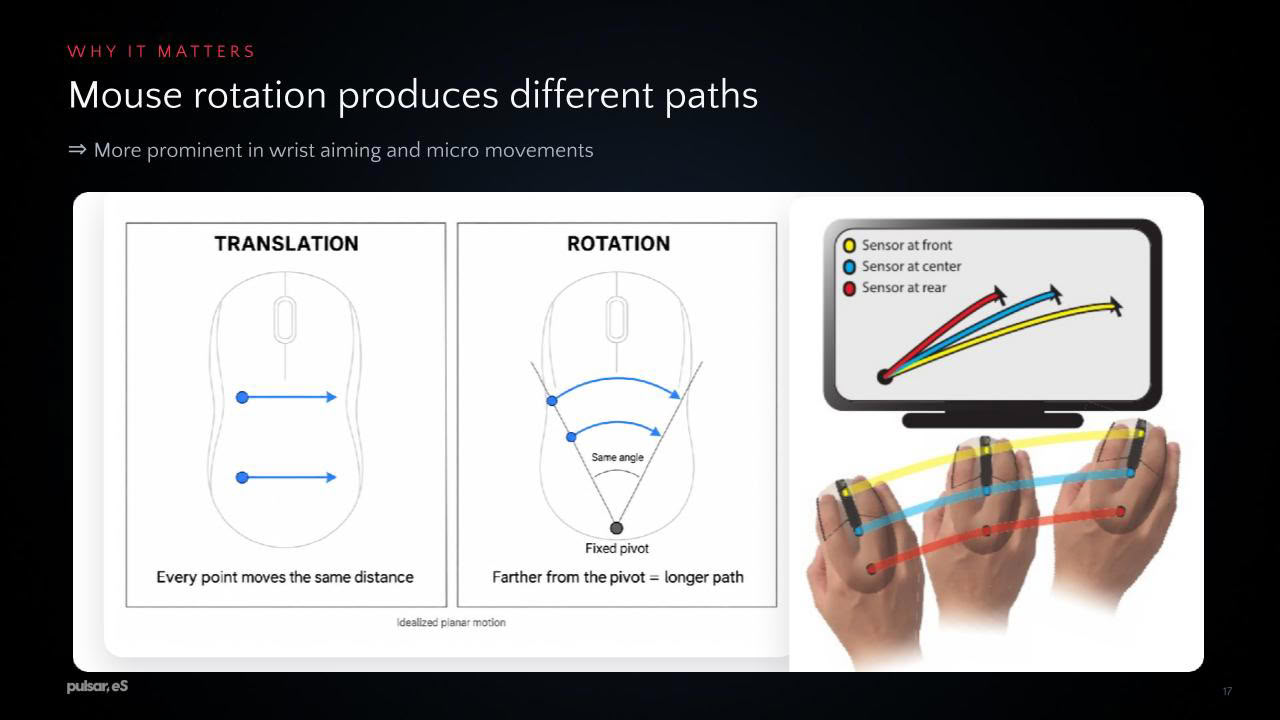
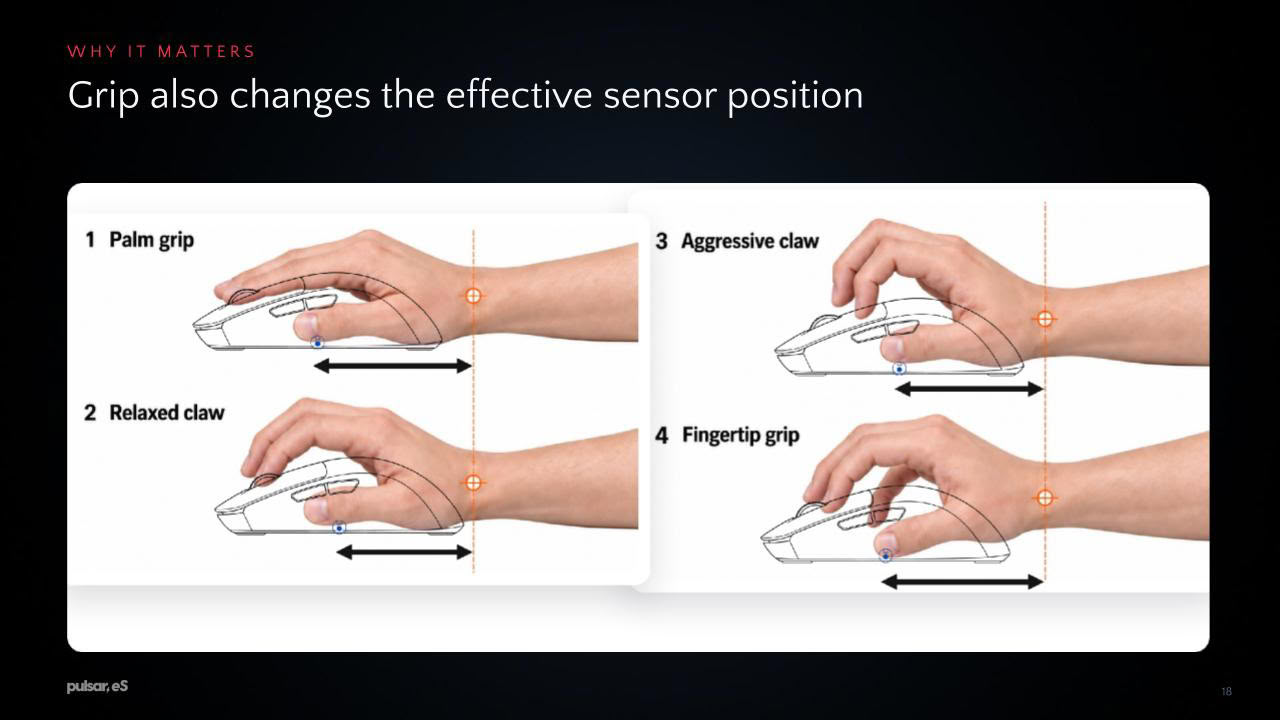
As far as the output of the sensor is concerned, this distinction between translational and rotational movement is of no importance. In principle, optical sensors are capable of outputting yaw by estimating the rotation based on the orientation of the surface texture (though doing so may be rather noisy), yet contemporary PixArt sensors merely output x- and y-axis deltas by design. Regardless of whether the motion is translational or rotational, the displacement occurs across a plane after all, and therefore across relative x- and y-coordinates (which are a function of the currently set CPI level). Hence, outputting yaw as a separate value provides little use as far as ordinary displacement is concerned.
From the considerations given above, it follows that sensor position is irrelevant for any purely translational movement. Regardless of where the sensor is physically located across a rigid body, the displacement across a plane will be identical across all possible locations. However, once any rotational component is added to rigid-body motion, the location becomes relevant in that the trajectory will change depending on the position of the sensor. If the sensor position is moved forward or backward across the vertical axis, the same horizontal rotational motion will yield a greater or smaller trajectory. The same applies if the sensor position is moved left or right across the horizontal axis, as the same vertical rotational motion will yield a greater or smaller trajectory. Put differently, the further the sensor is physically located from a posited center, the greater any rotation will contribute to displacement. Accordingly, for a given rotation, the effects of that rotation on displacement will be greater the further forward or backward (for horizontal motion) the sensor is positioned. The importance of sensor position is therefore the greater the more rotation one's motion incorporates.
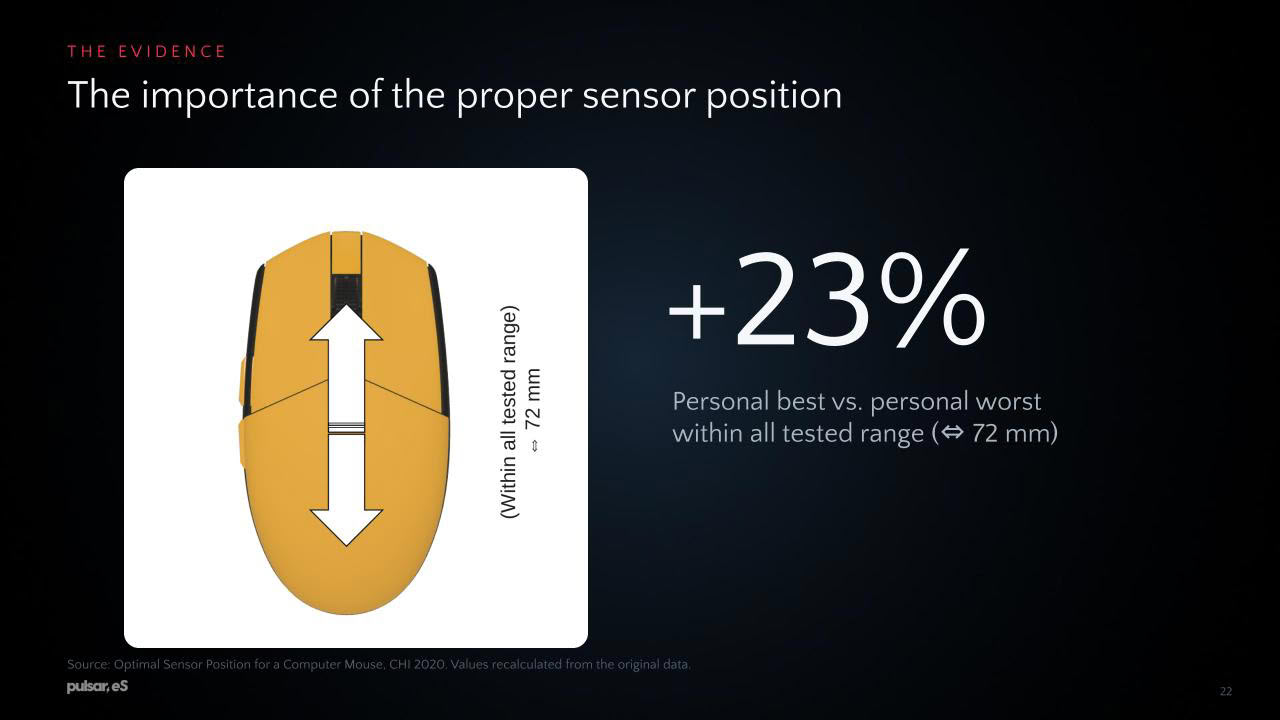
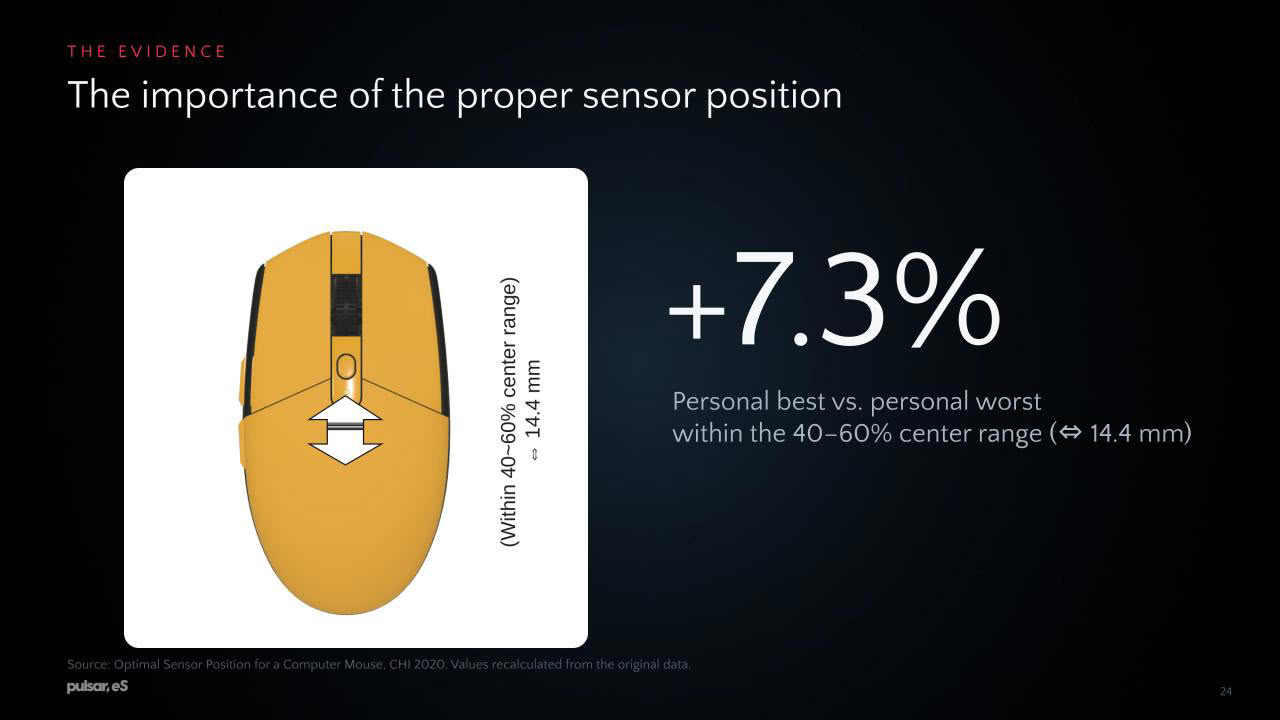
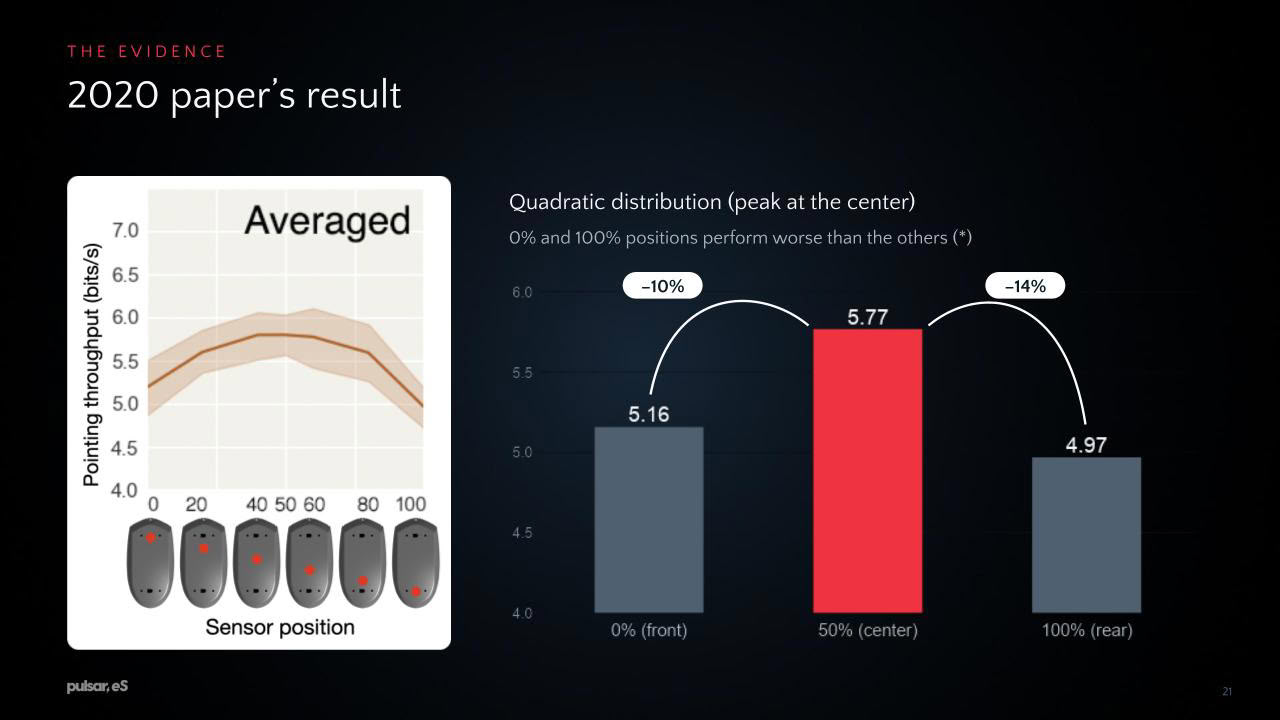
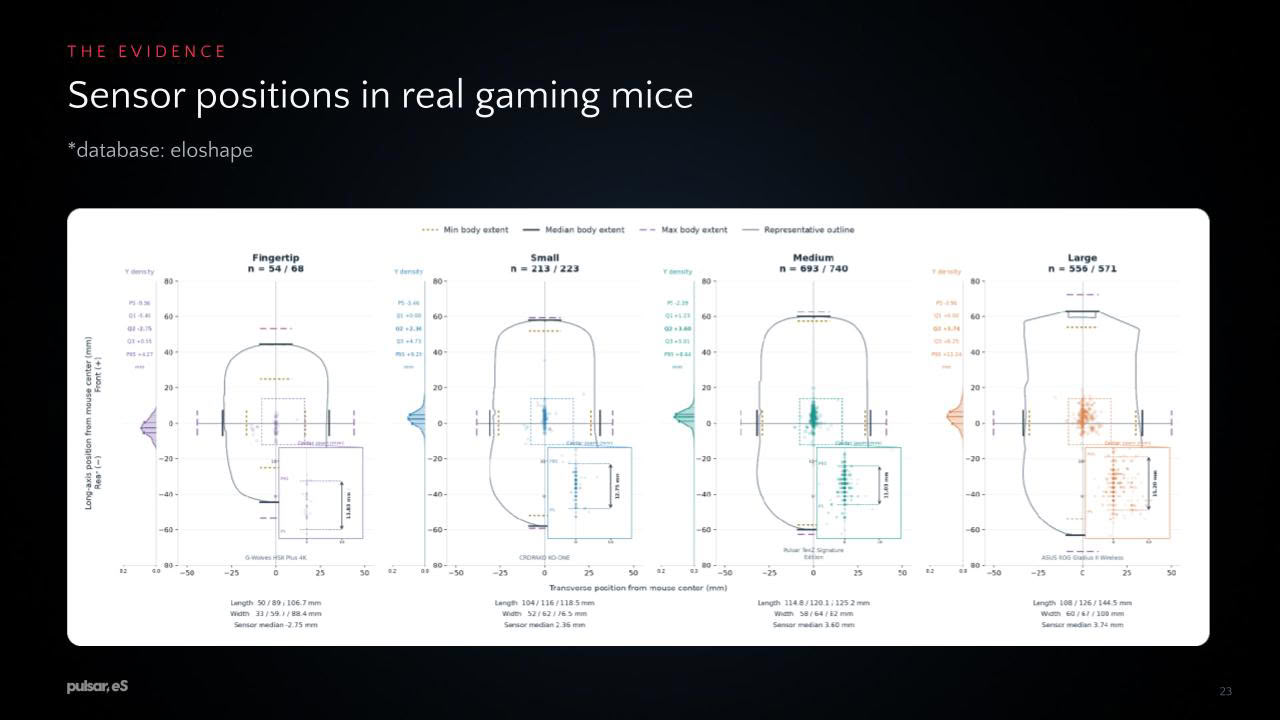
In the paper cited above, the question of which sensor position could be considered optimal was answered in favor of a more centered position, conceivably due to the effects of rotation being minimized in that case. More specifically, the study found improvements among participants for the centered position over the front and rear ones in the 11–14% range for throughput and in the 20–23% range for path deviation. Now, a manifest question is what "centered" is supposed to mean within this context. For the study, "centered" simply denotes the middle position between two posited forward and rearmost positions, which coincided with the geometric center. Since the Logitech G305 used for the study is a symmetrical design, determining the geometric center was trivial, but on non-symmetrical designs this becomes less straightforward. Rather than the geometric center, we could also look for the center of mass of the mouse, or we could look for the center relative to the effective pivot of the user's hand. Arguably, the most useful definition of "centered" in this regard therefore may be a functional one, i.e. a position which minimizes the contribution of the rotational component of a given motion to the displacement.
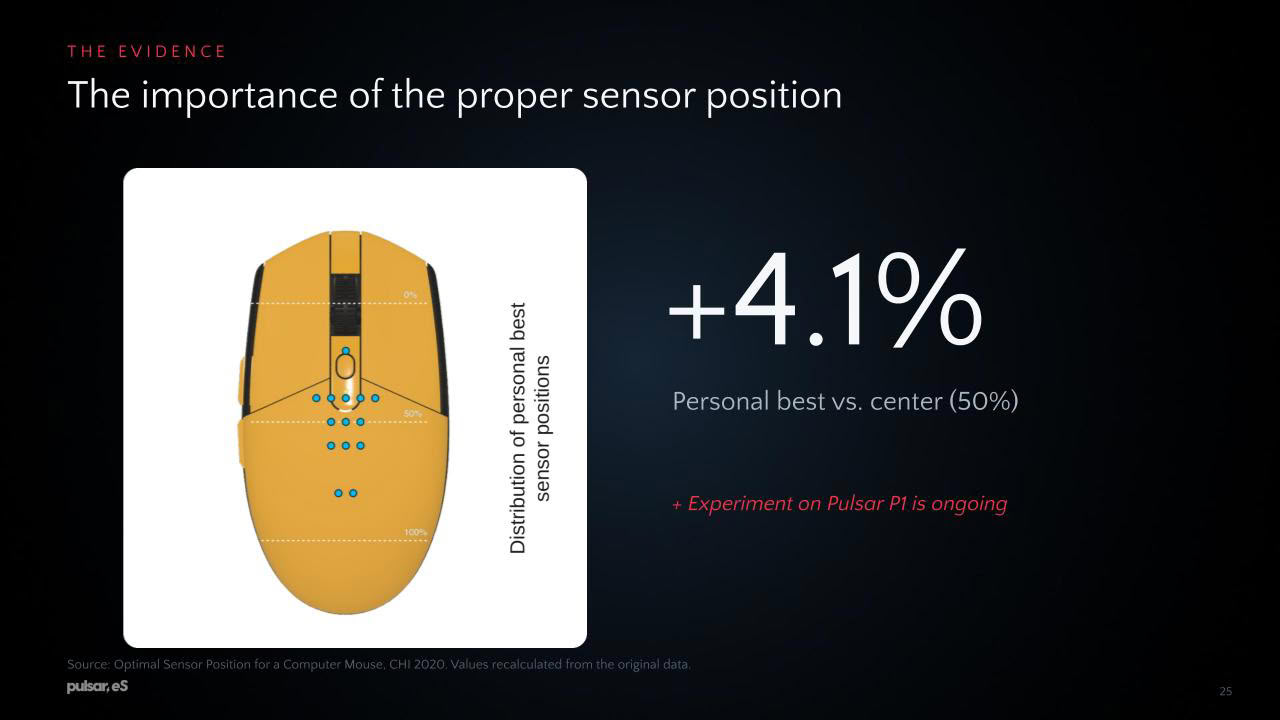
Hence, for practical purposes, we can surmise that there is an optimal position, namely one that minimizes the rotational component, yet where this position lies is subject to an individual determination. That is, as established earlier, the effective pivot of a user's motion will determine which sensor position results in the minimum of rotation being incorporated. Note that this theoretical optimum does not necessarily equate to an existing individual preference—given the human ability to adapt and compensate, it is reasonable to assume that our preferred sensor position may simply be one that works for us, even if it is not the optimal one. Even when using an objectively flawed technique, we may be able to yield subjectively good results, by virtue of practice and adaptation.
The Solution
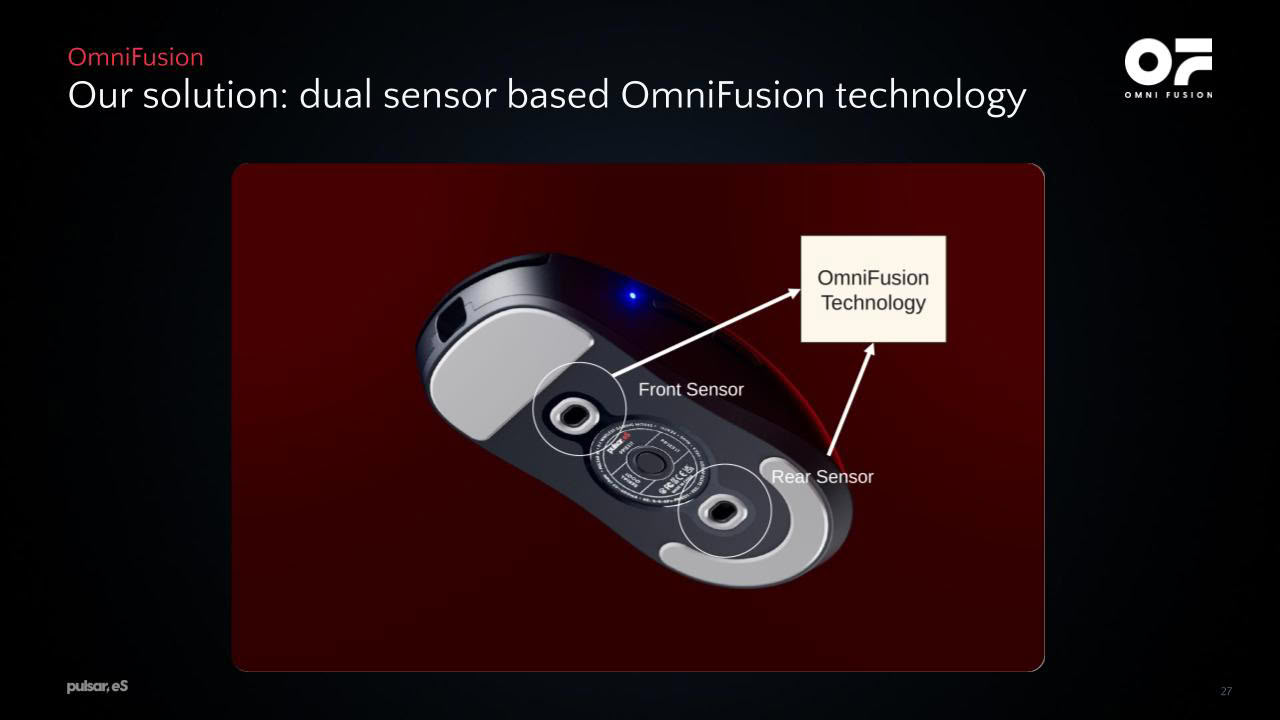
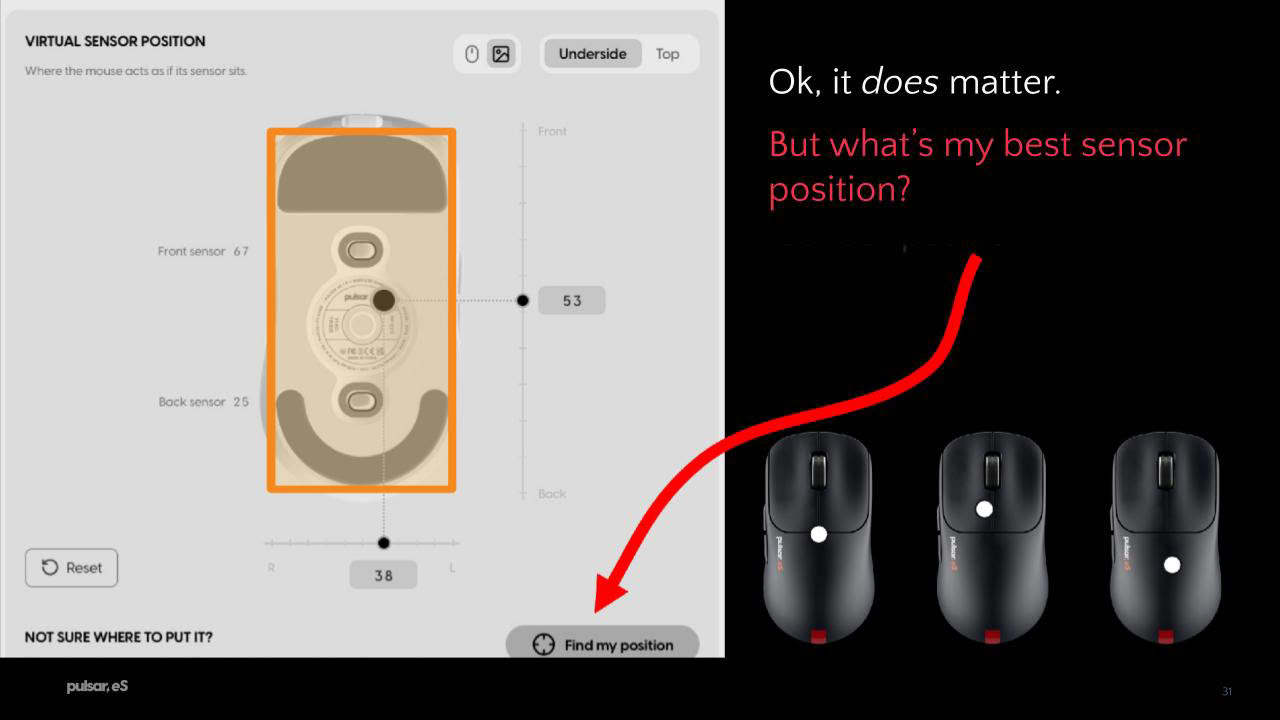
In order to tackle the issue outlined above as effectively as possible, two criteria need to be fulfilled: (1) the ability to set the sensor position arbitrarily, and (2) the ability to determine the optimal position. This is exactly what the Pulsar P1 is set out to accomplish. The P1 utilizes a dual-sensor design. Having two sensors spatially separated by a known distance allows calculating the rotational component of rigid-body motion. This, in turn, allows reconstructing the displacement at any arbitrary position. This is called a virtual sensor position, and although it is restricted to the physical extension of the P1 for the purpose of practicality, in theory it could be projected to any point even beyond said physical extension. In theory, it would also be possible to fully compensate for the rotational component, such that only the translational component would be accounted for in displacement. Compared to single-sensor setups allowing movement of the sensor across the vertical axis, the advantages of a dual-sensor setup allowing for virtual sensor position are obvious: not only is there no restriction to the vertical axis, there is none in terms of allowed distance either. Since any arbitrary position could be the optimal one, only a solution allowing for the sensor to be set to any position allows determining the optimal position.
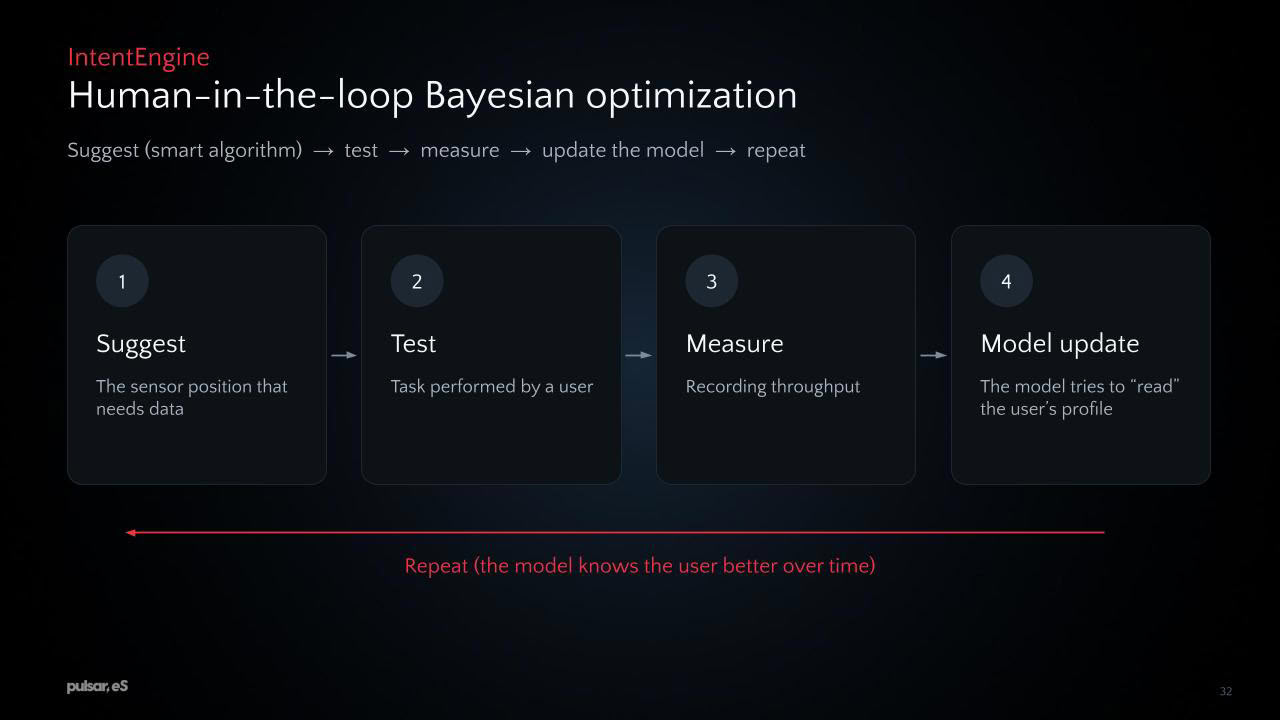
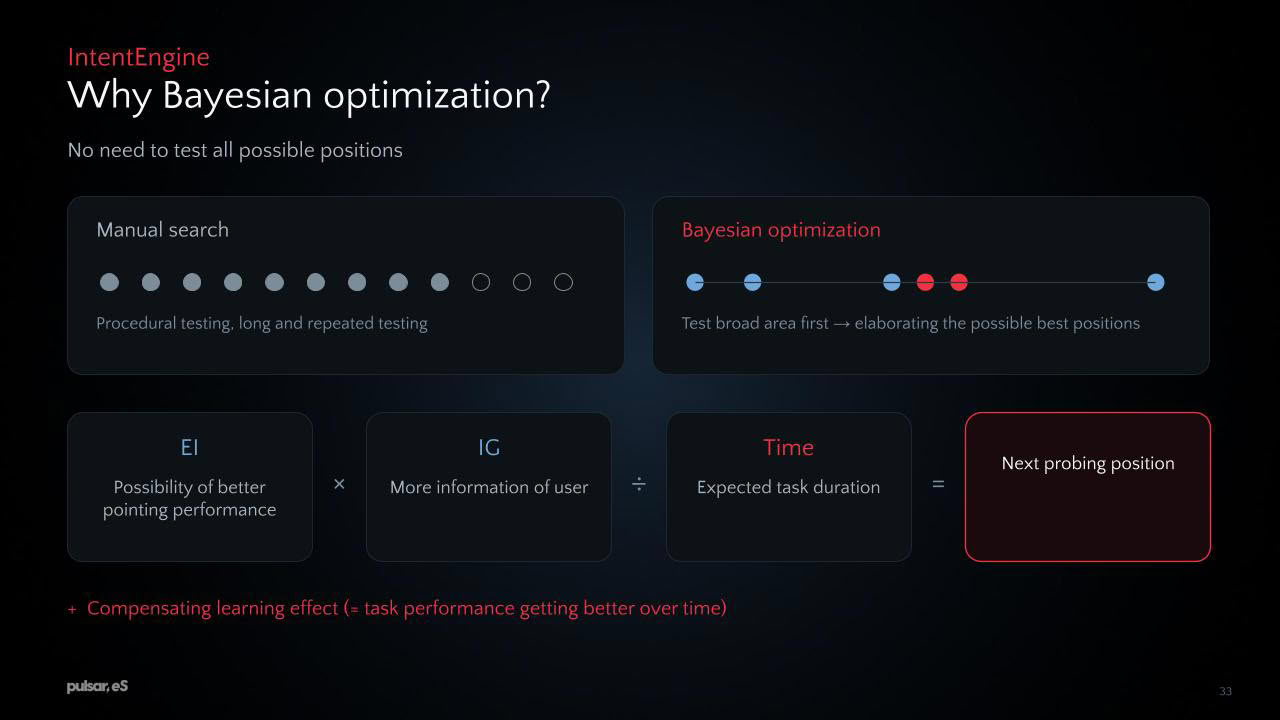
In order to determine the optimal position, Pulsar has conceived a test using human-in-the-loop Bayesian optimization. This test works iteratively: using a proposed position, a test is performed, the results of which are fed into an updated proposal. Over time, one will be able to continually approach the optimal position. Obviously, a single-sensor setup lacks the ability to arbitrarily set the sensor position, which is essential for this method.
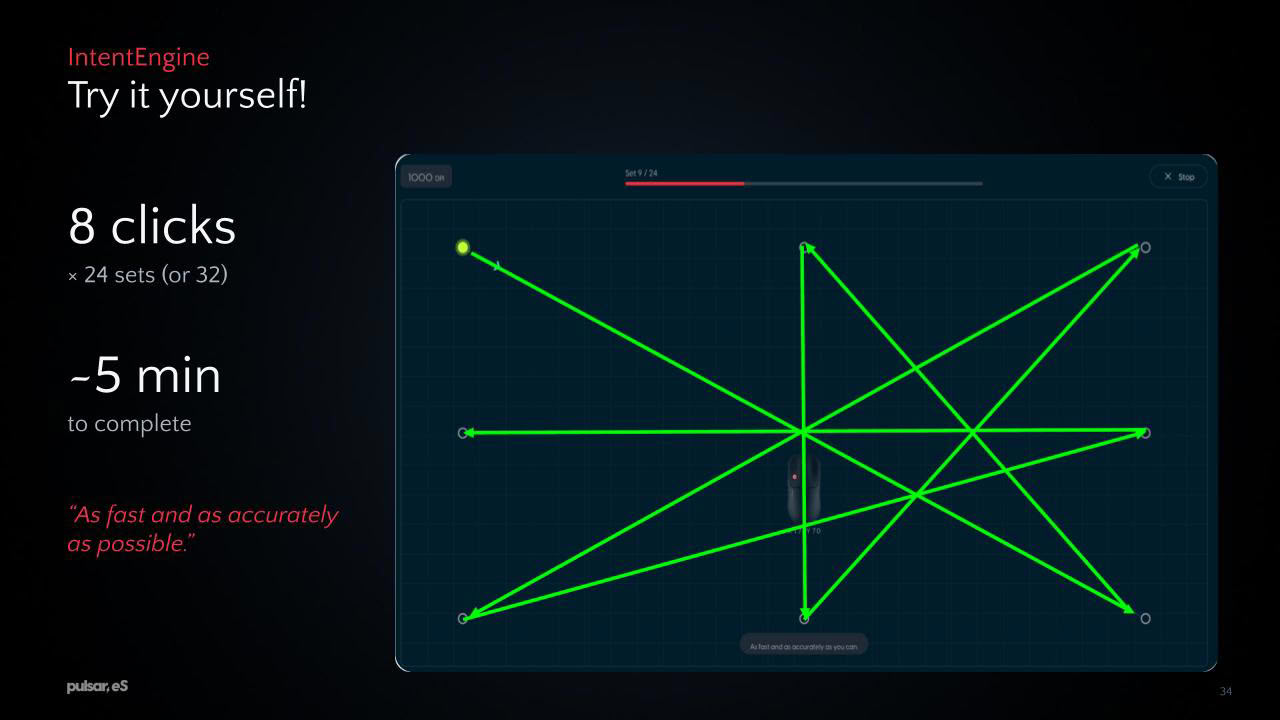
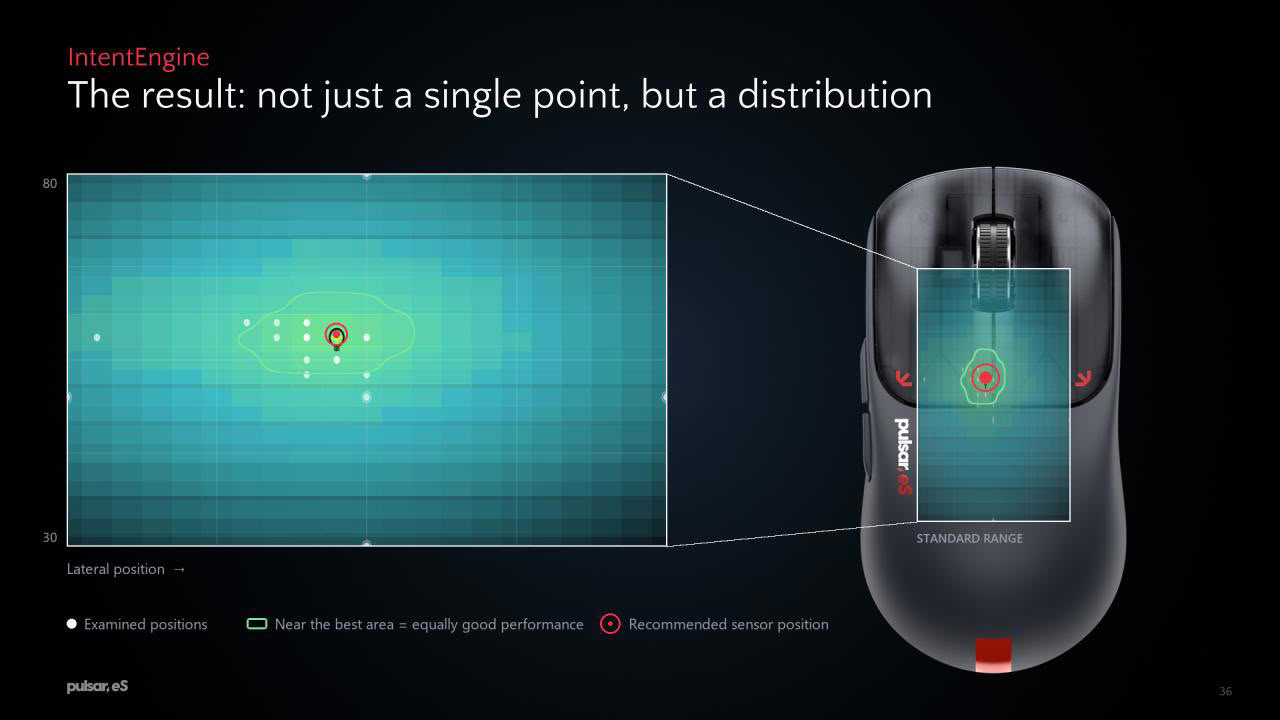
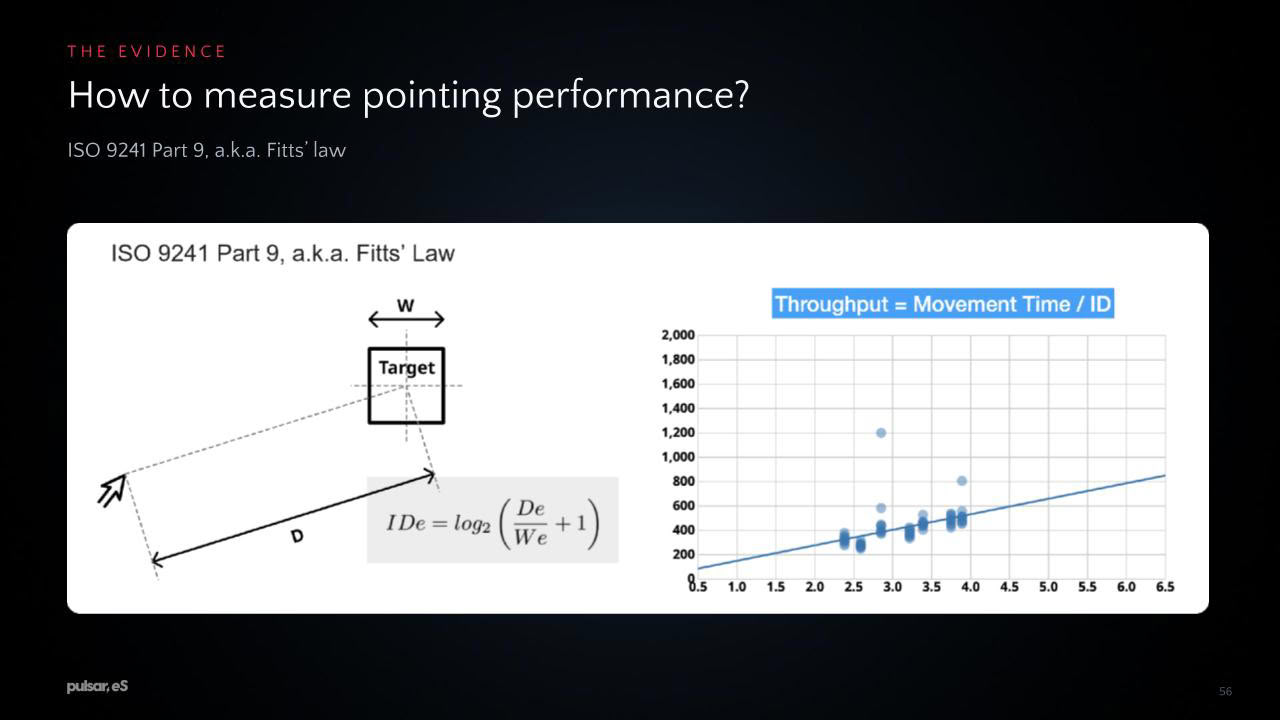
The test itself is rather basic: either in a 2D or in a 3D environment, one needs to move from target to target as fast and as accurately as possible, clicking whenever the cursor is on target. As the target pattern is fixed, one will inevitably improve at it, such that distinguishing between improving at the particular pointing task at hand and pointing tasks in general may be considered non-trivial. Theoretically, with enough repetition, one may end up being able to hit every target flawlessly without even looking at the screen. One could also argue that this test is, if anything, only partially representative of what constitutes aiming, such that other aspects (tracking, smaller corrections, etc.) are either underrepresented or not represented at all. Conceivably, a sensor position conducive to this specific pointing task may also be conducive to other categorically different pointing tasks, yet we cannot infer this to necessarily be the case. This is further complicated by the fact that for most users, their grip and thus typical pivot may change between or even throughout specific motions, and if such motions are not part of the test, then they will not enter the optimization. On a meta level, there is also another argument to be made: Even if we accept this to be a suitable test, then it still will only optimize the position such that the output is as good as it individually can be. A different, yet potentially more suitable approach would be to optimize towards a position that minimizes the rotational component. Put differently, rather than optimizing poor technique, and the output under this premise, the goal would be to fix poor technique by finding a position that is as translational as possible for the user. Whether this position may then, regardless of pointing task, also yield the best output, is a different matter, though one could surely make an argument for it. However, this is merely an idea and not yet implemented on the P1.
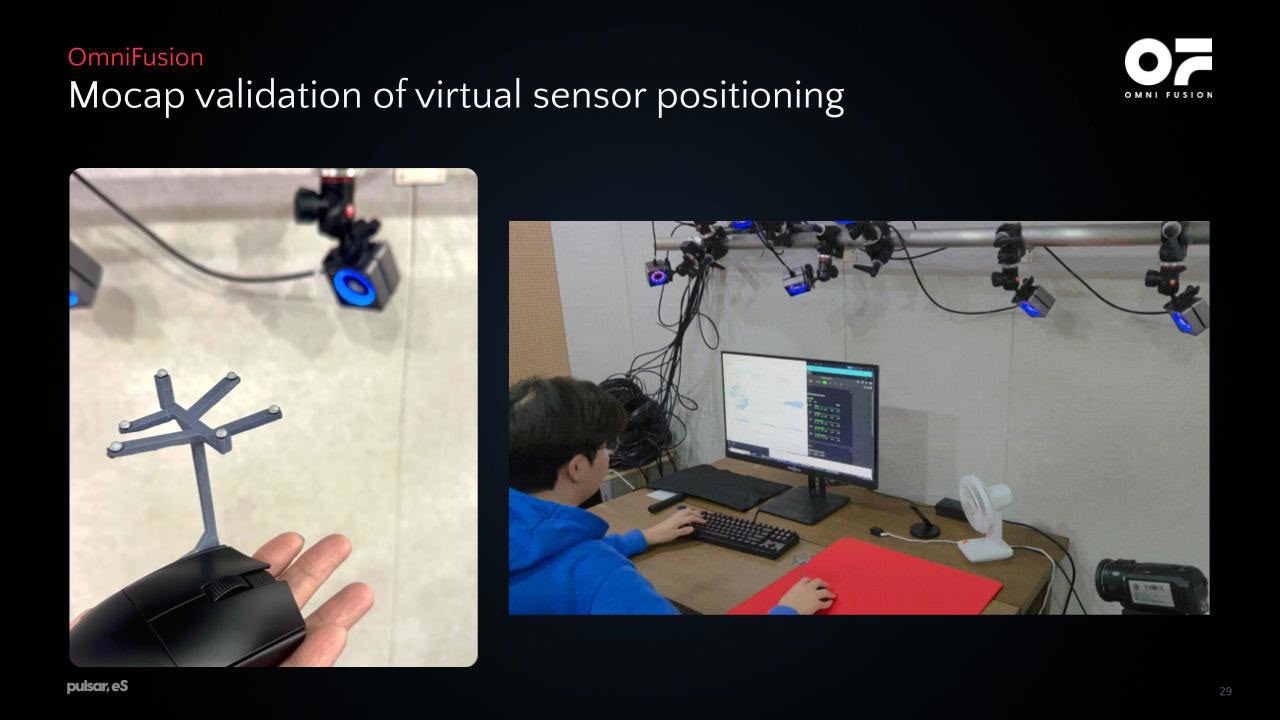
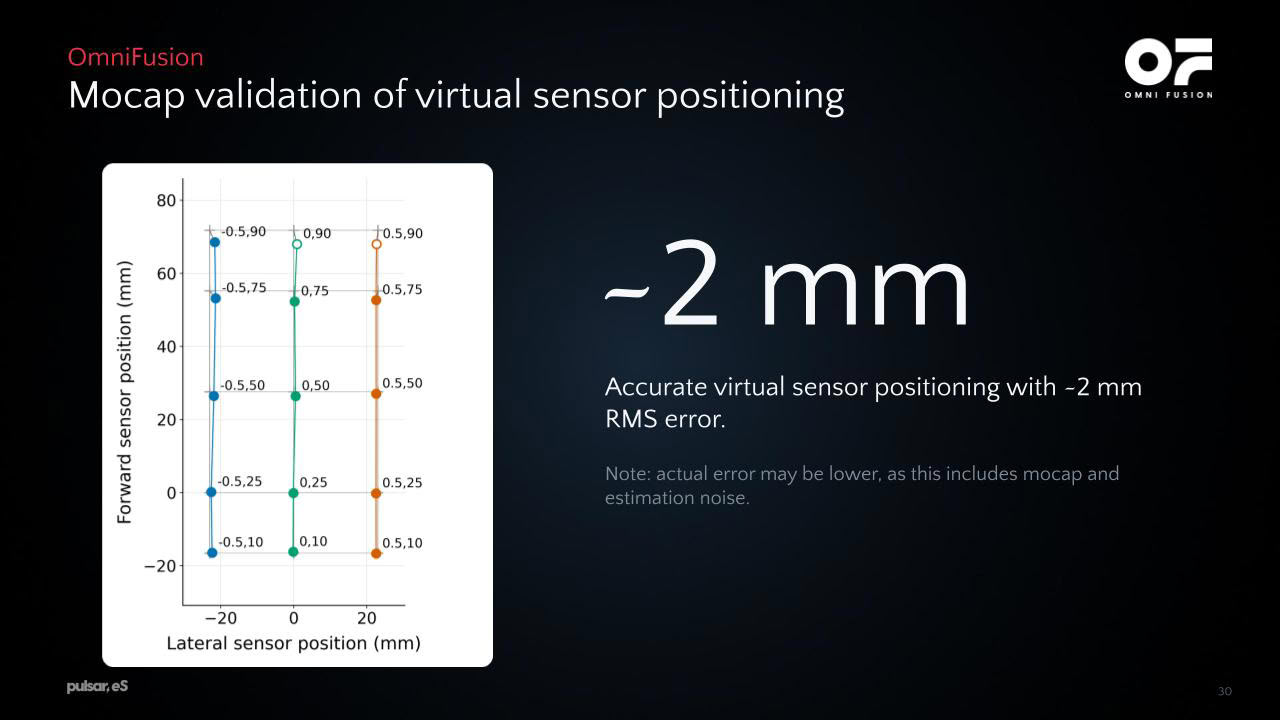
Likewise, it should not go unmentioned that the virtual sensor position mapping of the P1 is not perfect. On a single-sensor setup allowing physically moving the sensor, no calculation is performed and the position is therefore perfectly accurate. On a dual-sensor setup using a virtual sensor position, the calculation is an estimation, and this estimation may produce an error, i.e. a deviation between set (nominal) and actual virtual position. Pulsar has tested the error to be up to ~2 mm (root-mean-square), though given the limited accuracy of the method used to test this error itself, it may well be (and conceivably is) lower.
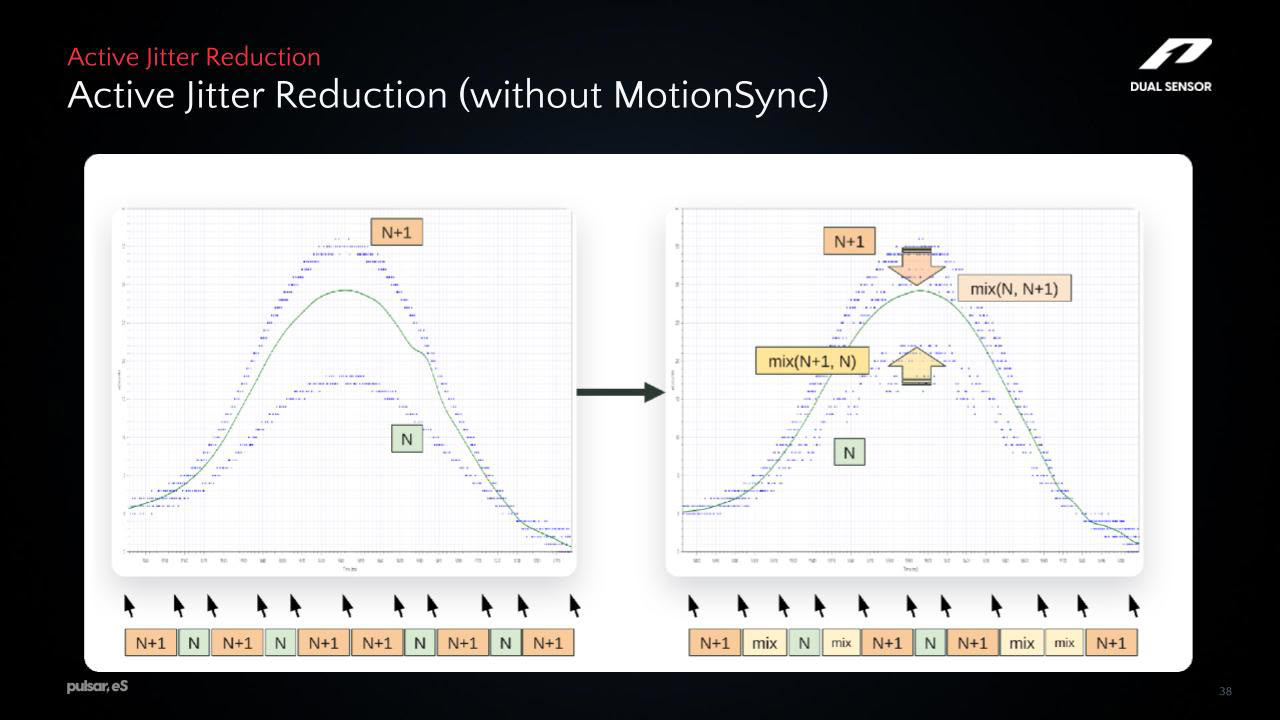
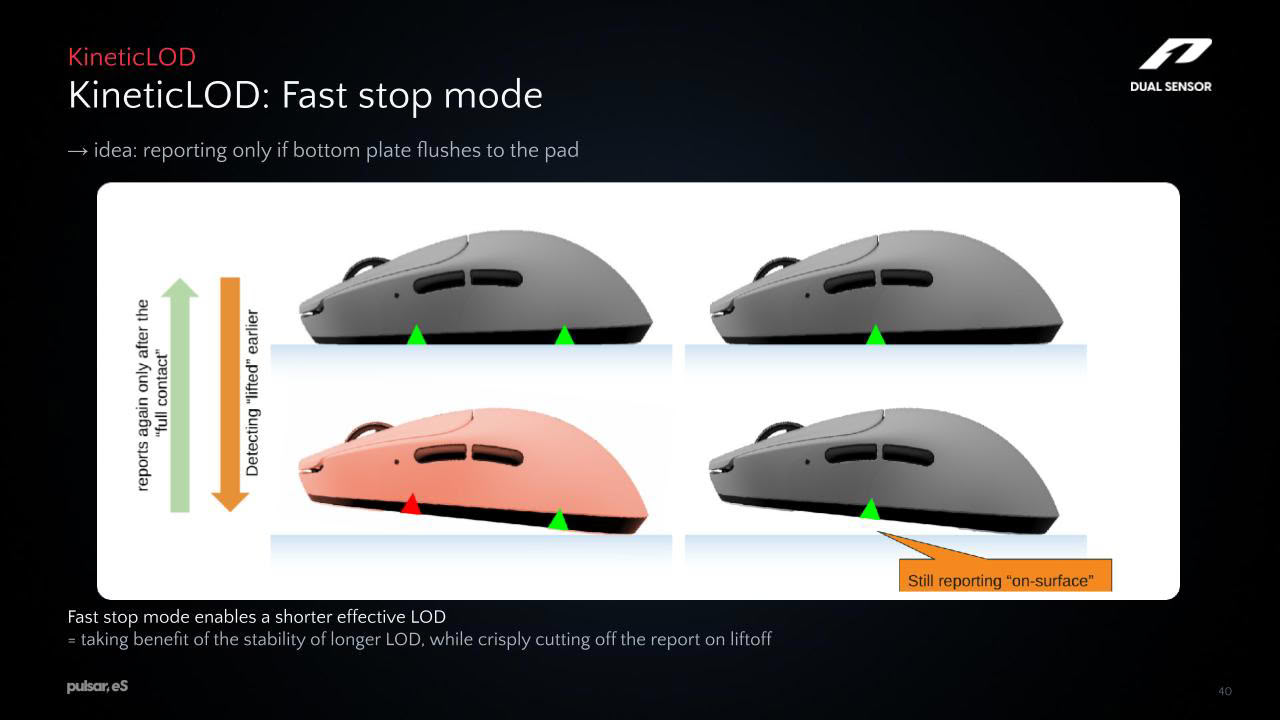
The dual-sensor setup provides two additional benefits. The first one has been dubbed "Active Jitter Reduction" by Pulsar. More specifically, the reduction is of spatial jitter. The idea is that a weighted averaging of the readings of both sensors is performed, which results in a noise reduction by a factor equal to the square root of 2 or by 29.3%. This factor applies at the midpoint position between the physical front and rear sensors, and the effect will get weaker the further away the virtual sensor position is from the midpoint, until it eventually is reversed, and the jitter reduction becomes a jitter increase. The second benefit is called "KineticLOD" and concerns lift-off detection. When lifting a mouse, most people do not hold it perfectly stable. On a single-sensor setup, depending on where the sensor is physically located, part of the mouse may already be lifted, yet the single sensor will still report as not lifted, introducing unintended sensor motion. On a dual-sensor setup with sufficiently spaced sensors, lifting the mouse more towards the front or rear will already result in the respective sensor reporting as lifted. When lifting the mouse in a perfectly stable or flat manner, this benefit is felt the least. Alternatively, one can configure the mouse to only stop tracking once both sensors report lifted status.
Nov 18th, 2026 12:56 CST
change timezone
Latest GPU Drivers
New Forum Posts
- [Poll] 12V-2x6 Connector Protection: What Are You Using? (WireView / Ampinel / Equalizer / Other / Nothing) (37)
- Wireless Internet sharing between PC and router both-ways, is it possible? (18)
- WarpCoreBench scores! (64)
- ProArt X870E-CREATOR WIFI - Bifurcation~Complication (15)
- Very unusual two gaming-pc scenarios. (4)
- Honestly, do you care about GTA VI? (141)
- My Final Barrier to Exclusively Using Linux has Fallen (Azure Virtual Desktops) (9)
- Ghetto Mods (4883)
- [Intel AX1xx/AX2xx/AX4xx/AX16xx/BE2xx/BE17xx] Intel Modded Wi-Fi Driver with Intel® Killer™ Features (633)
- RX 580 2048SP 8GB Samsung – Black Screens in Games, Looking for a Compatible BIOS (2)
Popular Reviews
- Acemagic Retro X3 Review
- Upcoming Hardware Launches 2027 (Updated Nov 2026)
- AMD Zen 6 Technical Deep Dive
- ASUS ROG Strix B850-I Gaming Wi-Fi7 W Review
- Corsair HX1000i Shift Crystal Review
- Biwin Black Opal NV7400 2 TB Review
- Chieftec Iceberg PRO 360 DARK Review
- AMD Ryzen 7 9800X3D Review - The Best Gaming Processor
- Phantom Blade Zero Performance Benchmark Review - 35 GPUs Tested
- Montech King 95 3D PRO Review
TPU on YouTube
Controversial News Posts
- NVIDIA Co-Founder and CEO Jensen Huang Officially Resigns (477)
- Report: Jensen Huang Eyes NVIDIA Comeback (185)
- Open Letter Asking NVIDIA to Reinstate Jensen Huang Passes 115,000 Signatures (184)
- OpenAI CEO Argues Home PCs Waste the World's Limited DRAM Supply (152)
- NVIDIA Launches Investigation Into Jensen Huang's Relationship With Suspected Chinese Spy (136)
- Intel "Raptor Lake Next" 16-Core and 20-Core CPUs Surface (130)
- Legendary Game Studio BioWare Shuts Down Following EA Layoffs (104)
- Dell CEO Says the Memory Shortage Will Get Worse in 2027 (95)