 4
Quick Look: CORSAIR K70 RGB TKL Optical-Mechanical Keyboard
(4 Comments) »Introduction

If you are experiencing déjà vu right now, let me help. We have already covered the CORSAIR K70 RGB TKL CHAMPION SERIES in all its long, capitalized name glory. It was something new from CORSAIR this time last year since it brought its popular K70 series of keyboards to a tenkeyless form factor, and along with it came a few other aspects for competitive gaming appeal. There was Axon processing, which allowed for far more onboard functionality than before and up to 8000 Hz polling rate, and the Tournament Mode switch—interesting but not the most relevant to TPU readers. At launch, the keyboard was made available with a variety of Cherry MX RGB mechanical switches, and something I had brought up as a negative was the missing CORSAIR optical-mechanical switch to take the whole fast keyboard aspect to a new level.

It took nearly a year, but here we are finally with the K70 RGB TKL optical-mechanical version. What makes this so is the use of CORSAIR's OPX optical switches that debuted with the flagship K100 RGB in 2020 and haven't made its way through other CORSAIR keyboards as much as I would like, including no doubt CORSAIR itself. It also necessitated a PCB change, but CORSAIR says the rest of the functionality is identical to the mechanical switch version. As such, I opted for a quick look article, but urge you to read the full review of the K70 RGB TKL mechanical keyboard, and thanks again to CORSAIR for providing TechPowerUp a review sample!
| CORSAIR K70 RGB TKL Optical-Mechanical Keyboard | |
|---|---|
| Layout: | TKL form factor in a US ANSI layout, language support dependent on region |
| Material: | ABS plastic case, PBT plastic keycaps, and anodized aluminium frame |
| Macro Support: | Yes |
| Weight: | 0.88 kg / 1.94 lbs |
| Wrist Rest: | No |
| Anti-ghosting: | Full N-Key rollover USB |
| Media Keys: | Dedicated |
| Dimensions: | 164 (L) x 360 (W) x 40 (H) mm |
| Cable Length: | 6 ft / 1.8 m |
| Software: | Yes |
| Switch Type: | CORSAIR OPX optical RGB switch |
| Backlighting: | Yes, 16.8 M per-key RGB lighting |
| Interface: | USB |
| Warranty: | Two years |
Packaging and Accessories


I was about to again point to the older review since I did not think a whole lot would be different with the packaging, but then realized that it is slimmer than the box for the mechanical switch version of the CORSAIR K70 RGB TKL. Gone is also the plastic wrap over the box, at least on this review sample, which is a good thing in my books. The front of the box has everything you expect—company logo, product name, keyboard render, and salient marketing features, including it being the optical-mechanical version after all. This continues on the back and sides with more illustrations calling out specific features, and it makes for packaging that catches the eye and helps make an informed purchasing decision if you chance upon it in a retail store. Opening the box, we see the keyboard inside a plastic seal.


Now I know why the box is slimmer: CORSAIR isn't including the extra keycaps and keycap puller with this model! This seems strange, but photos on the product page confirm that the accessories only consist of a warranty guide, safety information, and detachable USB Type-A to Type-C cable. These are also arranged slightly differently from the other version, and it is perhaps a case of these switches costing more for the volume margins to where CORSAIR had to cut down on packaging for more units to be shipped per crate, and of course save on the cost of the missing accessories, too.
Closer Look


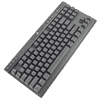
Nothing has changed about the keyboard exterior, though. It is the same K70 RGB TKL I remember and follows the design language of modern the CORSAIR K70, K95, and K100 keyboards with a brushed aluminium frame and newer "Sails" logo. The TKL form factor also means we get 87-keys on this US ANSI layout with standard row spacing, which CORSAIR calls out specifically on the packaging now. Aside from any special or limited editions, expect to see an all-black version with white doubleshot injected legends on black PBT keycaps. The keyboard has extra buttons at the top and a beveled edge at the bottom, which make this more biased in the top-down direction than the smaller bezels on the other two sides and helps the dedicated volume wheel, media playback controls, profile switches, backlighting toggle, and Win lock button.


Flipping the keyboard around, we see the usual certification sticker, but it is shaped like a trapezoid and biased towards the top to better align with the case design across the top. Four large rubber pads on the corners keep the keyboard from sliding around on the desk, and two feet at the top open up sideways to optionally elevate the keyboard; these feet also have rubber pads to ensure they don't scratch easily. Missing are any of the cable-routing cutouts we see with some other high-end CORSAIR keyboards and support for a wrist rest that attaches using magnets or plastic clips. Should you want one, you will need to purchase a standalone aftermarket wrist rest.


The detachable cable adds to the portability of the keyboard, but not as much as with the 60% form factor K65 Mini, of course. The side facing away from the user has a cutout in the middle where the USB Type-C connector of the cable plugs in, and substantial casing on either side protects the connectors. The cable is also braided in a durable black sleeve to match the rest of the keyboard. Next to the port is a switch instead of a USB pass-through port, which would have been nice but also difficult to implement with detachable cables. This switch is novel in that it activates Tournament Mode, which deactivates macros and custom actions to prevent any cheating in gaming tournaments, changes backlighting to a static single color, and only allows profile switching compatible with tournament regulations. A latch also goes over and secures the switch when in this mode, which has a hidden red LED indicate that tournament mode is on for referees and the audience.


The K70 RGB TKL uses the tried and tested OEM profile. It consists of keycaps in their usual slanted rows with concave surfaces on top, and we have the now-expected "standard" keycap spacing for the bottom row increasing compatibility with aftermarket keycap sets, in addition to first-party replacement sets we have examined before. However, the stock keycaps are very good because of their thick PBT plastic composition (average wall thickness 1.44 mm) and doubleshot injected legends that will not wear out before the rest of the keyboard—PBT plastic resists signs of wear and shine from finger oils better than ABS plastic. These are compatible with backlighting, which is no doubt part of the RGB lighting feature. The larger keycaps use what should be genuine Cherry plate-mounted stabilizers, albeit in white rather than the usual black, which helps with their removal, but at the expense of that typical mushy feeling with these stabilizers. CORSAIR has them lubed out of the factory, but not to where it tangibly improves. However, it is still appreciated, especially when paired with these PBT keycaps.
Our Patreon Silver Supporters can read articles in single-page format.
Nov 19th, 2026 09:10 PST
change timezone
Latest GPU Drivers
New Forum Posts
- Honestly, do you care about GTA VI? (160)
- How to prevent OLED burn damage due to PC freezes or power outtages? (0)
- GTA VI (1)
- Dual B70 or Dual R9700 Pro on Linux (9)
- Anime Nation (13187)
- Very unusual two gaming-pc scenarios. (20)
- Free Games Thread (5383)
- Gacha Games - Discussions, Pulls, Updates, etc. (1156)
- Why my RX 6800 XT read that it operate at x8 not x16 ? (46)
- [Poll] 12V-2x6 Connector Protection: What Are You Using? (WireView / Ampinel / Equalizer / Other / Nothing) (47)
Popular Reviews
- Acemagic Retro X3 Review
- Ugreen NASync DXP4800 GT Review
- Upcoming Hardware Launches 2027 (Updated Nov 2026)
- Pulsar Office Tour & First Look at P1 Dual-Sensor Mouse
- AMD Zen 6 Technical Deep Dive
- Biwin Black Opal NV7400 2 TB Review
- Sapphire Radeon RX 7700 XT Pure Review
- Sapphire Radeon RX 7700 XT Pulse Review
- AMD Ryzen 7 9800X3D Review - The Best Gaming Processor
- Chieftec Iceberg PRO 360 DARK Review
TPU on YouTube
Controversial News Posts
- NVIDIA Co-Founder and CEO Jensen Huang Officially Resigns (484)
- Report: Jensen Huang Eyes NVIDIA Comeback (221)
- Open Letter Asking NVIDIA to Reinstate Jensen Huang Passes 115,000 Signatures (184)
- OpenAI CEO Argues Home PCs Waste the World's Limited DRAM Supply (152)
- NVIDIA Launches Investigation Into Jensen Huang's Relationship With Suspected Chinese Spy (136)
- Intel "Raptor Lake Next" 16-Core and 20-Core CPUs Surface (130)
- Legendary Game Studio BioWare Shuts Down Following EA Layoffs (104)
- Dell CEO Says the Memory Shortage Will Get Worse in 2027 (95)