 10
Sandisk DC SN861 7.68 TB Review
Value & Conclusion »Power Consumption
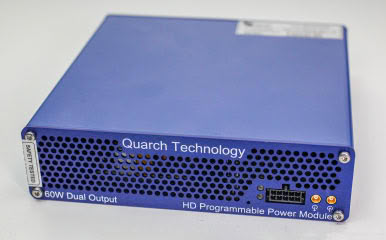
For the SSD power consumption tests, a Quarch QTL1999 programmable power module is used, alongside the proper fixture for the SSD. This method allows for the monitoring of a drive's power usage profile with microsecond precision in our custom workloads. Data is pulled into our processing pipeline over Ethernet, on a separate machine, ensuring that measurements do not affect the SSD being tested. All measurements are drive power only, not full system
Max Power Draw
During our power consumption test sequence, the peak value is recorded.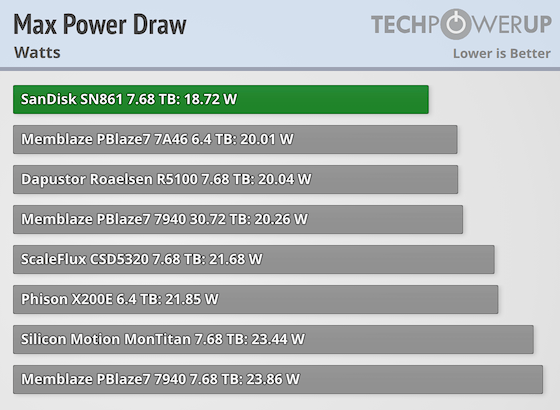
Throughout our test suite, the maximum power consumption we observed was a relatively modest 18.72 W, an excellent result for a high-performance enterprise SSD. While several competing drives consume more power, they also deliver higher performance in certain workloads. Overall, the SN861 strikes a solid balance between performance and power efficiency.
Average Power Draw
During the benchmark, we also recorded the average power consumption throughout the entire duration of the test.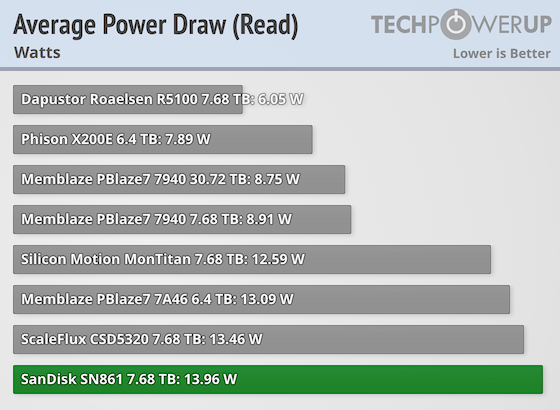
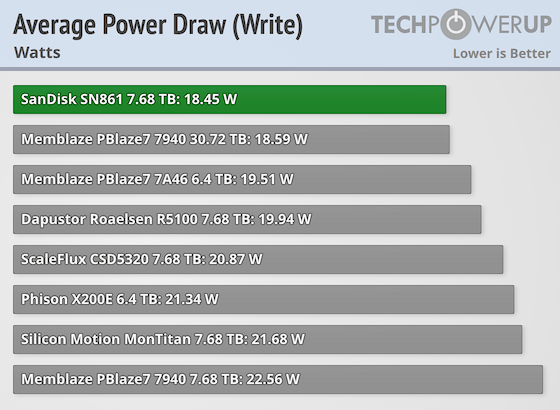
Our DC SN861 exhibited average read power consumption very similar to the ScaleFlux CSD5320, another PCIe Gen 5 SSD featuring Kioxia NAND and a 16-channel controller, making this a fairly typical result for drives in this class. During write workloads, however, the SN861 delivered the lowest average power consumption among all the SSDs tested, demonstrating excellent power efficiency under sustained write operations.
Idle Power
We will now test the SSD while idle on the desktop for 15 minutes to check its average power consumption. It's important to note that the test was conducted without enabling the L1 ASPM setting, which is designed to activate power-saving modes for peripherals and devices using the PCIe bus.L1 ASPM was disabled to reflect a more realistic server or workstation environment, where power-saving features are often turned off to prioritize stability and performance, allowing us to measure the SSD's idle power consumption without the influence of aggressive power management.
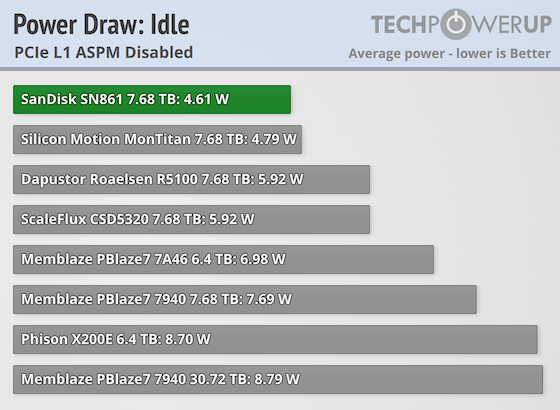
At idle, the SN861 impressed us even further, delivering the lowest power consumption among all the SSDs in our comparison. While enterprise SSDs like this are designed to operate under sustained workloads rather than idle conditions, this result nevertheless highlights the efficiency of its overall hardware design and power management implementation.
Power Draw at Fixed IOPS
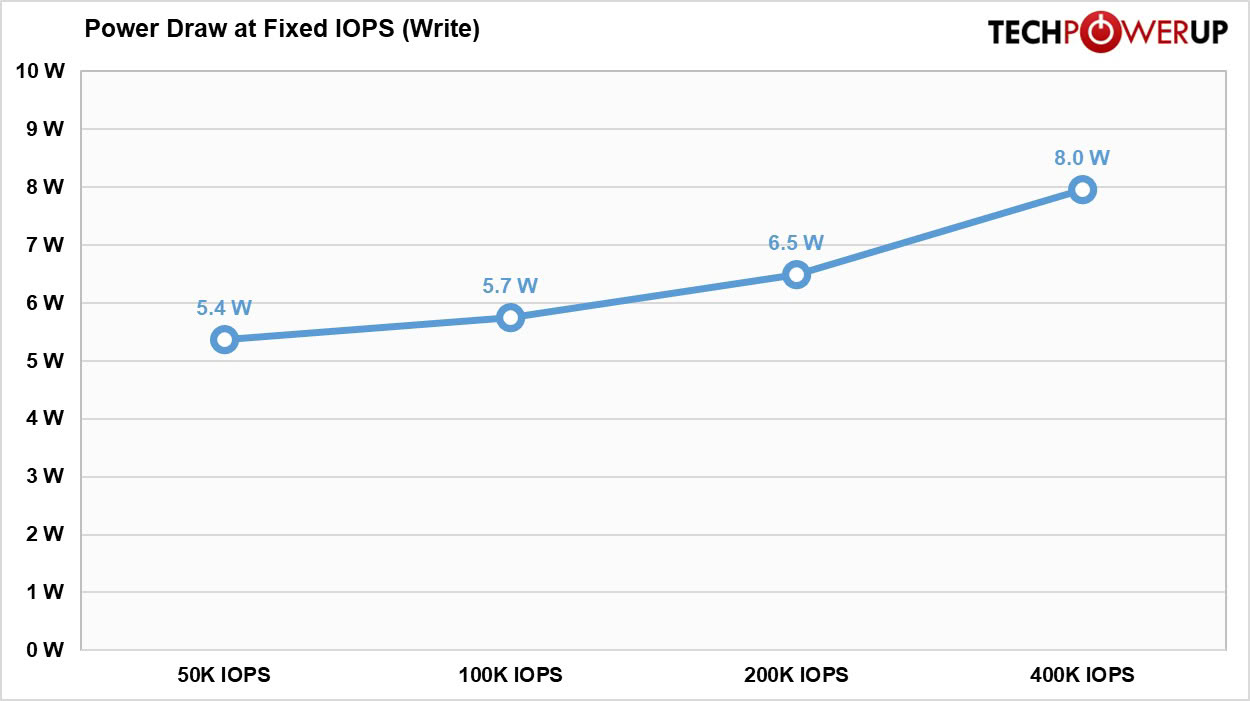
Using FIO, we measure the SSD's power consumption while operating at predefined fixed IOPS targets across both read and write workloads. This method allows us to evaluate how efficiently the drive scales power as performance increases, providing a clearer view of real-world efficiency behavior rather than only measuring peak power consumption.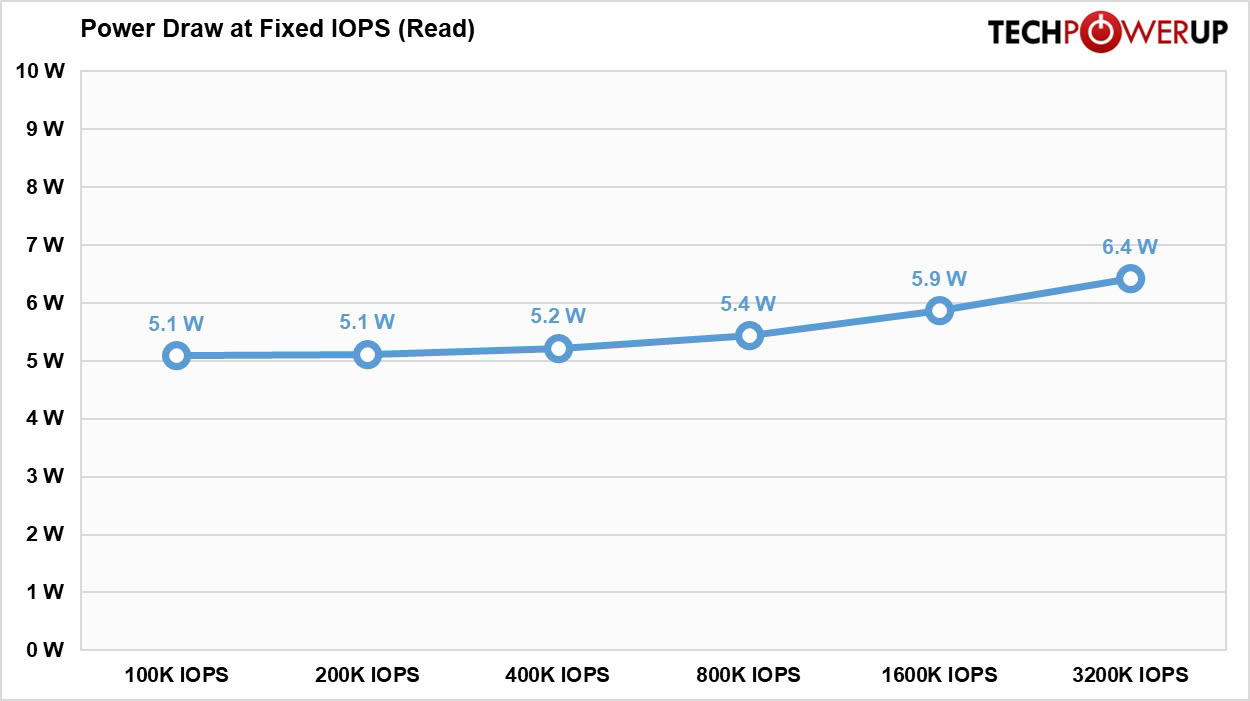
Energy Efficiency
Finally, we have the power efficiency test, with data collected from both the read and write speed benchmarks.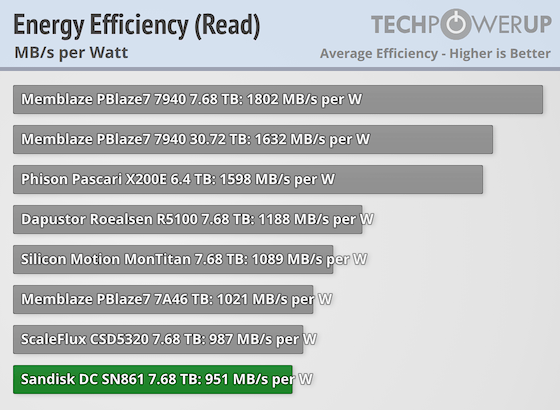
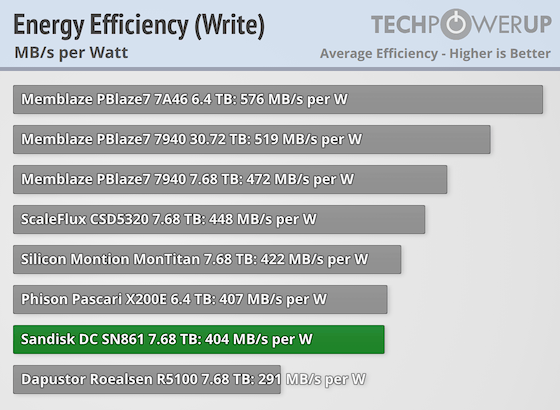
This new lineup from Sandisk has proven to be highly efficient, although it does not currently rank among the most power-efficient SSDs we've tested. Newer controllers paired with the latest Sandisk/Kioxia BiCS8 NAND are capable of achieving even better efficiency, as demonstrated by drives such as the ScaleFlux CSD5320. Nevertheless, the SN861 still delivers an excellent balance between performance and power consumption, particularly under write-intensive workloads.
Nov 15th, 2026 21:43 CST
change timezone
Latest GPU Drivers
New Forum Posts
- Asus Rog Maximus Z890 Extreme. (Various questions). (26)
- GPU Temperatures Rise Very Quickly in FurMark – Is This Normal? (7)
- Will zen 6 mobos have anything extra vs current ones? (46)
- Your PC ATM (36435)
- It’s been fascinating times in Retro agian r36s isn’t even worth 50-65 dollars no more and newly listed Rm36 64gb 4in IPS models for only 34 dollars. (6)
- Power supply noise stops when I move the mouse (10)
- Can you guess Which game it is? (320)
- What is the latest game you finished or 100% (203)
- HP Office Jet 7740 Pro - Supply system problem with replacement cartridge (4)
- What are you playing? (26224)
Popular Reviews
- ASUS ROG Strix B850-I Gaming Wi-Fi7 W Review
- Corsair HX1000i Shift Crystal Review
- AMD Zen 6 Technical Deep Dive
- Upcoming Hardware Launches 2027 (Updated Nov 2026)
- Montech King 95 3D PRO Review
- NZXT C1200 Platinum Review
- Phantom Blade Zero Performance Benchmark Review - 35 GPUs Tested
- AMD Ryzen 7 9800X3D Review - The Best Gaming Processor
- NZXT H5 Review
- NZXT H7 RGB+ Review
TPU on YouTube
Controversial News Posts
- NVIDIA Co-Founder and CEO Jensen Huang Officially Resigns (430)
- Open Letter Asking NVIDIA to Reinstate Jensen Huang Passes 115,000 Signatures (184)
- OpenAI CEO Argues Home PCs Waste the World's Limited DRAM Supply (152)
- NVIDIA Launches Investigation Into Jensen Huang's Relationship With Suspected Chinese Spy (136)
- Intel "Raptor Lake Next" 16-Core and 20-Core CPUs Surface (130)
- Legendary Game Studio BioWare Shuts Down Following EA Layoffs (104)
- Dell CEO Says the Memory Shortage Will Get Worse in 2027 (95)
- NVIDIA GeForce RTX 50-Series Scheduled for up to $500 Price Hike This Week (89)