 10
Sandisk DC SN861 7.68 TB Review
Sequential 128 KiB »Sustained Speeds and Preconditioning
Before measuring speed, the SSD must be properly prepared through a process known as preconditioning. This step ensures that performance measurements reflect consistent, sustained behavior. SSDs typically operate in three performance states: Fresh-out-of-box (FOB), a transitional phase, and the steady state.FOB refers to the initial condition when an SSD is first subjected to workload testing. The transitional phase is the period during which performance begins to decline and stabilize. Steady state is the point where performance levels off and remains consistent, regardless of continued workload.
A simple analogy helps clarify these phases: imagine a marathon runner who starts the race at full sprint, reaching peak speed—let's say 15 km/h. It's unrealistic to maintain that speed for the entire race. As fatigue sets in, the runner slows down. That slowdown represents the transitional state. Eventually, the runner finds a pace that can be sustained for the remainder of the distance—that would be the steady state.
Consumer-grade SSDs exhibit similar behavior but often rely on SLC caching to temporarily boost speeds. In most cases, these drives can't achieve their advertised maximum throughput without such techniques. Enterprise SSDs, on the other hand, are engineered for consistency and typically avoid performance-enhancing caches, maintaining steady speeds under continuous workloads.
Sequential 128 KiB - Write
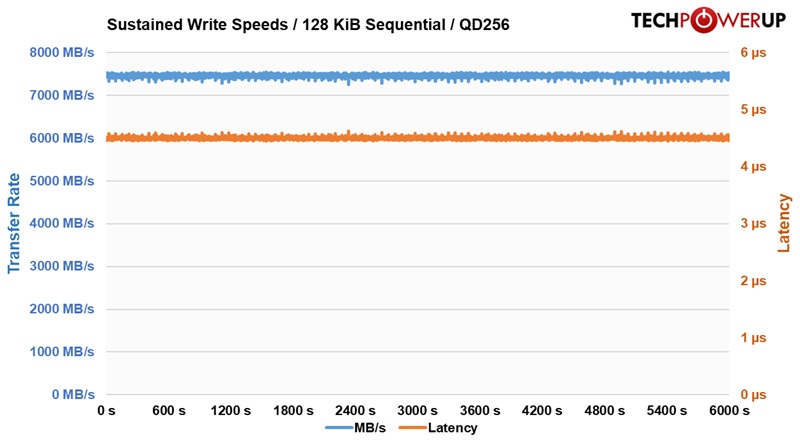
Starting with the sequential speed test, the SSD delivers as promised, maintaining its rated write speed throughout the entire test while also exhibiting very low latencies.
Random 4 KiB - 100% Write
We will now begin preconditioning the SSD using random 4 KiB write workloads at a queue depth of 256, running for several hours until the drive reaches steady state.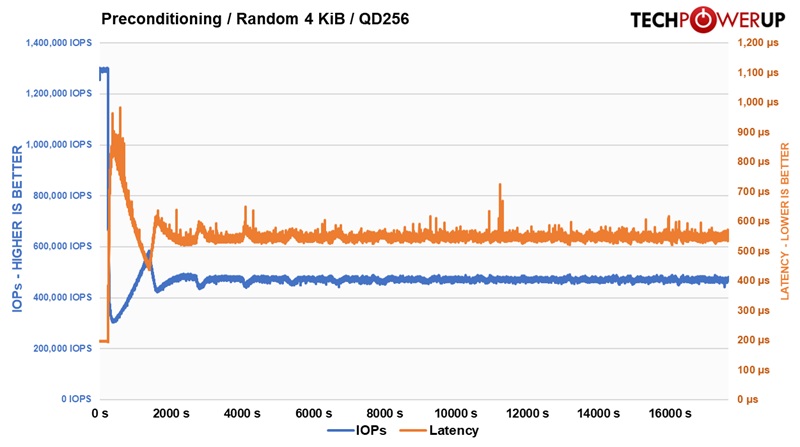
The Sandisk DC SN861 delivered excellent 4K random write performance, slightly exceeding the manufacturer's rated 430K IOPS. The SSD also came very close to the performance of the 7.68 TB Memblaze 7940, placing it among the fastest drives evaluated in this test.
Random 4 KiB - 70% Read and 30% Write
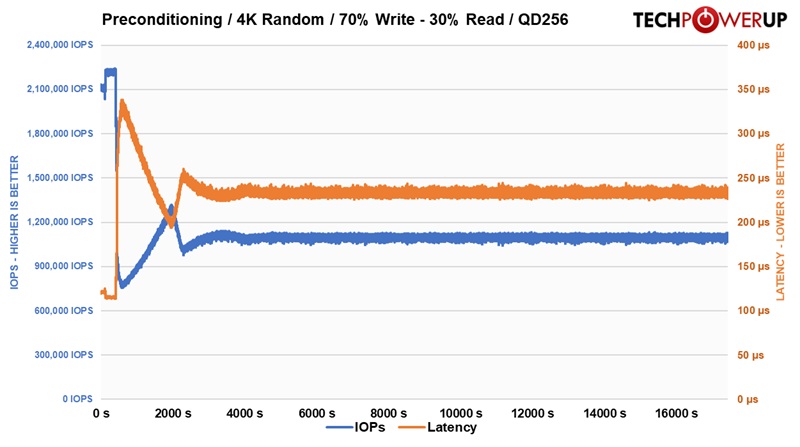
When running the mixed 4 KiB read and write benchmark, we noticed that in steady state, the DC SN861 delivered a good result so far, surpassing the 1 million IOPS mark and stabilizing around 1.1 million IOPS. It even outperformed the Memblaze 7940 and the Silicon Motion's MonTitan.
Nov 15th, 2026 19:40 CST
change timezone
Latest GPU Drivers
New Forum Posts
- Your PC ATM (36432)
- It’s been fascinating times in Retro agian r36s isn’t even worth 50-65 dollars no more and newly listed Rm36 64gb 4in IPS models for only 34 dollars. (6)
- Power supply noise stops when I move the mouse (10)
- Can you guess Which game it is? (320)
- What is the latest game you finished or 100% (203)
- HP Office Jet 7740 Pro - Supply system problem with replacement cartridge (4)
- What are you playing? (26224)
- WarpCoreBench scores! (55)
- Local LLM General Discussion (691)
- Folding Pie and Milestones!! (10205)
Popular Reviews
- ASUS ROG Strix B850-I Gaming Wi-Fi7 W Review
- Corsair HX1000i Shift Crystal Review
- AMD Zen 6 Technical Deep Dive
- Upcoming Hardware Launches 2027 (Updated Nov 2026)
- Montech King 95 3D PRO Review
- NZXT C1200 Platinum Review
- Phantom Blade Zero Performance Benchmark Review - 35 GPUs Tested
- AMD Ryzen 7 9800X3D Review - The Best Gaming Processor
- NZXT H7 RGB+ Review
- NZXT H5 Review
TPU on YouTube
Controversial News Posts
- NVIDIA Co-Founder and CEO Jensen Huang Officially Resigns (430)
- Open Letter Asking NVIDIA to Reinstate Jensen Huang Passes 115,000 Signatures (184)
- OpenAI CEO Argues Home PCs Waste the World's Limited DRAM Supply (152)
- NVIDIA Launches Investigation Into Jensen Huang's Relationship With Suspected Chinese Spy (136)
- Intel "Raptor Lake Next" 16-Core and 20-Core CPUs Surface (130)
- Legendary Game Studio BioWare Shuts Down Following EA Layoffs (104)
- Dell CEO Says the Memory Shortage Will Get Worse in 2027 (95)
- NVIDIA GeForce RTX 50-Series Scheduled for up to $500 Price Hike This Week (89)