 3
VZMORE AX9 Max Review
A Look Inside »Design and Build


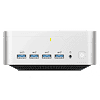
The AX9 Max uses a silver metal upper enclosure with rounded corners and a shield-shaped badge across the top. Its roughly 135 × 132 mm footprint and 57.7 mm height make it an average-sized Mini-PC, and easy to position beside a monitor without sacrificing much desk space. Across the front are four USB-A ports running at up to 10 Gbps, a headset connection, and the power button. One of those USB-A ports supports charging in the S5 power state, which could be useful for a phone or accessory when the PC is shut down but still connected to power. Having several full-size USB ports on the front is great for flash drives that I would otherwise connect behind the desk. The front panel is missing USB-C, though, which is a curious decision, as both of its USB4 ports are placed at the rear.
The rear connection panel has dual 40 Gbps USB4 ports for high-speed storage or docking accessories, with two HDMI outputs and two 2.5 GbE connections. One USB4 port also supports up to 100 W USB-C power input, giving owners another way to power the system, although the included 120 W adapter provides slightly more power headroom. Between HDMI and USB4 video output, the PC supports four monitors, which is more display flexibility than I need, but it can be useful for someone with a multiscreen workspace.


An SD 4.0 card reader is located on one side of the enclosure, while ventilation is concentrated along the bottom and rear. The lower intake works with the internal vapor chamber and fan to move heat through a chassis that has very little spare space, and the approach is especially relevant with a processor that can be configured for a 65 W performance profile. Air circulation will depend on how the unit is placed, so I would give the underside room to breathe instead of setting it on fabric or carpet.
It would have been nice to see one of the USB-C connections on the front, where it would be more convenient for an external SSD or phone. The oversized top badge also gives the enclosure a fairly distinctive appearance.
Nov 25th, 2026 08:05 CST
change timezone
Latest GPU Drivers
New Forum Posts
- Ryzen Owners Zen Garden (8566)
- WarpCoreBench scores! (104)
- Increasing Power Limit? (34)
- Sexy Hardware Close-Up Pic Clubhouse. (10344)
- {NA} 2026 Black November prices / deal (6)
- Smokin Hot Lappy (1)
- What is the latest game you finished or 100% (205)
- The time has come to upgrade...my desktop (20)
- Can you guess Which game it is? (358)
- Without Jensen, PC gaming will be (59)
Popular Reviews
- ASRock X870E Challenger Wi-Fi White Review
- Microsoft Surface Laptop Ultra Review - The Next-gen Arm Laptop
- VZMORE AX9 Max Review
- Upcoming Hardware Launches 2027 (Updated Nov 2026)
- AMD Ryzen 7 9800X3D Review - The Best Gaming Processor
- AMD Zen 6 Technical Deep Dive
- Corsair RM1200e (Second Generation) Review
- Phantom Blade Zero Performance Benchmark Review - 35 GPUs Tested
- Pulsar Office Tour & First Look at P1 Dual-Sensor Mouse
- Ocypus lota P1000 Review
TPU on YouTube
Controversial News Posts
- Jensen Huang Reinstated as CEO of NVIDIA (555)
- NVIDIA Co-Founder and CEO Jensen Huang Officially Resigns (492)
- Report: Jensen Huang Eyes NVIDIA Comeback (281)
- Open Letter Asking NVIDIA to Reinstate Jensen Huang Passes 115,000 Signatures (184)
- OpenAI CEO Argues Home PCs Waste the World's Limited DRAM Supply (152)
- NVIDIA Launches Investigation Into Jensen Huang's Relationship With Suspected Chinese Spy (136)
- Intel "Raptor Lake Next" 16-Core and 20-Core CPUs Surface (130)
- Intel Razor Lake Gets a 12 P-Core bLLC Chip With No E-Cores, Per Leak (94)