Monday, December 31st 2012

Arctic Leaks Bucket List of Socket LGA1150 Processor Model Numbers
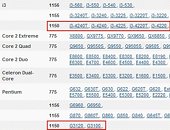
CPU cooler manufacturer Arctic (aka Arctic Cooling) may have inadvertently leaked a very long list of 4th generation Intel Core processors based on its LGA1150 socket. Longer than any currently posted lists of Core "Haswell" processors, the leak includes model numbers of nine Core i7, seventeen Core i5, five Core i3, and two Pentium models. Among the Core i7 models are already known i7-4770K flagship chip, i7-4770S, and a yet-unknown i7-4765T. The Core i5 processor list is exhaustive, and it appears that Intel wants to leave no price-point unattended. The Core i5-4570K could interest enthusiasts. In comparison to the Core i5 list, the LGA1150 Core i3 list is surprisingly short, indicating Intel is serious about phasing out dual-core chips. The Pentium LGA1150 list is even shorter.
The list of LGA1150 processor models appears to have been leaked in the data-sheets of one of its coolers, in the section that lists compatible processors. LGA1150 appears to have the same exact cooler mount-hole spacing as LGA1155 and LGA1156 sockets, and as such upgrading CPU cooler shouldn't be on your agenda. Intel's 4th generation Core processor family is based on Intel's spanking new "Haswell" micro-architecture, which promises higher performance per-core, and significantly faster integrated graphics over previous generation. The new chips will be built on Intel's now-mature 22 nm silicon fabrication process. The new chips will begin to roll out in the first-half of 2013.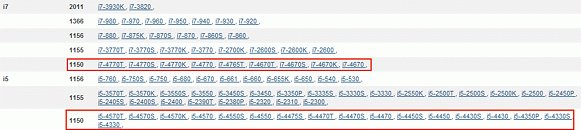
Source:
Expreview
The list of LGA1150 processor models appears to have been leaked in the data-sheets of one of its coolers, in the section that lists compatible processors. LGA1150 appears to have the same exact cooler mount-hole spacing as LGA1155 and LGA1156 sockets, and as such upgrading CPU cooler shouldn't be on your agenda. Intel's 4th generation Core processor family is based on Intel's spanking new "Haswell" micro-architecture, which promises higher performance per-core, and significantly faster integrated graphics over previous generation. The new chips will be built on Intel's now-mature 22 nm silicon fabrication process. The new chips will begin to roll out in the first-half of 2013.


58 Comments on Arctic Leaks Bucket List of Socket LGA1150 Processor Model Numbers
It's a consideration, but if you're rig is working fine for your purposes there is no reason to upgrade. You're right.Is it slowing you down? Prima.Vera has a good point, if you're not fully taxing your platform then there is no need to upgrade it.
And cloud is inferior not because of privacy, but because of uncertainty and security. What if the service goes down? What if there's an error on your account? What if it's hacked? Things of that nature. They are all legitimate concerns. Granted, there are good things about it, but it's far from perfect.
As far as these Haswell chips, I'll likely stick with my 980X for the foreseeable future. At least until I get a larger performance increase from upgrading. That will likely mean an unlocked 8 core or better.
And it's not perfect, but it's far from horrible as some people make it out to be. It's all about ones needs.
Edit: also i apologize if i came across as bitchy. Cant remember now what i wrote and im on the phone but i have a feeling i was bitchy, and if so i apologize.
@aquinus: as P.M say below, what did you do to have a bottleneck in specifically the memory?
As far as the other software, it's hard to say if it was the DRAM because I only tested it a little bit and making the switch from the 940 to the 3820 made everything run faster in general. It was just a good upgrade, sans the power consumption, but that doesn't bother me since the 940 could eat just as much and give me less. :p
Not to say that the 940 was a bad chip, it was a very capable rig. I had it for years and it was due to be upgraded. Plus, SB-E handles virtualization very well. I can't complain.
Also I have my machine crunching right now and my rig itself (no monitors) isn't eating more than 400-watts (385-watts to be exact, both GPUs loaded and only the CPU overclocked). Overclocking the 6870s can push that usage up towards 500-watts and in some cases up to 550-watts.