Wednesday, March 9th 2022

Apple's Brand New Mac Studio With the M1 Ultra CPU Gets First Benchmark Figures

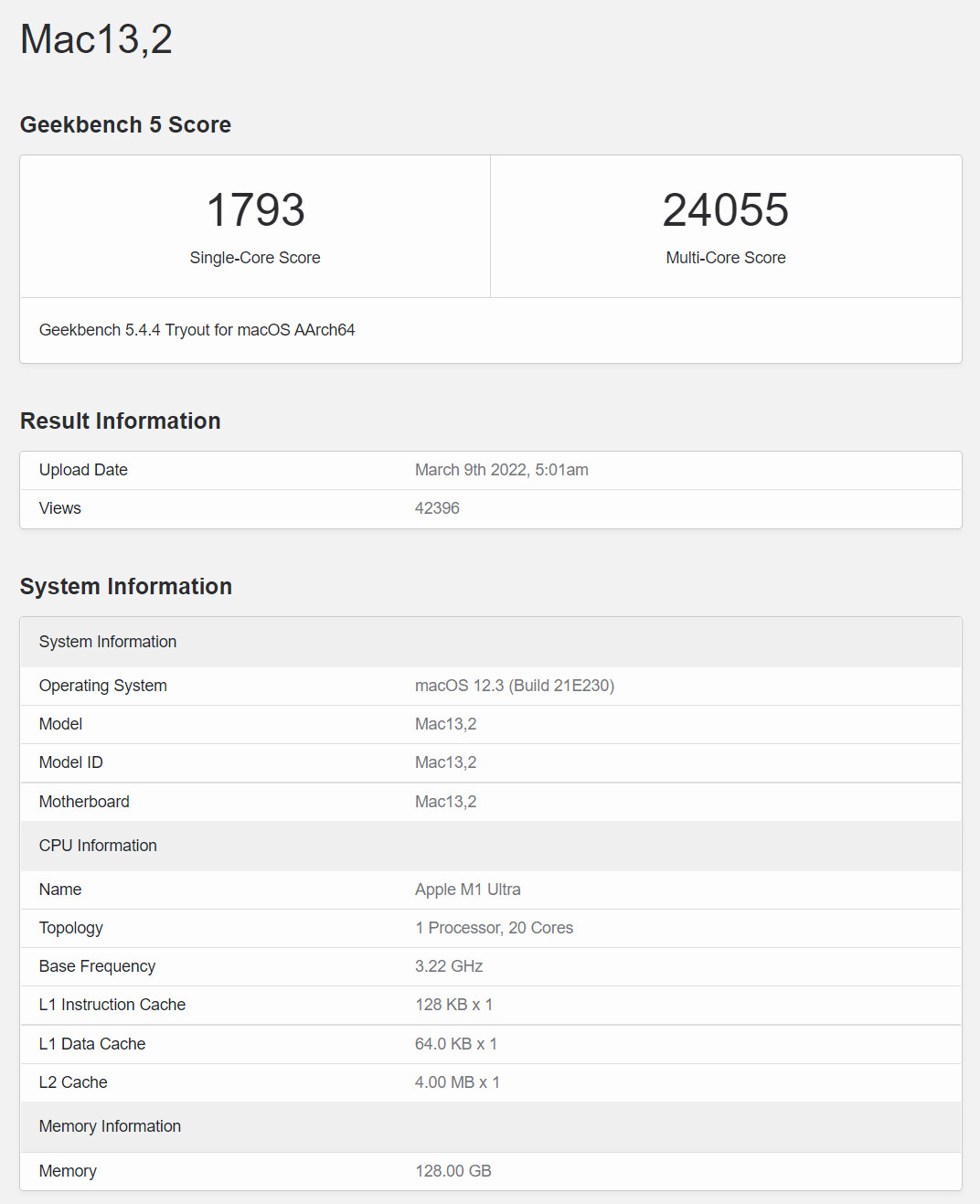
Less than 24 hours after Apple's launch event, the first Geekbench numbers for the new Apple M1 Ultra CPU are out and the numbers are interesting to say the least. For starters, the system the Geekbench numbers are from, is the top of the range 20 Core SKU with 128 GB of RAM. This helps us get some additional insight into Apple's new CPUs. As Apple didn't provide much in technical terms yesterday, nor on its website, we now know that the clock speed of the M1 Ultra is the same 3.2 GHz as the regular M1. It also appears that the CPU cache remains the same, even though Geekbench is only listing the cache of the efficiency cores for some reason.

Although Geekbench isn't a reliable cross-platform benchmark, we do at least get an idea of how the new SoC from Apple performs. The single core performance is more or less on par with the Apple M1 Max, but loses out quite easily to Intel's Alder Lake processors. However, once we move to the multi-threaded test, the M1 Ultra really shows what it's capable of. Surprisingly the performance scaling is almost linear with the double of performance CPU cores compared to the M1 Max, which suggests that Apple's multi-chip module design is extremely capable. The interesting thing will be to see how well this design scales for GPU intensive applications. Stepping outside of the Apple ecosystem, the M1 Ultra ends up somewhere around an AMD Ryzen Threadripper 3970X in terms of multi-core performance. Scaling over some of the detailed tests aren't somewhere between 80-90 percent depending on the particular test compared to the M1 Max, if we compare to the faster results on Geekbench, which is still quite impressive considering we're looking at two M1 Max CPUs that are technically glued together.
Sources: Geekbench, via Benchleaks
Add your own comment

38 Comments on Apple's Brand New Mac Studio With the M1 Ultra CPU Gets First Benchmark Figures

#26
lexluthermiester
TheLostSwedeSee above with regards to Geekbench and I also mentioned it in the news post.
Didn't see the front page post, I only saw the info in this forum post, the link is not present to be viewed. So I provided it for others who also see articles only in the forums. No offense intended.
DrediYou do realize that you linked 40 and 56 core comparisons here?
Oops. You're right. Did that on both of the Xeon links. I searched by CPU model and grabbed the highest scores. I should have looked in more detail.
Posted on Reply
#27
Vya Domus
FouquinYes, when a new benchmark releases, the results change. That's true for every single industry standard benchmark. You can NEVER compare results between versions, and just about every single product tells you as such.
This is isn't about comparing results between versions but rather about showing that those changes are obliviously meant to boost scores on certain chips. If you chose to remain oblivious to the bias here, that's your choice I guess but there is absolutely nothing invalid about taking into account these changes.
FouquinGeekbench dropped a few SIMD single precision tests in favour of ML and inference tests because just about every modern CPU is advertising those capabilities, so it makes sense to show test results and comparisons for them.
It actually makes zero sense, for one thing ML is best suited for GPUs or NPUs. Plus one of those tests that were removed, GEMM, is basically what ML is built upon. Again, those are basic tests that they've decided to remove.
FouquinAs for why Apple chips "miraculously" get faster with each release
I was being sarcastic because I know exactly why they got faster in this case and as I've explained it has nothing to do with optimizations.
Posted on Reply
#28
Fouquin
Vya DomusThis is isn't about comparing results between versions but rather about showing that those changes are obliviously meant to boost scores on certain chips. If you chose to remain oblivious to the bias here, that's your choice I guess but there is absolutely nothing invalid about taking into account these changes.


It actually makes zero sense, for one thing ML is best suited for GPUs or NPUs. Plus one of those tests that were removed, GEMM, is basically what ML is built upon. Again, those are basic tests that they've decided to remove.


I was being sarcastic because I know exactly why they got faster in this case and as I've explained it has nothing to do with optimizations.
Take off the tinfoil, this ain't a conspiracy.
Posted on Reply
#29
Vya Domus
FouquinTake off the tinfoil, this ain't a conspiracy.
It's not a conspiracy, Geekbench is crap benchmark that anyone who takes a closer look at it and knows a thing or two about how software is written wont take it serious.
Posted on Reply
#30
Tartaros
Apart of performance per se, how's software transition to M1 going? That's also a factor to have in count regarding to real world performance.
Posted on Reply
#31
lexluthermiester
TartarosApart of performance per se, how's software transition to M1 going?
Given Apple's track record for software, it will likely be very smooth, possibly even seemless. For all my complaints of Apple, their software & Operating Systems aren't among them.
Posted on Reply
#32
Cutechri
Never liked Geekbench, and it's interesting how it's ALWAYS the first benchmark figure to pop up for a new product. Gonna wait for other figures.
Posted on Reply
#33
TheoneandonlyMrK
While it's fairly irrelevant I am intrigued by how they're running two CPU and more importantly GPU over that interconnect tuuurbooo ultra thing that's not just like any other 2.5D solutions.
Slight, only slightly sarky at very end.
Posted on Reply
#34
Unregistered
Apple says there’s “never been anything like” the UltraFusion tech it unveiled today. It claims to debut a brand new method for scaling up processing performance, which doesn’t involve the trade-offs of hooking a pair of chips up to a motherboard. Instead, UltraFusion uses a “silicon interposer that connects the chips across more than 10,0000 signals,” Apple says.

This not only overcomes traditional downsides, like an uptick in latency, increased power consumption and reduced bandwidth, it gives all of those factors a significant boost, without developers having to rewrite any code because the software recognises the whole array as a single chip.

Apple says the technology provides “a massive 2.5TB/s of low latency, inter-processor bandwidth — more than 4x the bandwidth of the leading multi-chip interconnect technology.”

The ultra fusion thing is pretty swanky

www.trustedreviews.com/news/what-is-ultrafusion-apple-m1-ultra-secret-feature-explained-4215477
#35
Assimilator
FouquinAs for why Apple chips "miraculously" get faster with each release, it's probably due to them taking an interest in software optimization across the industry. They're porting every major application they can to their chips, of course you're going to see the results get better as they further optimize.
Yeah, it's easy to optimise when you have a dozen apps on your platform in total.
TiggerThe ultra fusion thing is pretty swanky
No, it's just more Apple bullshit hype. Vega used a silicon interposer half a decade ago, this is merely a refinement of it.
Posted on Reply
#36
Dredi
AssimilatorNo, it's just more Apple bullshit hype. Vega used a silicon interposer half a decade ago, this is merely a refinement of it.
This is more akin to intel emib. Though the density is an order of magnitude higher. Likely just some new (co funded) TSMC tech and nothing strictly apple specific really.
Posted on Reply
#37
Unregistered
DrediThis is more akin to intel emib. Though the density is an order of magnitude higher. Likely just some new (co funded) TSMC tech and nothing strictly apple specific really.
Same way 3D cache is TSMC tech not AMD's
Posted on Edit | Reply
#38
TheoneandonlyMrK
TiggerSame way 3D cache is TSMC tech not AMD's
Chip designer's design chip's using IP and process development kits, things have to be made precisely in a particular way.
But anything like that or this is developed with the foundries PDK and help, not by the chip designer's alone, and at best it's a evolution of what AMD and xilinx Nvidia ,Intel or Tesla and many others already released.
Great name though.

Better than onion or garlic.
Posted on Reply
Add your own comment
Nov 15th, 2026 20:23 CST change timezone

New Forum Posts

Popular Reviews

TPU on YouTube

Controversial News Posts