Friday, September 2nd 2022

AMD Ryzen 7000 Undervolting Yields Great Results with Temperatures
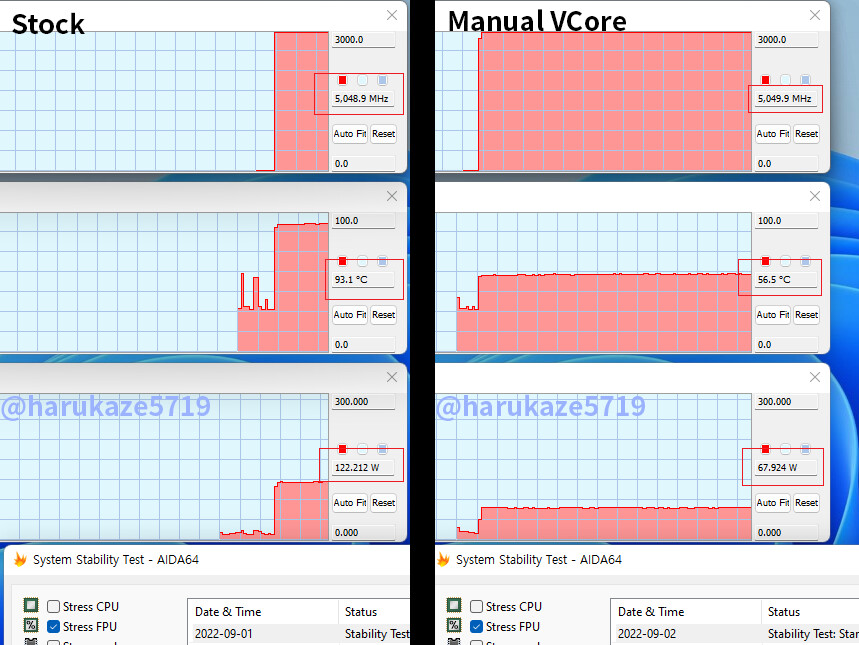
AMD Ryzen 7000 "Zen 4" processors can hit up to 95 °C at stock settings, with cooling most appropriate to the TDP level. This is because the PPT (package power tracking) limits for the 170 W TDP processors is as high as 230 W, and for the 105 W TDP models, it's 130 W. After reaching this temperature threshold, the processor begins to downclock itself to lower temperatures. Harukaze5719 discovered that higher than needed core voltages could be at play, and manually undervolting the processors could free up significant thermal headroom, letting the processors hold on to higher boost multipliers better.
Source:
harukaze5719 (Twitter)
101 Comments on AMD Ryzen 7000 Undervolting Yields Great Results with Temperatures
That being said, what appears to be going on is, that tester has a high bin chip, and therefore can undervolt pretty significantly.
Some mobo brands do it to make their boards look better(stable?) while others do it to enable higher clocks out of the box for corresponding CPU's which go in there.
What happens when the reviews come out and im correct, will you come back and apologize - admit you are the troll here?
And think that's reasonable.
After reviews are released and some Verified facts appear, Then a reasonable discussion could be had, I say could, but given your tone and general output it's not likely.
Anyways, the discussion started with his claims that Intel is pushing power consumption, when it's the exact opposite, amd is the one pushing it, and in a big way. So, deal with it.Anyone can say anything, but unless supported by some data - he can equally be just laughed out of the room. Any data for your claim? Cause up till now, ald > zen 3 in gaming efficiency and performance.
If you really believe that intel can beat 5nm efficiency, you should laugh at yourself.
Another variable is that when your competitor uses more power consumption to advance performance, which Intel has done over the last few generations, you eventually have no choice but to raise your own, or pull off a miracle design that can perform without that power. It’s just not out there—this is leading edge engineering, and there’s no low-fruit left to pick. If we were still talking 95W caps, the landscape would look quite different.
I’m sure that, should you wish, you can cap Zen4 to 95W and still see performance gains over previous generations, but it’s not the game anyone is playing in the industry anymore. Considering the existing and looming energy struggles, it’s a peculiar thing these companies are chasing. In California is asking folks not to charge EVs in the evening during a heat wave, it seems silly to have a 1kW gaming rig running instead. I’m not necessarily against consumption, mind you, but the grid doesn’t seem like it’s becoming more accommodating of high-consumption electronics—it’s going the other way!
By the way, how 12600k will be more efficient than 7600x when it is not even more efficient than 5600x
But arguing with fans is so tiring. Ill leave you to it man
Congratulations, you are the most clueless person in the thread!
And yeah, it makes sense that a 60% increase in power will lead to a <60% increase in performance. That's a given.
Do you realise that you comparing two different architectures on different nodes? Imagine even on same power the new architecture will have better performance/watt.
This is the last time when I lose time with you. Welcome to my block list
And again wrong, I disagree on who started pushing power first this decade, or are we looking back all the way to FX.
There is no actual VCore adjustment shown, just the "wattage difference", which obviously equates to a temperature difference.
There's no way a Ryzen 7000, any of them, will get to 93c at stock, as long as the cooler used is appropriate.
Period.
Makes sense not, then I read ES/QS.
Oh.
You can easily stay on BIOS updates before the windows 11 changes, manually enable TPM and secureboot and be problem free
You have to see this, and everything will be clear to you. Check out AMD fx-8370, fx-8350, fx-8320 at Cpu World. "Boosted p States", "Low power P states". After that, look for the fx-8370E. Same processor but TDP 95Watt vs 125Watt. Anyone who doesn't understand what this is about is crazy :)