Friday, March 3rd 2023

LG Display Claims Samsung's QD OLED More Susceptible to Screen Burn Than LG's WOLED
Welcome to the battle of the Korean OLED display makers, where LG Display is now claiming that Samsung's new-ish QD OLED displays are far more susceptible to screen burn, compared to its own WOLED displays. In a way, this is LG getting back at Samsung, as the latter has criticised LG for quite some time, over screen burn on its OLED displays, despite the fact that Samsung hasn't had any of its own OLED products until last year. LG Display is basing much of its claims on testing by Rtings, which isn't yet publicly available, but the company also has a technical explanation behind it all.
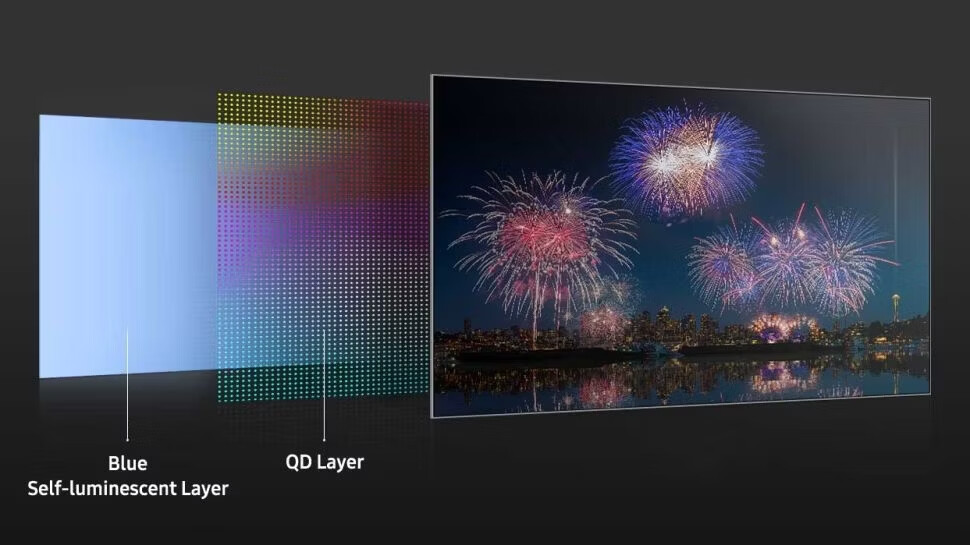
Both LG's and Samsung's OLED panels are based around RGB subpixels, just like most LCD panels, with the difference being that OLED panels don't have a backlight, as the pixels themselves are supposed to emit the light. However, RGB subpixels on larger screens tend to lack in brightness and this is why LG added white subpixels to its WOLED panels, which was also a source of criticism from Samsung. However, Samsung's QD OLED displays use a blue OLED layer behind a Quantum Dot layer, which is meant to produce a brighter image than LG's WOLED panels. LG now claims that because Samsung went down the path of using pure RGB subpixels, each subpixel is subjected to a lot more stress on static images than its own WOLED design, which in turn causes screen burn. LG Display did apparently not go into much more details than that at the online press conference the company had called last week, so we'll have to wait and see what Rtings reveals in its next update on its long term testing, which is supposed to take place sometime this month.
Update Mar 3rd 15:08 UTC: Rtings reached out to us and explained that they didn't provide any data to LG Display. Instead, LG Display based its assumptions on photos posted by Rtings on its website. Rtings provided the following statement:
Sources:
Forbes, Rtings
Both LG's and Samsung's OLED panels are based around RGB subpixels, just like most LCD panels, with the difference being that OLED panels don't have a backlight, as the pixels themselves are supposed to emit the light. However, RGB subpixels on larger screens tend to lack in brightness and this is why LG added white subpixels to its WOLED panels, which was also a source of criticism from Samsung. However, Samsung's QD OLED displays use a blue OLED layer behind a Quantum Dot layer, which is meant to produce a brighter image than LG's WOLED panels. LG now claims that because Samsung went down the path of using pure RGB subpixels, each subpixel is subjected to a lot more stress on static images than its own WOLED design, which in turn causes screen burn. LG Display did apparently not go into much more details than that at the online press conference the company had called last week, so we'll have to wait and see what Rtings reveals in its next update on its long term testing, which is supposed to take place sometime this month.
Update Mar 3rd 15:08 UTC: Rtings reached out to us and explained that they didn't provide any data to LG Display. Instead, LG Display based its assumptions on photos posted by Rtings on its website. Rtings provided the following statement:
We didn't send any information to LG Display. We published our two-month data and pictures in two waves on February 6th and 16th. It appears LG took these images from our reviews when they were released publicly.
Further to that point, LG Display also did not reach out to us prior to their press call where they referenced our test and images.
125 Comments on LG Display Claims Samsung's QD OLED More Susceptible to Screen Burn Than LG's WOLED
The only worry would have is that in the old days blue OLED's had a far shorter life than red or green oleds. I presume that issue has been fixed.
I may consider sticking with EIZO after all and skip OLED.I guess brightness also plays a role?
I use my current monitor at 50 CD/m², which translates to about 18% for that monitor.
Generally I like to run my monitors at 100-120 cd/m², for the LG C2 I currently use this is somewhere between 25-30 OLED Light setting. Thinking of turning it down a little because enabled ABL does sometimes kick in but it seems on the precipice of not having to kick in. Haven't used the C2 long enough to draw conclusions on burn-in yet though :)
9to5mac.com/2023/01/15/apple-micro-led-switch-mac-iphone-ipad/
Glad I just bought a C2... :)
Faith in Samsung Display was already at rock bottom after AMOLED retention & their VA panels all suffering from uniformity and bleed issues / shoddy build quality. To be honest I have yet to see a Samsung implementation that withstood the test of time. Its all overpromise underdeliver. And here we are again... QD-OLED is... surprise surprise, more of the same.
do you go and sit in a dark room to watch a movie, if no get FALD and be able to watch tv in a bright living room
What remains to be seen and is in question is if the current implementation by samsung is indeed better as they claimed in the past or if they failed to realise the potentials of the technology as LG now claims
Its obviously about the assumption that WOLED is more susceptible to retention 'because its brighter'... which is based on nothing that I have seen other than 'feels like that'.
Meanwhile RTings shows the polar opposite. You can see obvious color deviation, and always to a greater degree after 1200 hour longevity tests with WOLED en QD OLED side by side. It also shows that QD OLED can reach higher brightness levels / Samsung tweaks towards higher brightness rather than deeper blacks.
You can see obvious burn in on QD OLED's screen, check the lower 20% of the screen.
It also shows up on blue field. And that's 2 months in.
The thing is, burn-in is an umbrella term for several types of wear and if LG focus on high-contrast wear of only white logos, they're biased. Because coloured logos will cause a different type of burn-in on LG's WOLED that Samsung's QD-OLED will be far more resistant to. If they don't acknowledge that then they're just biased liars.
At any rate, I'm still avoiding OLED for monitors until we get a native RGB OLED stripe. The fringing of text from non-standard subpixel layouts is a nightmare for text legibility and whilst that *should* be something you can fix in software via the OS or graphics driver, but it's not currently fixed so until then we're still reliant on vertical rectangular RGB subpixels from left to right to work with Cleartype.
Whether uneven wear is a bigger problem for Samsung's QD OLED will be important to uncover though.It's because OLEDs don't have burn-in. As long as you avoid one region showing significantly brighter content over time, then you should have no issue, regardless of how static the content is. If you however often have a bright white bar at the top of a laptop or phone screen, then you will get uneven wear, even if it's never there for hours at the time, because it has nothing to do with being static or not.
But it's worth being said that pretty much every LCD screen is very uneven too(unless you're talking about premium screens from EIZO or NEC), much more uneven than an OLED screen will be after many years. There is really not much reason for concern with normal use, and an OLED's uneven wear can be corrected too; just watch more varied content and the problem will fade away.
Also, many LCDs do have some kind of image retention too.You should expect them to last only a few years, and pay accordingly. There is no point in buying an overpriced TV, there is no correlation between what you pay and how long it lasts (as long as it's a good brand). This is why I bought the outgoing model from LG last year at nearly half price.
One of the advantages of OLEDs is that even the "cheap" ones are pretty good too, way better than any LCD.
Data I obtained from the technical assistance that works with several brands. Sony's failure ratio to these other brands is something like 1/10. 3 TVs in trash within 5 years while an almost 7 year old sony still going strong despite recently appearing a row of dead pixels. :')
To be honest I've been thinking about replacing the TV partially with a decent laser projector, at least it has many years of warranty.
4K is useless. It high cost. Demanding for computers. Expensive to stream movie service. National TV is in full HD.
But that's just the (uniformed) engineer in me, we'll just have to wait and see.
Another issue though is it also has bleed-through to neighboring pixels on single pixel light tests.
How much that matters is debatable, but it certainly does not happen on WOLED.