Wednesday, August 19th 2026

LG Display Unveils FLiPP, Next-Generation OLED Technology
LG Display, the world's leading innovator of display technologies, announced today that it has successfully developed a dream OLED patterning method that is free from the conventional fine metal mask (FMM) process, using its own proprietary technology. Its groundbreaking FMM-less method delivers much greater flexibility in mass production as well as brighter panels with longer lifespan and lower power consumption.
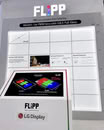
The company will unveil FLiPP (FMM-Less innovative Pixel Patterning) for the first time in the world at the International Meeting on Information Display (IMID) 2026 in Busan, where LG Display will host a dedicated exhibition hall for three days from Aug. 19.
 Compared with panels produced using FMMs under identical conditions, FLiPP enables displays to increase brightness by 1.6 times, extend lifespan by 2.4 times, and reduce power consumption by 13%. This is because FLiPP improves the aperture ratio—the proportion of the total display area occupied by RGB pixels—by approximately 55%.
The FMM method adds to manufacturing costs as expensive new FMMs must be produced whenever the panel size or resolution changes. In addition, due to the inherent properties of metal, large masks tend to sag in the center under their own weight, causing misalignment and sometimes resulting in color-mixing defects.
FLiPP eliminates the disadvantages associated with the metal plates used in the FMM process that has been the mainstream OLED manufacturing method for over a decade. The FMM process requires large mother glass substrates, such as 8.6th-generation or other 8th-generation (2,200 × 2,500 mm) substrates, to be divided and processed as half-cut substrates due to the limited size of FMM sticks.
After a year of concentrated R&D, LG Display came up with FLiPP as a new OLED manufacturing paradigm. Unlike the FMM method, which may be compared to a stencil art technique where red, green, and blue (RGB) organic materials are evaporated through tiny holes in metal plates, FLiPP coats RGB pixels in order, secures them in precise positions, and incorporates photolithography—employing precision UV light etching to erase unnecessary areas during OLED pixel patterning.
Leveraging its existing large-sized Tandem WOLED production infrastructure and technical expertise, FLiPP has allowed LG Display to become the first display company to manufacture FMM-less OLEDs using 8.5th-generation mother glass as a single whole piece. Compared to the production of OLED laptop panels of the same size made using FMMs or other FMM-less methods that require divided substrates, FLiPP delivers up to 64% higher mother glass utilization efficiency. As a result, less substrate material is wasted and FLiPP directly translates into higher productivity and lower manufacturing costs.
As the world's only FMM-less manufacturing process for 8.5th-generation OLED panels, LG Display has filed trademark applications for FLiPP in Korea and key global markets.
The company is strengthening its OLED technology leadership by combining RGB OLED, widely regarded as the most advanced OLED technology available today, with FLiPP, its next-generation innovative manufacturing process, to maximize production flexibility and efficiency.
One of FLiPP's greatest advantages is that it is free from panel size and resolution constraints. In theory, it can be used to produce displays ranging from 1 inch to 100 inches and can be applied not only to conventional panels but also to VR and AR displays, making it a virtually universal, "ultimate technology."
Starting with IT applications such as tablets and monitors, it will expand its range of FLiPP-manufactured panels to cover a range of products from 1-inch wearable devices to ultra-large TVs—tailoring products to customer needs.
Source:
LG Display
The company will unveil FLiPP (FMM-Less innovative Pixel Patterning) for the first time in the world at the International Meeting on Information Display (IMID) 2026 in Busan, where LG Display will host a dedicated exhibition hall for three days from Aug. 19.


The FMM method adds to manufacturing costs as expensive new FMMs must be produced whenever the panel size or resolution changes. In addition, due to the inherent properties of metal, large masks tend to sag in the center under their own weight, causing misalignment and sometimes resulting in color-mixing defects.
FLiPP eliminates the disadvantages associated with the metal plates used in the FMM process that has been the mainstream OLED manufacturing method for over a decade. The FMM process requires large mother glass substrates, such as 8.6th-generation or other 8th-generation (2,200 × 2,500 mm) substrates, to be divided and processed as half-cut substrates due to the limited size of FMM sticks.
After a year of concentrated R&D, LG Display came up with FLiPP as a new OLED manufacturing paradigm. Unlike the FMM method, which may be compared to a stencil art technique where red, green, and blue (RGB) organic materials are evaporated through tiny holes in metal plates, FLiPP coats RGB pixels in order, secures them in precise positions, and incorporates photolithography—employing precision UV light etching to erase unnecessary areas during OLED pixel patterning.
Leveraging its existing large-sized Tandem WOLED production infrastructure and technical expertise, FLiPP has allowed LG Display to become the first display company to manufacture FMM-less OLEDs using 8.5th-generation mother glass as a single whole piece. Compared to the production of OLED laptop panels of the same size made using FMMs or other FMM-less methods that require divided substrates, FLiPP delivers up to 64% higher mother glass utilization efficiency. As a result, less substrate material is wasted and FLiPP directly translates into higher productivity and lower manufacturing costs.
As the world's only FMM-less manufacturing process for 8.5th-generation OLED panels, LG Display has filed trademark applications for FLiPP in Korea and key global markets.
The company is strengthening its OLED technology leadership by combining RGB OLED, widely regarded as the most advanced OLED technology available today, with FLiPP, its next-generation innovative manufacturing process, to maximize production flexibility and efficiency.
One of FLiPP's greatest advantages is that it is free from panel size and resolution constraints. In theory, it can be used to produce displays ranging from 1 inch to 100 inches and can be applied not only to conventional panels but also to VR and AR displays, making it a virtually universal, "ultimate technology."
Starting with IT applications such as tablets and monitors, it will expand its range of FLiPP-manufactured panels to cover a range of products from 1-inch wearable devices to ultra-large TVs—tailoring products to customer needs.
"We were able to successfully realize FLiPP, a next-generation OLED patterning technology referred to as a 'dream technology,' by bringing together our proprietary WOLED technologies and know-how," said Choi Young-seok, CTO at LG Display. "Through our participation in IMID, we will lead next-generation OLED technologies and accelerate market differentiation."Meanwhile, LG Display's next-generation OLED TV panel driving technology, Hyper Double Scanning (HDS), has been recognized for its technological excellence by winning the IMID "Display of the Year Award." The award is presented to the most outstanding product among those commercialized each year. LG Display is currently mass-producing its entire lineup of OLED TV panels with HDS and plans to continue leading the global premium TV panel market.
21 Comments on LG Display Unveils FLiPP, Next-Generation OLED Technology
In a few years they have become much cheaper and faster.
It's just static elements vs watching more diverse contents I think
Max SDR brightness for my screen (32" 4K QD-OLED Gen 3) is about 265 nits. It's noticeably dimmer than my 12 year old SDR LCD which reaches 350 nits. Also, although my monitor is rated for 1000 nits HDR, that's limited by 1) a miniscule 2% window, and 2) PQ curve and gamma problems. So I generally run it at True Black 400, which peaks at only 400 nits. Your TVs might reach 4,000 nits, for comparison.
The other is of course the very nature of computer monitor displaying mostly static elements, if it is really used as a primary display, doing actual work on it etc. Using it solely for gaming or content consumption isn’t really reflecting how most of the people use their monitors.