Sunday, November 8th 2026
Dead Pixels Creep In Along the Edges of Older WOLED TVs, RTINGS Finds
Fourteen of the 16 WOLED TVs in RTINGS' 18,000-hour accelerated longevity test developed what the outlet calls "edge rot," meaning dead pixels and other damage creeping in along the panel edges. All of these sets use LG Display panels and were released between 2020 and 2023, and the test works out to roughly ten years of typical U.S. viewing. Older WBC panels fared worst, with nine of ten affected and five rated severe, while five of six newer WBE panels also showed it. Only the LG A2 and LG G3 came out clean. Meanwhile, the three QD-OLED TVs in the test, Samsung's S95B and S95C and Sony's A95K, didn't have a single dead pixel. However, RTINGS says three units are too few to call QD-OLED immune.
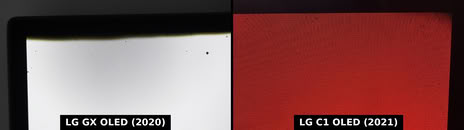
Unlike burn-in, edge rot doesn't depend on what you watch, so the usual advice of mixing up content won't help. RTINGS suspects contamination during manufacturing or flaws in the encapsulation layer that keeps moisture out, though confirming that would need proper failure analysis. Two staffers also found it on their own LG GX and C1 at home. In a statement to RTINGS, LG said the issue may appear in a very small number of products under prolonged heat, humidity or other harsh conditions, and isn't expected in normal use, which is interesting given that LG Display once argued QD-OLED was more prone to burn-in. RTINGS now rates WOLEDs slightly lower for expected reliability, including newer models as a precaution, though it still considers OLEDs more durable than LCDs. Its next planned test includes 2025 and 2026 models, some with LG's RGB Tandem panels, which should show if it's been fixed.

Sources:
RTINGS, via Videocardz
Unlike burn-in, edge rot doesn't depend on what you watch, so the usual advice of mixing up content won't help. RTINGS suspects contamination during manufacturing or flaws in the encapsulation layer that keeps moisture out, though confirming that would need proper failure analysis. Two staffers also found it on their own LG GX and C1 at home. In a statement to RTINGS, LG said the issue may appear in a very small number of products under prolonged heat, humidity or other harsh conditions, and isn't expected in normal use, which is interesting given that LG Display once argued QD-OLED was more prone to burn-in. RTINGS now rates WOLEDs slightly lower for expected reliability, including newer models as a precaution, though it still considers OLEDs more durable than LCDs. Its next planned test includes 2025 and 2026 models, some with LG's RGB Tandem panels, which should show if it's been fixed.


78 Comments on Dead Pixels Creep In Along the Edges of Older WOLED TVs, RTINGS Finds
The TikTok interface has caused screen burn-in; now, a "ghost" image of the TikTok UI is visible on the home screen.
IPS panels are the best.
So far I'm sticking with my $150 thrift-store-find Sony X930D. 10 years old and its VA panel still looks great.
I do not care for under normal use whataboutism statement of LG. I have a single green pixel which forced me to replace screens.
It was occasionally mildly annoying when I was still trying to use it as an oversized monitor, but is
virtuallyimpossible to see when watching or playing something at a reasonable distance 🤷🏻♂️Even if it ended up being a bit too large to use as a monitor, I still regret nothing.
OLED FTW!
These displays should be lasting 8-10 years of normal use as LCD's usually do.
Organic Light Emitting Diods require organic layers, which degrade with time and use.
Newer panels are significantly more robust, but they will all eventually degrade.
Other displays can also degrade over time, but if properly designed, they can usually last significantly longer.
What I am really looking forward to are μLED displays.
Once they shrink a bit further, and can be reliably and inexpensively manufactured, they have the potential to be a good bit better than OLED.