Friday, February 28th 2025

AMD RDNA 4 and Radeon RX 9070 Series Unveiled: $549 & $599
AMD today unveiled the highly-anticipated AMD RDNA 4 graphics architecture with the launch of the AMD Radeon RX 9070 XT and RX 9070 graphics cards as a part of the Radeon RX 9000 Series. The new graphics cards feature 16 GB of memory and extensive improvements designed for high-quality gaming graphics, including re-vamped raytracing accelerators and powerful AI accelerators for ultra-fast, cutting-edge performance, and breakthrough gaming experiences.
In a YouTube livestream, David McAfee, CVP and GM, Ryzen CPU and Radeon Graphics AMD, was joined by Andrej Zdravkovic, SVP of GPU Technologies and Engineering and Chief Software Officer, AMD, as well as Andy Pomianowski, CVP of Silicon Design Engineering, AMD, to discuss the outstanding performance and value proposition of the Radeon RX 9000 Series. In a related event in Zhuhai, China, Jack Huynh, SVP of the Client and Graphics Group, AMD, led a regional event for the new products. Huynh was joined by David Wang, SVP of GPU Technology and Engineering, AMD, and Lanzhi Wang, Senior Director of Product Management, AMD. The celebration was also marked by a customer celebration with Darren Grasby, EVP and Chief Sales Officer, AMD; Spencer Pan, President of AMD China, and partners including ASRock, ASUS, Gigabyte, Sapphire, Tul, Vastarmor, Veston, and XFX.
 "Today, we're thrilled to unveil the AMD Radeon RX 9000 Series, a significant leap forward in graphics performance powered by our next-generation AMD RDNA 4 architecture," said McAfee. "These GPUs are designed to meet the demands of today's games, delivering enthusiast-class gaming experiences to gamers everywhere, while ready to support tomorrow's innovations. Through the power of advanced AI and Raytracing accelerators, we're not just improving frame rates - we're fundamentally enhancing the gaming experience. Offering incredible performance, AI-powered features, and next-gen display support at competitive price points, the Radeon RX 9000 Series delivers exceptional value for gamers looking to upgrade their systems."
The RX 9000 Series, powered by the new AMD RDNA 4 architecture, offers gamers and creators a powerful blend of performance, visuals, and value. These advanced graphics cards redefine incredibly fast, high-resolution gaming with third-generation ray tracing technology enabling realistic lighting, shadows, and reflections to deliver immersive gaming experiences while integrating a suite of AMD features to maximize hardware utilization. Beyond gaming, the RX 9000 Series GPUs leverage new second-generation AI accelerators with up to 8x INT8 throughput per AI accelerator (for sparse matrices) to enhance creative applications and effectively run generative AI applications (vs. RDNA 3). The RX 9000 Series GPUs also implement the newly redesigned AMD Radiance Display Engine & Enhanced Media Engine for broad display support and elevated quality in both recording and streaming.
Gaming For Today and Tomorrow
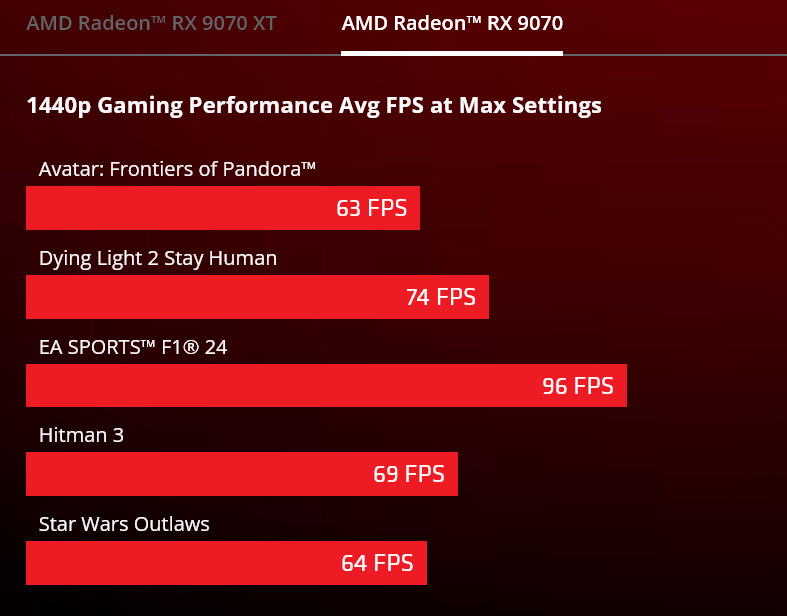
The Radeon RX 9000 Series unlocks new levels of performance while delivering a suite of new and enhanced features that improve the gaming experience. The Radeon RX 9070 Series offers 16 GB of GDDR6 memory, allowing gamers to render the most exciting games of today and tomorrow at max settings. Compared to the previous generation RX 7900 GRE, the latest AMD Radeon RX 9070 is able to deliver over 20% more performance on average when gaming at 1440, with the AMD Radeon RX 9070 XT extending that lead to over 40% on average.
 Both graphics cards make smart upgrades for gamers looking to future-proof their systems with a suite of next-gen features that will keep their experiences feeling fresh for years to come. Key features include:
AMD Radeon RX 9000 Series graphics cards are expected to be available from leading board partners including Acer, ASRock, ASUS, Gigabyte, PowerColor, Sapphire, Vastarmor, XFX and Yeston beginning March 6th, 2025. The AMD Radeon RX 9070 XT has an SEP of $599 USD, while the AMD Radeon RX 9070 has an SEP of $549 USD.
Source:
AMD
In a YouTube livestream, David McAfee, CVP and GM, Ryzen CPU and Radeon Graphics AMD, was joined by Andrej Zdravkovic, SVP of GPU Technologies and Engineering and Chief Software Officer, AMD, as well as Andy Pomianowski, CVP of Silicon Design Engineering, AMD, to discuss the outstanding performance and value proposition of the Radeon RX 9000 Series. In a related event in Zhuhai, China, Jack Huynh, SVP of the Client and Graphics Group, AMD, led a regional event for the new products. Huynh was joined by David Wang, SVP of GPU Technology and Engineering, AMD, and Lanzhi Wang, Senior Director of Product Management, AMD. The celebration was also marked by a customer celebration with Darren Grasby, EVP and Chief Sales Officer, AMD; Spencer Pan, President of AMD China, and partners including ASRock, ASUS, Gigabyte, Sapphire, Tul, Vastarmor, Veston, and XFX.


The RX 9000 Series, powered by the new AMD RDNA 4 architecture, offers gamers and creators a powerful blend of performance, visuals, and value. These advanced graphics cards redefine incredibly fast, high-resolution gaming with third-generation ray tracing technology enabling realistic lighting, shadows, and reflections to deliver immersive gaming experiences while integrating a suite of AMD features to maximize hardware utilization. Beyond gaming, the RX 9000 Series GPUs leverage new second-generation AI accelerators with up to 8x INT8 throughput per AI accelerator (for sparse matrices) to enhance creative applications and effectively run generative AI applications (vs. RDNA 3). The RX 9000 Series GPUs also implement the newly redesigned AMD Radiance Display Engine & Enhanced Media Engine for broad display support and elevated quality in both recording and streaming.
Gaming For Today and Tomorrow
The Radeon RX 9000 Series unlocks new levels of performance while delivering a suite of new and enhanced features that improve the gaming experience. The Radeon RX 9070 Series offers 16 GB of GDDR6 memory, allowing gamers to render the most exciting games of today and tomorrow at max settings. Compared to the previous generation RX 7900 GRE, the latest AMD Radeon RX 9070 is able to deliver over 20% more performance on average when gaming at 1440, with the AMD Radeon RX 9070 XT extending that lead to over 40% on average.

- Unified AMD RDNA 4 Compute Units - Features up to 64 advanced AMD RDNA 4 compute units delivering up to 40% higher gaming performance than the previous-generation AMD RDNA 3 architecture.
- High-Performance Raytracing - With 3rd generation Raytracing Accelerators, AMD RDNA 4 is able to deliver over 2x the Raytracing throughput per compute unit when compared to our previous generation. Gamers with the latest AMD Radeon RX 9000 Series are ready for immersive gaming experiences with high-quality graphics, including realistic lighting, shadows, and reflections.
- Supercharged AI Acceleration - 2nd Generation AI Accelerators received several enhancements, allowing AMD RDNA 4 to efficiently process advanced AI models much faster than what was possible with RDNA 3,4 through a combination of additional math pipelines for AI calculations, expanding the capabilities of the AI
- Accelerator to support new emerging data types such as FP8, and support for inference optimization techniques such as structured sparsity. These changes deliver up to 8x INT8 throughput per AI accelerator (for sparse matrices) per compute unit vs the previous generation.
- AMD FidelityFX Super Resolution Technology 4 (FSR 4) - AMD's new cutting-edge ML-powered upscaling technology delivers high-quality boosted frames under even the most demanding workloads, such as 4K gaming with maximum ray tracing settings and will be supported in over 30 games at launch.
- Innovative suite of features through HYPR-RX - Gamers can instantly improve their experience by activating AMD HYPR-RX and the suite of features within AMD Software, including AMD Radeon Super Resolution, AMD Fluid Motion Frames 2.1, AMD Radeon Anti-Lag, and AMD Radeon Boost. These features can all be tailored to gamers' hardware and preferences within AMD Software: Adrenalin Edition to drive increased FPS, responsiveness and efficiency.
- AI-Enhanced AMD Software: Adrenalin Edition Application - A new suite of software and resources designed to deliver an industry-leading AI user experience with AMD Radeon RX 9070 Series graphics cards. Keep your drivers and AI software up to date with the new Software Manager. Find the answers to your questions about all things AMD or create free and private text and images with AMD Chat. Discover, download and install new and exciting AMD-partnered AI applications with the App Portal, and leverage AI to improve software quality with the AMD Image Inspector.
- Ready for Next-Generation Displays - AMD Radiance Display Engine supports the latest DisplayPort 2.1a and HDMI 2.1b connections, enabling ultra-high resolutions and refresh rates up to 8K 144 Hz, with 12-bit HDR and full REC2020 Color Space for incredible color accuracy. Paired with AMD FreeSync technology, gamers can enjoy tear-free, stutter-free gaming experiences on over 4000 compatible displays, including upcoming 4K 240 Hz and 8K 144 Hz DisplayPort 2.1 monitors.
- Available exclusively on AMD Radeon RX 9000 Series graphics cards, AMD Software: Adrenalin Edition adds a new easy-to-use AMD FidelityFX Super Resolution 4 (AMD FSR 4) Upgrade feature that helps maximize performance at maximum quality in over 30 games at launch, with 75 coming later this year. AMD FSR 4 delivers a substantial image quality improvement over AMD FSR 3.1 upscaling, with the new ML-based algorithm helping to improve temporal stability, better preserve detail, and reduce ghosting.
- Utilizing features already built into the AMD FidelityFX API added when game developers integrate AMD FSR 3.1 into their games, AMD FSR 4 enables an easy upgrade for supported FSR 3.1 games and can be combined with existing in-game AMD FSR 3.1 advanced frame-generation and AMD Radeon Anti-Lag 2 for ultra-smooth, ultra-responsive gaming at incredible frame rates on AMD Radeon RX 9070 Series graphics cards.
- The new ML-accelerated AMD FSR 4 upscaling algorithm is trained using high-quality ground truth game data on AMD Instinct Accelerators and uses the hardware-accelerated FP8 Wave Matrix Multiply Accumulate (WMMA) feature of the AMD RDNA 4 architecture to ensure maximum upscaling quality while still providing a substantial game performance boost.
- AMD Radeon RX 9070 XT
- 64 Compute Units
- 16 GB GDDR6
- 2.4 Game Clock (GHz)
- Up to 3.0 Boost Clock (GHz)
- 256-bit Memory Interface
- 64 MB Infinity Cache
- 304 W TBP
- $599 Price (USD SEP)
- AMD Radeon RX 9070
- 56 Compute Units
- 16 GB GDDR6
- 2.1 Game Clock (GHz)
- Up to 2.5 Boost Clock (GHz)
- 256-bit Memory Interface
- 64 MB Infinity Cache
- 220 W TBP
- $549 Price (USD SEP)
AMD Radeon RX 9000 Series graphics cards are expected to be available from leading board partners including Acer, ASRock, ASUS, Gigabyte, PowerColor, Sapphire, Vastarmor, XFX and Yeston beginning March 6th, 2025. The AMD Radeon RX 9070 XT has an SEP of $599 USD, while the AMD Radeon RX 9070 has an SEP of $549 USD.
260 Comments on AMD RDNA 4 and Radeon RX 9070 Series Unveiled: $549 & $599
Even then the system doesn't always work because AAA studios can afford the bribes:
Anyone giving Starfield a 10/10 at launch needs to be blacklisted. It was a mess at launch and possibly the most mediocre, bland, unexciting, and generic piece of disappointment from Bethesda in 20 years. After Skyrim and Fallout you have to wonder what happened to the talent that made those games because it sure as hell wasn't working for Todd Howard any more!
rocm.docs.amd.com/projects/install-on-linux/en/latest/reference/system-requirements.html
With some fiddling it does work on older models too. E.g. my 6800m.
"Does AMD not want the 9070 to sell?" No they don't. That is why it is priced badly. AMD didn't accidently price it badly on accident.
They do not want to take functional N48 Dies and artificially cut them down to sell a lower margin product. They do not want people waiting on 9070 stock to come in and then buying the 5070 because NV can outproduce AMD any day of the week. They don't want people waiting on 9070 to restock instead of just buying a 9070XT. They don't want people that might buy their high margin 150mm2 N44 $399 9060XT to "buy up" to their lower margin cut 9070 part.
It is not a failure on their part. Informed purchasers make up a very small part of the market. Most people will check the brand first, price second, and then buy what makes the most sense to them.
7800xt and 7900 GRE: nVIDIA feature parity editions*.
*Now with 10-15% higher price bc of that thing.
Just remember these cards when 128-bit cards launch on 3nm. Remember 5080 16GB (or a higher-end N48) when 18GB 192-bit cards launch. Remember 4090 when 256-bit cards launch.
What we expect of typical low-end pricing (~$300?), mid-range (~$450-550?), and higher-end ($750-1000?)
Ask yourself how quickly you want to be on that train, and what tier is acceptable to you long-term. The glaring bummer is 5080 16GB (which would be fine with 24GB), and really anything below 9070xt.
1080pRT/1440p up-scaled FSR/DLSS, 1080p->4k FSR/DLSS, 1440p->4k FSR/DLSS. Below that is really only okay long-term for 1080p raster, the middle preferred for 1440p(->4k) raster, the top 4k raster.
Whatever cards exist above that are for native 4kRT, but I honestly question what that is worth to people, as I think 'quality' 4k up-scaling is fine. 4k requires a shitload more perf, and perf/IQ trade isn't worth it imho.
Any of the other steps make sense, though.
9070xt is the bottom.
There is no mid (PS6), because the 5080 too little ram, n48 maybe too little raster. There are different cards for different uses (including 7900xtx), but nothing is *perfect*.
There is 4090 that will do the thing on the high-end.
That's all I'm sayin'. Think about that.
Long-term and how this will 'trickle down' as RT hits mainstream. I know many of you say you don't use FSR/DLSS, bc most things you play (right now are purely) raster, but YOU WILL...oh, you will.
One of these cards are likely DOA and the other comes out as the real winner. Flip a coin because I couldn't tell you which one either.
7900GRE: 650 usd MSRP.
Hence, AMD chose the most balanced price of 599 usd - neither you nor us, exactly in the middle, right?
www.techspot.com/review/2812-amd-radeon-7900-gre-retest/You can buy components somewhere without VAT? Or do you have 8,(3)% VAT?
We know that RT is improved significantly and remember most of the RT games are optimized specifically for Nvidia, Cyberpunk 2077 is essentially a Nvidia tech demo! So RT optimized for all GPU's would likely put the 9000 series on par with Nvidia's latest 5000 series in terms of RT performance! So that is a big win for AMD, even if RT ends up being 10% slower on the 9000 series, it is still 23% cheaper from the $750 MSRP of the 5070ti and over 45% cheaper than the actual $950 prices.
So FSR4 being close to or equal to DLSS4, very close, equal or even faster than Nvidia in RT, impressive new media engine with quality improvements to streaming, decoding and encoding, same power consumption to their competition and even lower in the case of the 5070 vanilla, all that for $150 less than MSRP 5070ti is a huge deal and remember in reality $350-400 cheaper than most 5070ti right now!
If it delivers solid 1080p60 H.264 at unreasonably low 6K bitrates I won't need an Intel/nvidia card in the rack, just a capture card.
Does it screw with load balancing plans and offloading jobs to a separate computer? Yes. Is this a better problem to have? No idea.
the sellers of off-the-shelf PCs have tonnes of them on.... guess what components?
Plus a senior sales manager, who is always pushing salespeople to sell Intel+Nvidia bundles because of bonuses, and warehouses, as i said, are full of this hardware.
And yea, you're right, probably the overwhelming majority of those, who come to a ready-made PC shop for a PC have never read a single article about hardware in their entire lives -
but i still don't think, that's the main reason.
No worries, I'll defo get a 9070 XT now. :)
People buying 12GB card for $500+ in 2025 deserve it.
PS
It is curious how TSMC capacity booking really works and how quickly one could react.
Of course it would depend on the node.Tell me other "non main reason" why full tier sower (slower even at RT) power hungry and more expensive 3050 outsold 6600 four to one please.
Specifically, try to make it "because better product". That was the point I was responding to.
Reality is: Huang can shovel anything down the throat of, cough, let me call it "the market", no matter what.
And that is why "buh market share, so the product must be better" argument is at best dumb, at worst dishonest.
However, what makes everyone think that the scalping AIBs and actual scalpers will let these GPUs be purchased at this mythical thing called "MSRP?" AMD will have no FE cards.
Looked on the shelves, or online stores? There is a "shortage" expect these to sell out quickly and only a few will snag them for the actual MSRP.
Our online retailers adjusted prices within the hour of the launch to astronomical heights when it came to the 5000 series.
I fear a lot of people are going to be disappointed.
I hope I am wrong though.
No burn connections is nice indeed.
Besides, rumor says that AMD has been stocking up on 9070 series cards since January, so with a bit of luck, it'll all be fine. If not immediately, then within a month or so, definitely.
I bought an RX 6800 a couple of years ago after contemplating a 4070. I wasn't convinced that I should spend 200$ more for DLSS and ray-tracing. Instead, I bought a card with the same raster performance at 60% of the cost (with more VRAM). NVIDIA has failed to convince me again. I can't justify a 5070 Ti when a 9070 XT exists.
Now that RDNA 4 will compete a lot better against DLSS and ray-tracing, does it make any sense to pay a premium for NVIDIA's features? AMD also claimed to have improved their AI and creator tools, so at what point is NVIDIA no longer worth their tax? I never bought into it, but a lot of people seem genuinely hooked on something like DLSS.
The average consumer can't differentiate between models. While we understand the difference between XT and non XT, the average consumer in front of various model names, wouldn't notice that XT. I mean, can someone without knowledge understand that RX 9070 XT White Flame, for example, is better than RX 9070 Ultra Duper Super Amazing Immortal edition, that is also sold in a bigger more colorfull cardboard box? I think not and the fact that both cards come with 16GB of VRAM and both cards are called 9070 will make them look equal to the eyes of most people lacking tech knowledge.We could be facing another situation where XT was coming with a price tag of $649 and non XT with a price tag of $549. Those $100 difference could be driving us to the non XT version.
Personally I prefer $599 and $549 than $649 and $549.
It seems that who ever runs Radeon today, has more brains than the one running Radeon when 7000 series came out. Also the one making desisions of what the RDNA4 architecture should offer, seems to be smarter than the one making desitions about RDNA3 architecture.