Wednesday, July 30th 2025

AMD Now "World's Fastest" in Nearly all Processor Form-factors
AMD announced that it is now world's fastest in nearly all CPU form-factors. The company took Gold and Silver places in the latest Top500 supercomputers list, driven by a combination of 4th Gen EPYC "Genoa" CPUs and Instinct MI300A AI GPUs. It also has the world's most powerful AI PC processor with the Ryzen AI Max "Strix Halo" processor. With AMD enabling OEMs to combine the chip with up to 96 GB of unified 256-bit LPDDR5X memory, "Strix Halo" is the only PC processor capable of accelerating 128B-parameter AI models locally.
AMD has the world's fastest desktop processor for both gaming and productivity in the Ryzen 9 9950X3D "Granite Ridge-X", which is significantly faster than the Intel Core Ultra 9 285K in both gaming and productivity. It also has the world's fastest processor for laptops with the Ryzen 9 9955HX3D "Fire Range-X," which is essentially a mobile-friendly BGA package of the 9950X3D. With their high core counts, higher memory channel and PCIe lane counts, 5th Gen EPYC "Turin" processors dominate the server space in performance per socket. Ryzen semi-custom chips dominate gaming consoles. Ryzen Threadripper 9000 "Shimada Peak" is the undisputed king of HEDT and workstation processors. Perhaps the only form-factors AMD isn't dominating are mobile processors in the U- and H-segments, with the "Strix Point" silicon falling behind "Arrow Lake-U" and "Arrow Lake-H" in CPU performance.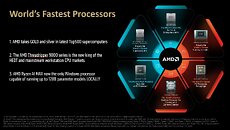
AMD has the world's fastest desktop processor for both gaming and productivity in the Ryzen 9 9950X3D "Granite Ridge-X", which is significantly faster than the Intel Core Ultra 9 285K in both gaming and productivity. It also has the world's fastest processor for laptops with the Ryzen 9 9955HX3D "Fire Range-X," which is essentially a mobile-friendly BGA package of the 9950X3D. With their high core counts, higher memory channel and PCIe lane counts, 5th Gen EPYC "Turin" processors dominate the server space in performance per socket. Ryzen semi-custom chips dominate gaming consoles. Ryzen Threadripper 9000 "Shimada Peak" is the undisputed king of HEDT and workstation processors. Perhaps the only form-factors AMD isn't dominating are mobile processors in the U- and H-segments, with the "Strix Point" silicon falling behind "Arrow Lake-U" and "Arrow Lake-H" in CPU performance.

70 Comments on AMD Now "World's Fastest" in Nearly all Processor Form-factors
Yes, I said essentially the same thing 3 times intentionally, which is to ensure that the article writer understands without any question. I did that because of how annoying it is, since there are computers out right now with 128GB of 8,000MT LPDDR5x RAM, which these writers have actually reviewed or written about.
Zen came out in 2016 and has been slowly iterating - there was no M processors and no ARM on windows -- they're both here and in a very short time they've been able to close the gap. M3 Ultra consumes
the same 200W that the 9950X3D and smashes it in multithreaded workloads. I'm not a fan of the "We're so great!!!11!!" marketing.
The 96GB limit is due to the total allocatable memory on the GTT, even if you set the "fixed" GPU VRAM to be 512MB.
In 2025, it turns out that even 6 big cores is still absolutely fine for entry desktop, and especially fine for gaming. In one of my systems there is 7600X, which is only around 9% slower in gaming on average than 9800X3D in 1440p and only 4% slower in 4K. Nothing wrong with 6 core CPUs. I bought it for $180 last year.You don't smear or try to discredit other members in order to make a point. You will first need to show respect to members if you are ever to be taken seriously for any technical point you want to make. It is you who brings Apple here and you are challenged for it. Stick to Apple guns and defend it on merit. In other words, be decent and show some basic class in arguing points you want to defend rather than gossiping about members working for this or that company.
I've made my point: AMD is losing the race in performance per/W badly, they're getting caught by ARM and have already lost to Apple - that's why their marketing slide reads "On Windows". Now their largest competitor, who decimated them on the graphics space, is entering with their own unified memory offering in the CPU space... While AMD is doing victory laps.
Apple made huge advancements since 2020, when they finally left Intel and released their own chips. There's no doubt about it. They have other serious issues in their closed ecosystem, such as not having on offer any DIY platform whatsoever despite being a super rich company, but that's not the topic of this thread.
You will need to be very, very careful as to which SKUs you compare and why, in order to make sense. M3 Ultra features 32 CPU cores and 80 GPU cores. It doesn't come as a socketed processor that can be exchanged or upgraded at any point of time. It cames in very expensive, preconfigured systems. That's the first thing to think about before making performance comparisons.
Secondly, as I said, M3 Ultra can be compared to a number of x86 processors, for different purposes. If you want a 'smashing' MT comparison, why don't you compare it to 9970X for this purpose? It's 32 cores against 32 cores, after all. Sure, it's faster than 9950X3D in MT, but it's also ridiculously more expensive, so what's the point here? X3D chips are miles better in gaming, but no one sane would compare it for that purpose to M3 Ultra. Those are different classes of CPUs, for different segments and platforms.I don't, indeed. In this case, I merely reminded you that this is a tech forum and not a gossip tabloid to tell members that they work for marketing.This is already better, something we can work with. Let's breakdown your claims, there's a lot to unpack here, as you are lumping things together, which is not helpful.
1. Performance per W is a broad category across many workloads. Let's take gamimg into consideration. You will need to show an evidence that Apple chips are faster in gaming per Watt. Have you got such evidence of fps per Watt?
2. Also, what is the price we need to pay for each frame to make it valuable, affordable and good experience? Now you have a chance to argue based on numbers.
3. Marketing dep is right to point out Windows, as vast majority of client CPUs work on Windows by default. Apple has nothing to offer natively on Windows, so there's that too. Plus, x86 CPUs work on Linux too, so there's OS flexibility for users. On the other hand, ARM on Windows still has several deep wrinkles to iron out. It's work in progress and Qualcomm has been badly burned by the experience, as you probably already know.
4. Let's not forget the elephant in the room, which is latest nodes Apple devices have a privilege to use 12-15 months before others. There's a price to pay for this and we see super expensive configurations of top M4 Max decices, selling over whopping $5,000. There's that too. Strix Halo devices are twice as cheaper in top config.
5. AMD is doing fine on N5 derivatives and on N3 for Turin Dense. They have managed to increase market share in recent years in every single segment of the industy. Next year, they will release CPUs on N3 and N2 nodes, which will be way more efficient due to node jump, have new Infinity Fabric already working really well in Strix Halo APU, and make further dent across segments. Next generation of Zen6 devices is predicted to be a significant leap on multiple fronts of design, performance uplift and efficiency. Zen5 devices mostly mentioned in this article are just a flavour of things to come.
6. Apple doesn't offer chiplet-based solutions, apart from fused monolithic Ultra chips. They are yet to show us technological courage and venture into disaggregated architectures. I am patiently waiting to see such CPU design one day. On this front, they are yet to show us new achievements.
7. ARM CPUs have become increasingly more competitive over the years and that's fine. Apple has carved out its niche in client segment, which is great, but they don't know where to go from there. They hover around 10% of market share and it's not moving in any significant direction. Clearly, they have some serious work to do in order to come up with products that would bring them another 5%. It will take them years to get there and a lot of innovation in diversifying their offer.
8. Will ARM CPU designers ever dare to offer a DIY platform to desktop consumers? What is stopping them from opening up their insulated systems so that users could comfortably upgrade components, like they do on Intel and AMD platforms? Apple, Qualcomm and Nvidia do not show any courage to venture into DIY market. They think that all-in-one systems are good enough, even if so called "desktop" devices are actually not DIY platforms. This is still 25-27% of entire PC market they don't dare competing in on equal terms.
9. AMD's largest competitor in graphics space, Nvidia, is not the topic of this thread, as Nvidia has still not fully developed a competitive CPU part for this segment. Nvidia has nothing to offer at the moment in Strix Halo segment at similar price to performance point. Check out the price of any Digits system and you will see what I mean.
So, no. There's not much evidence that AMD is losing anything significant in CPU space. It's quite opposite, as a matter of fact. They are as strong as they have ever been in CPU space, pushing for more, including rumoured ARM design, to further diversify heir offer.Irrelevant. This basic configuration comes with ridiculously low storage at 512GB and paltry 36GB of RAM. Absolute nonsense for 2K. Every next 512GB of SSD is whopping $200. And this is what is really tragicomic about Apple devices. 4TB SSD configuration will add whopping $1,200 to Studio bill, whereas one can buy 4TB SSD for any PC for as little as $230, FIVE times cheaper. Apple will bankrupt you for any decent amount of storage and more RAM. The most consumer unfriendly company in the world in relation to storage and lack of upgradeability.
People used to absolutely trash Intel for having high prices when competition was low. Now we have people wishing their demise. You really don't want that. X3D chips are incredibly expensive for what they are.
On the other hand, I don't think it's beneficial for AMD to claim the fastest processors in the consumer and laptop categories. Intel has paid a lot of attention to energy consumption in recent generations (e.g., Lunar Lake). Additionally, the productivity benchmarks of X3D chips don't often outperform their competitors.
Starting with the budget AMD gaming laptop CPUs known as Ryzen 5 3550H and Ryzen 7 3750H, they just had from Ryzen the name.
They were both 4c/8t CPUs based on Zen+ and as such, they inherited all the flaws from this architecture, in addition for the Ryzen 7 to be more expensive just for being named Ryzen 7, and the differences with his "little brother" was a 200MHz overclock and a slightly more powerful iGPU.
They also were just able to compete vs. Intel's mid-range high-performance laptop CPUs at best (9th gen, likely the i5 9300H). I bought a Ryzen 5 3550H + GTX 1650 Laptop back in 2019 (which had a fan die once in 2023 that I replaced, and another one died just few days ago), and the only improvement I got over my old i5 7300HQ + GTX 960M laptop bought in 2017 was 2x GPU performance. CPU performance in single-threaded tasks was the same as my 2y/o laptop back then, and this old laptop ran on DDR4-2133! (at least, my iGPU could match or beat this 960M :laugh: ). This Ryzen CPU was also among the hottest CPUs I've used ever.
Ryzen 5000 Laptop cut corners vs. Intel 11th gen on both PCIe lanes and PCIe generation, both performed the same and AMD was cheaper only because of these cut corners. The real deal was to get a Ryzen 4000 Laptop series CPU because Intel's 10th gen laptop CPUs were disappointing, but these were extremely rare on lots of regional markets.
Ryzen 7000 Laptop is a hot mess with its naming scheme, and by the time they arrived, AMD had fortified its position on the desktop market and allowed themselves to price most people out of the market for no reason. That's one of the reasons why there are tons of Ryzen 7000-based laptops still selling as brand new with insanely low prices today, because they couldn't sell them all since 2023.
We should also not forget the fact most Ryzen 7000 laptop CPUs are just rebranded Ryzen 5000 and 6000, and Ryzen 6000 is just Ryzen 5000 on DDR5 and saw no performance uplift for whatever reason.
Ryzen 8000 Laptop is (somehow) a sidegrade/downgrade vs. Ryzen 7000 in the mid-range, unless you get a Zen 5 based CPU but I haven't seen any of these hit the market in significant amounts yet, and I did learn about their high-end parts just few days ago.
Ryzen 9000 Laptop (and Ryzen AI) is mostly high-end only, and unaffordable for most consumers (on equal GPU performance) compared to even an i7 14700HX/i9 14900HX + 4080 laptop which is still pretty expensive, so it tells a lot of things. The few low end Ryzen AI (and/or Zen 5 non-AI) chips mostly ended up being put in expensive multimedia laptops, and it's too early to tell anything about their market penetration.
AMD's main issue right now on the laptop side is their marketing. They're targeting specific markets that they think "big" enough, even if they must sacrifice a whole geographic market, leading to them not being present even in Europe (except Germany and maybe Netherlands, I know lots of french hardware enthusiats order there). The price is also another factor for anything they release brand new (even the rebrands). They also need to communicate better with some manufacturers, as some of them (especially HP and Lenovo) barely receive BIOS and microcode updates for Ryzen-based laptops from AMD for whatever reason. From experience, the AMD fTPM issue was never fixed on Lenovo Legion laptops from 2021.
I hope they don't do that -- I would really like to see unified memory on the desktop.
A 9800x3d 9070 GPU chiplet combo with 64GB/128GB unified memory at 256bit feels like a blind spot at the moment.
9800X3D=550$ (from where I am at its almost 650$) just the processor alone..
Facts!!
The need for a Z790 motherboard and DDR5 8000 ram to make an arrow lake CPU perform well drives up the cost significantly.
What OS is used there? Windows for x86 and ARM, Windows for x86 and Android for ARM, or only Android for x86 and ARM?
If you look at that top 500 list, you will see that the AMD systems have many more CPUs and are much more power hungry. So, not apples to apples comparison with the smaller supercomputers in the list that can achieve more with less.
There are a dozen of X3D chips across three different generations, at different price points, as a stand-alone CPU and in different deals with other components.