Thursday, September 25th 2025

Early Benchmarks Reveal Impressive Snapdragon 8 Elite Gen 5 Gaming Performance
Qualcomm only just unveiled the new Snapdragon 8 Elite Gen 5 as its latest flagship mobile SoC, and although there were early Geekbench results presented at the Snapdragon Summit event, the first real-world performance figures are starting to emerge, courtesy of the as-yet unreleased OnePlus 15. These tests, carried out by Geekerwan on YouTube mostly center around the Adreno 840 GPU in the Snapdragon 8 Elite Gen 5, which is meant to deliver marked performance improvements, thanks to the inclusion of Snapdragon HPM (High Performance Memory) cache and updated GPU architecture. It's also important to note that these performance results won't necessarily be representative of results on other smartphones, since thermal management is a big determining factor for smartphone performance, especially when it comes to gaming and sustained workloads. The OnePlus device in question is also running pre-release drivers and firmware, so it's possible that more optimizations and performance gains are coming.
The YouTuber tested the Snapdragon 8 Elite Gen 5 across five different games (Honkai: Impact 3rd, Wuthering Waves, Honor of Kings, and Delta Force) and compared it to an iPhone 17 Pro Max and a MediaTek Dimensity 9500. The results are rather impressive, as the new Snapdragon SoC manages to keep up with the Apple A19 Pro in the iPhone 17 Pro Max for the most part. He also performed his own Geekbench 6 tests and found that the results presented on Qualcomm's test devices at the Snapdragon Summit were representative of retail devices, with the OnePlus 15 scoring 12,352 points in the multicore benchmark and 3,836 in single-core tests.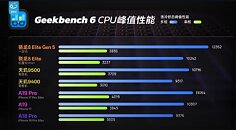
Test results for the Snapdragon 8 Elite Gen 5:
Check out the full suite of tests in the video below:
Source:
Geekerwan on YouTube
The YouTuber tested the Snapdragon 8 Elite Gen 5 across five different games (Honkai: Impact 3rd, Wuthering Waves, Honor of Kings, and Delta Force) and compared it to an iPhone 17 Pro Max and a MediaTek Dimensity 9500. The results are rather impressive, as the new Snapdragon SoC manages to keep up with the Apple A19 Pro in the iPhone 17 Pro Max for the most part. He also performed his own Geekbench 6 tests and found that the results presented on Qualcomm's test devices at the Snapdragon Summit were representative of retail devices, with the OnePlus 15 scoring 12,352 points in the multicore benchmark and 3,836 in single-core tests.

- Honkai Impact 3rd: 59.60 FPS (1680 × 770), 36 FPS 1% lows, 5.88 W; 59.4 FPS (2160 × 991), 28.2 FPS 1% lows, 7.33 W
- Wuthering Waves: 59.8 FPS, 29.3 FPS 1% lows, 5.13 W
- Honor of Kings: 119.9 FPS (FPS limiter hit), 119.0 FPS 1% lows, 3.47 W
- Delta Force: 164.9 FPS, 148.8 FPS 1% lows, 4.7 W
Check out the full suite of tests in the video below:
21 Comments on Early Benchmarks Reveal Impressive Snapdragon 8 Elite Gen 5 Gaming Performance
wccftech.com/snapdragon-8-elite-gen-5-beats-a19-pro-to-become-fastest-mobile-cpu-in-multi-core-workloads/
It's using 61% more power on single-core tests while posting essentially the same score.
The Snapdragon SoC is beating the A19 Pro on multi-core, again with greater power draw. It is also doing it with two more cores than the A19 Pro (which has 2 performance cores, 4 efficiency cores). From a performance-per-watt metric, the A19 Pro is considerably ahead of the Snapdragon 8 Elite Gen 5 with an even larger lead over the Dimensity 9500 part.
Personally for real world usage, I'd rather have the SoC that is more power efficient. The SoCs in today's premium smartphones are powerful enough to handle even the most demanding workflows. Good battery life ultimately benefits more users than a benchmark high score.
This is the same with cellular network download speeds. The top-tier cellular modems feature peak performance that no consumer will ever see in real world usage: performance is carrier limited. Again, the best Qualcomm part is a bit faster than Apple's C1X modem. But Apple's is something like 30% more power efficient. Even if I'm streaming 4K video I'm nowhere near saturating the pipe. The Qualcomm modem does have mmWave and sub-6GHz frequency support that the Apple modem currently lacks but again these are two additional network features that only come into play in limited situations and in limited locations.
Frankly I'd rather have a phone that with cellular and wifi chips that use less power. I really don't care if that big app store download takes 100 seconds versus 85 seconds.
And there's no way for some tester to put in some other graphics library that isn't being used anyhow. Testing with actual games is the more relevant methodology. Doing otherwise would be like testing a Honda Accord with tires made from compounds that only Formula One teams have access to. If OpenGL ES is the standard on Android, that should be part of the test because that is what Joe Consumer is going to be. Apple deprecated OpenGL years ago in favor of Metal so the latter is what should be tested on Apple devices BECAUSE THAT'S WHAT IS ON CONSUMER PHONES RUNNING CONSUMER GAMES.
Only card carrying dorkwads care about that stuff anyhow. Joe Consumer only cares about how well the game runs. They don't give a rat's arse about what graphics library is behind it all, what version compiler was used, or what conductivity rating the applied thermal paste has.
And we are talking about smartphones here. Joe Consumer really has three main priorities for smartphones: cameras, display, and battery. (And price obviously.) Probably less than 0.1% of consumers are going to select their phone based on gaming benchmarks.
People do all sorts of things on their PCs, not just play games. You're confusing PCs with consoles.
I have a $150 mini PC running Windows 11 Pro for ordinary desktop stuff. There's a better machine for a little heavier lifting (Studio drivers on that build). There's a notebook PC that isn't used for gaming at all; in fact it just collects dust unless I plan on getting on an airplane. The gaming PCs don't have all that other cloud crap, office productivity suites, notifications up the wazoo, maps, weather, news, etc.
There are plenty of people here who pick graphics cards based on how well it will play games, not how well it will open a Microsoft Excel spreadsheet. In fact, there is a whole section in this Q&A forum about graphics cards and something like 98% of the discussion is how they work/relate to games (like "how do I get more FPS").
Let's remember that the thread topic is about smartphones though. With a phone purchase, there are limited graphics options.
But hey we're here to entertain.
:D
Of course, this chip won't be seen on anything lower than $1200 Android flagships. Still, it may mark a trend change.
Let's face it, certain types of games are more suited for the small touchscreens on smartphones. The users are often on the go and don't have long stretches of time for uninterrupted gaming sessions. Your train station/subway stop is coming up in 13 minutes and you can't tell the train to slow down or spend an extra three minutes on the platform until you finish that level.
And what percentage of smartphone owners are rocking that $1400 flagship smartphone with the top-tier SoC? And how many of them bought it for gaming?
Let's face it, the iPhone 17 Pro Max isn't intended primarily for gamers. It's intended for professional videographers who were using $20K Red ONE digicams back in 2007 and think a $2K pocketable smartphone with ProRes RAW and genlock support in 2025 is a game changer. And it is good enough where they don't have to open up that other gearbag right now (the one with the fancy Sony/Canon), what they have in their hand will do the job.
If most of the games you see in the app store or running on some kid's phone next to you at Target are gacha crap, it's because that's what those kids want. And they probably aren't rocking that $1400 flagship Samsung Galaxy.
the xiaomi 15 is still going for ~€700
And it's not like you have much in the way of competition, especially from Google. Their Tensor G5 chips on the Pixel 10 phones have bitterly disappointing performance figures, the Geekbench single-core scores place it at the same level as the A12. MediaTek looking far too good from this angle.It's Vulkan now, but not that this matters. The problem with Android is Android itself, and it'll never change unless the developers sever backwards compatibility with everything that has made Android what it is since the early 2010's.I question the lucidity of anyone spending that much money on an Android phone other than maybe the Sony and Samsung uppermost tier phones (Xperia 1, S Ultra, Z Fold, etc.)
For me, prioritized well above the performance of the SoC comes build quality, security, support, reliability, and battery life. I would say about 50% of the Android phones I see in use or for sale I'd classify as disposable junk, but you'll never see that in a review. There are maybe 3 brands I'd look into, Samsung, Sony, Google. But my default would almost certainly be Google Pixel - entirely due to standard Android builds with faster, better, more trustworthy support and security.
Please try to keep up here. Thank you.
Remember that this is one benchmark run by one person on a non-statistically significant sample size of parts. And some of these tests were done on non-retail devices.
I'm guessing that Samsung will sell more Snapdragon 8 Elite Gen 5 devices than Apple will sell A19 Pro devices. But volume unit sales doesn't mean they are better.
Does Joe Consumer run benchmarks? NO. Smartphones have a wide variety of usages. Ultimately Joe Consumer prioritizes three features above all others: cameras, display and battery. Joe Consumer doesn't care about Geekbench scores. Only dorkwads do. Because having the fastest SoC isn't going to make watching TikTok videos or doomscrolling through social media apps any better.
Nor does Geekbench measure anything regarding AI functionality which is where much of this going. And that's why smartphone SoC designers are putting in a lot of ML cores into their silicon in 2025.
And besides, it's not like anyone can tell their smartphone "just run at 12.5W". Hell, I don't even think I can do that with my gaming PC.
Again, this appears to be yet another example of how detached some technologists are from reality.
add a battery screen memories... and you will be well over $400