Tuesday, October 21st 2025

Almost Nobody Uses Paid Third-Party Antivirus: TechPowerUp Frontpage Poll
Almost nobody cares about third-party antivirus applications, much less pay for them, a surprising set of TechPowerUp Frontpage Poll results show. There was a time when you couldn't have a reliable PC experience without a solid third-party antivirus software, paying protection money each year for subscription to updates. Then Microsoft decided to significantly up the ante with endpoint security. It began with Windows Defender, a free antivirus that's part of Windows that you used if you had nothing else. Over the years, Microsoft hardened Windows with features such as Malware Removal Tool, Secure Boot, BitLocker, TPM-based root of trust, and Virtualization-based Security, which ran the whole user-space in a secure enclave, as a virtual machine, which couldn't let malware break its host. All these mean that endpoints are safer than ever, and this reflects in our poll results. Our poll had a total of 34,316 responses.
A comfortable majority of 60.5% voted for Windows Defender as their AV software of choice. A small but not insignificant percentage of 15.7% says that it has no antivirus software installed whatsoever, which is difficult if not impossible as Windows runs Defender in some limited form. A combined 24% of the responses say they use third-party AV software. The biggest choice is "Other," which includes brands not covered in the poll. A good share of these could include Kaspersky. 6.1% of the total responses say they use Bitdefender. This is followed by Avast at a surprisingly low 2.9% given that it has a free version; and an even more surprising 1% for AVG. Among the known paid-only applications, Bitdefender is followed by Norton at 1.9%, and McAfee at 0.7%.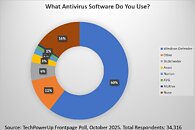
A comfortable majority of 60.5% voted for Windows Defender as their AV software of choice. A small but not insignificant percentage of 15.7% says that it has no antivirus software installed whatsoever, which is difficult if not impossible as Windows runs Defender in some limited form. A combined 24% of the responses say they use third-party AV software. The biggest choice is "Other," which includes brands not covered in the poll. A good share of these could include Kaspersky. 6.1% of the total responses say they use Bitdefender. This is followed by Avast at a surprisingly low 2.9% given that it has a free version; and an even more surprising 1% for AVG. Among the known paid-only applications, Bitdefender is followed by Norton at 1.9%, and McAfee at 0.7%.

70 Comments on Almost Nobody Uses Paid Third-Party Antivirus: TechPowerUp Frontpage Poll
Personally, I think the poll tracks with the history of these apps as well as the improvement of Defender and Windows (as well as built-in browser improvements). If you followed the effectiveness of each software whenever they're tested against each other, AVG and Avast surpassed the likes of Norton many years ago for security and effectiveness and were hugely popular for their free versions. That said, over the last decade or so (roughly), they started getting really bloated and full of advertisements and pop-ups for their paid versions, as well as using more resources to run, which gamers do not like. That led to more dispersion to the likes of Bitdefender, Malwarebytes, Panda, etc. in hopes of a lighter, but still robust and effective tool. I followed that path myself, but now, much like the majority of the polled, just use Defender.
Also, side note, one of my favorites was always Spybot Search and Destroy and I've recovered several friends' and family members' computers with that tool because you could run it from a USB drive on the infected computer that may or may not be so bad it can't download or install programs anymore. I don't think it's been active or needed for quite a while. It's certainly been many years since I've used it.
Having a browser with built in protection and the use of ad blockers is what keeps most people from getting malware.
For me though, I've given up on third party AV software since that Ars article on them like 10 years ago. There were two points in that whole thing that drove the nail deep:
- Mozilla noted that AV software can force applications to ASLR-disabled DLLs and other such libraries because that's how AV software supposedly can detect if software is misbehaving. So basically, AV software is actively making my computer less secure.
- There was a comment that said Microsoft has a reason to actually clean up malware: because it protects one of their primary products.
And the solution if I think I have malware? I just nuke the Windows install. I only need 30 minutes to get back up and I feel it's much better than spending a day trying to clean it up and hope it's gone.I use a stand alone 3rd party Firewall that blocks things m$ firewall does not, like windows update. Its very basic and does not tracking or reporting but it works well until you leave it in auto learn mode for too long.
I have used in one form or another, security software on my computers... But i have to count on the fingers of my hand the times i did got any malware...
The reason? I have carefully protected all my open points (disk drives, pens, and even sites, emails, etc...).
But i have to agree that the browser are way more robust and secure then ever! And that is the first line of defense... I don´t press EVERY LINK i see and i hover the mouse over it to see if what is being displayed is the same link that i will be pressing...
Today 90% of the solutions are good, no need to get the most expensive one...
Best Regards,
LPC
Someone got it from the Internet for whatever reason
Came to school with an infected USB drive and plugged it into one of the school computers, none of which had antivirus software
Worm spreads because stupid Windows XP Autorun settings
So, I come home with something from school and the AV finds out my USB drive is infected.
Windows defender is also a poor option, since it consistently ranks amongst the worst in tests after tests.
Also viruses and malware can come through mail, through java code, through downloads, through clicking on a link, through infected website or zombie website. So people might think they are safe and have no malware on their computer, when in fact its full of it and is stealing your info and data.
Ublock origin is the best antivirus, given how many infections are drive by attacks from compromised ad servers. Death to ads.Malwarebytes is an anti malware service, not antivirus. While there is overlap Malwarebytes is looking for different things then, say, avast or AVG.
Even back in the day it was common sense as a tech to have malwarebytes run on any Pc brought in for viruses, because malware was almost never detected by antivirus tools.Boomer, learn how to browse without putting your info in every tect box you see. And stop clicking "download now" on every page!
Defender frequently places among the best of antivirus software. Its all the same definitions anyway.
Personally, I've been using ESET for the last 15 years (Internet Security for my PC and Mobile Security for my smartphone). ESET products are outright overwhelming for normal users so what I generally recommend to others is Kaspersky Free. And yes I know all about the CEO's KGB-sponsored training and the close ties with the FSB and all the rest of the BS. I don't care. If you're an ukranian in a trench shooting at russians and you ask me for an AV to install in your laptop I'd still recommend Kaspersky to you. IYKYK.
EDIT: almost forgot about Panda AV. Tried it at different points int time, never liked it, never used it for more than a week at a time.
Of course it is different when you are a company and want to use on purpose windows 11. Than you are using not only a virus scanner but other software which slow down the hardware massively for basic O365 use.That stuff was quite common in my days. W95, W98, W2000, and before days. My cut was with Windows Vista. Windows XP also was very frindly in pass on such stuff when sharing data with others.
The shift has moved towards www-clients and www-client related actions. I did read about some guys having their whole C: locked wiht some nice software and can look at their encrypted data without a key or no possible key at all. According to different news items on different webpages in past years.
edit: Fixed a bit grammer by discussing wiht ai. not 100%.
It assumes only Windows Users could vote and tries it explain the results with various Microsoft technologies. But Linux and Mac user could vote as well.
The best anti-virus technologies are browser warnings against known bad sites either by the browser itself or by ad blockers.
Another major reason for not using anti-virus anymore is changed user behavior. For example Steam sales & streaming sites made piracy far less common so most people have no reason to visit shady sites anymore.
I do have malwarebytes, but I bought it way back for $40? when it was a lifetime license.
With kids, if there was something better than defender for $25/yr or less for 5 PC's I would consider it, but most of them here are $50/yr and a pig on resources.
ChatGPT, Grok, DeepSeek, Gemini, Apple Intelligence, Samsung AI, Mistral/Le Chat, Proton/Lumo, Locally run LLMs and including of course an "I don't' use AI" option
I think when it comes to a/v there is lots of things that come into my mind.
Using unsupported API's.
Can lower security in the way they operate, your ASLR example is one way of that, another one I read about is a/v operates at the highest privilege level, it ran malware through some kind of container operating at highest privilege level and that led to an infection worse than it would have been with no a/v as it was higher than standard admin elevation.
There is typically a visible performance hit.
There can be operational breakage.
It can lower security protocols, browser interception can lead to MITM certificate being used, which breaks the principle of end to end encryption, and has been known on occasion to end up with downgraded ciphers and handshaking being used.
An increased reliance on using the cloud for the best protections, which they have ultimately eventually led down to the path of authorised whitelisted binaries, of which you do not need an a/v for.
Maybe of them now unable to scan email attachments in discrete email clients.
Pricing models so expensive, it might be cheaper to just pay a ransomware fee, except for ransomware, its a "maybe", whilst for the a/v subscription its an assured fee for using it. Paying someone to slow down your PC, potentially break protocols, potentially break OS updates.
I dont think Defender is perfect, but if there is an a/v to be enabled, thats the clear choice.
In my case, even if ransomware gets installed on my computer, the worst it'll set me back is a week.