Monday, December 8th 2025

NVIDIA "Dawn & Dusk" Demo Rig Unearthed, GeForce FX 5950 Ultra Extracted Long Ago
A member of the PC Master Race (PCMR) subreddit has dusted off ancient NVIDIA demonstration hardware. A small handful of photos were accompanied by a short history lesson. Inclusive_3Dprinting described past and present circumstances in a late week post: "I took this home from work around 2005. It has a looping demo of Dawn and Dusk, and a few others. It currently has a 7800 AGP inside it, but I still have the original FX5950 Ultra. For some reason, the card has a brass I/O plate, and a brass top rail decoration." Presumably the "7800 AGP" refers to one of Team Green's GeForce 7800 GS-series graphics card models, of 2006 vintage.
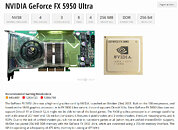
Around 2002, the power of NVIDIA's GeForce FX 5950 Ultra card—paired with DirectX 9—was harnessed during a twin sister fantasy fairy-themed "Dawn and Dusk" looped realtime showcase (preserved on Archive.org). According to TechPowerUp's GPU database, the demonstration rig's original dual-slot card is based on an NV38 GPU (featuring "Rankine" architecture). Spec highlights include a 130 nm TSMC node process, 475 MHz GPU clock, 256 MB of DDR memory, and a 256-bit bus interface. So far, PCMR commenters have shared nostalgia-tinged feedback—mostly honing in on NVIDIA's original fairy mascot: Dawn.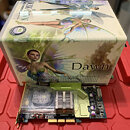
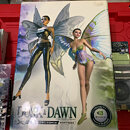

 The Hypernl YouTube channel has preserved footage of the Dawn and Dusk demo. Described as: "Dawn ushered in the dawn of cinematic shading with the introduction of the NVIDIA GeForce FX family of GPUs. Now, her twin sister Dusk shows us what's possible with a GeForce FX 5900 GPU. An urban, moonlit street is Dusk's stage as she relaxes to music overheard outside a nightclub. She dances to the beat, beckoning the attention of her nocturnal friends of the forest, who join her briefly before flitting off into the night."
Key Features:
Sources:
PC Master Race Subreddit, VideoCardz, GameGPU, Archive.org, PCGH.de
Around 2002, the power of NVIDIA's GeForce FX 5950 Ultra card—paired with DirectX 9—was harnessed during a twin sister fantasy fairy-themed "Dawn and Dusk" looped realtime showcase (preserved on Archive.org). According to TechPowerUp's GPU database, the demonstration rig's original dual-slot card is based on an NV38 GPU (featuring "Rankine" architecture). Spec highlights include a 130 nm TSMC node process, 475 MHz GPU clock, 256 MB of DDR memory, and a 256-bit bus interface. So far, PCMR commenters have shared nostalgia-tinged feedback—mostly honing in on NVIDIA's original fairy mascot: Dawn.


Key Features:
- Realistic Skin: Dusk's skin is a custom fragment shader that includes shadowing, diffuse and specular color, bump, and a simple subsurface scattering effect.
- Realistic Hair: Her hair is comprised entirely of geometry and is only possible due to the high-performance vertex shaders of the GeForce FX 5900 GPUs. Together, vertex and fragment shaders allow for an anisotropic lighting model, resulting in extremely realistic hair.
26 Comments on NVIDIA "Dawn & Dusk" Demo Rig Unearthed, GeForce FX 5950 Ultra Extracted Long Ago
Like for instance I learned early on that tessellation was pretty much overhyped. Not because it didn't make things look nicer, but you didn't need to move the sliders all that far before it looked dumb or did little to add to the detail (and then I learned later that sub-quad triangles are painful for GPUs to render).
Raster rendering can avoid these shortcuts, but then performance starts to tank. And if you're going to be tanking performance anyway, you may as well use ray tracing. Or as Anandtech put it, if you're going to spend all this effort cheating, you may as well just do the thing correctly.
FX got their ass kicked. Esp when running into DX9 which caused huge performance drop(s). It would be better to force HL2 on DX8.
Heck for years Geoforms was my screen saver, and you bet that still goes hard on an OLED!
This is from 2002 and it wasn't until Subnautica ~16 years after that we had an "underwater scene" with anywhere near this level of fidelity in a game
The ATI Radeon 9500 (softmodded) and 9700 Pros (9800 Pro is a waste of money) were the kings of that era. It was only until the 6800 GT came out that NVIDIA was able to compete again, although the X850 XT did give fierce competition.
We probably still ran them anyway and gushed over how nice it looked. I know I did even on my crappy FX 5600.
On a side note: I don't think you'd ever find an engine dev who can't -and didn't in some toy project or another- write their own physics system. One cannot overestimate how much of nerds these guys are... Here's an exercise: open Github, search for "game engine," count how many repos there are. :kookoo:That's pretty much the end game.
Loved that Nvidia was able to make fun of themselves with that card.
dustbuster??