Friday, January 9th 2026

New GPU Startup Bolt Graphics Promises 2.5x Path Tracing Performance of RTX 5090

Bolt Graphics is a new computer graphics hardware startup based out of Sunnyvale, California. This company wants to shake things up in the consumer graphics hardware market with a brand-new, grounds-up graphics architecture for graphics rendering, gaming, and HPC. What makes this startup unique and refreshing is that its architecture, or at least the marketing material of it, doesn't use the most uttered two-letter acronym in human history.

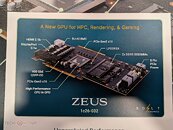
Called ZEUS by Bolt Graphics, the architecture offers a contemporary raster 3D graphics, ray tracing, and path tracing hardware pipeline, using an in-house designed SIMD architecture that's controlled by a RISC-V command processor that doubles up as a CPU. The prototype graphics card features a PCI-Express 5.0 x16 host interface, and LPDDR5X as its graphics memory, with additional DDR5 SODIMM slots for the RISC-V command processor. Together, the board can have up to 384 GB of memory to deal with large data sets. The card also features a 400 Gbps or 800 Gbps enterprise network interface, and a fully-fledged BMC/IPMI circuit on board, so you can manage large clusters of the card in a rackmount render server or workstation. The most surprising aspect of the card is power, and it only features an 8-pin PCIe power input, for a total of 225 W of power draw.
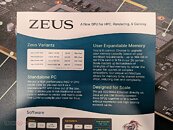
Besides hardware, Bolt Graphics is offering a fully-fledged software that that includes Vulkan and DirectX 12 interfaces, including support for Unreal Engine and Unity. Applications for the architecture support all modern programming environments. Bolt innovated a path tracing pipeline.

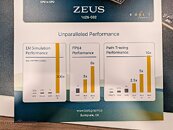
Bolt Graphics has made some astoundingly tall performance claims that indicate an ASIC-like approach towards popular use-cases, using fixed-function hardware. In FP64 EM simulation benchmarks, the Zeus 4C is claimed to offer 300 times the performance of an NVIDIA B200 "Blackwell." In another FP64 math benchmark, the Zeus 1C (single silicon) is shown offering 3 times the performance of a GeForce RTX 5090. Perhaps the most fascinating claim is path tracing performance, and here, a Zeus 1C is claimed to offer 2.5 times the path tracing performance of an RTX 5090, 5 times with 2C, and 10 times with 4C.

The part about Bolt Graphics marketing that caught our eye is their claim that the Zeus 1C is "the fastest graphics processor ever," made possible due to a fundamental reimagining of conventional graphics processing workflows.
Add your own comment

114 Comments on New GPU Startup Bolt Graphics Promises 2.5x Path Tracing Performance of RTX 5090

#51
lexluthermiester
cfentonI'm not saying it's impossible
You're implying it without any merit whatsoever.
EndymioGroq grew to a $20B valuation, Cerebras to $9B, and Cambricon to nearly $100 billion -- all in just the last decade.
This and more.
Posted on Reply
#52
Broken Processor
I'll take it as a grain of salt until they release a product until then it's just words.
Posted on Reply
#54
Patriot
Broken ProcessorI'll take it as a grain of salt until they release a product until then it's just words.
quite fair, the roadmap doesn't show silicon made till Q3 of this year so all of this is simulated performance.
Posted on Reply
#55
notoperable
If you read between the marketing babble, they don't have any silicon made but
are talking in benchmark results comparing silicon that exists vs simulated asic (synthesised FPGA?)
running on AMD Xilinx U5 - show me vkcube running and the silicon - or it didnt happened.

FPGA prototypes are soft cores, but what do I know.
Posted on Reply
#56
CornyOC
Dr. DroThey've been making this claim since like 2024? I'm more than just a little skeptical they have anything of substance to show by now.


I'll just paraphrase myself on the last time this thing came up


I just don't trust these guys. It took Nvidia 30 years of constant evolution to achieve Blackwell. I will be delighted if they actually deliver, but I treat this as nothing more than a proof of concept and an attempt to upsell this startup and keep capital coming.
Most likely that is the case, objetively speaking, they need fcktonne of money to start up a project like this. If they don't get enough funds, it's not happening. So they will hint all sorts of theoretical numbers as potential investors.
Posted on Reply
#57
notoperable
So, results that are based on simulated capacity is ... wierd
Posted on Reply
#58
Unregistered
notoperableSo, results that are based on simulated capacity is ... wierd
Only to someone who's never done any scientific or engineering work. We know the performance of transistors and logic gates manufactured under a specific node, and we know precisely how they will respond to each clock cycle of a processor. Why would we not be able to calculate to a high degree of precision how a given processor design will perform, without actually building it?

Obviously the simulation could have been done inaccurately, perhaps even mendaciously ... but there's absolutely zero reason to believe such simulations can't reveal in advance actual performance.
Posted on Edit | Reply
#59
cfenton
EndymioGroq grew to a $20B valuation, Cerebras to $9B, and Cambricon to nearly $100 billion -- all in just the last decade.

Those are all AI chips ... because all the industry growth is happening in AI. You're not seeing startups focus on gaming cards, because there's not nearly enough money in that segment to power the development of sub-5nm chips.
I was talking about performance, not market value. Granted, it sounds like those companies have made very specific AI processors that are very fast. I'm skeptical the same performance jumps are possible in graphics rendering.
lexluthermiesterYou're implying it without any merit whatsoever.


This and more.
I'm saying extraordinary claims require extraordinary evidence. Show me the hardware and let independent reviewers test it. I'm not willing to blindly trust the word of a startup's marketing department.
Posted on Reply
#60
Unregistered
cfentonI'm saying extraordinary claims require extraordinary evidence.
There's nothing extraordinary about the claim. Bolt is using fixed-function hardware rather than programmable. Given that, I'm actually surprised they're not showing an even larger performance boost.

For anyone who understands the issues here, the question you should be asking is this: how much flexibility do they surrender with that approach? Can they meet all the use cases?
Posted on Edit | Reply
#61
notoperable
EndymioOnly to someone who's never done any scientific or engineering work. We know the performance of transistors and logic gates manufactured under a specific node, and we know precisely how they will respond to each clock cycle of a processor. Why would we not be able to calculate to a high degree of precision how a given processor design will perform, without actually building it?

Obviously the simulation could have been done inaccurately, perhaps even mendaciously ... but there's absolutely zero reason to believe such simulations can't reveal in advance actual performance.
Simulation on its own os not wierd, what's wierd is comparison of real vs hypothetical. You need to roll back your assumptions and re-read what I wrote
Posted on Reply
#62
Unregistered
notoperableSimulation on its own os not wierd, what's wierd is comparison of real vs hypothetical. You need to roll back your assumptions and re-read what I wrote
That makes even less sense than your first post. If we can accurately simulate performance, why would we not be able to compare it to existing hardware? That is in fact the entire reason such simulations are done.
Posted on Edit | Reply
#63
cinemaware
File under "nothing will ever come out of it". Every now and then there's a headline like that and that is the end of it.
Posted on Reply
#64
Icon Charlie
AusWolfJust when I thought investing into a startup such as this one could pay off in the long run. I guess not, then. Thanks for sharing your insight. :)
You are welcome. This is how I have been (seriously) investing into corporations for 31+ years. I'm an old man now I especially can't take any serious risks now.

But you have to be extremely observant. Especially in these times. It's your money you are messing with. This company could pull it off if they got enough seed money to get rolling. But again you have to look at everything.

This is why I do not invest into AMD even though I know their game plan. They could be making so much more money but they don't IMHO a bit top heavy in my viewpoint. So they say are doing great with this AI thing.

Well I'm doing great with Commodies. With Real Estate. I made a killing in the oil spike in 2022. All because I was observant.

Another exmaple is my purchase of my RX 9070 Saphire Pulse. Good Price. Good Deal. Good Reviews. I saw something in the data points I was looking into and decided to buy something before the prices start to go high once more. Last month, you could buy a RX 9070XT in the $600 range. You could buy a non XT for the $500

Now its around the $700 (580 for the none XT). And though it really does not matter in my case financial wise this is not how I work. Which is why I am able to live confortably in Silicon Valley while everyone around me is running the rat race. That extra savings can go elseware. Like charity or a nice meal with friends.

Which is why I do not believe in luxury computers. In my 7+ decades on this earth... I have never... EVER seen someone get laid by someone's computer. Not once... Zero... Nada...

Computers are a important tool to be used in life. Not a luxury item that depreciates in value over time.

All I'm saying is really "look before you leap". Data mining is a skill in itself and if you are good at that it will save you in the long run.
Posted on Reply
#65
john_
Icon CharlieThis is why I do not invest into AMD even though I know their game plan. They could be making so much more money but they don't IMHO a bit top heavy in my viewpoint. So they say are doing great with this AI thing.
AMD under Su is very careful and doesn't take risks. That's why they aren't making money, why their financials didn't exploded like Nvidia's. Their big bet is with Helios and 400 series. If they find enough buyers for Helios and they will probably find, their share price will go to over $300. If they fail, their share price will go back down to $150. Intel is also a nice bet, because it is refocusing on consumer market and Xeons and consumer market and Xeons alone can drive their valuation up to $60. If 14A works and Apple or Nvidia start making products on Intel factories, their share price can hit $100.
Posted on Reply
#66
Vayra86
lexluthermiesterThat's what was said about Core2, Ryzen, GTX10X0 and RTX, yet here we are.. I choose to remain objective and optimistic.

That is an assumption, not a good one.

While that's a fair point of view...

...this isn't. Not even the same area of tech.
Mate... this article is similar to what was said about Core2, Zen, and Pascal?

You need a massive reality check
EndymioOnly to someone who's never done any scientific or engineering work. We know the performance of transistors and logic gates manufactured under a specific node, and we know precisely how they will respond to each clock cycle of a processor. Why would we not be able to calculate to a high degree of precision how a given processor design will perform, without actually building it?

Obviously the simulation could have been done inaccurately, perhaps even mendaciously ... but there's absolutely zero reason to believe such simulations can't reveal in advance actual performance.
Well... because yields, and physics, and resulting cost of solution?

Duh? This is semiconductor basics
Posted on Reply
#67
notoperable
EndymioThat makes even less sense than your first post. If we can accurately simulate performance, why would we not be able to compare it to existing hardware? That is in fact the entire reason such simulations are done.
With the difference it's a simulation, how much would you say the simulation is close to the silicone including the software it needs? Humor me, simulating a end product is barely accurate, but Im open to be enlightened
Posted on Reply
#68
lexluthermiester
Vayra86Mate... this article is similar to what was said about Core2, Zen, and Pascal?

You need a massive reality check
No I don't. There were an abundant number of nay-sayers about each of those, ESPECIALLY Core2 and Zen. If you don't remember this fact, that's on you.
Posted on Reply
#69
jesdals
Isnt ZEUS a Asus subbrand - dont hope they end up wasting time fighting over that
Posted on Reply
#70
Unregistered
Vayra86Well... because yields, and physics, and resulting cost of solution?

Duh? This is semiconductor basics
The claim was regarding performance only: performance simulations don't account for yields and costs. And do you honestly believe modern simulators don't account for the physics of the chip?
notoperableHumor me, simulating a end product is barely accurate, but Im open to be enlightened
They're far more accurate than you believe. Even open-source simulators can simulate performance on a known code sample to within 10% error, and professional tools can better 1%. The only real problem is calculating performance against real-world generic code baskets where you're not really sure what's going to be executed.
#71
notoperable
I believe in empirical data, s
EndymioThe claim was regarding performance only: performance simulations don't account for yields and costs. And do you honestly believe modern simulators don't account for the physics of the chip?


They're far more accurate than you believe. Even open-source simulators can simulate performance on a known code sample to within 10% error, and professional tools can better 1%. The only real problem is calculating performance against real-world generic code baskets where you're not really sure what's going to be executed.
If it were so as you claim we would be filled with predictable silicon performance in the ranges you quote, but, this is just pulling ropes. Do you have any empirical data that proves the above, I'm quite curious.
Posted on Reply
#72
cfenton
EndymioThere's nothing extraordinary about the claim. Bolt is using fixed-function hardware rather than programmable. Given that, I'm actually surprised they're not showing an even larger performance boost.

For anyone who understands the issues here, the question you should be asking is this: how much flexibility do they surrender with that approach? Can they meet all the use cases?
I was taking it for granted that the products do the same thing. If the Bolt card can't do everything the 5090 can do, then it's a pointless comparison. Even an older entry level GPU can render games better than a 9950X3D, but that doesn't matter because they are different products with different use cases. Bolt calls it a GPU, so it should do everything a GPU can do.
Posted on Reply
#73
Vayra86
EndymioThe claim was regarding performance only: performance simulations don't account for yields and costs. And do you honestly believe modern simulators don't account for the physics of the chip?


They're far more accurate than you believe. Even open-source simulators can simulate performance on a known code sample to within 10% error, and professional tools can better 1%. The only real problem is calculating performance against real-world generic code baskets where you're not really sure what's going to be executed.
Its interesting you can put these in one post. We've seen the real world implications of different kinds of workloads, especially when they run concurrently and push on several bits of the chip, like AVX. Pray tell, what happens in these circumstances IRL? The chip loses clock frequency to prevent burning to a crisp. What happened to scheduling on those fancy E Cores? You didn't get the projected performance win.

Modern simulators can not account for all manufacturing defects especially on new nodes, and various sorts of migration that happen in chips and materials over time, quite often closely related to workload. In fact, we've seen very recently that Intel made a whole generation of chips that radically spun out of control and simply burned themselves down. If modern simulators had shown this, do you think they would have released 13th gen? Do we know what was simulated, even?

The simulation we got here is a best-case Geekbench on a virtual chip that's never been manufactured, and it holds extremely bold claims, especially regarding its power budget.

But yeah, accurate stuff. Definitely. Did you fund em yet?
lexluthermiesterNo I don't. There were an abundant number of nay-sayers about each of those, ESPECIALLY Core2 and Zen. If you don't remember this fact, that's on you.
There are always abundant numbers in each camp if you search long enough, but AFAIK both Core2 and Zen were looked upon as promising architectures, especially Zen, due to involvement of Jim Keller, and equally so, due to the amount of time taken where AMD wasn't selling anything.

Similarly, Pascal wasn't nay sayed... it was waited upon much longer than we wanted, I believe this is when Nvidia started their 1,5 ~ 2 year cadence. Eventually what we got exceeded expectations by quite a bit. GPU Boost was perfected, and we already knew from Maxwell how good it was and that it was going to get improved.

It relates in NO way whatsoever, imho, to the outlandish claims in this article.
Posted on Reply
#74
Lycanwolfen
Dejavu. Reminds me of the 90's when Ati and Nvidia was staggering along no big improvment in Gaming then came along a small little company called 3dfx.
Posted on Reply
#75
Unregistered
Vayra86The simulation we got here is a best-case Geekbench on a virtual chip that's never been manufactured, and it holds extremely bold claim
This is the point you're missing. The performance claims are not bold. Fixed-function hardware can easily exceed a GP processor by 10-100X, both on performance and performance/power. When you add to the mix that Bolt will be manufactured on a node at least 1 step more advanced than the 5090's 5nm node, the performance part of the claim isn't bold at all. The question you should be asking is whether their processor can actually meet all the functional requirements of a modern graphics engine? Are some operations omitted? Are all featured rendered appropriately?

I have absolutely no doubt that Bolt is doing exactly what AMD, NVidia, and Intel do: showcasing performance off a workload optimal to their design. So?
Vayra86Modern simulators can not account for all manufacturing defects especially on new nodes, and various sorts of migration that happen in chips and materials over time.
Now you're simply being silly. Bolt is making claims about their own specific chip design -- not yield rates and longevity concerns regarding the entire semiconductor industry.
Posted on Edit | Reply
Add your own comment
Nov 18th, 2026 04:53 CST change timezone

New Forum Posts

Popular Reviews

TPU on YouTube

Controversial News Posts