Friday, January 9th 2026

New GPU Startup Bolt Graphics Promises 2.5x Path Tracing Performance of RTX 5090
Bolt Graphics is a new computer graphics hardware startup based out of Sunnyvale, California. This company wants to shake things up in the consumer graphics hardware market with a brand-new, grounds-up graphics architecture for graphics rendering, gaming, and HPC. What makes this startup unique and refreshing is that its architecture, or at least the marketing material of it, doesn't use the most uttered two-letter acronym in human history.
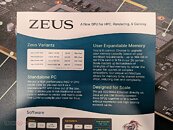
Called ZEUS by Bolt Graphics, the architecture offers a contemporary raster 3D graphics, ray tracing, and path tracing hardware pipeline, using an in-house designed SIMD architecture that's controlled by a RISC-V command processor that doubles up as a CPU. The prototype graphics card features a PCI-Express 5.0 x16 host interface, and LPDDR5X as its graphics memory, with additional DDR5 SODIMM slots for the RISC-V command processor. Together, the board can have up to 384 GB of memory to deal with large data sets. The card also features a 400 Gbps or 800 Gbps enterprise network interface, and a fully-fledged BMC/IPMI circuit on board, so you can manage large clusters of the card in a rackmount render server or workstation. The most surprising aspect of the card is power, and it only features an 8-pin PCIe power input, for a total of 225 W of power draw.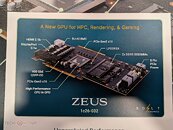
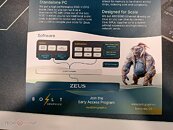
 Besides hardware, Bolt Graphics is offering a fully-fledged software that that includes Vulkan and DirectX 12 interfaces, including support for Unreal Engine and Unity. Applications for the architecture support all modern programming environments. Bolt innovated a path tracing pipeline.
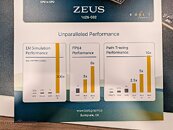
Bolt Graphics has made some astoundingly tall performance claims that indicate an ASIC-like approach towards popular use-cases, using fixed-function hardware. In FP64 EM simulation benchmarks, the Zeus 4C is claimed to offer 300 times the performance of an NVIDIA B200 "Blackwell." In another FP64 math benchmark, the Zeus 1C (single silicon) is shown offering 3 times the performance of a GeForce RTX 5090. Perhaps the most fascinating claim is path tracing performance, and here, a Zeus 1C is claimed to offer 2.5 times the path tracing performance of an RTX 5090, 5 times with 2C, and 10 times with 4C.
The part about Bolt Graphics marketing that caught our eye is their claim that the Zeus 1C is "the fastest graphics processor ever," made possible due to a fundamental reimagining of conventional graphics processing workflows.
Called ZEUS by Bolt Graphics, the architecture offers a contemporary raster 3D graphics, ray tracing, and path tracing hardware pipeline, using an in-house designed SIMD architecture that's controlled by a RISC-V command processor that doubles up as a CPU. The prototype graphics card features a PCI-Express 5.0 x16 host interface, and LPDDR5X as its graphics memory, with additional DDR5 SODIMM slots for the RISC-V command processor. Together, the board can have up to 384 GB of memory to deal with large data sets. The card also features a 400 Gbps or 800 Gbps enterprise network interface, and a fully-fledged BMC/IPMI circuit on board, so you can manage large clusters of the card in a rackmount render server or workstation. The most surprising aspect of the card is power, and it only features an 8-pin PCIe power input, for a total of 225 W of power draw.


Bolt Graphics has made some astoundingly tall performance claims that indicate an ASIC-like approach towards popular use-cases, using fixed-function hardware. In FP64 EM simulation benchmarks, the Zeus 4C is claimed to offer 300 times the performance of an NVIDIA B200 "Blackwell." In another FP64 math benchmark, the Zeus 1C (single silicon) is shown offering 3 times the performance of a GeForce RTX 5090. Perhaps the most fascinating claim is path tracing performance, and here, a Zeus 1C is claimed to offer 2.5 times the path tracing performance of an RTX 5090, 5 times with 2C, and 10 times with 4C.
The part about Bolt Graphics marketing that caught our eye is their claim that the Zeus 1C is "the fastest graphics processor ever," made possible due to a fundamental reimagining of conventional graphics processing workflows.
114 Comments on New GPU Startup Bolt Graphics Promises 2.5x Path Tracing Performance of RTX 5090
If anything it will be bought by one of the major players very quickly if claims hold true. But probably just playing the game like Elon of overhyped products and then under deliver.
Intel, needs a win.
AMD, there head are screwed on the wrong way lately.
Nvidia, there head is so far up their own arses doubt they see anything.
www.jonpeddie.com/news/bolt-graphics-zeus-gpu-technical-overview/
The Zeus 1c configuration is purported to have only 10 TFLOPS FP32, this makes it somewhat slower than a laptop RTX 3060. The usage of RISC-V clusters is also reminiscent of Intel's old Larrabee GPU, and it likely suffers from the same problem: absolutely abysmal, unscalable general purpose and raster performance, leaving it - provided that their claims are both true and provable - as a hyperspecialized ray tracing accelerator or a (slow) compute device that has a very high memory capacity. The thing they're doing with RAM was tried before by AMD with the Radeon Pro SSG, which was a Vega 64 that could take M.2 NVMe SSDs as a memory expansion.
Everything I know about GPUs and how they work at a fundamental level simply don't click when I look at this thing.
Wouldn't that also imply it was at least 2x faster and 8x more efficient than a 5090 in raster? (or is that not how it works??)
Also no mentions on what system specs they tested it... (OS, Processor etc...)
---
Also that Graph comparison looks funny (yellow bar goes over the line)
(even if the end product wasn't viable cost wise/too expensive)
We already saw with intel that it's no easy task to "just" create dgpu division (and Intel is humongous company, with a lot of smart heads & resources)
Why would a GPU in 2026 have a PCIe slot on both sides?
Pics are likely AI slop at the very least
Nvidia's focus has not been gaming for years now. Their processors are still capable of raster and RT, but the focus is entirely on data-center workloads. So it wouldn't surprise me if someone else came along, completely focused on raster and ray tracing and beat them, while not doing well at data-centers. Do I think this company has done that? no lol. At least not yet. I can't even tell if they have real hardware.
Even if the 'stated' performance and power use is correct, other performance aspects will likely suck, limiting its use.
I'm inclined to take another look only when a trusted review or appraisal is published.
It has that whiff of Star Citizen.
However, the high-end rendering and HPC markets are certainly ripe for disruption. Nvidia is in the difficult situation of trying to balance a lot of different markets. AI markets want pure tensor cores, gamers want low-precision calculation for high frame rates, HPC and rendering want high-precision and care less about speed. No architecture can meet all those needs. So if they focus on supporting common rendering engines (including UE5) and make a versatile framework for writing HPC code, they can certainly make a better (on paper) product than Nvidia in those specific markets.
Flawless support of all games with their mess, optimization, mitigations, workarounds, ... not likely.Does it only RT things or does it something more (RR denoising, upscaling, raster, ...)?
That is the question.
Its not a big thing to get higher RT performance than rtx 5090 as all rtx series cards have fixed ratio 1 RT core : 4 tensors : 128 shaders.
rtx 5090 has 170 RT cores .. with 640 its wont be a challenge.Exaggeration.
Very common in advertisement.
However, if they want to make $$$ fast, they just spit out these claims, and just use it as a tactic to get someone to buy them out / "invest" in them, pretty much like Scam Altman, and people buy into the BS