Friday, January 16th 2026

AMD Ryzen 9 9950X3D2 Gets Benchmarked, Shows 7% Improvement over Regular X3D SKU

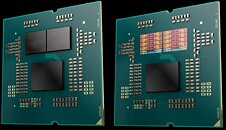
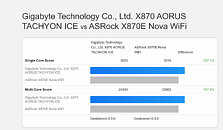
AMD's Ryzen 9 9950X3D2 processor has taken on a mythical status in the CPU world, as it has been rumored for some time without any commercial release. Recently, the CPU appeared in the online database of the Geekbench CPU benchmark, showing a slight performance improvement over its predecessor—the regular Ryzen 9 9950X3D CPU. A Geekbench v6.5 test revealed scores of 3,553 for single-core performance and 24,340 for multicore performance. This represents about a 7% improvement for the X3D2 model over the X3D in both single and multicore scores. Initially, CES 2026 was expected to be the announcement date for this processor, but after the show we got more hints that the SKU will perhaps appear later in the year.

Reportedly, the SKU features 16 cores and 32 threads, with 3D V-Cache on both chiplets, hence the name X3D2, totaling around 192 MB of L3 cache. It operates at a base frequency of 4.30 GHz, with boost clocks reaching up to 5.6 GHz. Compared to its predecessor, it sacrifices a modest 100 MHz in peak speed for significantly greater cache capacity. This configuration is expected to benefit cache-sensitive workloads and gaming, while also appealing to workstation users and content creators handling memory-intensive tasks. However, this enhanced capability comes with a thermal cost, as the rumored TDP increases to 200 W from the 9950X3D's 170 W, potentially pushing PPT values close to 250 W. With 3D V-Cache on both CCDs, the overall performance appears to be boosted by about 7%, so its appearance is justified in some workloads that enthusiasts would appreciate.
Sources: Geekbench, via HXL on X
Add your own comment

45 Comments on AMD Ryzen 9 9950X3D2 Gets Benchmarked, Shows 7% Improvement over Regular X3D SKU

#1
Dimitriman
7% really goes to show that 3D cache indeed has diminishing returns above 8 cores.
Posted on Reply
#2
Solaris17
Super Dainty Moderator
Dimitriman7% really goes to show that 3D cache indeed has diminishing returns above 8 cores.
If geekbench is your workload maybe lol I don’t give credence to this trash benchmark in any way and it’s crazy to me that it somehow got popularized
Posted on Reply
#4
AnotherReader
Solaris17If geekbench is your workload maybe lol I don’t give credence to this trash benchmark in any way and it’s crazy to me that it somehow got popularized
It's also rather useless for comparing multithreaded performance with high core count CPUs and yet people use it.
Dimitriman7% really goes to show that 3D cache indeed has diminishing returns above 8 cores.
On the contrary, in systems with high core counts, extra cache has outsized benefits for some workloads. The results below are for a EPYC 9684X: a 96 core Zen 4 SKU with 12 CCDs and 96 MB of L3 for each CCD.

Posted on Reply
#5
Quicks
Cool this will warrant at least 25% increase in chip price.
Posted on Reply
#6
bug
Dimitriman7% really goes to show that 3D cache indeed has diminishing returns above 8 cores.
And that's in a synthetic benchmark, which is designed to exercise the whole silicon. The increase in games will be lower than that.
Posted on Reply
#7
ThomasK
Should be called shitbench.
Posted on Reply
#8
hsew
QuicksCool this will warrant at least 25% increase in chip price.
It's more expensive to make and a niche, low volume product.

But hey, it could be worse. Back in the Core 2 days, a C2D could be had for under $200 while the C2Q launched for just under $900!
Posted on Reply
#9
bug
ThomasKShould be called shitbench.
Just because people don't grasp what a synthetic benchmark is meant to do anymore? I don't think so.
hsewIt's more expensive to make and a niche, low volume product.

But hey, it could be worse. Back in the Core 2 days, a C2D could be had for under $200 while the C2Q launched for just under $900!
It's not more expensive to make per se. You take two cored that you would pair wit two cores without 3D cache to make 2 9950X3D units and you make one 9950X3D unit instead.
Posted on Reply
#10
Braegnok
I was planning on buying EPYC 4005 4565P chip last week, had it in my cart for a few days $575.99,.. the egg raised the price yesterday $44.00 when I went to checkout. :eek:


That ticked me off, so I removed item from my cart.

Now looking at 9950X3D2 chip, I'm guessing it will be $700.00 chip. The GB6 multi-core 24340 score is not very impressive,.. think I will stick with my 9950X for now.

Posted on Reply
#11
AnotherReader
BraegnokI was planning on buying EPYC 4005 4565P chip last week, had it in my cart for a few days $575.99,.. the egg raised the price yesterday $44.00 when I went to checkout. :eek:


That ticked me off, so I removed item from my cart.

Now looking at 9950X3D2 chip, I'm guessing it will be $700.00 chip. The GB6 multi-core 24340 score is not very impressive,.. think I will stick with my 9950X for now.

If you have a 9950X, then switching to a 9950X3D only makes sense for very specific workloads.

Posted on Reply
#12
hsew
bugIt's not more expensive to make per se. You take two cored that you would pair wit two cores without 3D cache to make 2 9950X3D units and you make one 9950X3D unit instead.
That 3D cache is manufactured separately and packaged differently from the die itself, requiring several extra and complicated steps to join together using AMD's newest method of mounting the cache underneath the die to reenable CPU overclocking on X3D chips. So yes, it is more expensive to make per se.
Posted on Reply
#13
evernessince
Dimitriman7% really goes to show that 3D cache indeed has diminishing returns above 8 cores.
bugAnd that's in a synthetic benchmark, which is designed to exercise the whole silicon. The increase in games will be lower than that.
Wise to note that the 7800X3D is only 10% faster in geekbench than the 7700. So by comparison a 7% increase in this particular benchmark is decent, although it gives us zero indication of the boost from the extra cache.
bugJust because people don't grasp what a synthetic benchmark is meant to do anymore? I don't think so.
Geekbench is not a measure of X3D performance and never has been (as evidenced earlier in my comment). Striking out at others because you misjudged the use case of a given benchmark is certainly a take.
BraegnokI was planning on buying EPYC 4005 4565P chip last week, had it in my cart for a few days $575.99,.. the egg raised the price yesterday $44.00 when I went to checkout.
Welcome to the modern world of dynamic pricing. Never leave things in your cart, don't use wishlist features, and always make sure to double check pricing after coming back to an item. These companies will do anything nowadays to milk out extra money.
Solaris17If geekbench is your workload maybe lol I don’t give credence to this trash benchmark in any way and it’s crazy to me that it somehow got popularized
I'd say it's because it's multi-platform, otherwise it's individual tests don't align with other benchmarks testing the same thing. Geekbench only very recently supported AVX 512. Before that it was AVX2 to more closely align with the max bit width on mobile processors (which is a disadvantage for desktop processors). Their shared task model, in which one task is run and shared across all the cores, also scales very poorly across desktop cores and doesn't accurately represent many workloads. Sharing a task means that a lot of data needs to be passed around. Something that higher bandwidth unified memory systems (mobile) are better at while desktop PCs are poor at. Workstation CPUs get the worst end of the stick though as this benchmark approach results in an ever increasing amount of overhead as you increase core count. This is because you are breaking the work down into smaller parts and thus increasing the amount of data that needs to be fetched from any individual core. It's horrible design for desktop / workstation CPUs. It's basically the polar opposite of Cinebench, where each square being rendered is a separate task and each CPU core is assigned a square to render at any given time. On top of all that, their tests are short and their datasets small (great for mobile but does not challenge the L3 size or even X3D cache available on desktop). Geekbench is fundamentally designed for mobile architectures. They've made babysteps in making the test better for X86 but they need to include an entirely different work assignment model in order to represent X86 properly.
Posted on Reply
#14
Nhonho
If the x86 cores of Ryzen processors for home consumers had direct access to RAM, they wouldn't need as much cache memory, since RAM access latency would be much lower, and read and write speeds would increase significantly.

AMD should consider manufacturing them like this:
Posted on Reply
#15
evernessince
NhonhoIf the x86 cores of Ryzen processors for home consumers had direct access to RAM, they wouldn't need as much cache memory, since RAM access latency would be much lower, and read and write speeds would increase significantly.

AMD should consider manufacturing them like this:
Intel already does that with their SoC chip by placing two cores on what it calls a low power island and yet it's memory latency is worse than AMD. Placing 8 cores on the SoC tile isn't a good idea. It means AMD would need a ton of SoC tile designs to accommodate desktop. You'd need 4, 6, 8, 12, and 16 core variants. Forgot about workstation, server, and mobile where not only do the core counts change but the IO does as well. You'd need multiple subvariants of each variant to cover all IO options that AMD currently offers. The benefits of having the IO separate are just way too huge, especially as we add more features like AI NPUs and faster IO (DDR5 Phys is not small and DDR6 Phys will be even bigger).
Posted on Reply
#16
mrpaco
I would love to see a benchmark with games that eat for breakfast 3D cache, like tarkov or factorio.

tarkov specially every new x3d iteration improves massively on the min fps, like about 30% from 7800 to 9800, would love to see it with this one.
Posted on Reply
#17
Dr. Dro
Dimitriman7% really goes to show that 3D cache indeed has diminishing returns above 8 cores.
You're overlooking what is long known: 3D cache does not benefit every single workload. In such cases, 3D CPUs are actually slower due to cycle penalty the processor takes to access cache slices.

7% improvement in a non-cache sensitive application points out to higher average clocks, less time context switching and perhaps the increased TDP helps with median clock despite the reduction in max boost.
Posted on Reply
#18
Atomofvoid
"+7%"... Is anyone really going to buy this ?
Posted on Reply
#19
bug
NhonhoIf the x86 cores of Ryzen processors for home consumers had direct access to RAM, they wouldn't need as much cache memory, since RAM access latency would be much lower, and read and write speeds would increase significantly.

AMD should consider manufacturing them like this:
True, but cache access would still be faster than going to RAM. It's a delicate balance to strike and, as you noted, tailored to each and every design.
Posted on Reply
#20
waltc
Solaris17If geekbench is your workload maybe lol I don’t give credence to this trash benchmark in any way and it’s crazy to me that it somehow got popularized
Precisely...;) People should never draw solid conclusions from single benchmarks. Especially Geekbench...! It should be interesting to see how it fares in some newer, demanding games, I'd think.
Posted on Reply
#21
Braegnok
AnotherReaderIf you have a 9950X, then switching to a 9950X3D only makes sense for very specific workloads.

I'm only interested in the silicon quality, IMC quality,.. :)

I was hoping for a new stepping vs 0,.. but it's still the same. Also I wanted to know if the 9950X3D2 is running a higher/lower clock bin chip like 9950X or has AMD dropped the clocks to give you 2 full speed 5.6 CCDs. Based on the multi-core GB6 bench it's clear they are not running 2 full speed CCDs, I will most likely pass on this chip and wait for the 9000 APUs to test.
Posted on Reply
#22
freeagent
I too was expecting miracles.

I guess AMD was right all along haha.

Could have increased the clocks a little though.. I am sure its in the power budget. But silicon quality might be to blame there since the good stuff goes to the pro environment.

Posted on Reply
#23
CornyOC
Just wait for Zen6, this is a refresh Zen 5 that doesn't justify buying if you already have a Zen5.
Posted on Reply
#24
ZeDestructor
Dimitriman7% really goes to show that 3D cache indeed has diminishing returns above 8 cores.
Diminishing returns across CCDs, actually - there is a large penalty from having to fetch data from main memory of the other die's cache.

The benefit of an X3D2 is simplifying the scheduling algorithms into just being a simple, two-equal-node NUMA-ish system, something that schedulers have been pretty good at doing for decades. If you were expecting miracles... that's on you I'm afraid. Personally, I was expecting something like a 3% increase in geekbench, so 7% is a pleasant surprise.
Posted on Reply
#25
flyingdoc
I wonder if this will be an improvement over my 7950X3D. Helping some of the CPU bottleneck on some game?
Posted on Reply
Add your own comment
Nov 20th, 2026 09:44 PST change timezone

New Forum Posts

Popular Reviews

TPU on YouTube

Controversial News Posts