Thursday, February 19th 2026
AMD GPU Prices Rebound Slightly As Demand Drops
It's no secret that GPU prices have skyrocketed lately as a result of increased AI data center demand. This has been especially true for any GPU featuring more than 8 GB of VRAM, like AMD's Radeon RX 9060 and 9070 series. However, while AMD GPUs were previously seen as a viable alternative when NVIDIA GPUs were unaffordable or unavailable, that increased demand resulted in price spikes of up to 40% by December 2025. This is based on Japanese data collected by Gaz:Log, who also found that, since that massive price hike, reduced demand has forced retailers to drop prices for both the RX 9070 XT and RX 9060 XT 16 GB GPUs by as much as 15% and 20% respectively.
Obviously, this is just one market, and it can't be guaranteed that events will play out similarly in other regions, but it is an indication that hardware pricing may be reaching a tipping point, after which we may see prices stabilize or fall slightly in response to reduced demand. It's also worth noting that AMD and NVIDIA have both been rumored to be planning to effectively increase MSRP in early 2026, which would result in price increases of at least 10% across the board. This is on top of a late 2025 price increase of $20-40 on both 8 and 16 GB GPUs.
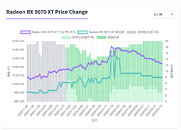
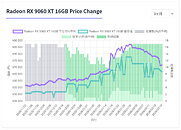
Source:
Gaz:Log
Obviously, this is just one market, and it can't be guaranteed that events will play out similarly in other regions, but it is an indication that hardware pricing may be reaching a tipping point, after which we may see prices stabilize or fall slightly in response to reduced demand. It's also worth noting that AMD and NVIDIA have both been rumored to be planning to effectively increase MSRP in early 2026, which would result in price increases of at least 10% across the board. This is on top of a late 2025 price increase of $20-40 on both 8 and 16 GB GPUs.


23 Comments on AMD GPU Prices Rebound Slightly As Demand Drops
Nothing have impacted AMD <3.
Nvidia on other hand - f you, who the heck will pay for 5070 ti above ~1100€. Chukcuuu.
also loads of websites that offer to send you a price allert when prices drop below a certain level
What I meant is, that whenever I want to buy something, a price increase is announced, it is directly applied to the HW I am looking. And when a price decrease is announced, it is never coming. Yes, I am using at least 1 or 2 price check websites with alarms. Also, those alarms are not always trustworthy.
Also, VPN.
You'll be surprised.
Another nice one is having your mobile on said website next to it.
First possible scenario, people will pay anything for an Nvidia GPU, which is bad because it sends the wrong signal to the company that controls the market, the company that controls pricing. They will just not pay anything for a Radeon GPU.
Second possible scenario, AMD send new shipment of Radeon cards in Japan, with the GPU pricing remaining lower than what retailers in Japan where expecting. They could be expecting the new GPUS to have much higher prices because of VRAM costs and after seeing that this wasn't the case, they felt secure enough to drop prices.
In any case we need info about Nvidia prices and I really don't understand how someone can take RX 90x0 16GB pricing alone here and come to conclusions about what consumers are willing to pay for a Radeon GPU. Let me add here that the narrative "AMD needs to be at least 25% cheaper than Nvidia" is pushed from Nvidia friendly sites constantly the last few years. This does look like a coordinated effort to convince consumers that Radeon products are second grade products, something that was Nvidia's marketing and business plan from the day they started promoting PhysX, more than 15 years ago.
This isn't the first case of bad publicity targeting AMD this week alone.
Until recently every Nvidia fan, every Nvidia employee, every Nvidia something on the planet, was saying to us that even DLSS2 was better than native. Recently in a
Blind Testing Shows Gamers Prefer NVIDIA DLSS 4.5 Over Native Resolution Rendering and AMD FSR 4 | TechPowerUp
we learned that FSR4 that reviewers where saying that it is probably even better than DLSS3, is worst than native.
I wonder how much of a blind test that was. Because we can't have DLSS2 better than native and FSR4 worst than native at the same time except if we assume that reviewers saying than FSR4 is better than DLSS3 where wrong and in fact FSR4 is worst not just compare to even DLSS2.
I've seen some websites mention a lowest point pricing of 108.000 yen, which is currently €591 or US$695 (but idk how taxes work there so I can't tell if they're included or not).
In any case, the only country in Europe able to get these kind of prices is Germany, and it may not be the case in the current international economic climate. 9070 XT are already back beyond the €800 mark for the base models and €1k for the top end in France, same prices as release month.