Monday, March 9th 2026

Intel Releases Official XeSS 3.0 Software Development Kit
Intel has launched its official XeSS 3.0 software development kit (SDK), which allows game developers to incorporate the latest binaries into their games and integrate XeSS 3.0 into game engines. Interestingly, Intel has released this version as a binary, pre-compiled file, rather than the open-source XeSS version the company promised a long time ago. This promise has remained unfulfilled for four years, with each XeSS release being closed-source, only available on GitHub under the Intel Simplified Software License as of the October 2022 revision. This binary is provided as a DLL file for Windows operating systems, meaning that Linux users cannot run this SDK on their systems without a translation layer. For users wanting to update older XeSS 2.x versions, you simply need to replace the libxess.dll, libxell.dll, and libxess_fg.dll files with those from the newest XeSS 3.0 ZIP folder.
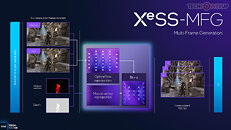
Intel promotes XeSS 3.0 with its main feature being multi-frame generation (MFG). This version integrates up to three generated frames between two rendered frames, resulting in up to a fourfold frame increase using MFG, similar to NVIDIA's DLSS MFG technology. Intel is joining the AI-generated frame insertion trend, which seems to be gradually expanding. Interestingly, Intel also added a feature that allows XeSS 3.0 to use external memory heaps. This means the Intel XeSS SDK can now utilize GPU memory allocated by the game engine itself, allowing XeSS and the engine to operate on the same VRAM blocks instead of each reserving separate ones. This helps developers avoid duplicate buffers and fragmentation, gives them direct control over allocation and residency, and makes integrating XeSS into an existing render pipeline cleaner and more efficient.
Sources:
Intel, via Phoronix
Intel promotes XeSS 3.0 with its main feature being multi-frame generation (MFG). This version integrates up to three generated frames between two rendered frames, resulting in up to a fourfold frame increase using MFG, similar to NVIDIA's DLSS MFG technology. Intel is joining the AI-generated frame insertion trend, which seems to be gradually expanding. Interestingly, Intel also added a feature that allows XeSS 3.0 to use external memory heaps. This means the Intel XeSS SDK can now utilize GPU memory allocated by the game engine itself, allowing XeSS and the engine to operate on the same VRAM blocks instead of each reserving separate ones. This helps developers avoid duplicate buffers and fragmentation, gives them direct control over allocation and residency, and makes integrating XeSS into an existing render pipeline cleaner and more efficient.


5 Comments on Intel Releases Official XeSS 3.0 Software Development Kit