Monday, March 23rd 2026

AMD Ryzen 5 9600X Price Drops to $190 in Anticipation of Core Ultra 5 250K Plus
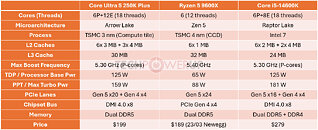
Pricing of AMD Ryzen 5 9600X dropped to $190 on Newegg over the weekend. This is a massive 32% drop from its $280 launch price, although the chip's price had been on a gradual slope over 2025 as it faced stiff competition from the Intel Core i5-14600K and Core Ultra 5 245K. The $190 price puts the 9600X at $10 lower than the $200 launch price of the Core Ultra 5 250K Plus. The 250K Plus offers a significantly higher core count, with 6 P-cores and 12 E-cores, for a total of 18 threads. Both the 250K Plus and 270K Plus are expected to stir things up in the desktop processor market due to their aggressive pricing and value proposition. The 270K Plus is priced at a strategic $300, at which it goes up against the Ryzen 7 9700X, 9800X3D, and even 9900X. It is essentially a 285K on paper, with marginally lower clock speeds. With the 9600X price cut, AMD might be also clearing the decks for the rumored Ryzen 5 9650X refresh.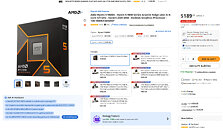


29 Comments on AMD Ryzen 5 9600X Price Drops to $190 in Anticipation of Core Ultra 5 250K Plus
It's either the intended processor (HTPC, family PC or the ilk) or a stand in while you get the rest of the machine and are saving up for a 98xxX3D or above or waiting for 10xxx series to drop
Don't look at PASSMARK for the recent Core Ultra and Ultra Plus stuff - they seem to be wildly at odds (grossly overstating performance) with other larger benchmark suites which test a wide array of apps and scenarios. And for god's sake NEVER look at Userbenchmark.com - it just outright lies and has been doing so for a decade.
And don't look at the launch reviews/benchmarks of the 9600X and 9700X from 2024 - updated bios and the change in PBO profiles has given them a VERY noticeable performance boost.
The Ultra 270k plus looks like a real winner over it's competitor the 9900X - faster single thread, faster multi-thread, 10%+ lower price, and the 9900X doesn't benefit much from PBO.
The Ultra 250K plus is a bit of a weird position - a good bit faster than the 9600X + PBO, only modestly slower than the 9700X + PBO, but hovering pretty much in the middle in price. I'd say the 250K+ is probably the better value than either, but its very close and the total lack of meaningful upgrade path and the still-not-great power usage really don't give it any decent chance against those other two.
But at the lower end, the 9600X and 9700X stack up very well against the 245K and 265K, especially in single-threaded performance and gaming, and that's leaving off the AM5 advantage.
I look at relative performance (average of all tests).Yes right now in my country the 9600X is priced like the 245K.
5% you say? This app avg shows exactly 15%.
www.techpowerup.com/review/intel-core-ultra-7-270k-plus/28.html
And also 2% higher than the 9700X, so again I'll reiterate the 245K is a competitor for the 9700X.That's not what I remember, here the app avg is 2.4% higher for max PBO, 720p gaming 1.3%:
www.techpowerup.com/review/amd-ryzen-5-9600x/27.html
www.techpowerup.com/review/amd-ryzen-5-9600x/23.html
Power draw is higher by 36.6%.
www.techpowerup.com/review/intel-core-ultra-5-245k/24.html
Slightly higher than that of the 245K, while still performing clearly under it in app avg.
Max PBO for the 9700X shows 5.5% increase from stock but with horrible power draw (+60.6% more in app avg).
www.techpowerup.com/review/amd-ryzen-7-9700x/27.html
www.techpowerup.com/review/amd-ryzen-7-9700x/23.html
In 720p gaming barely 1%.
So that 2% difference in app avg vs the 245K can be canceled via slightly increased power draw, the 9700X would still be somewhat less than the 245K (or very close to it, I can't be sure), but it wouldn't become a 250K competitor since that one has a 16% lead over it although with higher power draw than the 245K (19% in app avg).
The slightly increased power draw of a tweaked 9700X wouldn't increase gaming performance meaningfully since max PBO didn't, but in 720p the 9700X would be victorious. So okay if we value both gaming and productivity the same then the tweaked 9700X would be 4% better in 720p than the 250K, and the 250K would be 14% better in app avg but with higher power draw (maybe 22% more or so).
So normalizing for power draw they would be closer to equal, meaning that at the most (taking the upgrade path kool-aid into account) the 9700X should be a competitor for the 250K and not for the 265K, that is just ridiculous.
I have simulated the 9700X with a 7700X TDP/PPT here. As you can see the power draw is rather high, so the 7700X settings are too much, the performance will be higher than of the 245K but also the power draw, even more so.
Right now in my country the 9700X is priced (referencing the lowest prices) halfway between the 250K and the 270K. The 265K is too close to the 270K. But that isn't Intel's fault, the scalper retailers here haven't fully conformed to the prior price cuts (and looking at the pricing history the 265K has gone up in the last two weeks).
As such the CPU maker that needs to make some price cuts is still AMD.
The 9950X still has a huge difference over the 270K (more than €200).The 245K doesn't necessarily need that boost, if you're referring to 200S Boost, yes that only works on Z890, but the higher boost comes from higher speed RAM, so using B860 (along with higher speed RAM) gets people more than halfway there.
The 250K and 270K have made the 200S feature redundant. You can ignore that requirement from the mobo feature list.
Also if we're comparing a Z890 to a B850 feature wise, yeah good luck with that, emphasizing cheaper boards that give AM5 such a good value then also bringing up the upgrade path which works best with a fancier board (if you plan on keeping a board for at least twice its warranty period better get one with strong VRM and 8 layer PCB while you're at it). Cognitive dissonance much?
For productivity it is the 9950X, for Gaming it is the 9800X3D or 9950X3D
The 9950X3D2 is a halo product like the KF or 4790K era from intel.
The 270K is the "Sane" option at the moment for people who don't upgrade often/tinker with their rig, otherwise you accept your buying into a dead platform.