Tuesday, April 28th 2026
LincPlus LincStation E1 NAS Brings the Cloud Home
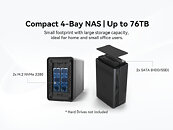
LincPlus has officially unveiled LincStation E1, a compact and versatile 4-bay network-attached storage (NAS) solution designed for creators, home labs, and modern households. The device will launch soon on Kickstarter, giving early supporters access to exclusive early-bird offers.
As subscription fatigue grows and concerns around data privacy increase, more users are reconsidering traditional cloud storage services. LincStation E1 aims to provide a compelling alternative by allowing users to build their own private cloud while maintaining full ownership of their data. "LincStation E1 is built to give users the freedom of the cloud with the control of local storage."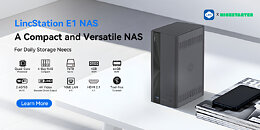
 A Personal Cloud Alternative to Traditional Cloud Storage
Public cloud platforms such as Google Drive, Dropbox, and other subscription services have become essential tools for storing files and collaborating online. However, recurring costs and growing privacy concerns are pushing many users toward personal storage solutions.
LincStation E1 addresses this need by enabling users to store, manage, and access their files from anywhere without monthly fees, while keeping their data under their own control.
From photo libraries and video projects to business documents and backups, the device centralizes data in one secure location.
Powered by LincOS
At the core of the system is LincOS, LincPlus's operating system designed specifically for its NAS devices.
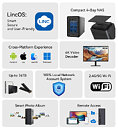
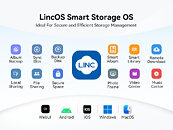
LincOS provides an intuitive interface that simplifies storage management, file access, and system configuration. Users can easily set up shared folders, manage backups, and access files remotely, making it suitable for both beginners and experienced NAS users.
The system is designed to balance simplicity with powerful functionality, enabling users to build a personal cloud without the complexity often associated with traditional NAS setups.
Key Features of LincStation E1
LincPlus will launch the LincStation E1 campaign on Kickstarter, where early supporters will have the opportunity to secure the device at special pricing and join the growing community of self-hosted storage enthusiasts.
More information about the campaign timeline and rewards will be released ahead of the official launch.
LincPlus is a technology company focused on developing innovative computing and storage products that combine performance, usability, and design. The company's work has been recognized internationally, including honors such as the Red Dot Design Award and the iF Design Award.
Through products like LincStation, LincPlus aims to make powerful personal computing and private cloud solutions more accessible to users around the world.
Sources:
LincPlus, LincStation E1 Kickstarter campaign
As subscription fatigue grows and concerns around data privacy increase, more users are reconsidering traditional cloud storage services. LincStation E1 aims to provide a compelling alternative by allowing users to build their own private cloud while maintaining full ownership of their data. "LincStation E1 is built to give users the freedom of the cloud with the control of local storage."


Public cloud platforms such as Google Drive, Dropbox, and other subscription services have become essential tools for storing files and collaborating online. However, recurring costs and growing privacy concerns are pushing many users toward personal storage solutions.
LincStation E1 addresses this need by enabling users to store, manage, and access their files from anywhere without monthly fees, while keeping their data under their own control.
From photo libraries and video projects to business documents and backups, the device centralizes data in one secure location.
Powered by LincOS
At the core of the system is LincOS, LincPlus's operating system designed specifically for its NAS devices.
LincOS provides an intuitive interface that simplifies storage management, file access, and system configuration. Users can easily set up shared folders, manage backups, and access files remotely, making it suitable for both beginners and experienced NAS users.
The system is designed to balance simplicity with powerful functionality, enabling users to build a personal cloud without the complexity often associated with traditional NAS setups.
Key Features of LincStation E1
- 4-Bay Storage Expansion
- Flexible drive support allows users to scale their storage as their data grows.
- Compact Desktop Design
- A space-efficient form factor ideal for home offices, studios, and small workspaces.
- Private Cloud Access
- Securely access files from anywhere while maintaining full data ownership.
- Designed for Creators and Home Labs
- Supports media libraries, backups, collaboration, and self-hosted services.
LincPlus will launch the LincStation E1 campaign on Kickstarter, where early supporters will have the opportunity to secure the device at special pricing and join the growing community of self-hosted storage enthusiasts.
More information about the campaign timeline and rewards will be released ahead of the official launch.
LincPlus is a technology company focused on developing innovative computing and storage products that combine performance, usability, and design. The company's work has been recognized internationally, including honors such as the Red Dot Design Award and the iF Design Award.
Through products like LincStation, LincPlus aims to make powerful personal computing and private cloud solutions more accessible to users around the world.
6 Comments on LincPlus LincStation E1 NAS Brings the Cloud Home
I HATE kickstarter, unknown companies often don't deliver what they claim or even better catch your money and disapear. Kickstarter did absolutely nothing to get my money back.
buffaloamericas.com/products/linkstation-200-series
We actually delivered a much better product than what was originally planned, but it was also a year and a half late. That company lost less than a handful of backers, as I did one important thing, I posted an update (or more) every month, as that's what I had promised when I took over the campaign management. The CEO didn't think it was that important, but I didn't care, as I made a promise to the backers.
On the other hand, I worked for a company that shipped their product (I was their boots on the ground in Taiwan) and then ran out of money, which meant that the product ended up being a doorstop almost immediately after their customers got them.
There was also a massive scam going on on multiple crowd funding platforms around the time I was working for the first company and I tried to warn our backers as good as I could, but some of them still went full in and ended up losing a fair amount of money.
I don't think this is a scam, as much as Ugreen has done two campaigns on Kickstarter, but a lot of companies don't take these things seriously, or don't have enough in-house expertise to pull something like this off. They rely on third parties that don't always deliver and then it all goes to...
I would most definitely not back something where I know I couldn't afford to lose the money and one should consider a crowdfunding campaign as supporting the company rather than purchasing a product and this is a mistake some people do when they back products from unknown companies.
I do agree that these platforms need to do a better job vetting companies though, as there are still very obvious scams. Most people can't tell, but as someone that has worked in the tech industry for most of my working life, I'm pretty good at spotting the scams. I backed a few things, but as they posted more information, I cancelled, as things just didn't appear right. I even got a company to refund me, since they were lying about the reasons for their delays and I called them out on it. They weren't happy, but at least I got my money back. The product did sort of ship a year or two later, but wasn't really what they promised.Is Buffalo even actively doing anything with that product range?
It's a company you barely see any more.
It's a good thing.
They were very Japanese UI/UX wise back then and I guess that might've been the reason they ended up losing customers, as it was a bit quirky using their products in comparison to other brands.
I also think they ended up being too pricey vs. the competition at one point.