Wednesday, May 20th 2026

AMD Launches the Ryzen AI Max 400 Series Processors: "Strix Halo" Gets a Memory Upgrade
In addition to the Ryzen AI Halo, AMD today debuted the Ryzen AI Max 400 series of processors for AI development platforms. This is a refresh to the Ryzen AI Max 300 series "Strix Halo" processor. The chip combines up to 16 full-size "Zen 5" CPU cores with a large SoC die that has a powerful iGPU with 40 compute units powered by the RDNA 3.5 graphics architecture; a 50 TOPS-class NPU, and a 4-channel (256-bit wide) LPDDR5X unified memory interface. The series consists of three processor models, all three of these get AMD PRO features that rival Intel's vPro. There are consumer versions also planned for later this year.
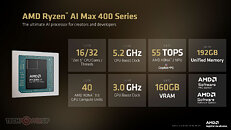
Memory is the focus of this refresh. AMD updated the memory controllers on the "Strix Halo" SoC die to now support up to 192 GB of LPDDR5X memory. The previous Ryzen AI Max 300 series tops out at 128 GB. Here, users have the flexibility to manually partition the memory between the system and the iGPU, giving the latter up to 160 GB of video memory. AMD also took the opportunity to give the GPU a maximum boost frequency increase to 3.00 GHz, up from 2.90 GHz on the Ryzen AI Max 300 series; while the "Zen 5" CPU cores now boost up to 5.20 GHz, up from 5.10 GHz on the previous generation. The integrated NPU gets a 10% performance boost, now being capable of 55 TOPS.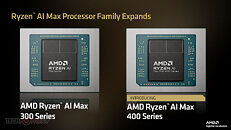
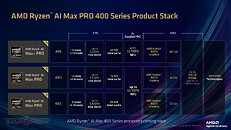
 There are three processor models in the series, the Ryzen AI Max+ PRO 495, the Ryzen AI Max PRO 490, and the Ryzen AI Max PRO 485.
The Ryzen AI Max+ PRO 495 tops the series, with a 16-core/32-thread "Zen 5" CPU that boosts up to 5.20 GHz. It maxes out the iGPU, with all 40 CU being enabled. The NPU offers 55 TOPS. The Ryzen AI Max PRO 490 comes with a 12-core/24-thread CPU that boosts up to 5.00 GHz, and comes with an iGPU that has 32 CU. The NPU runs at up to 50 TOPS. Lastly, there's the Ryzen AI Max PRO 485, featuring an 8-core/16-thread CPU boosting up to 5.00 GHz, the same iGPU as the 490 with 32 CU, and the same 50 TOPS NPU. AMD is planning an updated Ryzen AI Halo machine based on the Ryzen AI Max+ PRO 495 and 192 GB of memory some time later.
The biggest advantage of supporting up to 192 GB of memory is that the processor now supports 300B+ parameter LLMs.
Memory is the focus of this refresh. AMD updated the memory controllers on the "Strix Halo" SoC die to now support up to 192 GB of LPDDR5X memory. The previous Ryzen AI Max 300 series tops out at 128 GB. Here, users have the flexibility to manually partition the memory between the system and the iGPU, giving the latter up to 160 GB of video memory. AMD also took the opportunity to give the GPU a maximum boost frequency increase to 3.00 GHz, up from 2.90 GHz on the Ryzen AI Max 300 series; while the "Zen 5" CPU cores now boost up to 5.20 GHz, up from 5.10 GHz on the previous generation. The integrated NPU gets a 10% performance boost, now being capable of 55 TOPS.


The Ryzen AI Max+ PRO 495 tops the series, with a 16-core/32-thread "Zen 5" CPU that boosts up to 5.20 GHz. It maxes out the iGPU, with all 40 CU being enabled. The NPU offers 55 TOPS. The Ryzen AI Max PRO 490 comes with a 12-core/24-thread CPU that boosts up to 5.00 GHz, and comes with an iGPU that has 32 CU. The NPU runs at up to 50 TOPS. Lastly, there's the Ryzen AI Max PRO 485, featuring an 8-core/16-thread CPU boosting up to 5.00 GHz, the same iGPU as the 490 with 32 CU, and the same 50 TOPS NPU.

The biggest advantage of supporting up to 192 GB of memory is that the processor now supports 300B+ parameter LLMs.
18 Comments on AMD Launches the Ryzen AI Max 400 Series Processors: "Strix Halo" Gets a Memory Upgrade
They aren’t lying.
chipsandcheese.com/p/amds-strix-halo-under-the-hood
chipsandcheese.com/p/strix-halos-memory-subsystem-tackling
160GB Vram not 160Gib VRAM on the slides. At the end of the slide there is staed with unitied memory, most likely all the VRAM is taken from the DRAM.
Kinda awesome to see AMD using on AMD slides the wrong units
i would not buy any systems anymore with 160Gib Vram when the main box is limited to 32gib dram. that is the amount i had 10 years ago and far too less.
But you have software that goes: "How much memory does the GPU have?"
And if the GPU answers 256MB/512MB it will only use that memory and intentionally not allocate more even though it can use 150GB easily. Some LLM runners are like that for example. So for the chip to be compatible with those programs, AMD allows you to "allocate" almost all of the memory to the GPU. It is legacy compatibility basically.
The GPU driver/chip does require some amount of ram to be dedicated to the GPU to allocate the display buffers, command buffers etc, basically anything that needs DMA access. And that small amount of memory has to be dedicated to the gpu and often it is mapped in a different physical range reserved for hardware, and with special "cache" rules. I haven't worked with DMA in the PC context recently, but I expect the DMA engines to also be virtual memory based as well. So even that "special" ram is not really necessary other than legacy compatibility.
It seems Nova Lake might be at least partly a Sandy Bridge moment for Intel, so AMD needs more than 6-7% IPC improvement this time with Zen 6.
Totally pointless AI Max 400 chip series. Waste of sand, same as Ryzen 9 9950X3D2. Plenty of RAM for such a poor NPU.
Both for TG, where you are mostly bw-bound, it performs pretty much equal with a Spark and for MoE models it'd be a nice machine with the extra memory.At this price? You get taxed as dumb. But assuming the regular market price of Strix Halo, it's considerably cheaper (or used to be) than a Spark, so you could almost afford 2 of these with the price of a single Spark.
If Windows support and x86 is a thing that you require, this is also a better option.
Otherwise, the Spark has a better GPU, proper networking, and a better software stack, but comes with a higher price tag.The NPU is irrelevant. If AMD did their homework and released good kernels for compute this would be a nice option for a local inference node for "smaller" models.
Unless you have to run 120B models, you are 100% better off spending that money on a gpu...as their launch slides show.
Both spark and strix halo and rebrand are limited by memory bandwidth. Spark gets fp4 and 200gbit rdma nic, this is priced too close without it.Let's be serious now, no one uses Gibibytes in marketing, are you going to complain now that windows and linux say GB when they mean Gib?
When you buy 8Gb of ram, it shows up as 8Gb of ram in the OS because they are both... Gib. It's all base 2 here no need to cry about marketing not confusing the masses.
Also, the comment before you had the answer to your confusion on ram partitioning... its a unified bus, the partition can be ignored, its mainly a windows issue.
You should definitely go read up on the architecture, chips and cheese does great stuff.
I can state truthfully that most units were converted to base 2 and base 10 at least 3 or 4 years ago with all gnu userspace and linux kernel related software
your whataboutism linux uses the wrong unit, = gnu userspace + linux kernel, is invalid
i checked around february my refurbished notebook with w11 pro, w11 pro still is unable to use the standardized units for DRAM, storage etc. the claim for windows using the wrong units is correct.
it does not change the facts, wrong units. i give you base 10 money and you give me base 2 money back, okay? 2000 euro from me, and i get 2048 euro from you, kk?
the only area were base 10 is valid is for storage. i thougt about it again over the years several times. i came to the conclusion, if those uneducated would use GIB always, they would be more right, as only storage would be wrong. Why they not enforce gib for storage and drop gib is another topic.
i see it from the electronic logic components. 1 data wire, 4 data wires, 16 data wires. you can not have base 10. the root cause i see clearly when you use sevearl or / or / and gates you end up always with base.
AMD is not a toddler company as those cheap motherboard / gpu / gaming gear brands which fail on those units also.
rant: for storage it gets kinda complicated when using disk free with base 2 on kib / mib / gib. i have myself issues when using base 2 on those
No, despite it being debated in the linux mailing lists for over 20 years, in 2026 units in linux are still a cluster F.
So when you run cat /proc/meminfo what does it show you? Does it show you kB or kiB? Cause I can tell you what my arch machine says...
Says you just use linux to browse reddit/rhomelab. Further if you ask for for human readable it give you base 2... its worse than being wrong, its inconsistent. It's not a whataboutism, its a get over it, no one cares, and no one does it right, be happy you might know which is which...