Thursday, May 21st 2026

Phison's Pascari Enterprise Storage Honored with COMPUTEX Best Choice Golden Award for Breakthrough 245.76 TB Capacity
Phison Electronics, a global leader in NAND flash controllers and storage solutions, today announced that its Pascari D206V PCIe Gen 5 data center SSD has received the prestigious COMPUTEX Best Choice Golden Award, recognizing the next generation of innovation in ultra-high-capacity enterprise storage for AI and modern data center infrastructure.
The Pascari D206V is designed to address the growing industry challenge of efficiently scaling storage capacity for AI, cloud and data-intensive workloads without increasing operational complexity or infrastructure costs. Delivering up to 245.76 TB in a single U.2 PCIe Gen 5 SSD, the D206V enables hyperscale and enterprise customers to significantly increase storage density while reducing rack footprint, power consumption and total data center OPEX.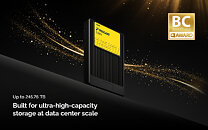 "We are honored to receive the COMPUTEX Best Choice Golden Award and thank the organizers and judging panel for this recognition," said K.S. Pua, Founder and CEO of Phison Electronics. "As AI and HPC deployments increase worldwide, organizations face growing demands for storage infrastructure that delivers greater density, efficiency, reliability and performance. The Pascari D206V was purpose-built for this new era of data center scale to help organizations store more, scale faster and optimize operational efficiency. This award reinforces Phison's commitment to enable organizations to innovate through their data."
Key Pascari D206V features and benefits include:
The Pascari D206V is designed to address the growing industry challenge of efficiently scaling storage capacity for AI, cloud and data-intensive workloads without increasing operational complexity or infrastructure costs. Delivering up to 245.76 TB in a single U.2 PCIe Gen 5 SSD, the D206V enables hyperscale and enterprise customers to significantly increase storage density while reducing rack footprint, power consumption and total data center OPEX.

Key Pascari D206V features and benefits include:
- Ultra-high storage density: Up to 245.76 TB in a single U.2 SSD enables organizations to consolidate infrastructure and maximize storage capacity per rack.
- Reduced data center OPEX: Up to an 8:1 capacity advantage over traditional HDD-based cold storage environments1 helps lower power consumption, cooling demands, rack space usage and overall operational costs.
- Read-optimized Gen 5 performance: Up to 14 GB/s sequential read speeds and 2,625K million random read IOPS accelerate access to large-scale AI and enterprise datasets.
- Enterprise-grade reliability and protection: Features including dual-port connectivity, power loss protection (PLP), AES-256 encryption, TCG Opal 2.0, NVMe-MI management, 128 namespaces and end-to-end data path protection help ensure data integrity, security and system resiliency.
- OCP-aligned compatibility: Supports OCP Datacenter NVMe SSD specifications for streamlined deployment across hyperscale and open compute environments.
- Flexible deployment options: Available in U.2 for 245.76 TB capacity and E1.L, E3.L and E3.S form factors for all other D206V capacities to optimize density, thermal efficiency and scalability across diverse infrastructure architectures.
4 Comments on Phison's Pascari Enterprise Storage Honored with COMPUTEX Best Choice Golden Award for Breakthrough 245.76 TB Capacity
Probably will see this in 10, 20 years. I do not expect this to become affordable anytime sooner.
There isn't a question when the 256 TB consumer drives will arrive. The question is when the 500 GB drives will be the norm again.
The problem with the typically "consumer" or not server pro grande TLC / QLC/VLC is that, if you fill more than say the 70% of its capacity, then the write speeds are suuuperr slow, but of course, as for backup purposes, it can be ok, whether profesionals take care about the 4 bits per cell.
Well, I might be wrong, but, if speeds on Pascari D2026V are say 3GBps instead of 12GBps, then I've got the Maths, as they are using QLC, they might divide, so
In consumers QLC the pSLC speed of 12GB then after 70% goes to MBps, but
On Pascari, they write all the time at up to 3.3GBps (sequential large blocks of course) to equal all the length of the drive, so even used say the 80% of the capacity, they still , in theory, run at up to 3GBps.
Not sure if @Chris_Ramseyer can talk about, that's a good idea cause in fact , 3GBps on all +200TB its a major milestone
My question is, what about the 4K block read and writes ? as these figures listed ?
Of course the purpose, for server usage, it will depend of these 4K random Writes and then Reads, vs large block size +1MB secuential writes, which will go close to 3GBps
So I think that for backup these drives are a must go for
I did not check prices but its insane for a U.2 form factor
I'm not sure if Phison has SLC like Solidigm say the P5810, of course at less space, say 1/4 of its space for same price, cause I still think, that, as of SCM are no longer available and the patents are still in hold/own of micron and Intel, SLC still can be manufactured, and, for true professionals, of course depending on use case, but SLC is SLC (the king , just below SCM).
Am I wrong @btarunr ?
My idea, is to design a SLC in dual or multistack layer, similar but not the same as SCM, my idea is like filling one cell above/below (physically) the other one, and the use somekind of RAID 5 (like P320H did) to do similar of what SCM's optane achieved
of course, this has a price, either engineering, sample manufacturing and bla bla, but .. well, of course, depends on customers demands, the issue is that most customers are not aware of the true benefits of one or other kind of storage, of course, depending use case
For enterprise SSDs, the way performance is measured and the info distributed is different. For the most part, there isn't a pSLC cache unless the drive is 100% pSLC (AKA X200z, X202z). So the sustained write performance is about as low as you will see in a workload that it is measured in (typically 128KB blocks at a certain QD and OIO).