Friday, May 22nd 2026
Muse Announces HiFi Muse 300 Desktop DAC/AMP with Dedicated OS
Audiophiles get ready!! Muse Hi-fi is gearing up to release a brand new innovative product, the Muse Hi-fi Muse 300. This is going to be the world's first desktop DAC/AMP with its own operating system. Muse Hi-fi has developed an in-house operating system strictly designed for fluidity and responsiveness, with seamless capabilities, leaving behind the laggy interfaces usually found in such devices. The Muse Hi-fi Muse 300 is coming soon to elevate your desk space with its vivid UI and brand-new playback capabilities.
World's First Desktop DAC/AMP with A Dedicated Operating System—Muse OS
The Muse Hi-fi team members are music lovers first. Compared to a decade ago, today's streaming platforms are highly mature and music formats are incredibly rich. Although streaming audio quality is not quite on par with local DSD files, it is more than sufficient for the vast majority of listeners. However, there is a clear gap in the market: existing music players are mostly developed based on Android systems, but there is no operating system specifically designed for DAC/headphone amplifier devices. A DAC/amp can directly connect to streaming platforms on a phone, eliminating the tedious process of downloading various versions of audio files. This can significantly expand the number of ordinary users in the Hi-fi market.


 What Are the Challenges of Developing an OS for DAC/Amps?
With Android systems, developers simply need to build their own UI on top of the existing Android framework—a relatively straightforward process. But a DAC/amp is built on an MCU foundation—development starts from scratch. Our MUSE 300 and U7 incorporate over 150 MCU interfaces, and the system manages 150 state variables. An error in any state machine could lead to hard-to-reproduce failures. This requires exceptionally rigorous design and documentation. It demands outstanding algorithmic capabilities from engineers, who must avoid complex floating-point operations, instead using lookup tables and fixed-point arithmetic.
This is precisely why, to date, no closed OS has been developed specifically for DAC/headphone amplifiers.
Three Distinctive UI Themes
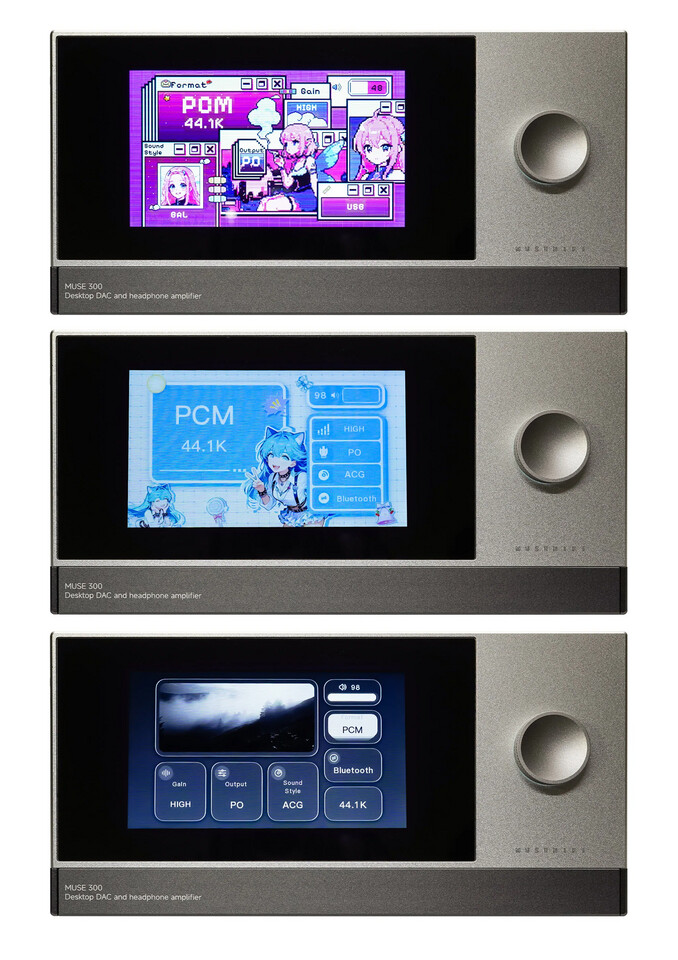
Make the Muse 300 truly your own. To complement its stunning 5" display and smooth operating system, the DAC comes preloaded with three unique UI themes, allowing you to customize the visual interface to match your personal aesthetic. The device features three themes: Cyberpunk (neon lights, high-tech vibes), Minimalistic (clean and refined, for modern homes or offices), and ACG Style (bright, playful, anime-inspired visuals). Users can freely switch between themes to match their décor at any time.
 Technical Specifications
Music is a sensory experience, and the Muse 300 honors that with a stunning 5-inch high-definition display. This isn't just a screen; it's a companion to your listening sessions. With crisp resolution and vibrant color reproduction, the Muse 300 brings you a vivid display of different available UI themes. It can also be used as a second screen for your PC.
Source:
Muse (product page)
World's First Desktop DAC/AMP with A Dedicated Operating System—Muse OS
The Muse Hi-fi team members are music lovers first. Compared to a decade ago, today's streaming platforms are highly mature and music formats are incredibly rich. Although streaming audio quality is not quite on par with local DSD files, it is more than sufficient for the vast majority of listeners. However, there is a clear gap in the market: existing music players are mostly developed based on Android systems, but there is no operating system specifically designed for DAC/headphone amplifier devices. A DAC/amp can directly connect to streaming platforms on a phone, eliminating the tedious process of downloading various versions of audio files. This can significantly expand the number of ordinary users in the Hi-fi market.


With Android systems, developers simply need to build their own UI on top of the existing Android framework—a relatively straightforward process. But a DAC/amp is built on an MCU foundation—development starts from scratch. Our MUSE 300 and U7 incorporate over 150 MCU interfaces, and the system manages 150 state variables. An error in any state machine could lead to hard-to-reproduce failures. This requires exceptionally rigorous design and documentation. It demands outstanding algorithmic capabilities from engineers, who must avoid complex floating-point operations, instead using lookup tables and fixed-point arithmetic.
This is precisely why, to date, no closed OS has been developed specifically for DAC/headphone amplifiers.
Three Distinctive UI Themes
Make the Muse 300 truly your own. To complement its stunning 5" display and smooth operating system, the DAC comes preloaded with three unique UI themes, allowing you to customize the visual interface to match your personal aesthetic. The device features three themes: Cyberpunk (neon lights, high-tech vibes), Minimalistic (clean and refined, for modern homes or offices), and ACG Style (bright, playful, anime-inspired visuals). Users can freely switch between themes to match their décor at any time.

- Main Controller: 32-bit Microcontroller Unit (MCU)
- Display: 5-inch, 480 x 854 IPS
- Input Interfaces: USB / Coaxial / Optical / Bluetooth
- Output Interfaces:
- Line Out: RCA + XLR × 2
- Headphone Out: 6.35 mm + 4.4 mm
- USB Controller: SA9137L
- Bluetooth: QCC3095
- Coaxial Interface: AK4118
- DAC: ES9039 ultra
- I/V Conversion: ES9603X2
- Low-Pass Filter (LPF): OPA1612 × 2
- Amplifier: TP6120A × 2
- Sampling: NE5532A
Music is a sensory experience, and the Muse 300 honors that with a stunning 5-inch high-definition display. This isn't just a screen; it's a companion to your listening sessions. With crisp resolution and vibrant color reproduction, the Muse 300 brings you a vivid display of different available UI themes. It can also be used as a second screen for your PC.
12 Comments on Muse Announces HiFi Muse 300 Desktop DAC/AMP with Dedicated OS
Regards,
V7C-D-1
This would be some custom OS, not that hard to do and display output via SPI or possibly a parallel display interface.
Judging by the slow screen update time, I'd say it's a poorly implemented SPI display.
It seems the OP-AMP hooked up to my Xonar AE was just having a bit of fun.
I'm referring to "Fosi Audio" from the Far East.
Regards,
Fred.
The big analog knob i use for audio deos not clutter my desk.
to nitpick, I do not want to see any 12 VDC jack or old USB-b 2.0 printer like port.
my m-audio air 192|6 has only usb-c for also balanced outputs. and it has much bigger analog knob and phantom power.
*typo I didn't want to correct
The press release even states:Which I still think isn't entirely true and they make it sound like they're some kind of geniuses for being able to develop an OS for an MCU, with a display interface that lags...
I worked for the company that made the router below and admittedly that had a MIPS processor, but that interface wasn't lagging and that's over a decade old device. The display was connected via the SPI bus.
Seems like they would go with the former 2 channel chip, this way it's cheaper and requires a lot less supporting hardware and they can get away with quite a bit lower quality power supply.
Perhaps its a custom version like what Colorfly used to call their alpha dac (es9018k2m with custom filters)