Tuesday, May 26th 2026

NVIDIA "Vera" CPU Benchmarked: Beating Intel Xeon and AMD EPYC in Select Workloads
Phoronix conducted an exclusive round of testing with NVIDIA's latest "Vera" CPU, showcasing early benchmarks that highlight NVIDIA's advancements in custom CPU design. The initial results indicate that this Arm-based CPU platform is powerful enough to outperform the latest Intel Xeon and AMD EPYC models in the data center sector. The "Vera" CPU is equipped with 88 custom Armv9.2 "Olympus" cores, featuring 176 threads through physical resource partitioning. These custom cores support native FP8 processing, allowing certain AI workloads to be executed directly on the CPU with a 6x128-bit SVE2 implementation. The chip offers 1.2 TB/s of memory bandwidth and supports up to 1.5 TB of LPDDR5X memory in the SOCAMM2 format. A second-generation Scalable Coherency Fabric provides 3.4 TB/s of bisection bandwidth, connecting the cores across a unified monolithic die and eliminating the latency issues common in chiplet architectures.
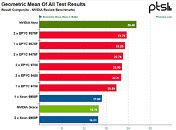
For comparison, Phoronix tested single and dual Intel Xeon "Granite Rapids" 6980P CPUs, as well as AMD EPYC "Turin" and "Turin Dense" models like the AMD EPYC 9755, 9575F, and 9475F. They also included NVIDIA's first-generation "Grace" design based on Arm Neoverse V2 cores. NVIDIA allowed only a specific subset of tests on this pre-release chip, including standard workloads like code compilation, stream memory performance, video encoding, Python/Java, and database performance. In the geometric mean of all test results, NVIDIA's "Vera" topped the chart, performing nearly 11% better than AMD's most advanced designs and about 55.3% better than the best single-socket Intel Xeon. It also outperformed dual-socket configurations, suggesting that some workloads have scaling issues across multiple sockets. These limited results place "Vera" above any Arm-based design, with a 450 W TDP for the CPU and 50 W for the 768 GB memory pool.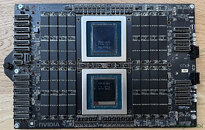
 NVIDIA is projected to sell about $20 billion worth of "Vera" and "Grace" CPUs, tapping into a $200 billion Total Addressable Market (TAM) with its standalone offerings. As NVIDIA partners with every major hyperscaler to supply "Vera" CPU racks, we are starting to see many deployments across infrastructure providers for their own use cases and offerings to third-party customers. This approach allows NVIDIA to tap into a massive market, potentially propelling it to become one of the largest CPU makers this year and likely for years to come.
Source:
Phoronix
For comparison, Phoronix tested single and dual Intel Xeon "Granite Rapids" 6980P CPUs, as well as AMD EPYC "Turin" and "Turin Dense" models like the AMD EPYC 9755, 9575F, and 9475F. They also included NVIDIA's first-generation "Grace" design based on Arm Neoverse V2 cores. NVIDIA allowed only a specific subset of tests on this pre-release chip, including standard workloads like code compilation, stream memory performance, video encoding, Python/Java, and database performance. In the geometric mean of all test results, NVIDIA's "Vera" topped the chart, performing nearly 11% better than AMD's most advanced designs and about 55.3% better than the best single-socket Intel Xeon. It also outperformed dual-socket configurations, suggesting that some workloads have scaling issues across multiple sockets. These limited results place "Vera" above any Arm-based design, with a 450 W TDP for the CPU and 50 W for the 768 GB memory pool.


57 Comments on NVIDIA "Vera" CPU Benchmarked: Beating Intel Xeon and AMD EPYC in Select Workloads
The second half of this is the AI aspect, where corporations are aggressively adding capacity for a new use case. This second half of the discussion is where we need to worry, as it’s not just treading water on our current, gradually growing datacenter needs, but drastically increases potential demand and even greater resource needs.
The only reason I could think of them excluding the benchmarks is that the performance was uncompetitive with x86, which would be a real disappointment.
it has already lost..
13.5% faster vs the single 64c, high-clock dense version at 400W.
25% faster vs the single 128c, low-clock dense version at 500W.
But yeah, I believe Zen 6 will be faster by all metrics as well. Even the memory bandwidth should be improved a lot.
Vera currently has a 1024-bit wide LPDDR5X memory bus @ 9600MT/s, thus achieving the 1.2TB/s bw mark.
Venice is rumored to support DDR5 RDIMMs @ 8000MT/s, or MRDIMMs @ 12800MT/s, on a 16-channel platform, meaning 1TB/s @ 8000MT/s or 1.6TB/s @ 12800MT/s. 12-channel numbers should land at 768GB/s or 1.2TB/s, respectively. That extra memory bandwidth alone should make even the current Zen 5 dies surpass Vera, IMO.
The tests being curated by Nvidia should be in the title if there was an ounce of journalistic integrity given just how important that fact is.
My dayum was more in the shape of dayum that is not the worst efficiency given its performance on ARM.
I mean; let's appreciate that 450W is beating TWO 400W 9575Fs
It needs to specify "Nvidia curated workloads".
Good
And that is not new to them; plus this is not a small win either.
But I agree, needs more detail
I'm seeing one upside here. Moving the AI workloads to CPU is going to give GPU markets breathing room.
Yeah, maybe the reason your reasoning is not understood is because your reasoning doesn't make any sense. Or because you posted three words like everyone here is Nostradamus and can read your mind.