Monday, June 22nd 2026

Intel to Revive "Raptor Lake Next" Even for Gaming Notebooks to Soak Up DDR4 SODIMM Inventory
Last week, it was reported that Intel is bringing back its Core "Raptor Lake" client microarchitecture a second time under the "Raptor Lake Next" internal codename, and newer Core (non-Ultra) nomenclature, to cater to the PC crowd benefiting from its DDR4 memory backwards compatibility to save on memory costs. It turns out that the company is also bringing this second refresh to the gaming notebook segment, specifically the HX segment that uses discrete GPUs. These processors will feature Core (non-Ultra) series 2 (200 series) processor model numbering to align with Intel's new naming scheme.
Intel uses a common silicon for its desktop S-segment and the HX-segment, so the top SKU based on "Raptor Lake Next-HX" will max out the silicon, with a core-configuration of 8P+16E, with HyperThreading enabled on the P-cores, for a total logical processor count of 32. The monolithic die is built on the Intel 7 foundry node, and the lack of low-power island E-cores mean that these will be power hungry chips by contemporary standards. The HX segment calls for a processor base power of 55 W, and a three-figure maximum turbo power. For reference, the Core i9-14900HX from the "Raptor Lake Refresh" generation came with 55 W base power, and 159 W of maximum turbo power, requiring notebook OEMs to bundle power bricks with 320 W on tap, with some OEMs even including 400 W bricks.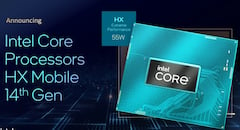 To ensure that "Raptor Lake Next-HX" doesn't cannibalize "Arrow Lake-HX," there could be product segmentation recommendations from Intel to OEMs, to ensure that gaming notebooks powered by the latter come with faster DDR5 SODIMM memory; at least until "Nova Lake" makes its way to this segment in 2027.
Source:
VideoCardz
Intel uses a common silicon for its desktop S-segment and the HX-segment, so the top SKU based on "Raptor Lake Next-HX" will max out the silicon, with a core-configuration of 8P+16E, with HyperThreading enabled on the P-cores, for a total logical processor count of 32. The monolithic die is built on the Intel 7 foundry node, and the lack of low-power island E-cores mean that these will be power hungry chips by contemporary standards. The HX segment calls for a processor base power of 55 W, and a three-figure maximum turbo power. For reference, the Core i9-14900HX from the "Raptor Lake Refresh" generation came with 55 W base power, and 159 W of maximum turbo power, requiring notebook OEMs to bundle power bricks with 320 W on tap, with some OEMs even including 400 W bricks.

14 Comments on Intel to Revive "Raptor Lake Next" Even for Gaming Notebooks to Soak Up DDR4 SODIMM Inventory
The total and utter lack of development and innovation is now touted as 'NEXT'... Nvidia's doing it too.
But it is in fact PREVIOUS
This is what a bubble sounds like
Going back to Raptor Lake is a massive step back for mobile CPU's and significantly more power hungry than Arrow Lake.
(as in, I'm very sure by now the cost increases weren't because people were buying DDR4 like crazy....in 2025)
I mean, if Raptor Lake would actually come redone without leakage and in a very smaller and efficient node, at 2/3s the cost, it miiiight be a viable option but not in the gaming segment.
Raptor lake CPUs are still pretty modern, relevant and usable CPUs, there is nothing wrong about them, and they are much better for utilising DDR4 RAM sticks than 5000 AMD chips.
Every value oriented consumer who wants to take advantage of the lower cost of DDR4 memory should be happy that he will have an option to buy such great CPUs probably for a good price.
I REALLY do not understand what and why some people write here...
Nobody complained about Zen+ and Zen3+, yet I always see people whining whenever it's about Intel. Get a life.
Raptor Lake is still competitive against AMD in laptop battery life because all the high-end high-performance high-core count options from AMD on the laptop market right now are the chiplet desktop CPUs which have quite horrendous idle power usage. It's not like you'll see the difference between older Intel and AMD on a 60Wh battery anyways when you have a Nvidia dGPU, I personally couldn't with 3 budget laptops (1 Intel and 2 AMD, all of them with a Nvidia dGPU) as they all last 3 hours on battery while browsing the web, but the older the laptop is, the smaller is the battery (my first laptop was the Intel one with a 42Wh battery iirc). I would even point to the fact we went backwards when it comes to battery life; something AMD " excelled " at, and now is completely out of consideration.
I'm gonna be honest there, I fell for the "Ryzen have better battery life" marketing, and never again I would consider AMD on laptops considering how bad their match up was against Intel even just in raw performance. Zen+ Picasso was horrendous and couldn't match even an old i5-7300HQ which was 2 years old by that point. Zen3 Cezanne was decent, outside of iGPU driver issues, but its successor Zen3+ Rembrandt actually sucked because it was a step backwards in performance while needing DDR5. And unironically, right now I can't even afford to go AMD on the laptop market.
Not to mention the degradation risk, I doubt these would be a new design, just spinning back up an old fab because it's higher margins, while AI gets cutting edge tech.Well, Zen+ and Zen3+ were still improvements on the architecture. Raptor lake next is just selling you an old CPU on 10nm again. Intel is a larger company with nearly 80% market share, who's also getting help from Nvidia now. Get a life and stop shielding for Intel.
You know you could also get a life and stop worshipping AMD at every chance you get. Intel has always been lightyears ahead on mobile CPU's compared to AMD, and that isn't changing any time soon.
-NVIDIA stock price quote:
-AMD stock price quote:
www.techpowerup.com/349988/amd-brings-back-zen2-zen-architecture-with-three-new-processors#comments
If you want the bleeding edge, you can still buy it if you want to. Nor AMD or Intel are putting a gun over the customers heads to force them to buy the old tech.
Lastly, Intel is the proof that being bigger doesn’t guarantee success. Their fabs have been a pain bleeding money with little to show for years. They’ve lost their bleeding edge advantage and had to push the silicon to the brink because the old leadership had too much pride to dare going external when it was obvious that their in-house fab was about to become a liability.
Intel size also doesn’t prevent them from slowly but surely losing ground in the market that matter the most: data center. AMD managed to have revenues equals to Intel in that sector despite being a smaller company.
The Q1 revenue of AMD was 10.3B. Intel was 13.6B we aren’t in a David vs Goliath situation anymore, especially when AMD is flat out absent in some of intel’s market. For example Intel client revenue is padded by all the network hardware that you are pretty much guaranteed to find on every Intel based computer. (Amd is juste rebadging mediatek)