Thursday, July 2nd 2026

Intel Raises MSRP of Core Ultra 7 270K Plus and Core Ultra 5 250K Plus
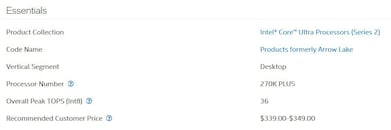
Intel quietly increased the recommended selling price of its recently launched Core Ultra 7 270K Plus and Core Ultra 5 250K Plus "Arrow Lake-S" desktop processors from their launch prices of $299.99 and $199.99, respectively. The 270K Plus now sees a significant 16% price increase, and comes with an MSRP of $349.99. Meanwhile, the Core Ultra 5 250K Plus, which received much praise in the media for its disruptive price, gets a 15% price increase, with an MSRP of $229.99. The new prices are reflected in Intel's online product information pages for the 270K Plus and 250K Plus.
Both chips are Socket LGA1851 processors meant for Intel 800-series chipset motherboards. The 270K Plus offers an 8P+16E core configuration that maxes out the "Arrow Lake-S" silicon, with its entire 36 MB L3 cache, and a maximum P-core boost frequency of 5.50 GHz; meanwhile the 250K Plus comes with the highest core count among any Intel "5" segment processor, with 6P+12E, and 30 MB of L3 cache. Both chips also support Intel's new Binary Optimization technology.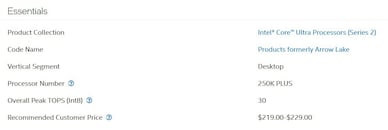
Source:
Harukaze5719 (Twitter)
Both chips are Socket LGA1851 processors meant for Intel 800-series chipset motherboards. The 270K Plus offers an 8P+16E core configuration that maxes out the "Arrow Lake-S" silicon, with its entire 36 MB L3 cache, and a maximum P-core boost frequency of 5.50 GHz; meanwhile the 250K Plus comes with the highest core count among any Intel "5" segment processor, with 6P+12E, and 30 MB of L3 cache. Both chips also support Intel's new Binary Optimization technology.


101 Comments on Intel Raises MSRP of Core Ultra 7 270K Plus and Core Ultra 5 250K Plus
There's no need to buy a 9950X3D when a 7800X3D is $349 which is still an upgrade over a 7700X, A 270K plus might save you a bit if you cheap out on a motherboard, though you'd have to buy a new mobo again for Nova Lake.
For the earliest am5, the b650, the problem appears even more serious, and the b650 was expensive, even a mid-range b650 is not cheap at that time.
I think many people are thinking about upgrading, but they bought low-spec motherboards and will eventually have to replace them anyway.
I think for the zen6 12c, 10-12 phase 55A drmos, or 80A drmos 8 phase may be required, so mainstream b650 am5 and cost-effective b850 may not be enough to run the zen6 12c, and the problem with zen7 16c appears even more serious. Unless staying at 8 core all the time, but 8 core will be a low-end option after the release of zen6. This also points to a downward price trend for am5 cpus.
Anyway, even high-end b650 boards won't be worth much by then. New am5 boards will have more comprehensive features and better specs to match the new cpus, and they will launch at appropriate prices.This should be a chipset comparison, z890 supports more pcie lanes. And x870-e is daisy chain, which is very cope.
Doing that they have recovered a lot of the money paid for the component.
Good for them, that's basically the schtick I was talking about, if you sell it while it's still attractive you recover a lot of the money.Okay I'll use your example.
Let's say someone got on the AM5 train in early 2023 by buying a budget mobo (a B650 ATX for $200) and a 7600X for $250.
Then he decides he will change the CPU at the end of the socket.
Suppose that is Zen7.
Pretty much whatever Zen7 CPU he gets it will be an upgrade over 7600X.
But let's say he gets a 16 core single CCD "11800X3D" which is a substantial upgrade.
Okay so he buys the Zen7 CPU in 2028 or something, a bit after release to wait for some discounts.
Thus 5.5 years or so after his 7600X.
Alright he saves money for the mobo but how much can he recover by selling the 7600X?
Again this is two or more years after the warranty expired, how attractive can such a CPU be on the used market?
Some will say "ah no big deal, the CPU doesn't matter much what's important is that you save money on the mobo" okay but the CPU was initially slightly more expensive than the mobo how is a briliant move???
See my point? If you hold out too much then you're not actually reaping the benefits more like you're settling for scraps. Yeah you get a cutting edge CPU on a mobo which is not cutting edge anymore in some regards which might matter (because it has to provide what you need for the next several years after those first 5.5-6), also you're rocking a RAM kit which might be holding back the CPU a bit if the frequency sweetspot for Zen7 will be 7200-7600 or maybe 8000.
I'm having mad trouble in seeing this scenario as being a banger. Maybe it's just me.Ok my bad.
I'll redo the example with 9700X vs 265K.
In 2025, that is before the Arrow Lake Refresh and RAM/NAND crisis, the 265K was discounted to the point where it competed with the 9700X for the same price.
Was that based on performance?
Intel made some adjustments because Arrow Lake wasn't competitive in gaming against Zen5 X3D. Because against non-X3D it was very close.
I don't remember seeing AMD fans being butthurt about the fact that for the same money they get a 9700X while the other guys get a 265K.
But what I do remember is some of those AMD fans trying to justify the poor value of the 9700X (compared to the discounted 265K) by using the upgrade path angle. Sort of like yeah you buy a lackluster CPU now but you can then upgrade to the Zen6 "10800X3D" whereas LGA1851 is a dead socket.
So is this platform tax? If not then what is it?
CPU: *Intel Core Ultra 7 270K Plus 3.7 GHz 24-Core Processor ($309.99 @ Amazon)
Total: $309.99
Prices include shipping, taxes, and discounts when available
*Lowest price parts chosen from parametric criteria
Generated by PCPartPicker 2026-07-02 12:51 EDT-0400
PCPartPicker Part List
CPU: *AMD Ryzen 9 9950X 4.3 GHz 16-Core Processor ($501.25 @ Amazon)
Total: $501.25
Prices include shipping, taxes, and discounts when available
*Lowest price parts chosen from parametric criteria
Generated by PCPartPicker 2026-07-02 12:57 EDT-0400
PCPartPicker Part List
CPU: *AMD Ryzen 9 9950X3D 4.3 GHz 16-Core Processor ($669.00 @ Newegg)
Total: $669.00
Prices include shipping, taxes, and discounts when available
*Lowest price parts chosen from parametric criteria
Generated by PCPartPicker 2026-07-02 12:54 EDT-0400
www.techpowerup.com/review/intel-core-ultra-7-270k-plus/10.html
To be fair though, both the 9950x and the 9950x 3d are great chips. Intel just pulled a gotcha with the arrowlake refresh. AMD could slash prices and compete but right now is not the time to do it, they are knee deep into AI money.
You're welcome to your opinion, but I categorically disagree with your logic. "Platform tax" has always referred to having to replace your platform—not having the option to keep it.
Just because AMD had the stronger product and charged more doesn't suddenly redefine the term. That's simply free-market economics. Companies charge what the market will bear. Intel did exactly the same thing when it was in that position.
And here in EU they've been below MSRP starting like 2-3 weeks after release.
This leads to a scarcity of new cpus and an oversupply of old cpus. You keep selling the oversupply and buying the scarce ones, while retaining a motherboard oversupplied.
If you sell a cpu and then buy another cpu, is the ratio of cpus sold to motherboards still close to 1:1 for intel and amd? This has no impact on intel and amd. When you buy a cpu, sell a cpu, and keep the motherboard, another person in the market buys your cpu and most likely buys a motherboard. From amd's perspective, they sold 2 motherboards and 2 cpus, and that is all.
Intel constantly changed sockets in the past, not at all to make that bit of money from diy. Intel has a massive business desktop market, and what intel needs is to maintain control. Changing sockets causes the ratio of motherboards and cpus in each generation to be close to 1:1 instead of spanning across several generations. Therefore, intel can to some extent maintain the prices of old cpus. Before intel enters the next generation, old cpus often rise in price, indicating that the motherboard supply is normal but the cpu supply is reduced, which helps maintain the value of old cpus. So intel's cpus from several years ago can always sell for incredible prices. Although they are outdated, the people who need them still need them, and the people who pay might not care, or it might not be their money. There might be some dirty things involved, but it is not what you think.
This situation has lasted for many years, perhaps companies are paying a "platform tax", thereby maintaining the price of intel diy users selling old cpus. I do not care, as long as I can try out intel cpus for free for several years, and then sell them at close to the purchase price.
AMD doesn't even sell motherboards, so the "AMD sold two motherboards and two CPUs" example doesn't make sense. Board vendors sell the motherboards.
More importantly, you've spent several posts explaining your theory of Intel's socket strategy, but none of it answers the original question.
Even if your entire economic model were true, it still doesn't make a long-lived socket a platform tax.
A platform tax is a mandatory cost. Replacing a perfectly functional motherboard because your new CPU requires it is a mandatory cost.
A long-lived socket simply gives the owner the option to reuse existing hardware. That's the opposite of a mandatory cost.
Whether Intel historically changed sockets to protect used CPU prices or for OEM validation cycles is an entirely different discussion.
X3D tax is separate because it only applies to 3D V-Cache CPUs which are uncontested in gaming.
Even though 3D V-Cache has benefits outside of gaming. Not every time but enough that it's not negligible.
The problem especially with single CCD X3D CPUs is their poorer value when considering mixed usage or non-gaming scenarios.
Because the high price for the overall performance translates into a lower bang per buck ratio.
Unfortunately because X3D CPUs are king of the hill that means AMD gets to set the price how it wants. And then this high price influences the price of non-X3D CPUs, which is obviously lower but in the context of this discussion higher than of comparable Intel CPUs (again we can ignore the Arrow Lake Refresh models and talk only about the situation in 2025).
Oh right and Zen5 is made on a larger node than Arrow Lake which means they're not as expensive to produce. Especially non-X3D models which don't have that extra feature.
So the question arises, why aren't non-X3D Zen5 CPUs priced (almost) the same as comparable Intel CPUs?
When talking about motherboards I can give my own example from spring 2025.
At first I was looking at an AM5 platform, mainly 7950X with a X870(E) motherboard.
But after some weeks prices of CPUs started to change, and LGA1851 started to look like the better option, for me anyway. I'm not talking about the 245K and 265K discounts this is before that.
So I went with LGA1851.
I can tell you for sure that prices of Z890 motherboards were lower than of comparable X870E ones. 100% that's how it was, because I remember being a bit surprised that I'm getting like almost the same thing (apart from the socket of course) but for less money.
Again this is before the CPU discounts and the Microcenter bundles and all of the crazy Intel charity when you also got a game code.
So if Arrow Lake CPUs were comparable to various non-X3D Zen5 CPUs and if Z890 mobos were comparable to X870E mobos then why were they discounted?
Because people did not like Arrow Lake right?
Why?
Because the gaming performance was clearly lower than of X3D CPUs.
Oh yeah and because it didn't manage to surpass Raptor Lake, which definitely didn't help.
And that there was no upgrade path.
That is it.
Aka platform tax. You pay more because you can change the CPU later from non-X3D to X3D (which is a massive asset for AMD) or even better to the next gen etc.
And for this benefit/privilege which makes AM5 more attractive people are willing to pay more.I agree CPU makers can definitely abuse the socket change, Intel is a prime example.
Of course from time to time a socket change is necessary. Sometimes sooner sometimes later.
Which brings us the question how long lived should a socket be?
Do we it admit the possibility of it overstaying its welcome?
If yes how would that look like?
Doesn't a long lived socket imply some degree of stagnation?
Funny (or actually the opposite) how Intel abused the socket change while being stagnant regarding core count at the same time. Hall of shame champions no less.
You've redefined "platform tax" to mean "paying more than I think it's worth."
Historically, platform tax has referred to the mandatory cost of adopting a platform—motherboard, memory, cooler compatibility, etc. It has never meant "I personally don't like the price."
AMD charging more because demand is high or because it has the gaming crown isn't a platform tax. It's simply pricing. Intel did exactly the same thing when it had the performance lead.
If you think Ryzen or X3D are overpriced, that's a perfectly fair opinion. But that's a value argument, not a platform argument.
The platform itself is what gives you the option to keep your motherboard across CPU generations. That's a platform benefit, not a platform tax.
EG1. Before people start arguing about getting to keep your ddr4 ram, yes you can keep your ddr4 ram with a bunch of other CPUs that aren't 350$. You can buy a 12400f for 120 and a 14600kf for 230.
So you're saying that you think AM5 is worth more because of the non-performance benefits?
Well good, then pay for it. If re-framing it from "paying more for non-performance benefits aka what I call platform tax" to "paying what you think the extra features are worth" makes the price more palatable and suppresses any hints of regret then do what's required.
But you're not convincing me that it's worth it. I already made my choice. When I'll feel I need an upgrade I'll do it, $300-400 or whatever for a new motherboard is practically irrelevant, everything is half baked shit anyway so that's my primary concern not the cost of a new mobo, that's background noise if I'm being generous.But there's not really a performance lead when discussing non-X3D Zen5 vs Arrow Lake is it?
Well for Linux it is, but Linux userbase is much smaller so probably the mainstream Windows performance is still what dictates pricing.
But the X3D greatness does influence non-X3D as well. Halo effect right? Not quite fair, each should be judged strictly on its own merits but it is what it is.High demand incentivizes discounts.
Because high demand means they can place a larger order, sign a new contract whatever, for the foundry mofos it means that large scale production is the most profitable aka they can afford to lower costs.
We all know that small scale production, limited run, boutique manufacture is the most expensive.
That's why we see this with Chinese manufacture of electric drills, lawn mowers, espresso makers etc. you buy 10,000 units you get a price per unit, you buy 100,000 units you get a lower price per unit, you buy 1,000,000 units you get an even lower price per unit.It costs more due to that benefit.
But it's not like AMD is making an active effort to make the socket longer lived.
I could simply say they're being lazy because they're king of the hill thanks to X3D gaming dominance.
So while this longevity is a benefit, it's not like a feature that's being glued to the motherboard to give you some extra connection or whatever. Something that costs money to make and then money to make it fit on the mobo. See what I mean?
If AMD isn't spending money to keep the socket why do you pay more for this benefit?
Well maybe it's to keep the mobo makers happy. After all they're only selling one AM5 motherboard to some users and I'm guessing that is less than ideal for them. So having motherboards be a wee bit overpriced means that in the end mobo makers are pretty well fed even with a long lived socket.
Only for two relatively short period of time that it was under $300, but for the majority of the time it was above the MSRP with an average price of $314.52.
Here I brought you a chart.
On the actual subject of the price increases, I'm simply... exhausted? These price hikes mean nothing to me because there was already so much pitted against me ever being personally interested in these, chief among them being memory prices. I refuse to make such an expenditure, not to mention the added cost of swapping to a new motherboard. The price of the CPU itself wasn't my first or second concern, really.
1. A mandatory platform cost is the motherboard/memory/socket/cooler cost required to adopt or replace a platform.
2. A market premium is paying more because the product or ecosystem is more attractive.
3. A poor-value product is simply a product you think costs too much for its performance.
Only the first one is a platform tax.
AM5 longevity may create a market premium because buyers value the upgrade path. That is fair to argue. But reuse of an existing motherboard is not a tax. It reduces mandatory platform cost.
The 5800X3D/AM4 example proves the opposite of what you think it proves. If an old-socket CPU sells at a high price because existing AM4 owners want a drop-in upgrade, that is pricing power from demand and scarcity. It is not a mandatory tax. Nobody is forced to buy it, and the user is still avoiding the cost of a board/RAM/platform swap.
Same with AM5. If Ryzen costs more because AMD has stronger demand, X3D gaming leadership, or a longer upgrade path, that is a value/pricing argument. It does not redefine “platform tax.”
A platform tax is when the platform forces an extra spend. Socket longevity gives the user the option not to spend. That is the opposite mechanism.
Am I taking crazy pills? Or is this logic from anyone who has built a pc before 2 years ago.
But people will buy it because they think this is the best option to them.
Intel just restarted to sell 12th/13th/14th Gen. Let's see who will sell.
Depending on your game and resolution - yes. But it's the same as calling a formular 1 car the best car. On a specific racing track - yes, on your regular city streets with all it's flaws - no.
Same for your type of game. Play chess and you barely notice a difference, play CS on 8k and you also barely notice any difference. Play on 360p and you'll see.
But do I only/mostly play videogames?
Personaly, no. So these X3D's are nice, but I keep using the regular 12 core counterpart that dose the same trick but cheaper.
You forget to mention efficiency. X3D CPU's are much more efficient in gaming (especially 7800X3D).
Sure, regular CPUs will do the same job, no doubt about it.
X3D cache (vertically layered/stacked extra L3 cache pile) offers huge advantage in processes that rely heavily on RAM latency or bandwidth (or both).
What extra L3 cache does is it reduces need for accessing RAM so often. Instead, apps/games can leverage much faster pile of cache directly in CPU.
That's why X3D CPUs' performance is much less dependent on RAM bandwidth and latency than regular non X3D CPUs.
I'm not saying you're telling lies, it's just there's more to it than you think. Image and video processing apps can also leverage X3D cache to their advantage.
Getting bigger VRAM improves performance cause you don't have to load textures all the time.
Getting more and faster RAM will (depending on your OS) get you some benefits cause you'r program can store and access more data on faster RAM instead of swapping it from/to slower solid storage.
Getting faster solid storage (HDD / SSD) will increase your performance (at least as long as you have to read/write data).
To oversimplify it further 5GHz 96MB L3 vs 10GHz 32MB L3 - who will win?
It has been proven many times. When you run out of memory and you still need to load other things, no bandwidth can help you.
That's why RTX 4060 8GB and similar struggle so much in some games even in 1080p when you dial up RT and/or Ray Regeneration.
If you need to access memory often and you're already in state where you don't have enough of it, it also puts load on CPU.
L3 cache is physically right below/above the CPU cores, latency is around 12-15 ns, bandwidth is 10-15x more than RAM bandwidth.
That along with capacity is what makes L3 cache big deal. But as you said, there's a limit about when it becomes irrelevant.
For instance, you need to have just enough large L3 cache to substitute all needs for regular memory. After that, it becomes irrelevant.
Of course, you can't have 32 GB L3 cache ...