Thursday, July 2nd 2026

Intel Raises MSRP of Core Ultra 7 270K Plus and Core Ultra 5 250K Plus
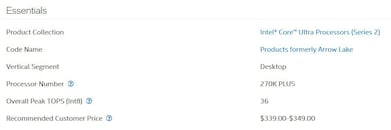
Intel quietly increased the recommended selling price of its recently launched Core Ultra 7 270K Plus and Core Ultra 5 250K Plus "Arrow Lake-S" desktop processors from their launch prices of $299.99 and $199.99, respectively. The 270K Plus now sees a significant 16% price increase, and comes with an MSRP of $349.99. Meanwhile, the Core Ultra 5 250K Plus, which received much praise in the media for its disruptive price, gets a 15% price increase, with an MSRP of $229.99. The new prices are reflected in Intel's online product information pages for the 270K Plus and 250K Plus.
Both chips are Socket LGA1851 processors meant for Intel 800-series chipset motherboards. The 270K Plus offers an 8P+16E core configuration that maxes out the "Arrow Lake-S" silicon, with its entire 36 MB L3 cache, and a maximum P-core boost frequency of 5.50 GHz; meanwhile the 250K Plus comes with the highest core count among any Intel "5" segment processor, with 6P+12E, and 30 MB of L3 cache. Both chips also support Intel's new Binary Optimization technology.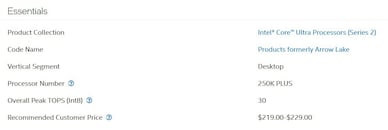
Source:
Harukaze5719 (Twitter)
Both chips are Socket LGA1851 processors meant for Intel 800-series chipset motherboards. The 270K Plus offers an 8P+16E core configuration that maxes out the "Arrow Lake-S" silicon, with its entire 36 MB L3 cache, and a maximum P-core boost frequency of 5.50 GHz; meanwhile the 250K Plus comes with the highest core count among any Intel "5" segment processor, with 6P+12E, and 30 MB of L3 cache. Both chips also support Intel's new Binary Optimization technology.


101 Comments on Intel Raises MSRP of Core Ultra 7 270K Plus and Core Ultra 5 250K Plus
The X3Ds are gaming champions because of their efficiency, we can all agree the net performance is surpassed over time, but I'd still not trade my 7800X3D for ANYTHING ELSE on the market currently for a gaming PC.
Yes, you can indeed get other CPUs that are more jack of all trades master of none. And that's fine too. But the X3Ds remain the gaming champions, there isn't a sliver of doubt. Most importantly because they push the heaviest gaming workloads (4X, late game strategy, etc.) forward much better than any other CPU can. And yes, at that point, every bit of ST performance and lowered latency in the pipeline is valuable, and no, you can't get that any other way currently.
From launch till now those were early bird prices. :laugh:You wouldn't be saying that if the P vs E tests would've been done on Arrow Lake to show the truth.
If you don't swap out your CPU every year and don't care about socket longevity that's a screaming deal on a hell of a lot of processing power.
No matter which camp you root for... no matter if you want Another Mid Disappointment, a Shintel or a leather clad active fire hazard...
PC component prices suck balls right now.
Because you are leaning on America’s pricing situation to excuse the value argument falling apart.
The issue is not whether U.S. buyers sometimes get better deals. The issue is that Intel raised the price on chips whose main selling point was aggressive pricing. That is the entire problem.
And using the 5800X3D as the comparison is cherry-picking. It is an old AM4 drop-in chip with inflated used/new-old-stock pricing because people can upgrade without buying a new board or RAM. That does not magically make a 250K/270K price hike good.
If your defense of Intel’s price hike is “well, it is still better than an overpriced old X3D listing,” then that is not a strong defense. That is just moving the goalposts to the ugliest comparison you can find.
It's not worth fighting over this. It sucks they raised the prices by what 15%? But then again, what didn't get a price hike? Maybe power supplies and cases, so far those are the only two components for a PC that didn't somewhat see of a price increase. We're going through a major semiconductor crisis.
The thread is about Intel raising MSRP on the 250K+ and 270K+. These chips were attractive because the pricing was aggressive. Once the price goes up 15–17%, the value argument gets weaker. That is the whole point.
Comparing it to an overpriced 5800X3D listing does not prove it is a good deal. Bringing up U.S. pricing does not prove it is a good deal. Saying “everything is expensive now” does not prove it is a good deal.
Those are all ways around the argument, not answers to it.
If Intel’s best defense is “well, the whole market sucks too,” then congratulations, that is not a defense. That is just admitting the price hike makes a bad market worse.
Tan has demonstrated he understands what needs to be done to make Intel successful again. The retail market is largely irrelevant to the task. Big customers competing for the same wafers win. Retail sales are poor, so it is good business to make as much as you can off of each unit sold. Shoppers choosing 1851 are going to do it regardless of the price hike. I.E. $30-$50 is not going to be a deal breaker.
Everyone else happily pays the Nvidia and AMD tax as they have been dubbed. Complain all you want about the 5800X3D; it came right off the stool when the bell rang and molly whopped everything Intel makes. Newegg completely sold out. The 270K costing less than the 4 year old X3D is also a bad look from a neuromarketing aspect. Price hike is a smart play all around.
Since the COVID pandemic you can count on one hand the periods of relative stability, and with the ongoing memory shortages affecting RAM and NAND, (~9 months give or take a few weeks, depending where you are), everything is selling as stock shortages became a constant. Privileged regions (North America and Western Europe) get some relief, but overall, the DIY channel is currently going through a stroke.
Things have never been as bad as they are right now, not even during the crypto madness of 2021-2023.
And this is indeed a 1st world problem, while amd also sells very well in other countries, it is not like what is shown on amazon. I think this is because the distribution of intelligence and knowledge is more even, while capital is concentrated in countries like the US, so a high school graduate in the US can earn $20/h at Mcdonald's, while a Ph.D in the 3rd world with a full-time job may not be able to achieve this, because the market does not allow him to get more. Relative to intel, amd is roughly equivalent to 2 more days of work at Mcdonald's, which might help him get an upgrade path or something like that, he thinks it is worth it, and does not mind working 4 more days to get zen6, which is far lower than local housing and other expenses. this is fair, a very fun product, amd provides such a product, so it is what amd deserves.