Thursday, July 16th 2026
Bosgame Demonstrates Scalable Private AI with 7-Node AI MAX+ 395 Cluster
Bosgame, a technology-based electronic product brand, has demonstrated distributed inference of the DeepSeek-V3.1 671B-parameter model on its AI MAX+ 395 7-Node Cluster. Built from seven Bosgame M5 AI Mini PCs connected through USB4 Direct Connection, the system presents a scalable approach to private AI deployment and local large language model (LLM) inference.
As AI models continue to expand in parameter size and complexity, a single AI PC may lack the memory and computing resources required for advanced workloads. While traditional AI servers can provide the necessary computing power, their high deployment costs and infrastructure complexity can limit adoption. Enterprises and developers are therefore exploring scale-out architectures that support larger models while providing greater flexibility than conventional AI server deployments.
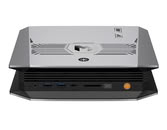

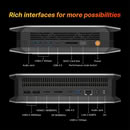
 Against this backdrop, the Bosgame AI Cluster offers a modular, cost-effective approach that grows with users' needs.
The Bosgame demonstration shows how seven M5 AI Mini PCs can operate as a unified AI Cluster. By distributing the inference process across multiple nodes, the cluster supports models that may exceed the memory capacity of a standalone system. Its ability to run the DeepSeek-V3.1 671B model highlights the potential of distributed computing for locally deployed generative AI applications.
Across seven nodes, the cluster provides 896 GB of Unified Memory, with up to 672 GB allocated as Unified VRAM, creating a substantial resource pool for memory-intensive AI workloads. USB4 Direct Connection enables the nodes to work together without requiring a traditional centralized server architecture.
Designed around a modular scale-out architecture, the Bosgame AI Cluster allows organizations and developers to begin with one M5 AI Mini PC and expand capacity as project requirements evolve. This flexible expansion model supports workload-based growth and offers a simpler alternative to traditional AI servers while aligning infrastructure investment with actual computing needs.
Beyond AI inference, the platform also supports local AI development through a local API service powered by Llama.cpp. The cluster can be used for software development, debugging, Kubernetes operations, enterprise AI initiatives, and edge AI computing applications. By keeping workloads and data on local infrastructure, organizations can maintain greater control over data management and deployment environments.
The demonstration reflects growing demand for scalable private AI infrastructure capable of supporting increasingly large models. Through distributed inference, modular expansion, and local deployment, Bosgame aims to provide flexible computing options for enterprises, developers, and edge AI applications.
Source:
Bosgame
As AI models continue to expand in parameter size and complexity, a single AI PC may lack the memory and computing resources required for advanced workloads. While traditional AI servers can provide the necessary computing power, their high deployment costs and infrastructure complexity can limit adoption. Enterprises and developers are therefore exploring scale-out architectures that support larger models while providing greater flexibility than conventional AI server deployments.


The Bosgame demonstration shows how seven M5 AI Mini PCs can operate as a unified AI Cluster. By distributing the inference process across multiple nodes, the cluster supports models that may exceed the memory capacity of a standalone system. Its ability to run the DeepSeek-V3.1 671B model highlights the potential of distributed computing for locally deployed generative AI applications.
Across seven nodes, the cluster provides 896 GB of Unified Memory, with up to 672 GB allocated as Unified VRAM, creating a substantial resource pool for memory-intensive AI workloads. USB4 Direct Connection enables the nodes to work together without requiring a traditional centralized server architecture.
Designed around a modular scale-out architecture, the Bosgame AI Cluster allows organizations and developers to begin with one M5 AI Mini PC and expand capacity as project requirements evolve. This flexible expansion model supports workload-based growth and offers a simpler alternative to traditional AI servers while aligning infrastructure investment with actual computing needs.
Beyond AI inference, the platform also supports local AI development through a local API service powered by Llama.cpp. The cluster can be used for software development, debugging, Kubernetes operations, enterprise AI initiatives, and edge AI computing applications. By keeping workloads and data on local infrastructure, organizations can maintain greater control over data management and deployment environments.
The demonstration reflects growing demand for scalable private AI infrastructure capable of supporting increasingly large models. Through distributed inference, modular expansion, and local deployment, Bosgame aims to provide flexible computing options for enterprises, developers, and edge AI applications.
6 Comments on Bosgame Demonstrates Scalable Private AI with 7-Node AI MAX+ 395 Cluster
For that amount of money and ram it may be able to run large models with acceptable power efficiency, but the response speed would be unbearably slow for any real use imho.
However, with tensor parallelism you'd be able to actually distribute the compute load and in theory achieve ~70tok/s, which is way more usable given the model size. But that's not really feasible with AMD stack and the bandwidth limitation of USB4.
At this price range one would be way better off with a cluster of DGX Sparks, which have way better interconnects with CX7 and way better raw compute perf for way faster prefill speeds, or even getting some 8-channel platform with a single GPU to help on the PP part. Even a DDR4 platform with 8-channels at 3200MHz would theoretically give you a little bit over 200GB/s, which is not so far off from Strix Halo's 256GB/s.
If one manages a DDR5 platform it's even better, given that now you can get 4800~5200MHz at 6/8/12-channels, meaning a bandwidth of 230GB/s on the lower end, and up to 500GB/s on the higher end of the spectrum, but then you're throwing the power efficiency part out of the window.
Something like Intel's Crescent Island inference cards should be way better in terms of hardware but the software stack remains a problem there as well.
Man, the hardware prices suck, the so called trickle down economics ain't working for us plebs.
www.bosgamepc.com/blogs/application-scenarios/bosgame-7-node-ai-max-395-cluster
Too bad that post doesn't really get into any technical details, bummer.