Monday, July 20th 2026

ARCTIC Updates MX-4 Thermal Paste Packaging and Syringe Design
ARCTIC has updated the packaging for its MX-4 thermal paste, bringing its visual identity in line with the current MX-7 series design. The redesign introduces new packaging alongside a custom syringe developed by ARCTIC. While the appearance has changed, the MX-4 formula remains exactly the same. Users can continue to expect the same proven thermal performance, reliability, and ease of application that have made MX-4 one of the most trusted thermal compounds on the market.
Protecting customers remains ARCTIC's top priority, so here is how customers can check if the product is genuine. Customers who have questions regarding product authentication or verification can contact ARCTIC support. 2026 marks ARCTIC's 25th anniversary - a milestone celebrating a quarter-century of innovation, engineering excellence, and commitment to PC cooling. To mark this special occasion, a variety of new promotions and initiatives will be introduced throughout the anniversary period, including exclusive offers and community activities.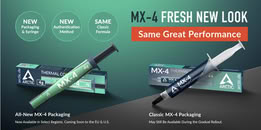
Protecting customers remains ARCTIC's top priority, so here is how customers can check if the product is genuine. Customers who have questions regarding product authentication or verification can contact ARCTIC support. 2026 marks ARCTIC's 25th anniversary - a milestone celebrating a quarter-century of innovation, engineering excellence, and commitment to PC cooling. To mark this special occasion, a variety of new promotions and initiatives will be introduced throughout the anniversary period, including exclusive offers and community activities.

27 Comments on ARCTIC Updates MX-4 Thermal Paste Packaging and Syringe Design
people don't really care how it looks, they just care about performance
I'd agree 100% with you, for the price doesn’t lack performance, and is very easy to apply.
I like to spread a thin layer with a plastic strip, and works well with that method.
I'm indifferent to the new packaging update and I shall continue to buy it.
What's with these pissy 2g/4g/8g syringes? They're practically the size of the tubes you get free with every cooler on the market these days. Give me 20g minimum, like the old packaging had
Maybe not the best, but it serves my needs, it conducts heat very well.
Must have been a 'golden' batch back then :rolleyes:.
@Chrispy_ yup you're right, 20 grams can last you for a while. I do have to mention that the last couple of years I hardly did any repasting as there was no need for it.
Thermal paste group tests tend to look something like this where there's only a couple of degrees between the best and the worst, if you ignore liquid metal for sanity reasons.
If 2C is going to make a meaningful difference, then your rig is probably already unstable or not really suitable as a daily driver. For most people thermal paste is the difference between a Cinebench score of 21536 and 21546. I think you can just buy a generic tube or tub of Jimbo Johnson's grey thermal schmoo and call it a year. You're not going to notice the difference to anything except your wallet.
Once you have all the other aspects fully optimised (preferably with an overhead cooling capacity), only then the cherry on the pie (the last couple of degrees) can be achieved with the best TIM.
My 8g is reserve :salute: .
Serves it's purpose and isn't priced exorbitantly. Just like Arctic fans, I like the price foremost and peformance meets my needs.
I use same Bykski water block from 2017, as it was multi socket design. Originally used in Threadripper, then AM4, these days AM5.
I use 6x fans from 2017, 3x I added later to front rad to go push/pull, when got rid of HDD trays and went full solid state.
I run my main rig day in and out.
I have original white fan blade, black frame, blue and white fan hub sticker ones. 3x on front rad, 3x top rad, from 2017...
Only issue I had was some of the 2017 fans have erractic RPM sensor read back (happen last year), but for a fan that was £4 a pop that is non issue in my book. And I just use another fan's RPM out of same set as readback.
When P12 came out tried them and didn't like noise profile. When P12 Pro came out tried those also, still stuck to F12 from 2017, may try P12 Pro LN.
It was the most generic silicone oil/zinc oxide mix you can imagine and I'm sure fancier pastes lasted longer but I always use the included syringe with a new cooler and I honestly can't tell the difference between fancy Noctua NT-H1 paste and quarter-century-old generic white slop. Maybe after a couple of years the NT-H1 would be dramatically better, but hey - the tub of Servisol cost 1/500th of an NT-H1 per application, so I can afford to re-goop it every time it comes back for a reimage and fan check.
Anyway, I grabbed 25g of HY510, 30g of HY710, and 20g of MX-4 - all similarly priced and very very cheap. What I meant to do at some point was some back-to-back testing but I haven't bothered yet.
Still need to get me a decently large sheet of PTM though, for the few machines where I do care about thermals, i.e: my desktop and the non-LM laptops (did you know that Lenovo puts LM in their ThinkPad P1 directly from factory, their highest-performance dGPU-equipped enterprise thin-and-light-ish?).
Thanks.
For CPUs been happy with 4, only thing I can add to prior reasons why I use it, is that clean off is nice and easy as well.
I've been considering 6 or 7 for waterblocks on GPU, somewhat the fact it's a bit harder and requires pressure to spread makes it seem not right. But then if pump out is less then maybe the way to go.
Yes considered PTM, but based on cost I then go back pondering on TIM. May just keep sticking to 4 on GPU as well.
Only had one waterblock on GPU be a PITA for pump out; RX 7900 XTX with Alphacool block, on the other hand have a RX 6800 XT on Bykski block with 4 on die, and never had to redo it since original application. But then the die style differs between the 2 GPUs besides block.
Maybe 7 could be worth a punt.
For cleaning, I use arcticlean. It is magnitudes faster than plain alcohol, the drier/more cured/more cemented, the bigger the gap.