Friday, October 16th 2026
Long-Term Liquid Metal Tests Reveal Promising Longevity Despite Reactions
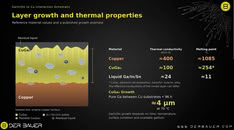
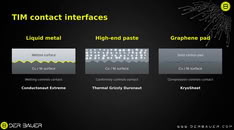
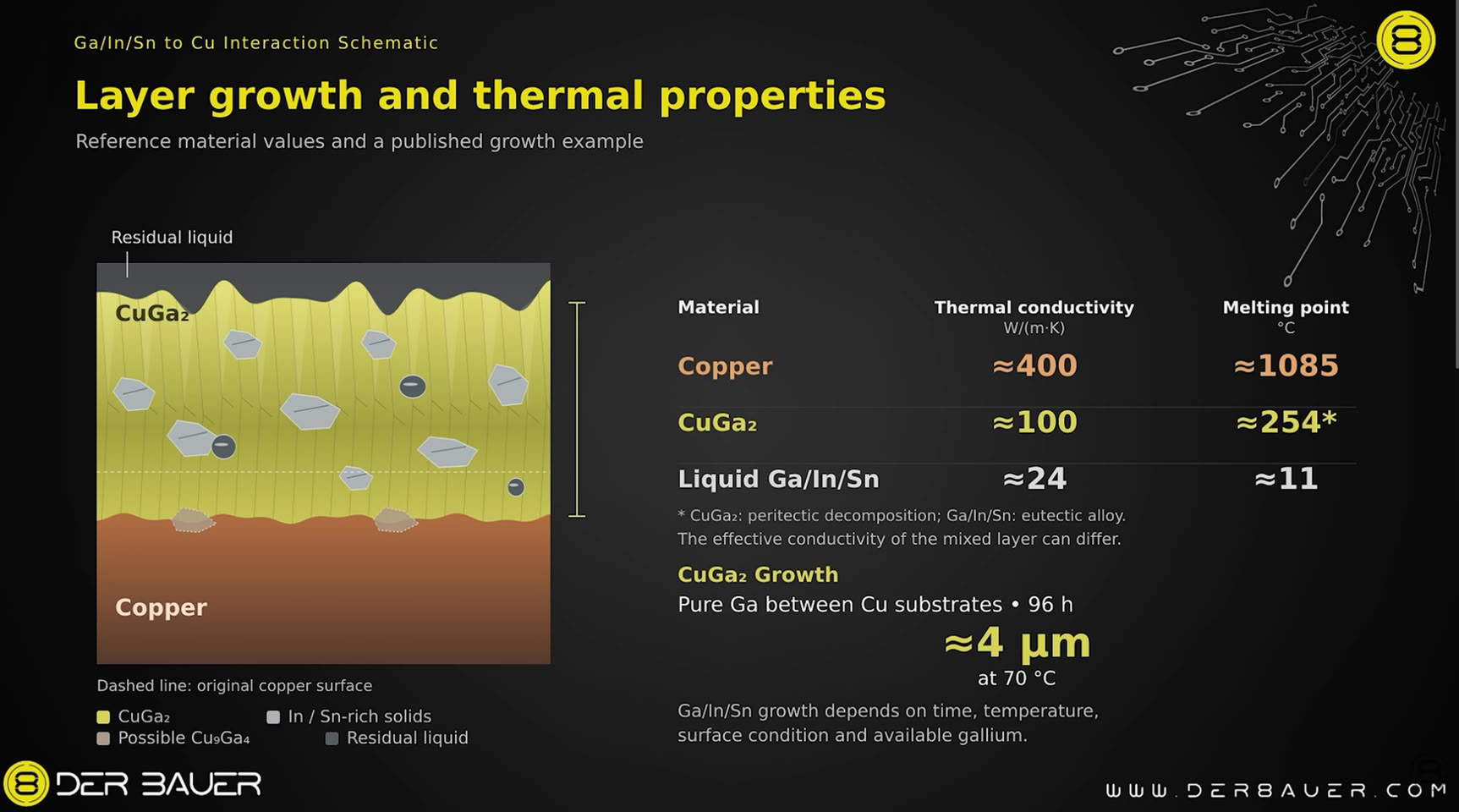
Responding to a question from a customer with a stained copper cold plate, modder and overclocker, Der8auer, has published an analysis of Thermal Grizzly's Conductonaut Extreme liquid metal thermal interface, revealing the long-term effects of the TIM. In the video, published to YouTube, Der8auer explains that the staining that can often be seen after the use of liquid metal TIMs is a simple reaction between the copper and gallium in the liquid metal forming CuGa2 in what is known as a peritectic reaction. The resulting alloy has an effective thermal conductivity of around 100 W/m·K, which is significantly lower than pure copper but much higher than the liquid metal alone. Fortunately, this deposition grows at around 1 µm per day until it reaches 50-100 µm, and it is given as the explanation for online reports of liquid metal evaporation over time.
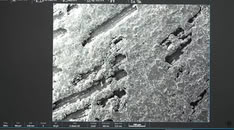
Moving onto the actual long-term testing and analysis, Der8auer analyzed a copper plug applied with Thermal Grizzly Conductonaut Extreme intermittently over a two-year period to see how the thermal interface material changed over time. While the liquid's surface is clearly visible under the electron microscope after the initial application, it changed significantly after just two weeks, with obvious crystallization and solid particulates forming in the TIM surface. These crystals continued to grow as the test sample sat in a de-oxygenated environment, losing any appearance of the liquid by the end of the second month after the initial application, with the surface then comprised exclusively of crystals. No further changes were observed in the liquid metal's surface between the two-month and two-year marks, suggesting that no major changes happened after the first 50-60 days, as predicted by Der8auer's initial explanation that peritectic deposition would occur at a rate of roughly 1 µm per day until it reached around 50 µm thick.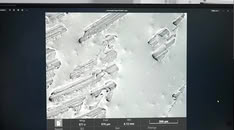
 Der8auer goes on to explain that the liquid metal wetting and the very chemical reactions mentioned throughout the video can be advantageous, since it helps reduce the microscopic roughness of the copper heat sink surface and better adhere to the cooler itself. This effectively increases the thermal conductivity of the cooling setup by packing into microscopic imperfections more tightly.
Source:
der8auer on YouTube
Moving onto the actual long-term testing and analysis, Der8auer analyzed a copper plug applied with Thermal Grizzly Conductonaut Extreme intermittently over a two-year period to see how the thermal interface material changed over time. While the liquid's surface is clearly visible under the electron microscope after the initial application, it changed significantly after just two weeks, with obvious crystallization and solid particulates forming in the TIM surface. These crystals continued to grow as the test sample sat in a de-oxygenated environment, losing any appearance of the liquid by the end of the second month after the initial application, with the surface then comprised exclusively of crystals. No further changes were observed in the liquid metal's surface between the two-month and two-year marks, suggesting that no major changes happened after the first 50-60 days, as predicted by Der8auer's initial explanation that peritectic deposition would occur at a rate of roughly 1 µm per day until it reached around 50 µm thick.



16 Comments on Long-Term Liquid Metal Tests Reveal Promising Longevity Despite Reactions
The metal diffusion between the heatsink alloy and Liquid Metal is always a bad thing, because it creates weakness inside the crystalline atomic structure of the heatsink itself.
So, in the end, it doesn't really matter if the heatsink is nickel-plated or not, because in any case the metallic diffusion with Liquid Metal (62.5Ga/21.5In/16.0Sn) is inevitable anyway....
P.S: Der8auer claims another load of bollocks, like: his exclusive liquid metal that achieves thermal conductivity about 100 W/m·K.
That's another lie, because under ordinary conditions, liquid metal's thermal conductivity reaches no more than 35 W/m·K at 85°C.
The whole claim about inter-alloy making things better is total no sense, the only purpose for pushing this low-quality bias is, to sell you more of Der8auer’s overpriced crap.
Or I would never buy a laptop that the company put liquid metal on, Asus is the top contender.
Take a look pls.
Do i want to replace my 250€ motherboard when a replacement with similar features is around 400€? no.
DRAM, is the same but we talk about 1200€
Data loss because of the m2 slot, costly, 2TB nvme 300€
... nope. I am honestly scared to use liquid metall, although i have it next to me stored. It would also most likely ruin my fancy red aluminum am5 socket replacement.
I highly doubt gallium will be friendly to my red aluminum am5 socket replacement. Not everyone only has a cpu + the original cpu socket and only a cpu tower cooler or aio pump header there.
--
I did not watch Romans overclock channel. I doubt you can make generic statements. IT may be true for his own brand thermalgrizzly and his own product. I doubt I know or can determine what materials i have in that area. And It will not apply for any sold "liquid metall".
I think i have the dc2 or dc2 pro stored. the so called "liquid metal"
www.bequiet.com/en/accessories/4023
I do not have a chemical degree
Gallium (%) 55
Indium (%) 30
Tin (%) 15
No one talks about tin and indium in that chemical mess with copper, nickel plating, aluminium, etc.
--
whataboutism warning.
when you use liquid metall you should first sand down 3 mm of your am5 cpu. than sand the cooler, adapt the mounting pressure. than use liquid metall. your warranty is gone anyway in every aspect. For all this mess, wasted money and time you can buy the next better am5 cpu.
I personally will not buy any CPU which is sanded down or can not be read or has signs of liquid metall usage.
You dont even need liquid metal. This is on image of Raijintek Morpheus II Core aftermarket heatsink for GPU's. The letters partially imprinted to the nickel plated coldplate are from an Nvidia TU102 chip. LM was never used here. Only regular thermal paste. I forget the exact model. I think it might have been Arctic MX-4. If not then MX-6. Later i used Kryonaut and then Kryonaut Extreme, but the imprint happened before. Thankfully it was purely visual and didn't affect performance.
Removing liquid metal reveals black powder that can be scraped, i scrubbed enough with a q-tip, put on new LM and temperatures are the same. CPU 87c at 78W TDP, factory TPM throttled to 65W at 100C.
The raised bumps on the die are metal chunks and appear as a dent on the heatsink.
The existing LM (Conductonaut) became gel-like, can be slightly pulled with tooth pick.
Unfortunately, my phone decided not to save the heatsink surface photos. The heatsink looked shiny aluminum color, even when scrubbing off the liquid metal.
The damage doesn't affect thermal performance as long as LM is always used.
It's interesting to see that the borders of the GPU and CPU are not stained, and they vary in size, I guess it's the coolest part of the chip?
I chose LM over PTM back in 2021 because of keyboard temperature under load (compiling software in background), not necessarily for life or performance, the difference is significant in fan noise too.
Dropping TDP to 45W was still not enough to make the keyboard area comfortable with TPM, not to mention the annoying fan speed cycling on various load is gone with LM.
Don't mind my (very) artistic nail polished caps.