Tuesday, August 4th 2026

AMD Reports Second Quarter 2026 Financial Results
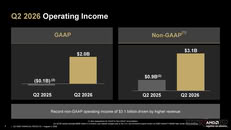
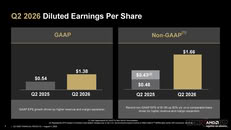
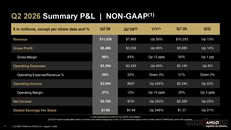
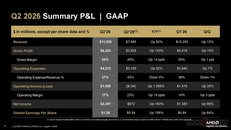
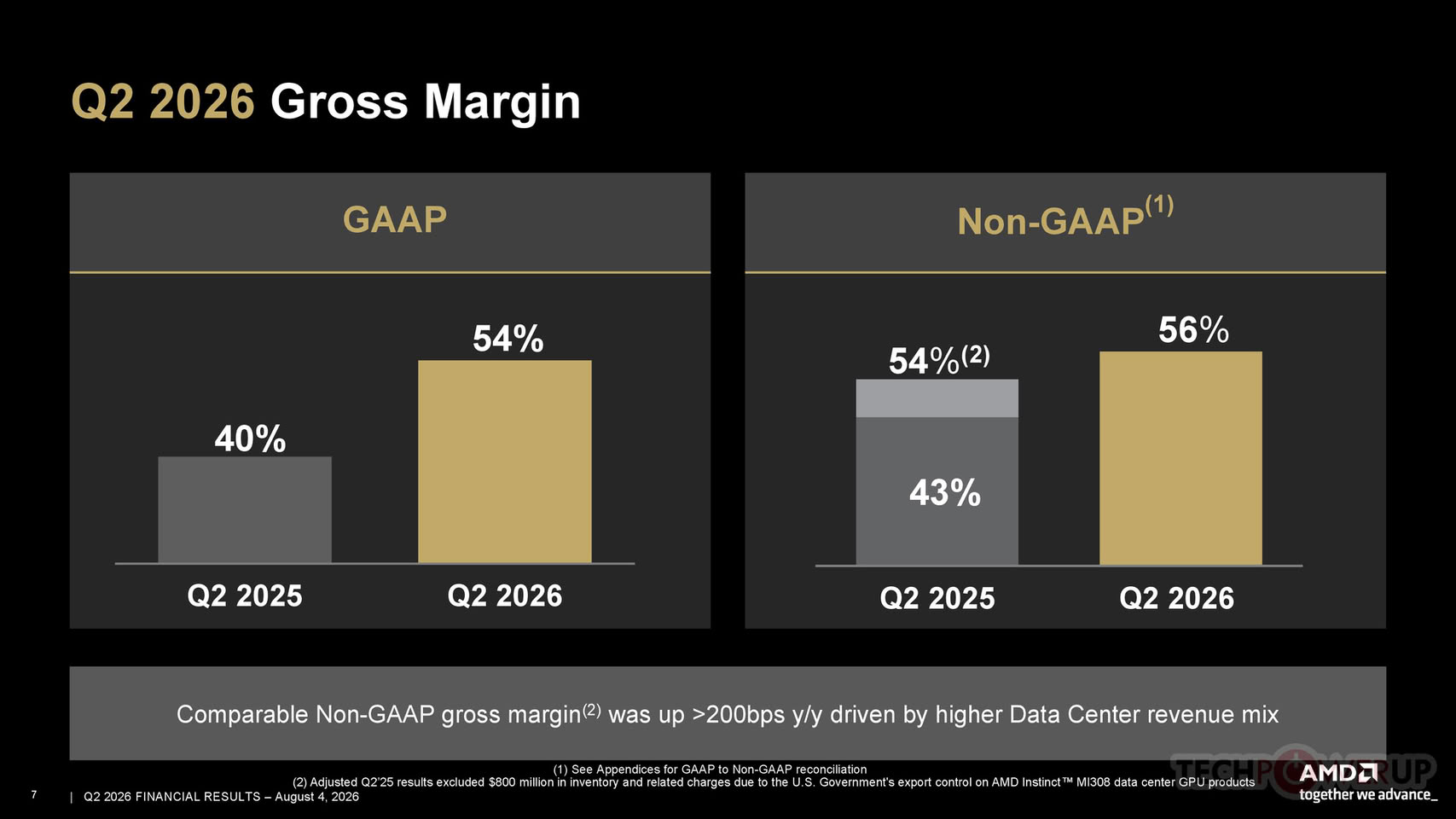
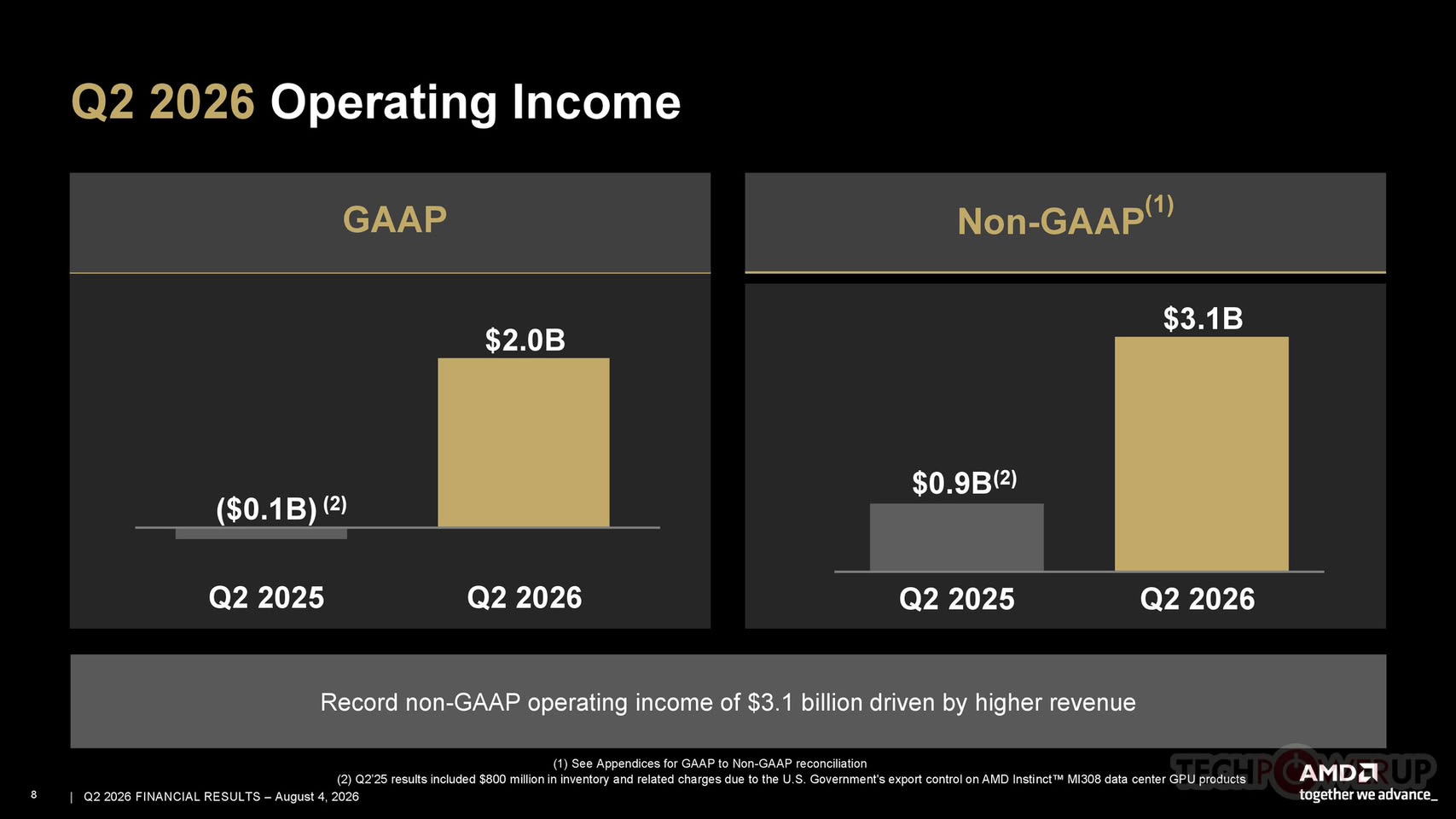
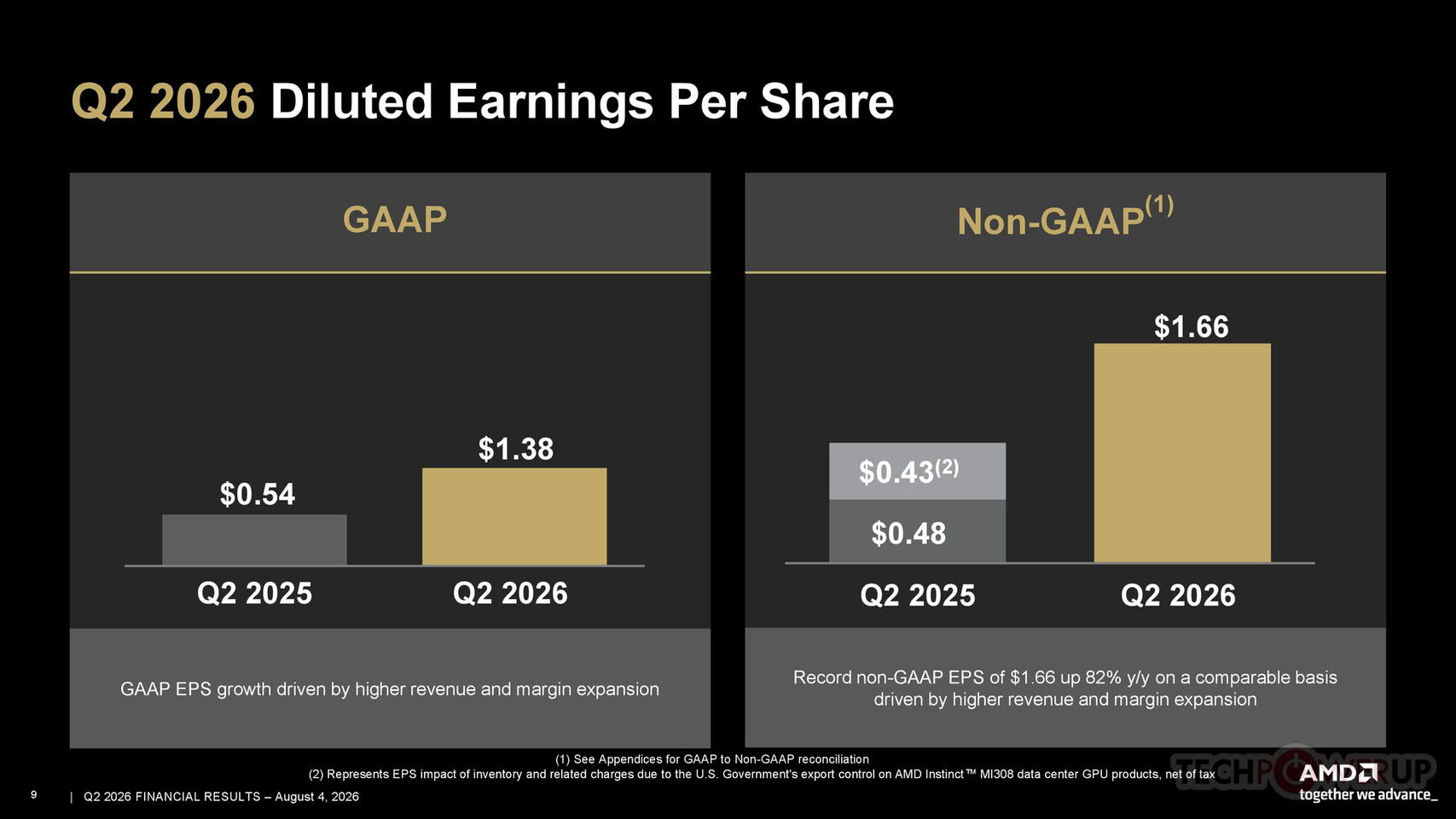
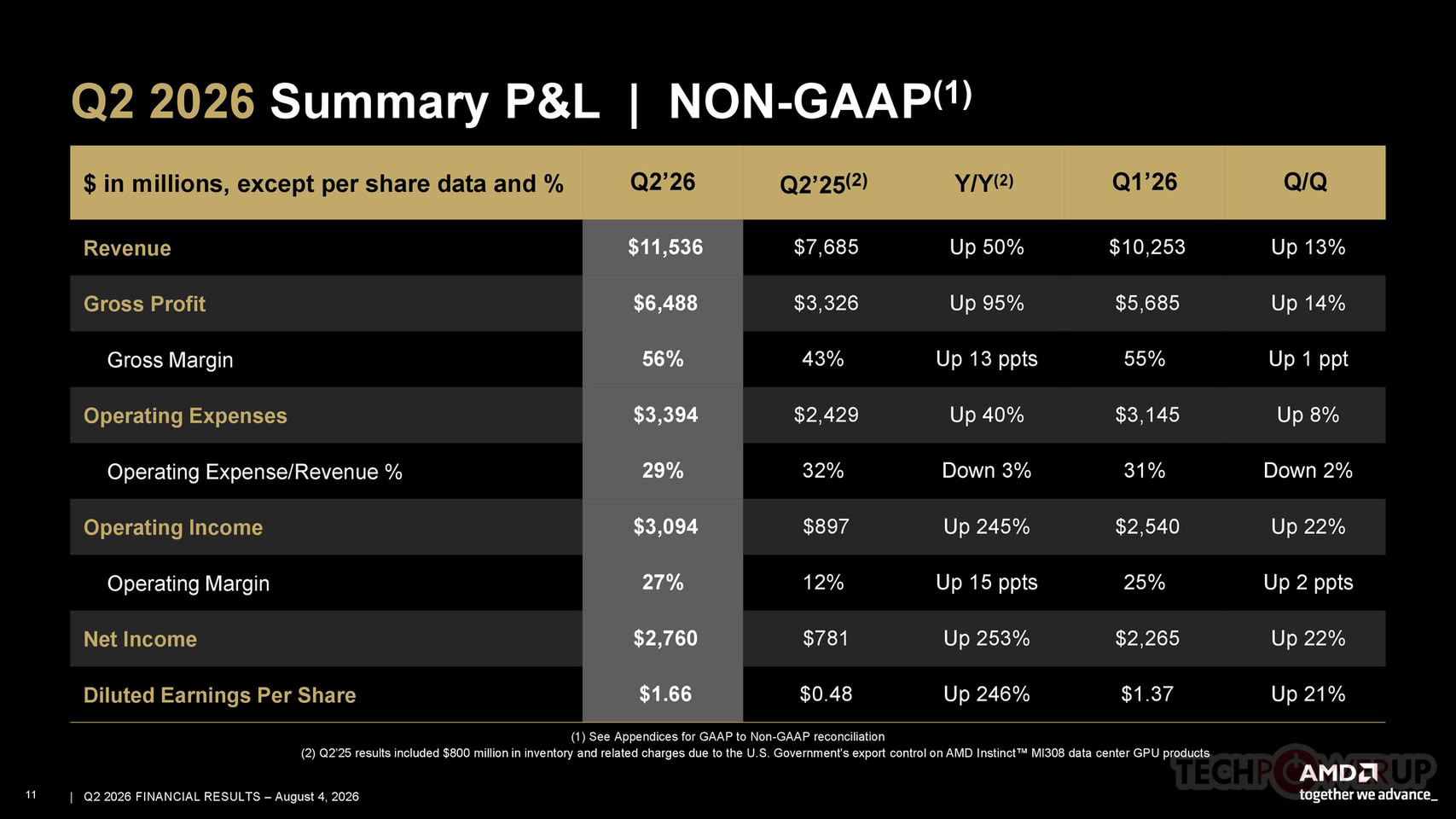
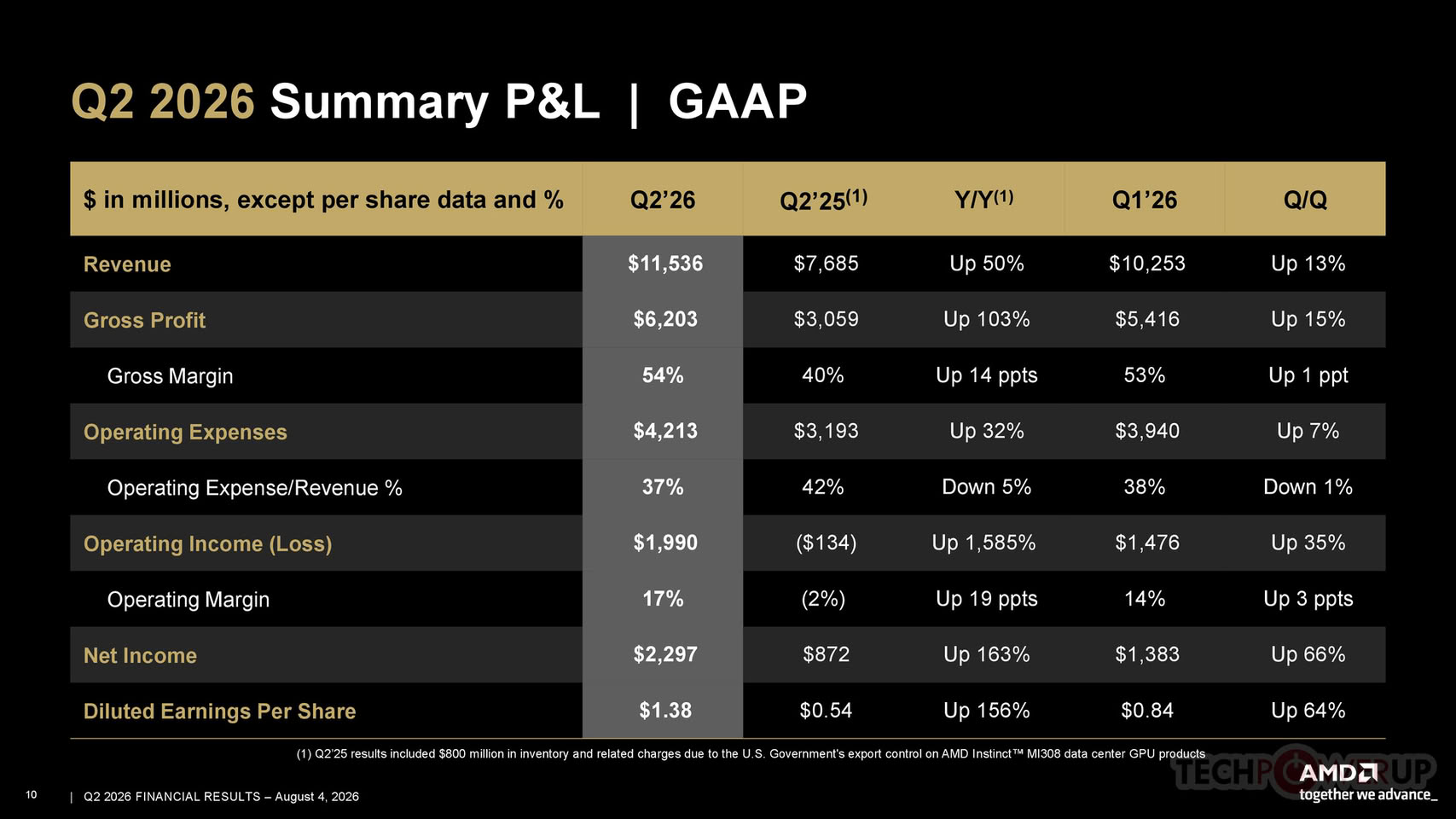
AMD (NASDAQ:AMD) today announced financial results for the second quarter of 2026. Second quarter revenue was $11.5 billion, gross margin was 54%, operating income was $2.0 billion, net income was $2.3 billion and diluted earnings per share was $1.38. On a non-GAAP basis, gross margin was 56%, operating income was $3.1 billion, net income was $2.8 billion and diluted earnings per share was $1.66.
"We delivered an excellent quarter, with record revenue and profitability as Data Center revenue more than doubled year-over-year," said Dr. Lisa Su, AMD chair and CEO. "We enter the second half with strong momentum as EPYC demand accelerates, Instinct deployments scale and Helios begins to ramp. More broadly, AI is driving a significant expansion in demand for compute across all of our markets, and our leadership portfolio and growing customer visibility position us exceptionally well to capture this expanding opportunity and deliver substantial revenue and earnings growth in the years ahead."

 "Revenue increased 50% year-over-year to a record $11.5 billion, driven by continued strength in our Data Center business, which represented 58% of company revenue in the quarter," said Jean Hu, AMD executive vice president, chief financial officer and treasurer. "We expect Data Center sales to accelerate in the second half of 2026, driving stronger overall revenue growth and continued earnings expansion."
Segment Summary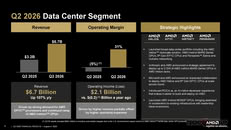
 Recent Highlights
AMD's outlook statements are based on current expectations. The following statements are forward-looking and actual results could differ materially depending on market conditions and the factors set forth under "Cautionary Statement" below.
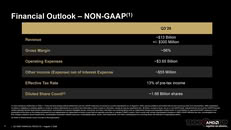
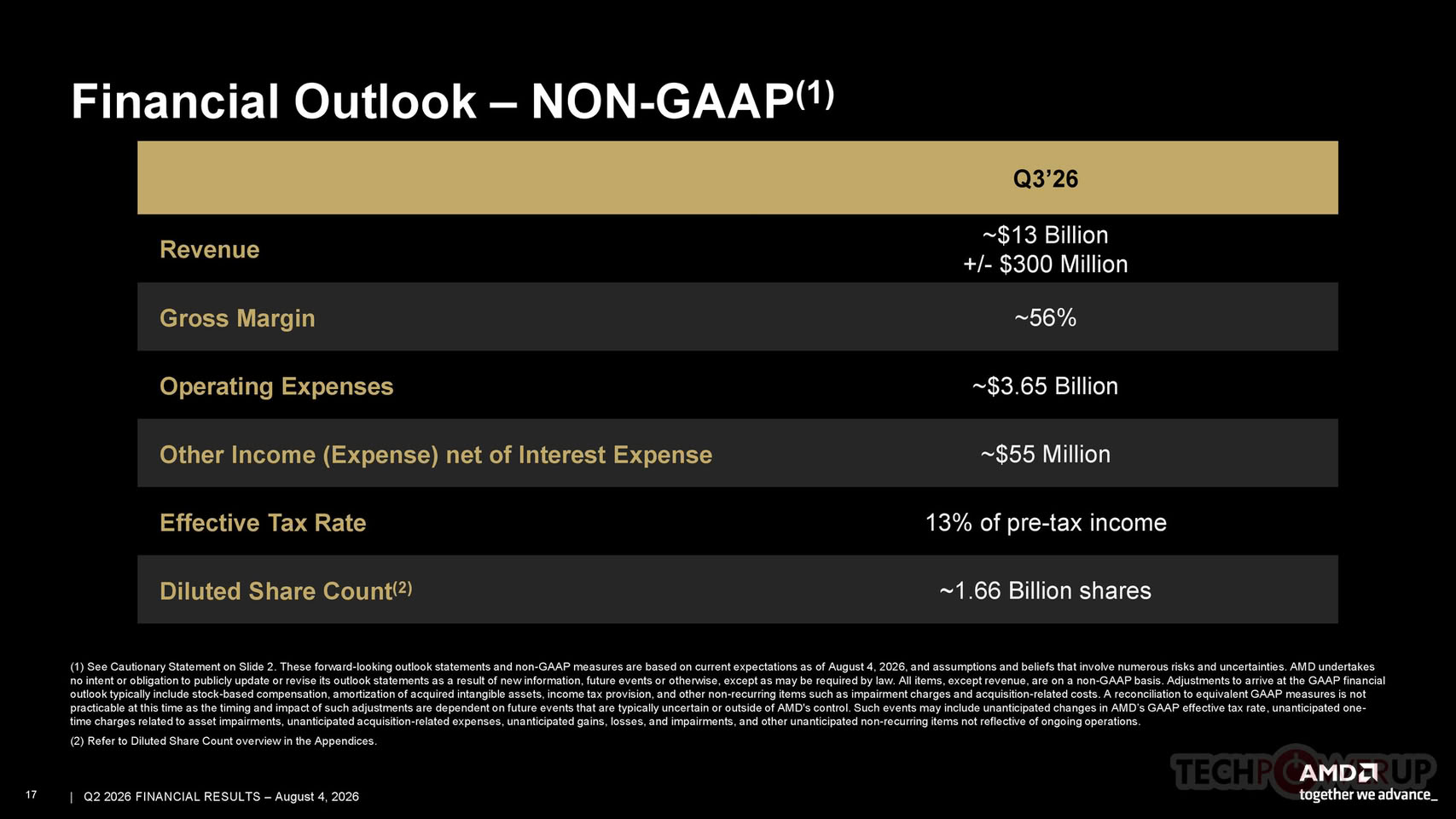
For the third quarter of 2026, AMD expects revenue to be approximately $13 billion, plus or minus $300 million. The mid-point of the revenue range represents year-over-year growth of approximately 41% and a sequential increase of approximately 13%. Non-GAAP gross margin is expected to be approximately 56%.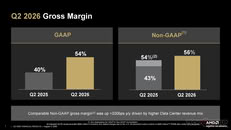
Source:
AMD
"We delivered an excellent quarter, with record revenue and profitability as Data Center revenue more than doubled year-over-year," said Dr. Lisa Su, AMD chair and CEO. "We enter the second half with strong momentum as EPYC demand accelerates, Instinct deployments scale and Helios begins to ramp. More broadly, AI is driving a significant expansion in demand for compute across all of our markets, and our leadership portfolio and growing customer visibility position us exceptionally well to capture this expanding opportunity and deliver substantial revenue and earnings growth in the years ahead."


Segment Summary
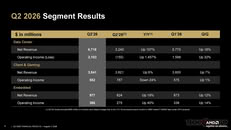
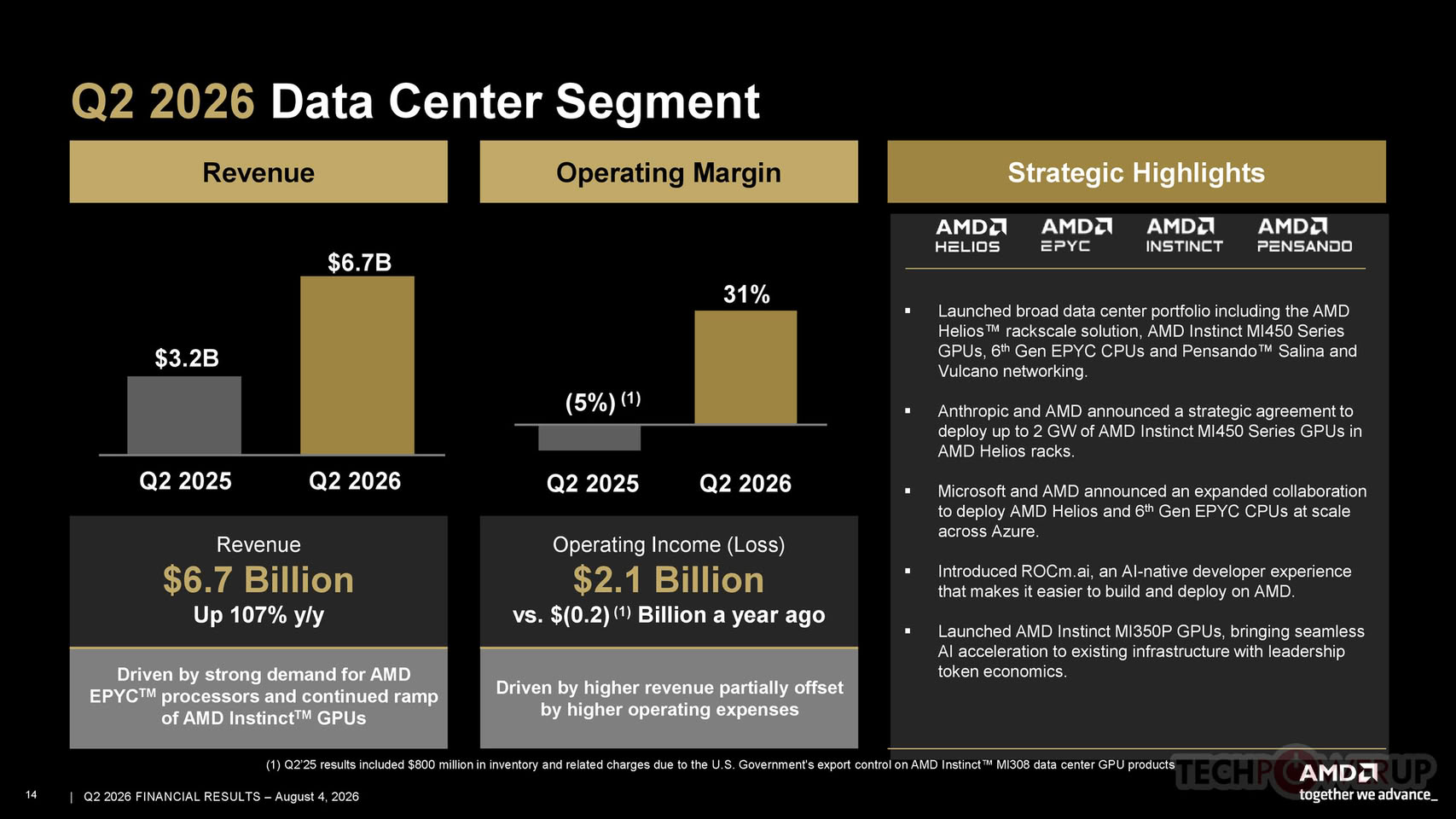
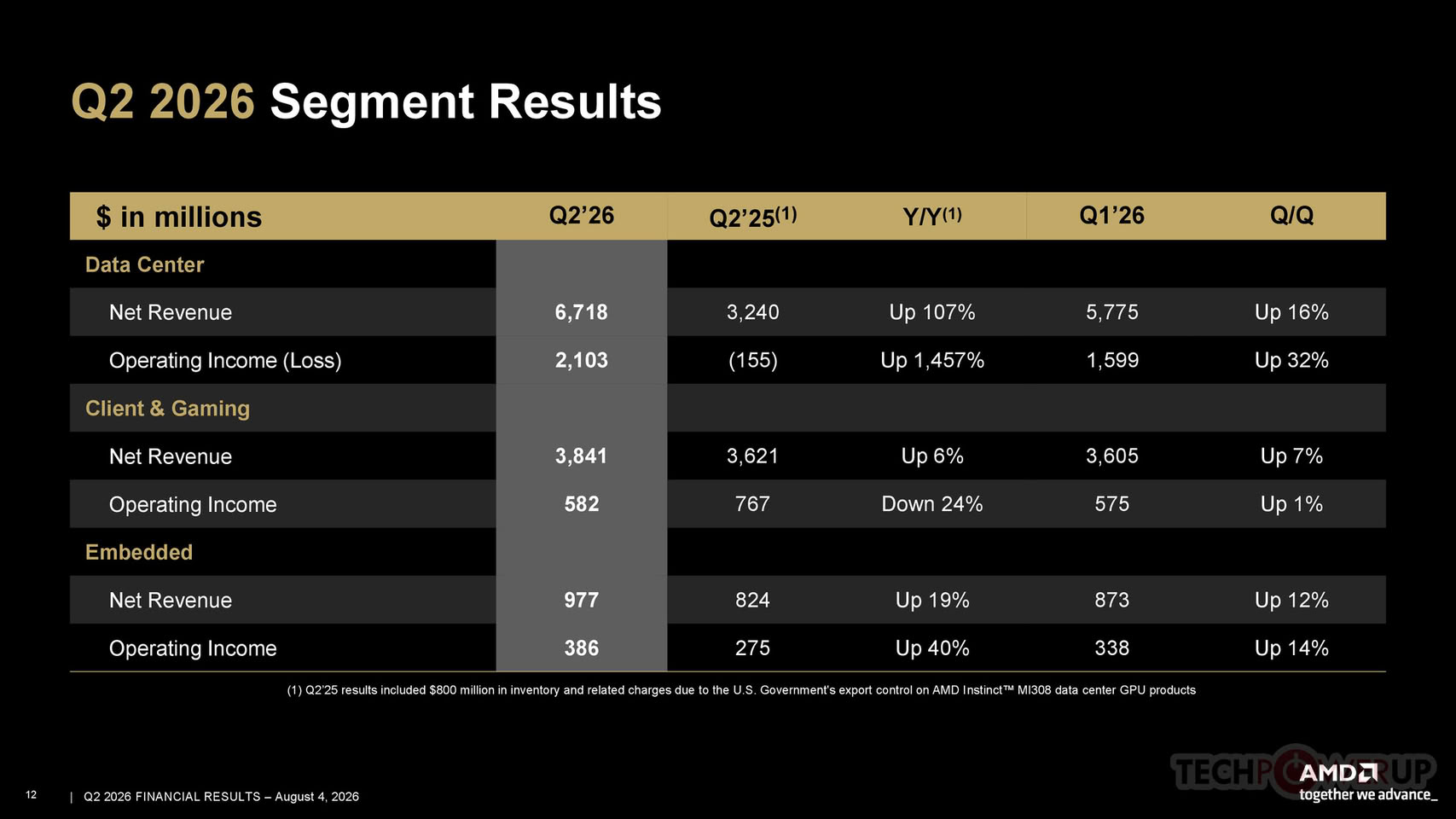
- Data Center segment revenue was $6.7 billion, up 107% year-over-year, driven by strong demand for AMD EPYC processors and AMD Instinct GPUs.
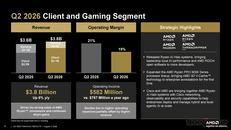
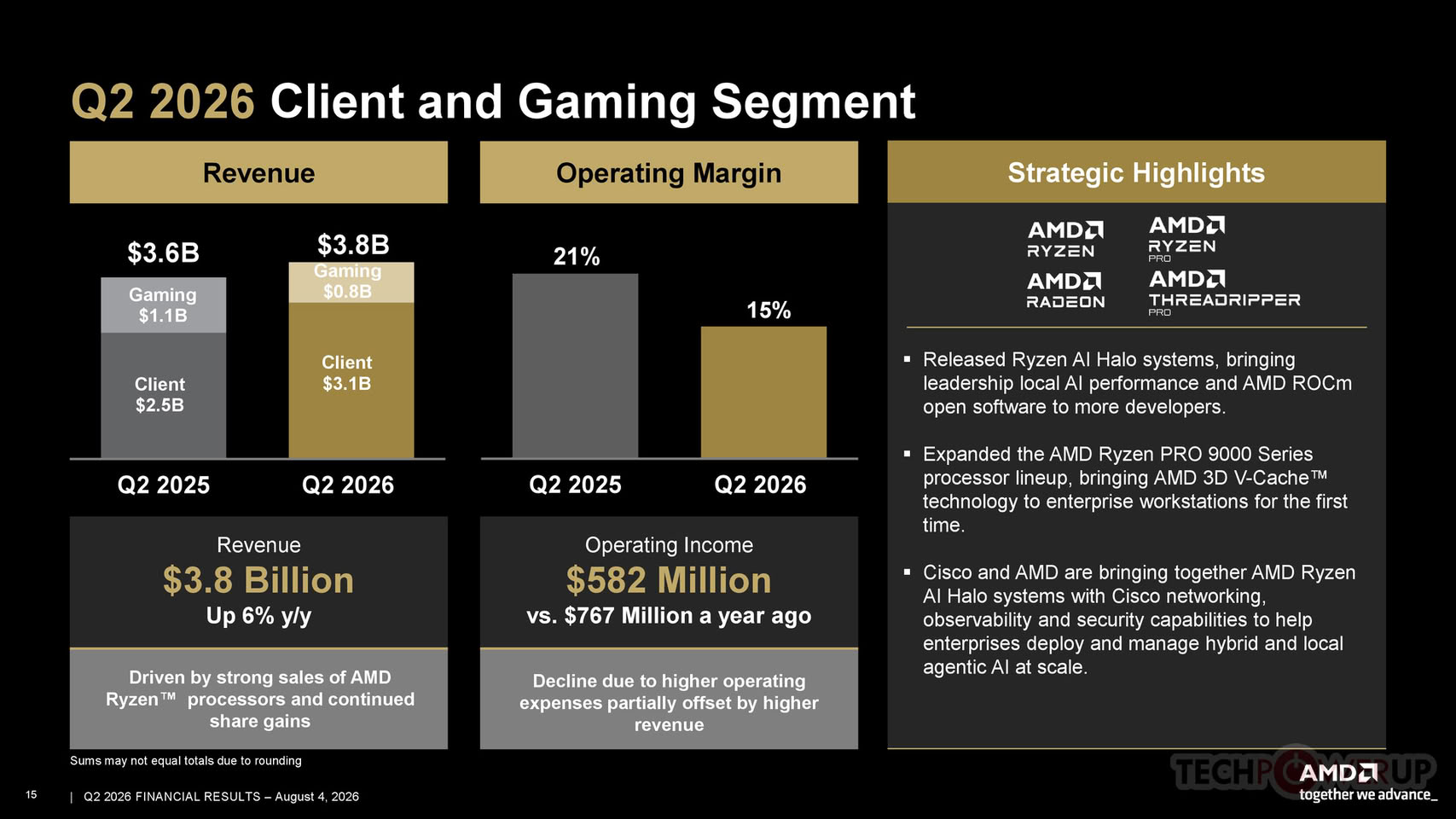
- Client and Gaming segment revenue was $3.8 billion, up 6% year-over-year. Client business revenue was $3.1 billion, up 23% year-over-year, primarily driven by strong demand for AMD Ryzen processors. Gaming business revenue was $779 million, down 31% year-over-year, due to lower semi-custom revenue.
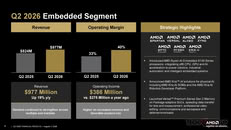
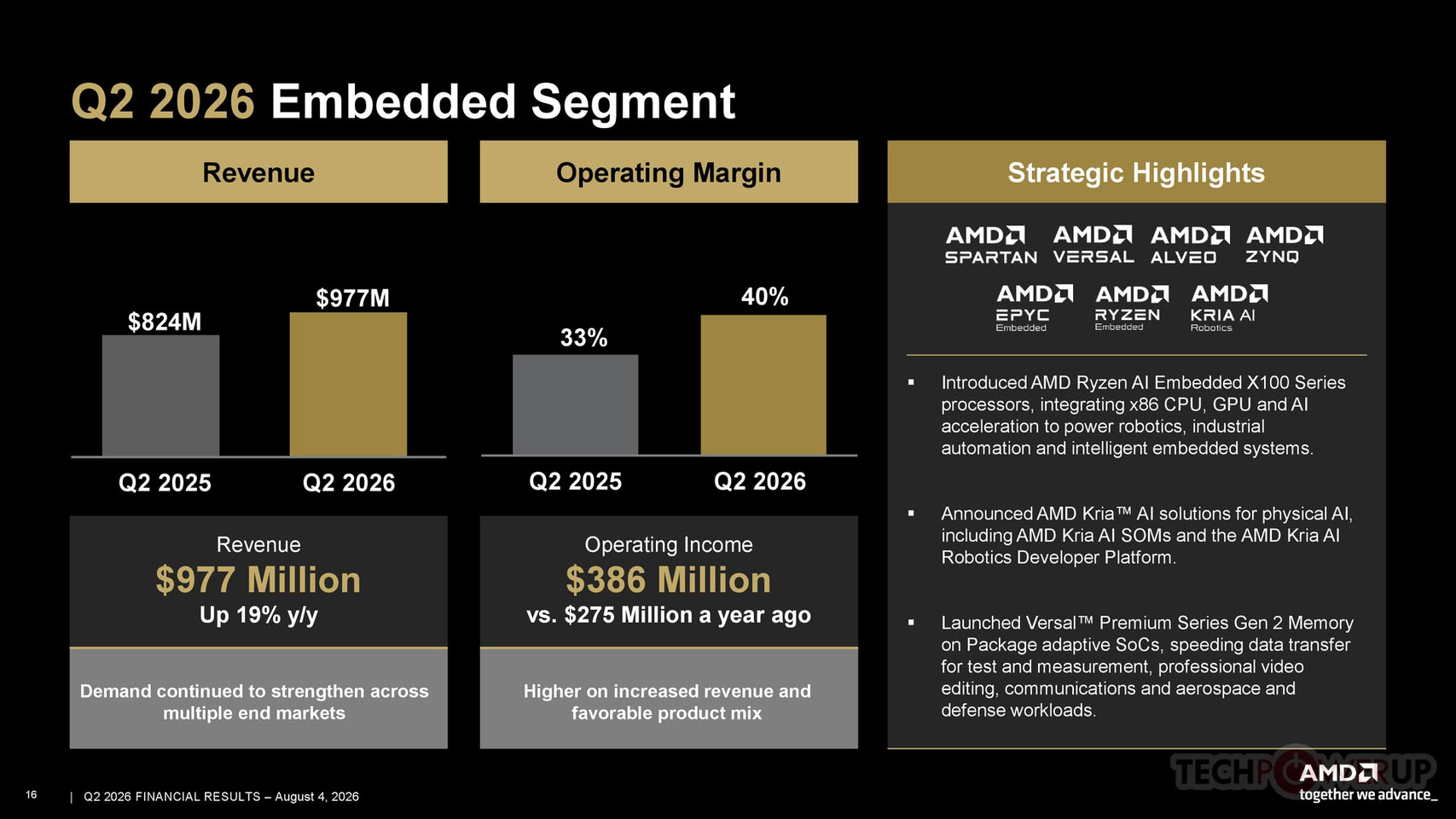
- Embedded segment revenue was $977 million, up 19% year-over-year, as demand strengthened across multiple end markets.
- AMD announced a broad portfolio of high-performance and AI computing solutions and strategic partnerships to accelerate AI deployments at scale:
- Launched the AMD Helios rackscale solution, the world's most powerful AI server rack. AMD Helios delivers leadership inference tokens per dollar and is being deployed by leading AI labs and cloud providers including Anthropic, Cirrascale, HUMAIN, Meta, Microsoft, OpenAI, Oracle, Tensorwave, Vultr and others.
- Launched the AMD Instinct MI400 Series GPU family, including MI455X, bringing leadership compute, memory capacity and bandwidth for large-scale AI training and inference, and MI430X, the most advanced accelerator for HPC and sovereign AI workloads.
- Introduced 6th Gen AMD EPYC server CPUs, built to deliver leadership performance across the full range of agentic AI, general-purpose and enterprise workloads.
- Released ROCm.ai, an AI-native developer experience designed to help developers build, deploy and optimize faster across AMD platforms.
- Announced a strategic partnership with Anthropic to deploy up to 2 gigawatts of MI450 Series GPUs in AMD Helios racks and a multiyear collaboration to optimize AMD Instinct GPUs and ROCm software development using Claude.
- Expanded collaboration with Microsoft to deploy AMD Helios racks at scale on Azure to power frontier model inference. Azure will also add two new AMD EPYC CPU-powered VM series and broaden its deployment of Pensando DPUs to support Azure networking services.
- Announced a collaboration with Cerebras to bring together AMD Helios and Cerebras Wafer-Scale Engine to improve efficiency, scalability and economics for ultra-low-latency inference serving.
- Launched the AMD Instinct MI350P GPU, designed to bring seamless AI acceleration to existing infrastructure with leadership token economics.
- Acquired MEXT, adding AI-powered predictive memory technology designed to optimize memory use and expand usable capacity for AI workloads.
- AMD extended its PC offerings for enterprises, developers and gamers:
- Released Ryzen AI Halo systems, purpose-built for developers to build, test and run agentic AI workflows locally with leadership performance optimized by AMD ROCm open software support.
- Expanded the AMD Ryzen PRO 9000 Series processor lineup, bringing AMD 3D V-Cache technology to enterprise workstations for the first time.
- Launched AMD Ryzen 7700X3D processors and extended support for Socket AM5 platforms through 2029, giving gamers more performance and longevity.
- Cisco and AMD are collaborating to bring together AMD Ryzen AI Halo systems with Cisco networking, observability and security capabilities, so enterprises can deploy, govern and manage hybrid and local agentic AI at scale.
- Expanded global availability of AMD Radeon RX 9070 GRE graphics cards, extending performance and advanced ray tracing capabilities to more gamers.
- AMD expanded its adaptive and embedded AI portfolio:
- Introduced AMD Ryzen AI Embedded X100 Series processors, a new family of embedded x86 processors integrating CPU, GPU and AI acceleration to power robotics, industrial automation and intelligent embedded systems.
- Announced AMD Kria AI solutions, including AMD Kria AI system-on-modules and the AMD Kria AI Robotics Developer Platform to accelerate the development of next-generation physical AI systems.
- Launched Versal Premium Series Gen 2 Memory on Package adaptive SoCs, to speed data transfer for test and measurement, professional video editing, communications and aerospace and defense workloads.
AMD's outlook statements are based on current expectations. The following statements are forward-looking and actual results could differ materially depending on market conditions and the factors set forth under "Cautionary Statement" below.
For the third quarter of 2026, AMD expects revenue to be approximately $13 billion, plus or minus $300 million. The mid-point of the revenue range represents year-over-year growth of approximately 41% and a sequential increase of approximately 13%. Non-GAAP gross margin is expected to be approximately 56%.
30 Comments on AMD Reports Second Quarter 2026 Financial Results
The statement was generic enough, but new generations of APUs, consoles and GPUs are literally being developed for next year and onwards. So, no, they did not forget about gaming. It will get more spotlight with Zen 6 and RDNA5 products once those are ready. Pretty simple stuff.
And I like the analyst commentary on the deck.... nice to see that gross margin. Dang. Investors don't like it apparently,...afterhours down 8%
"Strong sequential revenue growth in our EESC segment and channel business was not enough to offset near-term challenges in our PC processor business due to lower than expected consumer demand that impacted sales to OEMs," said Dr. Lisa Su, AMD president and CEO. "We continue to execute our long-term strategy while we navigate the current market environment. Our focus is on developing leadership computing and graphics products capable of driving profitable share growth across our target markets."
Q2 2015 Results
- Revenue of $942 million, down 8 percent sequentially and 35 percent year-over-year. The sequential decrease was primarily due to weaker than expected consumer PC demand impacting the company's Original Equipment Manufacturer (OEM) APU sales. The year-over-year decline was primarily due to decreased sales across client and graphics product lines.
- Gross margin of 25 percent, down 7 percentage points sequentially, primarily due to a higher mix of Enterprise, Embedded and Semi-Custom segment sales, lower than anticipated Computing and Graphics segment APU unit volumes, and a charge of approximately $33 million associated with a technology node transition from 20 nanometer (nm) to FinFET. Non-GAAP(1) gross margin, excluding the impact of the $33 million charge was 28 percent.
- Operating loss of $137 million, compared to an operating loss of $137 million for the prior quarter. Non-GAAP(1) operating loss of $87 million, compared to non-GAAP(1) operating loss of $30 million in Q1 2015, primarily due to lower revenue and gross margin driven by lower sales to OEMs attributable to a weak consumer PC market.
- Net loss of $181 million, loss per share of $0.23, and non-GAAP(1) net loss of $131 million, non-GAAP(1) loss per share of $0.17, compared to a net loss of $180 million, loss per share of $0.23 and non-GAAP(1) net loss of $73 million, non-GAAP(1) loss per share of $0.09 in Q1 2015.
- Cash, cash equivalents, and marketable securities were $829 million at the end of the quarter, down $77 million from the end of the prior quarter.
- Total debt at the end of the quarter was $2.27 billion, flat from the prior quarter.
ir.amd.com/news-events/press-releases/detail/626/amd-reports-2015-second-quarter-resultsIt was pretty much all bad news back then, but a CPU with a codename of "Zen" was soon to be launched.
I wonder how much of that “strong demand for AMD Ryzen processors” is actually some other (AI, server related) revenue, not an actual consumer orders. Just 6% lower yearly revenue, in this climate? What strong demand? Revenue in this sector for first quarter was $3.6 billion, 2.9 billion for Client and 720 million for Gaming. So they both actually went up since last quarter? While nobody’s buying?
How?
AMD Reports First Quarter 2026 Financial Results
Also of note, they dumped many times the revenue 50billion in to hardware for I think it was anthrophic…
Moody investors with unreasonable expectations can get rid off their stock. Others will buy it, gladly.
Some naive investors expected AMD to become similar in growth to Nvidia. That's not going to happen. AMD is a different type of company, with more diverse portfolio and strategy.
Anyone sticking with gaming with same passion they were in the past instead of just dumping it for the new Ai milking cow, that would be a long term commitment. Instead they all put it all on the side track to chase massive short term profits for entire ecosystem they damn well know a) no one asked for b) isn't sustainable.
And companies who regularly swapped their computers every few years for a similarly priced models, just to avoid reliability problems before they happen, suddenly didn't do that because they were told they would be getting worse PCs they currently have for more money, with questionable improvement in reliability.
I know it's all anecdotal, but I fear all our "data" actually is, companies aren't publishing numbers of products sold, and revenue listings are intentionally getting more and more vague about sectors. We have stopped talking about outlets that actually published numbers of products sold, because we don't like to explain the differences between those and revenue numbers, market shares...
It has become quite clear nobody will be able to afford hardware in the close future, I've actually placed all my future upgrade plans on hold for the time being, and decided to build one last midrange PC to weather this storm.
Keep continuing and make me laugh 😂
A couple of government ordered super computers isn't going to net them billions, it's nice revenue but it's not going to ofset the svp's they have going with neoclouds.
It's ugly and people will see their savings shaved because of it.
New generation of gaming products, as said, is being developed for next year. This is also when another major transition will kick-off, as entire home entertainment systems are being prepared with HDMI 2.2 in mind, both sources and sink devices.They have consistently extended both CPU market share and revenue share across all segments in last 8 years. Are you not following CPU stats?Neoclouds are just one part of the market. Even without them, their CPU business segment has never been as robust as it is now.
A next gen GPU would be exciting if prices of memory prices were normal, however I wouldn't expect anything new to be remotely reasonable in price. Sure you can buy new hardware for gaming, but the price is what is going to prevent most people from doing so. Every company involved with the AI circular investment are too busy doing everything to inflate their value for short term gains, instead of caring about the consumers who built these companies.
Global supply chain has become increasingly fragile due to regional conflicts, higher costs of raw materials and politics of tariffs. Several crucial components for EUV lithography tools, such as Helium, and materials for motherboards are produced in the Gulf states. We all know what is happening there and who started the crisis... Export and import prices have increased substantially of a result of this crisis. It's not surprising that motherboards and chips will be more expensive, not only for client PC segment, but for data centre and other consumer electronics too.
www.kunalganglani.com/blog/helium-shortage-semiconductor-supply-chain
www.business-standard.com/industry/news/ai-boom-west-asia-crisis-fuel-pcb-shortage-electronics-prices-rise-126080200524_1.html
You can conveniently blame it on greedy companies and their profit-driven priorities, but this is short-sighted and shallow criticism. Seeking profits is enshrined in their fiduciary duty, a lawful obligation to shareholders. You will need to complain to politicians who have enabled such economic environment and practices. You will also need to complain to politicians for being passive, allowing predatory pricing of memory and doing little to protect consumer market and environment. They don't care much, unless ordinary consumers and citizens truly organise themselves to protest and be constantly vocal about it, which we can see in mass protests against rapid expansion of data centres. Global capital concentrated in small amount of hands and entities means power, and it is one of the biggest threats to fragile democracy and quality of life of ordinary citizens. In this case it is blocking access to electronic goods at reasonable prices.
The current admin pushed AI using the $500 billion Stargate program.