Monday, October 12th 2026

Intel "Crescent Island" GPU Gets D-Series Name, Supports Up to 480 GB of LPDDR5X

Intel has finally unveiled what its "Crescent Island" D-Series GPUs will look like, introducing a dedicated AI accelerator in a server form factor after previous projects stalled. The newly named D-Series GPU features a total of 32 Xe3P cores, 256 XMX engines, 32 MB of unified L2 cache, and up to 480 GB of LPDDR5X memory with up to 1.5 TB of memory bandwidth. Intel rates it for up to 1.3 PetaFLOPS of FP8 performance, with support for formats ranging from FP4 to FP64. A media engine with four encoders and four decoders is also included, which could assist with multimodal workloads where video generation and understanding is a must. The card comes with 160 GB memory configuration out of the box, which is exclusive to Intel-branded "Crescent Island" graphics cards, while the company allows its ODMs to equip the card with up to 480 GB of LPDDR5X memory for maximum VRAM capacity.

What is particularly interesting about the Xe3P is its pipeline. The XMX engines have been redesigned from the four-deep systolic design on the regular Xe3 to 16-deep processing on the Xe3P. Additional details include FP4 data format support alongside FP8, as well as large register files of 1 MB per core and L1 cache of 512 KB per core. In total, there are 256 Vector engines and 256 of the new XMX engines, each divided into groups of eight per Xe3P core. Additionally, in the Xe3P, there are no graphics processing elements to output imagery, as the silicon is designed purely for AI inference workloads that require long context and agentic tasks.
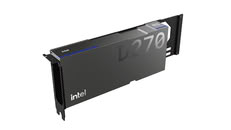

The accelerator is designed as a 350 W, air-cooled PCIe 5.0 x16 card, allowing it to fit into conventional server infrastructure without the need for dedicated liquid cooling. Intel is also leveraging its common Xe software foundation and support for established AI frameworks to facilitate deployment. Customer sampling is underway, but pricing, general availability, and independent performance results have yet to be disclosed. Ultimately, the cost per generated token and software maturity will determine whether the D-Series can compete with established AI accelerator platforms. Intel envisions a single card powering models up to 300 billion parameters in size, with a 8x GPU cluster running trillion-parameter models without issues.
Source: Intel
Add your own comment

23 Comments on Intel "Crescent Island" GPU Gets D-Series Name, Supports Up to 480 GB of LPDDR5X

#2
Darmok N Jalad
Curious if/when Intel will release another consumer dGPU. I’m guessing all near-term efforts are aimed at the AI money train.
Posted on Reply
#3
wNotyarD
So much for consumer-class Druid. Heck, we haven't even seen Celestial.
Posted on Reply
#4
kondamin
I guess I'm happy intel is doing well, I hope these products will somehow trickle down
Posted on Reply
#5
evernessince
That's enough memory to run the big boy open source models. Might be nice if the price is right.
Posted on Reply
#6
lemonadesoda
What a beast.
kondaminI guess I'm happy intel is doing well, I hope these products will somehow trickle down
"I'm sorry, Dave. I'm afraid I can't do that"
Posted on Reply
#7
Dr. Dro
1.3 PF almost 2x the RTX 5090's 838 TF FP8 rating, those are some nice compute gains.
Posted on Reply
#8
A&P211
lemonadesodaWhat a beast.


"I'm sorry, Dave. I'm afraid I can't do that"
*fixed
I'm sorry, lemonadesoda. I'm afraid I can't do that"
Posted on Reply
#9
TumbleGeorge
My first time read for so big L1 caches.
Posted on Reply
#10
ARM Fan Boy
AleksandarKIntel has finally unveiled what its "Crescent Island" D-Series GPUs will look like, introducing a dedicated AI accelerator in a server form factor after previous projects stalled. The newly named D-Series GPU features a total of 32 Xe3P cores, 256 XMX engines, 32 MB of unified L2 cache, and up to 480 GB of LPDDR5X memory. Intel rates it for up to 1.3 PetaFLOPS of FP8 performance, with support for formats ranging from FP4 to FP64. A media engine with four encoders and four decoders is also included, which could assist with multimodal workloads where video generation and understanding is a must. The card comes with 160 GB memory configuration out of the box, which is exclusive to Intel-branded "Crescent Island" graphics cards, while the company allows its ODMs to equip the card with up to 480 GB of LPDDR5X memory for maximum VRAM capacity.

What is particularly interesting about the Xe3P is its pipeline. The XMX engines have been redesigned from the four-deep systolic design on the regular Xe3 to 16-deep processing on the Xe3P. Additional details include FP4 data format support alongside FP8, as well as large register files of 1 MB per core and L1 cache of 512 KB per core. In total, there are 256 Vector engines and 256 of the new XMX engines, each divided into groups of eight per Xe3P core. Additionally, in the Xe3P, there are no graphics processing elements to output imagery, as the silicon is designed purely for AI inference workloads that require long context and agentic tasks.


The accelerator is designed as a 350 W, air-cooled PCIe 5.0 x16 card, allowing it to fit into conventional server infrastructure without the need for dedicated liquid cooling. Intel is also leveraging its common Xe software foundation and support for established AI frameworks to facilitate deployment. Customer sampling is underway, but pricing, general availability, and independent performance results have yet to be disclosed. Ultimately, the cost per generated token and software maturity will determine whether the D-Series can compete with established AI accelerator platforms. Intel envisions a single card powering models up to 300 billion parameters in size, with a 8x GPU cluster running trillion-parameter models without issues.
This card is hung like a horse!
Posted on Reply
#11
Bigshrimp
It's too bad that Intel seems to have abandoned releasing future consumer GPUs. Not surprising as they are now in the same club as the rest of the tech companies exploiting the AI grift that never ends.
Posted on Reply
#12
kondamin
BigshrimpIt's too bad that Intel seems to have abandoned releasing future consumer GPUs. Not surprising as they are now in the same club as the rest of the tech companies exploiting the AI grift that never ends.
Posted on Reply
#13
unwind-protect
That thing will be crippled by lack of memory bandwidth when it comes to inference.

All the FLOPS are nice but it won't reach those in that setup.
Posted on Reply
#14
Solid State Brain
It's reported by Intel to have 1.5TB/s of memory bandwidth.

www.intel.com/content/www/us/en/newsroom/news/artificial-intelligence/intel-accelerates-open-infrastructure-agentic-ai-era.html
Intel GPU D-series, code-named Crescent Island, is designed to improve the economics of sustained, memory-intensive AI inference. Built on Intel's latest Xe3P architecture, the GPU combines up to 480 GB of LPDDR5X memory, 1.5 TB/s of memory bandwidth and 1.3 petaflops of FP8 compute within a 350-watt power envelope. This balance of memory capacity, compute performance and power efficiency reflects Intel's approach to optimizing infrastructure for real-world inference workloads.
Posted on Reply
#15
Chomiq
350W only? Nvidia should be worried.
Posted on Reply
#16
Wirko
kondamin
The graph shows how AI is giving way to SI.
Posted on Reply
#17
kondamin
WirkoThe graph shows how AI is giving way to SI.
Yes, it's the money that is being loaned out to companies doing the data centre build out.
investors are sick of seeing no return on the money they have been stuffing in the bottomless pit
Posted on Reply
#18
mashie
Interesting cards, it will all come down to price and software stack if they will be a hit.
Posted on Reply
#19
TumbleGeorge
Solid State BrainIt's reported by Intel to have 1.5TB/s of memory bandwidth
Latest Nvidia/AMD "ai" accelerators with custom HBM4 have 19&22TB/s
Posted on Reply
#20
mashie
TumbleGeorgeLatest Nvidia/AMD "ai" accelerators with custom HBM4 have 19&22TB/s
Yes but those are mainly designed for training workloads, not inferance even though they will do that really well if required.
Posted on Reply
#21
Wirko
mashieYes but those are mainly designed for training workloads, not inferance even though they will do that really well if required.
HBM is for those who need density and can pay for it. A hundred-kilowatt rack full of accelerators can't run on GDDR/LPDDR/DDR. A workstation with four professional PCIe cards can.
Posted on Reply
#22
kizvy
wNotyarDSo much for consumer-class Druid. Heck, we haven't even seen Celestial.
Ain't celestial just the mobile version of battlemage? like b390?
Posted on Reply
#23
wNotyarD
kizvyAin't celestial just the mobile version of battlemage? like b390?
No. While the B390 is Xe3 instead of Xe2, it still is a B-series GPU.
Celestial should be C-series, if they ever came to the market. Likewise, I called this D-series "Druid" because that was the roadmap once presented by Intel: A for Alchemist, B for Battlemage, C for Celestial, D for Druid.
Posted on Reply
Add your own comment
Nov 12th, 2026 04:40 CST change timezone

New Forum Posts

Popular Reviews

TPU on YouTube

Controversial News Posts