Thursday, November 19th 2026
NAND Flash Prices Set to Decline in 2027 as Chinese CSP Order Cuts Outweigh North American Demand Growth
TrendForce's latest memory industry research indicates that the global NAND Flash market is expected to see a reversal in supply-demand dynamics in 2027. With supply set to grow rapidly, substantial cuts to enterprise SSD orders from Chinese CSPs—coupled with a potential further contraction in consumer electronics demand—are expected to exacerbate oversupply.
TrendForce forecasts that the overall NAND Flash contract prices will begin declining in the first quarter of 2027, with quarterly price drops potentially widening as the year progresses. TrendForce estimates that global NAND Flash industry CapEx will increase 26.7% YoY to US$29.9 billion in 2027. Strong demand for high-performance storage in North America continues to drive manufacturers to expand capacity and upgrade process technology. Meanwhile, rising QLC penetration and the transition to higher-layer-count NAND technologies will further boost bit output. Although some suppliers may slightly slow their expansion plans in response to sluggish consumer demand, global NAND Flash bit supply is still projected to grow by somewhere between 25-30% YoY in 2027.
Enterprise SSDs remain the primary growth driver for the NAND Flash industry, but regional demand trends are increasingly diverging. In North America, U.S.-based CSPs have recently raised their 2027 demand forecasts again, supported by AI agent and general-purpose server projects already under construction.
Chinese CSPs, however, are facing challenges including GPU shortages, elevated inventory levels, and intensifying competition over token pricing. As a result, they have reduced their total enterprise SSD orders for 2027 by an amount that exceeds the additional demand from U.S.-based CSPs.
In the consumer market, inventories of low-cost memory are expected to be depleted in 2027, putting upward pressure on finished-device prices and further weighing on shipments. Additionally, brands seeking to control bill-of-materials (BOM) costs will need to reduce storage capacity specifications, resulting in a significant decline in average capacity per device and further widening the demand shortfall.
NAND Flash prices forecast to fall 0-5% QoQ in 1Q27, with all product categories entering a downward cycle from 2Q27
TrendForce notes that continued downward revisions to global consumer electronics shipments, along with reduced enterprise SSD orders in China, have already begun to weigh on NAND Flash contract prices in the fourth quarter of 2026.
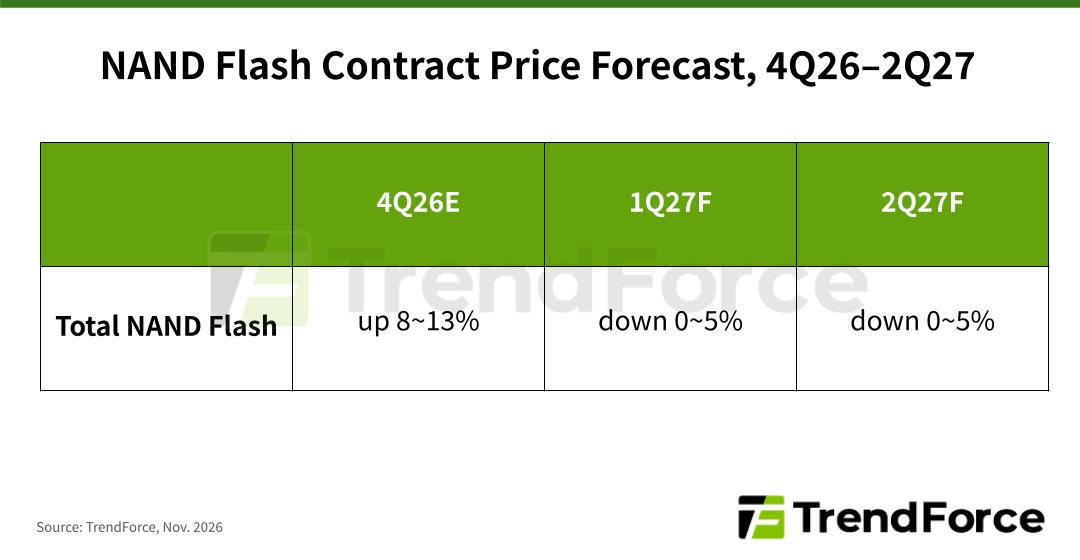
In response, TrendForce has lowered its forecast for quarterly contract price increases to 8-13%. Weakening demand has also intensified inventory-clearing pressure in distribution channels, triggering a sharp correction of more than 20% in spot prices recently.
Looking ahead to 2027, cuts to enterprise SSD demand from Chinese CSPs are expected to offset order growth in North America, while supply growth will significantly outpace demand throughout the year. As oversupply intensifies, TrendForce forecasts that overall NAND Flash contract prices will decline by 0-5% QoQ in the first quarter, with all product categories entering a downward price cycle beginning in the second quarter.
TrendForce emphasizes that the market outlook will depend on the pace of inventory reduction among Chinese CSPs, changes to restrictions on overseas GPU procurement, and whether consumer electronics manufacturers continue adopting lower memory specifications in 2028.
Another key factor will be the direction of US policy following the mid-term election, particularly whether any changes affect major AI data center projects planned for 2028 that are still in the planning and permitting stages. The pace of project approvals and capital expenditure will directly influence advance inventory procurement in the second half of 2027.
Source:
TrendForce
TrendForce forecasts that the overall NAND Flash contract prices will begin declining in the first quarter of 2027, with quarterly price drops potentially widening as the year progresses. TrendForce estimates that global NAND Flash industry CapEx will increase 26.7% YoY to US$29.9 billion in 2027.
Enterprise SSDs remain the primary growth driver for the NAND Flash industry, but regional demand trends are increasingly diverging. In North America, U.S.-based CSPs have recently raised their 2027 demand forecasts again, supported by AI agent and general-purpose server projects already under construction.
Chinese CSPs, however, are facing challenges including GPU shortages, elevated inventory levels, and intensifying competition over token pricing. As a result, they have reduced their total enterprise SSD orders for 2027 by an amount that exceeds the additional demand from U.S.-based CSPs.
In the consumer market, inventories of low-cost memory are expected to be depleted in 2027, putting upward pressure on finished-device prices and further weighing on shipments. Additionally, brands seeking to control bill-of-materials (BOM) costs will need to reduce storage capacity specifications, resulting in a significant decline in average capacity per device and further widening the demand shortfall.
NAND Flash prices forecast to fall 0-5% QoQ in 1Q27, with all product categories entering a downward cycle from 2Q27
TrendForce notes that continued downward revisions to global consumer electronics shipments, along with reduced enterprise SSD orders in China, have already begun to weigh on NAND Flash contract prices in the fourth quarter of 2026.
In response, TrendForce has lowered its forecast for quarterly contract price increases to 8-13%. Weakening demand has also intensified inventory-clearing pressure in distribution channels, triggering a sharp correction of more than 20% in spot prices recently.
Looking ahead to 2027, cuts to enterprise SSD demand from Chinese CSPs are expected to offset order growth in North America, while supply growth will significantly outpace demand throughout the year. As oversupply intensifies, TrendForce forecasts that overall NAND Flash contract prices will decline by 0-5% QoQ in the first quarter, with all product categories entering a downward price cycle beginning in the second quarter.
TrendForce emphasizes that the market outlook will depend on the pace of inventory reduction among Chinese CSPs, changes to restrictions on overseas GPU procurement, and whether consumer electronics manufacturers continue adopting lower memory specifications in 2028.
Another key factor will be the direction of US policy following the mid-term election, particularly whether any changes affect major AI data center projects planned for 2028 that are still in the planning and permitting stages. The pace of project approvals and capital expenditure will directly influence advance inventory procurement in the second half of 2027.
11 Comments on NAND Flash Prices Set to Decline in 2027 as Chinese CSP Order Cuts Outweigh North American Demand Growth
2028-2030 might very well turn out to be a hardware christmas tree.
AI is flickering and flailing wildly now, just like candles do right before they go out.
The investment is never, ever going to be recovered and the penny is dropping, rapidly.
If the prediction for next year (short horizon) is already like the article says, you can do the math
How's that going? There simply was an insane amount of speculative money going around, and there still is. That's that money that we lost over the years as inflation rose above pay increases. This entire affair is a huge money pit, nothing else. Some people get rich here, most don't.
Regardless, am not going to start buying before the AI/datacenter/neocloud bubble and CAPEX insanity has finally started unwinding.
2028 might be good year, lets' see.