News Posts matching #8 kHz

Return to Keyword Browsing

Ninjutso Teases Sora V3 Gaming Mouse Coming February 2026

The Ninjutso Sora V2 is one of the lightest full-size solid-shell wireless gaming mice on the market, coming in at just 39 g, and despite the V2 only just recently having received an updated 8K update, Ninjutso is already teasing a Sora V3 for early February. This is according to a new post on the brand's X page. Not much else has been revealed about the mouse, but we can infer some likely specs and changes based on the available information. Based on the recent update to the Sora V2, we can at least expect the Sora V3 to weigh no more than 39 g and feature 8 kHz polling, at least a PixArt 3395 sensor, if not the 3950, and Omron Optical switches for the main clicks.

Along with an early sneak peek at the mouse's design, Ninjutso commented "Best claw grip mouse of 2026?" This suggests that the Sora V3 will have some minor changes to the shell, even though the shell looks nearly identical to the V2 in the teaser image. When Ninjutso announced the Sora V2, one of the major changes was that the V2 mouse was shorter than its predecessor and had a somewhat taller hump. Judging from the image of the V3, it appears as though Ninjutso is leaning into this design trend once more, because the hump looks to have grown somewhat again. It also appears as though the front edge of the mouse, along with the left and right click buttons, has been lowered slightly compared to the V2. The side buttons on the Sora V3 also look slightly more pronounced than those of the V2, which would make them easier to find and trigger in tense gaming sessions.



Epomaker Reveals Carbonis Gaming Mouse With PAW 3950 Sensor, LCD, and Online Driver

Epomaker is no stranger to carbon fiber gaming mice, having previously launched the CarbonX gaming mouse, which used a lattice frame shell to reduce weight. The latest carbon fiber mouse from Epomaker is the Carbonis, and although it hasn't been fully revealed just yet, Epomaker has made early bird reservations available, charging prospective buyers a $1 non-refundable fee in exchange for a reservation and $15 discount when the mouse eventually launches later in January. No pricing is available just yet, but if it falls under around $70-80, it might be a competitive affordable alternative to flagship gaming mice, depending on the execution.

What we do know from the existing product page for the Carbonis mouse is that it will have a solid carbon fiber shell, and it will be a right-handed ergo shape, somewhat reminiscent of the Razer DeathAdder V4 Pro we reviewed prior. It will also be powered by the PixArt PAW 3950 sensor and the Nordic N54L MCU, and it will have an 8 kHz polling rate. It will also feature an online driver, instead of a Windows-only driver that needs to be installed. It will also have a small LCD on the top, likely used to display polling rate, battery level, and DPI settings, similarly to the Chilkey Glacier L W. Weight figures have not yet been announced, but it would be surprising to see a "lightweight" carbon fiber mouse launch at much over 60 g at most. The Carbonis will be available in a purple gradient colorway and a black colorway with the raw forged carbon fiber pattern visible on the surface. Both colorways have a gold scroll wheel, and no switches or encoder specs have been revealed.

FL Esports Previews Carbon Fiber Gaming Keyboards and Ultra-Light Gaming Mice at CES 2026

FL Esports, a gaming peripherals brand mostly known for making retro-inspired gaming keyboards, made an appearance at CES 2026 to show off a bunch of new gaming gear, both from the main FL Esports brand and its TNT sub-brand. At the show, FL Esports showed off a slew of new carbon fiber gaming peripherals, including a new mouse and several carbon fiber gaming keyboards. FL Esports also showed off two new gaming mouse designs at CES 2026, both featuring carbon fiber shells. Both mice featured symmetrical right-handed designs, and one mouse matched the orange and forged carbon fiber look of the T60 HE keyboard. The other mouse seems to have a regular injection molded plastic shell and a carbon fiber outer shell with a more conventional fiber layup aesthetic. Not much else is known about the new gaming mice, but you can check out photos below for a look at what's to come.

The three new TNT keyboards shown off at CES 2026, which have been previously teased but not yet launched, are the T60 HE, T68 HE, and the T87 HE—HE keyboards with 60%, 65%, and TKL layouts, respectively. According to the information presented on the showroom floor, the T60 HE, T68, and T87 HE are all tray mount keyboards, although they ship with silicone and Poron foam sound deadening material, and they are made from injection-molded, carbon fiber-impregnated plastic. The exact resin is unclear, but the combination results in a smoky translucent look with the carbon fiber striations typical of forged carbon fiber. The keycaps on both keyboards are also translucent, but the T87 HE's keycaps are similar to the typical translucent smoky set seen on keyboards like the Iqunix EZ80 Dark Side RS or the QwertyKeys Sonic65 HE. The smaller T60 HE and T68 HE, on the other hand, have the same carbon fiber look on the keycaps as it has on the chassis. All of the new carbon fiber HE keyboards boast 8 kHz polling with a 0.1 ms input delay, as well as 0.005 mm Rapid Trigger sensitivity and 0.005-3.4 mm key travel with adjustable actuation.

Epomaker Previews Typewriter-Style Mechanical Keyboard at CES 2026

Epomaker's appearance at CES hasn't been particularly stacked with new launches, with many of the exotic keyboards at the show, like the Luma40, and Split70 having already launched in the months leading up to CES 2026. However, the TechPowerUp team did catch a glimpse of some new Epomaker designs at the show, including a prototype for an upcoming mechanical keyboard the brand is working on. The new keyboard, which appears to not yet have a name, takes inspiration from vintage typewriters, but integrates modern touches that a few might see as gimmicks. Not much has been revealed about the new prototype typewriter keyboard, but there are a few details we can glean from what's being showcased at CES 2026.

For starters, and the most obvious difference from a regular mechanical keyboard, the typwriter keyboard seems to be using some form of custom round keycap with a strange wavy pattern along the bottom edge. Additionally, it appears to be using regular full-height mechanical switches, which should be a relief for low-profile haters. The keyboard also has a built-in tablet or phone stand, seven-segment display ribbon, and a built-in display—somewhat comically being used to display what looks like a fireplace—on the right side of the top edge of the keyboard. The actual keyboard layout follows the standard 75% form factor, and the typewriter prototype has per-key RGB backlighting, although the keycaps are not shine-through. The typewriter keyboard also features wireless connectivity, although specs have obviously not been released just yet.

Ducky Showcases Keyboard Lineup at CES 2026 Including Old School RuneScape Edition

Ducky presented its keyboard lineup at CES 2026 with a few new models ranging from themed special editions to high-performance and budget-friendly variants. One of the products that instantly caught our eyes came from a new partnership with Starforge Systems. The two companies will start by bringing licensed designs to Ducky-based keyboards. The first models include an Old School RuneScape-themed keyboard aimed at retro gaming fans, alongside designs inspired by Frieren: Beyond Journey's End. These models are based on Ducky's limited-edition platforms and focus primarily on visual design. For competitive users, Ducky is preparing the Strata 98 and Strata 75. Both keyboards feature true 8 kHz scan and polling rate and support Rapid Trigger, SOCD, MPT, and controller emulation. They also offer tri-mode connectivity for wired, wireless, and Bluetooth.

Ducky also presented its OK-M series, a more affordable lineup designed for everyday typing. These keyboards use a gasket-mounted structure with five layers of internal dampening, support hot-swappable linear or tactile switches, and include tri-mode connectivity with VIA software support.

Keychron Launches 3 New Aluminium TMR Gaming Keyboards with 8K Polling

Keychron has just expanded its line-up of analog gaming keyboards, launching three new all-aluminium Q HE series gaming keyboards with 8K polling and new TMR sensors. The new Q HE 8K series keyboards will kick off with the launch of the Keychron Q6 HE 8K, a full-size all aluminium gaming keyboard, and the Q3 HE 8K, which adopts a TKL layout, instead. The Q3 HE 8K ($229.99) and Q6 HE 8K ($239.99) will both be available on Keychron's site starting November 18, 2025, while the Keychron Q1 HE 8K, with a 75% layout, will be available from December 11. All of the new TMR keyboards are available in black and white with purple accent keys on the enter and escape keys. As the name suggests, the new Keychron Q HE 8K keyboards feature 8 kHz polling rate, but that comes at the cost of wireless connectivity. The new Q HE 8K keyboards use USB Type-C connections exclusively, although the connection mode switch typically found on Keychron keyboards has been replaced by a hardware profile selection switch.

The Keychron Q HE 8K keyboards have similar designs to previous Keychron Q HE keyboards, with the same aluminium switch plate and double-shot PBT keycaps in OSA profile. However, Keychron has swapped out the Gateron Double-Rail Magnetic switches found in its previous Hall effect and TMR keyboards with the Keychron Ultra-Fast Magnetic Lime switches, which are a lightweight (26-40 gf) linear switches with a standard orientation, making the Q HE 8K keyboards compatible with most other magnetic switches currently available. The new Q HE 8K series keyboards are powered by QMK firmware and are configurable and customizable through Keychron Launcher, a web app that is very similar to something like VIA but with a few additional features, like easy firmware updates.

Keychron Launches M2 Mini 8K: 50 g Gaming Mouse With PAW 3950 Sensor

Keychron has silently expanded its range of lightweight gaming mice with the new M2 Mini 8K. The new M2 Mini 8K features many of the same features as the M2 8K but in a more compact design ideal for users with smaller hands looking for a somewhat more affordable gaming mouse with top-tier hardware and a moderately asymmetrical ergonomic design. The Keychron M2 Mini 8K is available for $59.99 from the Keychron online store. The updated version of the Keychron M2 Mini 8K updates the polling rate from 1 kHz to 8 kHz and upgrades the sensor of the existing M2 Mini from the PixArt PAW 3395 to the PAW 3950 for reduce input latency and improved tracking features.

The sensor upgrade also means that the Keychron M2 Mini 8K is capable of up to 30,000 DPI sensitivity and tracking at up to 750 IPS and 50 G acceleration, even on glass, as long as it's thicker than 4 mm. The Keychron M2 Mini 8K has the same tri-mode wireless connectivity—Bluetooth 5.3, 2.4 GHz, and wired, with 8 kHz polling available over 2.4 GHz and USB-C connections—powered by a 600 mAh battery that Keychron estimates will deliver 140 hours of use when connected via Bluetooth. The Keychron M2 Mini 8K weighs in at just 50 g and has PTFE feet. The main click switches are Keychron's typical Huano Transparent Blue Shell Pink Dot switches, which are rated for 80 million clicks. The M2 Mini 8K measures in at just 177 × 64 mm and 38 mm tall, compared to the regular M2's 121.5 × 66.7 × 40.60 mm. The regular M2 8K also weighs 55 g, so the weight difference is almost negligible.

Epomaker Launches the CarbonX and Click Lite Gaming Mice

With continuous support from its growing community, Epomaker has received valuable feedback and suggestions. Many community members have expressed a desire for mice that not only offer a visually striking design but also deliver exceptional performance. In response to this, Epomaker is proud to announce the launch of two new mice, designed and developed based on the input of its dedicated users.

The Epomaker CarbonX
Although Epomaker is not a traditional mouse brand, the CarbonX was designed from the outset to break the mold. Featuring an innovative aerospace-grade carbon fiber shell, this mouse combines a lightweight 50 g build with exceptional durability, efficient heat dissipation, and a comfortable user experience.
To achieve a more stable 8 kHz polling rate, the Epomaker CarbonX moves away from traditional, lower-cost sensors, opting for the high-performance PixArt PAW3950 sensor. Paired with Omron optical switches, the Epomaker CarbonX is designed to assist users in achieving peak performance in both gaming and daily use, with a lifespan of up to 1 million clicks. An 8 kHz polling rate is a rare feature found only in high-end gaming mice, providing an ultra-fast response speed that is several times that of most wireless mice.

Logitech G Drops a Wide Array of New Products and Innovations at Logitech G PLAY 2025

Today at Logitech G PLAY 2025 in Shanghai, Madrid, and on livestream, Logitech G unveiled one of the most significant upgrades to its portfolio to date. The array of products and experiences included major innovations across PC and console gaming, esports, sim racing, and streaming tools, along with partnerships with McLaren Racing, NVIDIA, and more.

Logitech G PLAY 2025 is a live-streamed global gaming event that brings together press, partners, creators, and fans to explore the future of gaming, fueled by breakthrough technology, inclusive design, and the power of community.

Logitech's Pro X Superlight 2c Leaks Ahead of Launch

Details of Logitech's upcoming Pro X Superlight 2c—where c stands for compact—has leaked courtesy of WinFuture. As the name suggests, this is a smaller version of Logitech's popular competitive gaming mouse. It sports Logitech's Hero 2 sensor that supports a sensitivity of up to 44,000 DPI, an 8 kHz polling rate and 88 G of acceleration. It also has LightForce optical switches, USB-C charging, PTFE feet and Logitech's LightSpeed wireless technology.

The Pro X Superlight 2c weighs in at a mere 53 grams, which is seven grams less than the full-size model, although the leak doesn't include how much smaller it is in size. The battery life remains at 95 hours, so the smaller size doesn't mean shorter play time. The rodent is expected to be available in retail relatively soon with a retail price of around €170, in black, white or magenta.

Lemokey L0 HE Launches as Classic One-Sided Gaming Key Pad with 8 kHz Polling and Hall Effect Customization

The latest in the recent flurry of gaming peripherals to launch comes out of Keychron's gaming-focused brand, Lemokey. The L0 HE 8K is a one-handed gaming keyboard reminiscent of the game pads, like the Logitech G13, that started flooding the scene in the early 2010s. However, instead of including functionality like extra side buttons and analog thumb sticks, the Lemokey L0 HE opts for 35 keys from the left half of the traditional QWERTY layout, and it includes a metal knob on the right edge of the keyboard. The knob and all of the keys are customizable and remappable in Keychron or Lemokey Launcher, and the switches used offer a resolution of 0.01 mm when it comes to actuation customization. The chassis is made from CNC machined aluminium, although it doesn't use the same gasket-mount structure Keychron and Lemokey typically use.

uses semi-proprietary "Lemokey Ultra-Fast Lime Magnetic Switches," which feature a dust-proof box stem—generally preferred for increased stability. The switches have a starting weight of 25 gf and a bottom-out force of 48 gf, which is very progressive for a linear switch, and they have customizable actuation point up to 3.35 mm. Lemokey doesn't specify the physical travel distance, but it seems to be 3.35 mm, as well, which is on the shorter side, even for HE switches. Curiously, the L0 HE uses two-sided "nuclear reactor" keycaps, which have a transparent window on the side and an opaque top, instead of the usual letter shine-through keycaps found on other Lemokey Hall effect keyboards. At least the keycaps seem to use the standard Cherry profile, and they're made of double-shot PBT, so the legend shouldn't wear off over time. The keycaps also allow for better shine-through effects from the south-facing per-key RGB LEDs.

Wooting Reveals More 60HE v2 Gaming Keyboard Details and Kit Options

Wooting recently revealed that the company is working on an update to its wildly popular 60HE keyboard, with a bunch of welcome improvements slated to arrive with the new Hall effect keyboard. Now, in a recent Q&A video on YouTube, Calder Limmen, Wooting's CEO has addressed some frequent questions about the 60HE v2, with two particularly interesting details coming to light. Firstly, Limmen confirms that the 60HE v2 will be available as a module, just like the original 60HE. This was expected by fans of the company, but this is official confirmation that this will be the case. He goes on to explain that the 60HE v2 module will include the necessary foam pad to mount the PCB and plate assembly both with the friction-fit pad and in a regular tray-mount configuration. The module will also be backwards compatible with both the previous Wooting 60HE stock plastic case and all of the other cases that are compatible with the 60HE, like the Tofu60 Redux, GT60, and the Wooting x Optimum case.

The other big news is that the original 60HE v2 will eventually replace the original 60HE as the brand's only 60% option, although the two will be sold alongside one-another when the 60HE v2 first launches. While Wooting has previously hinted that it does not yet know the price of the 60HE v2, confirming that the 60HE v2 will be sold alongside the v1 suggests that the 60HE v2 will cost more than the v1, at least initially. Limmen also confirmed that the 60HE v2 will be available with both an aluminium and plastic case, with the plastic version of the v2 offering a lower-cost option for gamers who are a little more budget-constrained. The Wooting 60HE v2's expected release and delivery date has seemingly not changed, despite the recent struggles Wooting was experiencing finding a coating that wouldn't react to skin oils and sweat.

Iqunix Announces EZ75 As Latest in its Premium HE Gaming Keyboard Line-Up

After teasing the EZ75 all the way back in January at CES, Iqunix has finally released the new 75% Hall-effect gaming keyboard via an announcement in its Discord server. The EZ75 combines the design and compact width of the EZ63 with the more versatile 75% layout that features an expanded navigation column and a full F row, replete with an F13 "Delete" key. The EZ75 is available from the Iqunix web store with a price of $259, and it appears to only be available with Iqunix's own Magnetic X Ultra switch, which is a lightweight (36-48 gf actuation force) Hall-effect switch with a box stem for added stability. The keyboard is also compatible with common HE switches, like the Gateron Magnetic Jade Gaming, Jade Pro, and Geon Raw, but those will have to be purchased separately by users looking to upgrade.

The EZ75 has the same aluminium case design as the EZ63, with its bolt-on side rails, CNC-cut aluminium plate, and rubber gasket mount, and it also has the same black and gray double-shot PBT keycaps with plain white legends. As far as gaming performance goes, the EZ75 offers 8 kHz polling with a 16 kHz PCB scan rate for a claimed latency of 0.18 ms. HE features are configured in a proprietary web driver, and Iqunix offers RT sensitivity of up to 0.005 mm with the X Ultra switches. The EZ75 will also come with an accessory kit featuring a carrying case, keycap and switch puller, paracord USB Type-A-to-C cable, and a cleaning brush.

ATK Duckbill Ultra 8K Wireless Gaming Mouse Launches With Mid-Range Price, 46 G Weight, and Flagship Specs

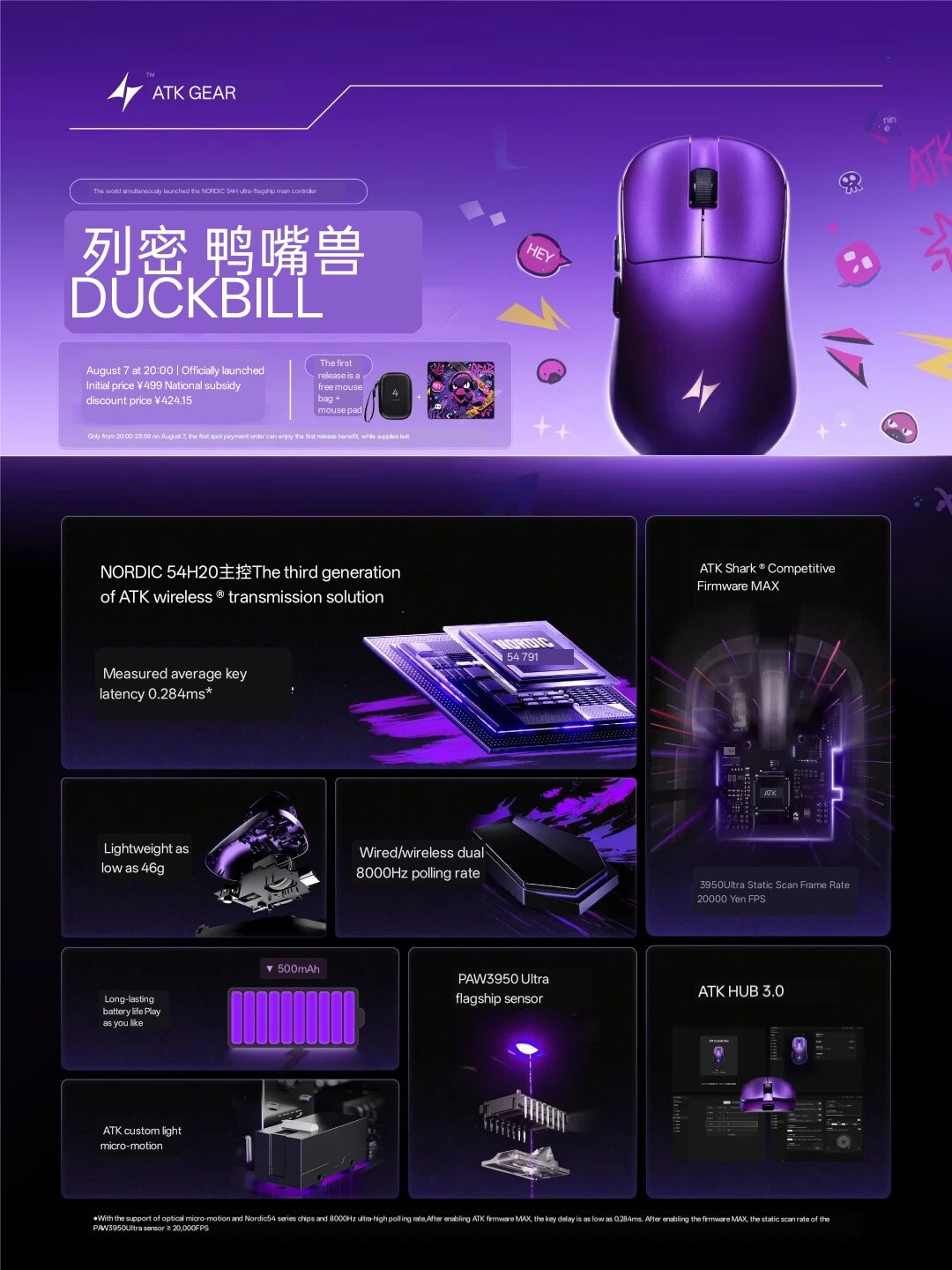
After weeks of teasers and leaks, ATK has officially launched the Duckbill Ultra, a compact symmetrical wireless gaming mouse with a shape that emphasizes the low front height of the main left and right click buttons, a rearward hump and side buttons, and swooping sculpted left and right clicks. The images that are available of the Duckbill make it look like a more affordable spin on the Pulsar TenZ Signature Edition with a few tweaks to the design. ATK says the Duckbill will weigh in at around 46 g, but it's unclear whether this will include the mouse skates or not. This puts it in roughly the same weight class as the Kysona Mercury that launched just a day before it. The Duckbill Ultra measures in at just 118 × 62.5 × 37.4 mm, with a grip width of 55 mm, and it is designed for a claw grip. It also features all the internals you might expect from an esports-oriented mouse, like the PixArt PAW3950 sensor, Nordic 54H20 sensor, and 2.4 GHz wireless connectivity with 8 kHz polling. The Duckbill Ultra features a 500 mAh battery that the brand says should deliver around 150 hours of use, although there is no clarification which connection mode was used for this calculation. Fortunately, it also offers 8 kHz wired polling for when you do need to charge it.

The Chinese launch post was spotted by @hitoshi_1107 on X, and the launch materials say that the ATK Duckbill Ultra is slated to go on sale on August 7 at a price of ¥499, which converts to $69.53 at the time of writing. This is somewhat more expensive than expected, since ATK has generally catered to the affordable peripherals niche, with many of the brand's previous gaming mice coming in at between $30 and $50. The launch currently seems limited to China, although it will likely show up on sites like AliExpress before long, and the marketing materials mention that it will be a simultaneous global launch. ATK is seemingly simultaneously launching its ATK Hub 3.0 for peripheral configuration. Fortunately, there is a web version available, so users don't necessarily need to worry about falling victim to the same malware infection issues that befell Endgame Gear users recently.

Kysona Launches Mercury: 41g, $69.99 Wireless Gaming Mouse With Flagship Internals "Built for Small Hands"

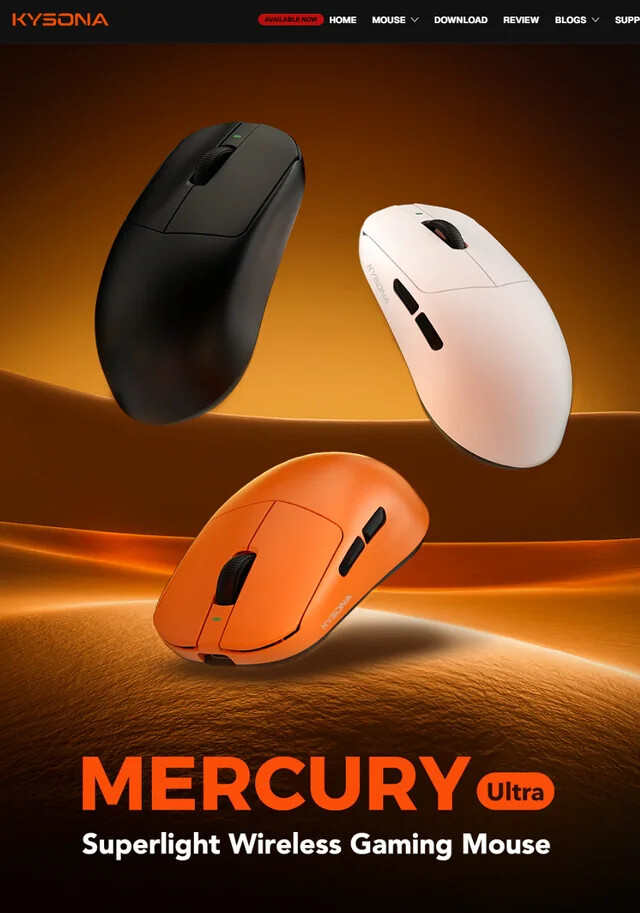
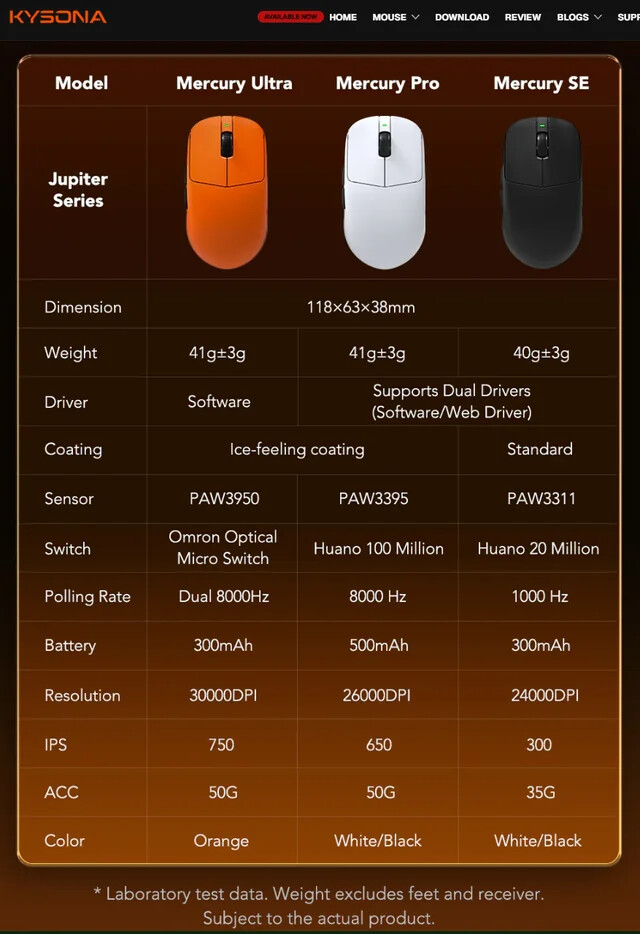
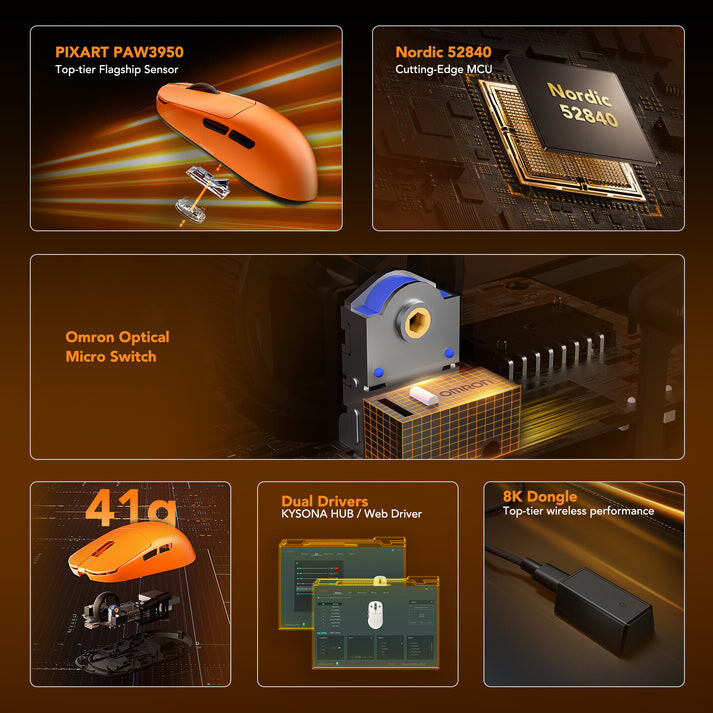
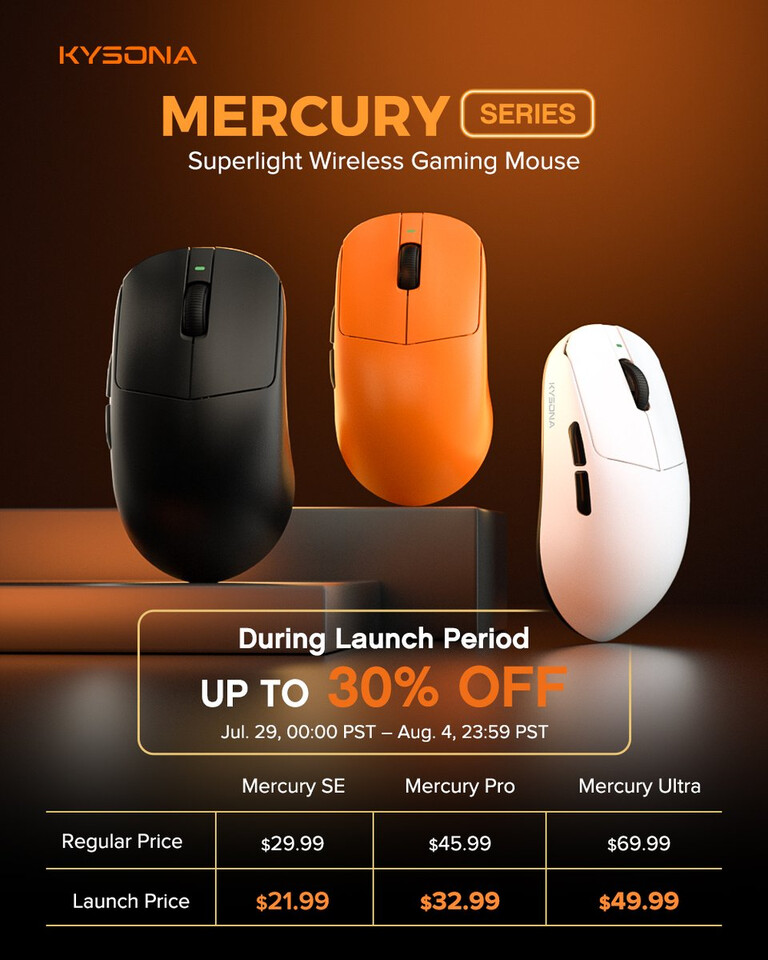
Kysona has recently made a name for itself in the ultralight wireless gaming mouse space with the launch of the Uranus Pro, and now it is following that launch up with the Mercury series, headed up by the Mercury Ultra, which packs a PixArt PAW3950 sensor, a 41 g weight with no holes, and Omron Optical Micro switches, which should be good for 70 million clicks. The Mercury Pro and Mercury SE both also feature similarly lightweight designs and identical dimensions, with lower pricing and slightly altered internals. The Mercury Ultra carries a $69.99 MSRP and $49.99 launch price, while the Mercury Pro is $49.99 but $32.99 at launch, and the Mercury SE is $29.99 with a $21.99 launch price. Currently, it is only available via the Kysona online store, but Kysona's products have previously been available on Amazon, so that seems like a matter of time, too.

Kysona says the Mercury is built for smaller hands, measuring in at just 118×63×38 mm, and it features a similar shape to the Pulsar X2 Crazylight we recently reviewed, albeit with some slight tweaks to the curvature on the sides and a slightly heavier weight of 41 g, measured without the skates. The Mercury SE weighs in at 40 g, which is 1 g lighter than the Mercury Pro and Ultra. The Mercury Ultra features Omron optical switches and a PAW3950 sensor, while the Pro and SE have Huano mechanical switches—100 million "transparent white" and 20 million "blue shell white dot," respectively. The Mercury SE also drops the 8 kHz polling featured in the Ultra and Pro versions and uses the PAW3311 sensor, while the Mercury Pro maintains 8 kHz polling with a PAW3395 sensor. Curiously, the Ultra and the SE share the same 300 mAh battery capacity, while the Pro version steps it up to 500 mAh. All three mice also feature both Bluetooth and 2.4 GHz wireless connectivity, with wired USB Type-C as an option as well. All three mice also have the same five buttons (including scroll wheel click), and they are all remappable with macro support, although only the Pro and SE support a web driver, while the Mercury Ultra requires the installation of software—which has recently been proven to be suboptimal.
Return to Keyword Browsing
Nov 11th, 2026 07:09 CST change timezone

New Forum Posts

Popular Reviews

TPU on YouTube

Controversial News Posts