News Posts matching #8 kHz

Return to Keyword Browsing

Keychron V6 Ultra Hybrid TMR Keyboard Launches on Kickstarter

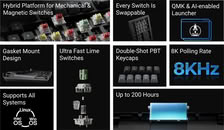
Keychron previously teased the V6 Ultra Hybrid, a new wireless hybrid keyboard that is compatible with both magnetic and mechanical switches, and the company has now officially launched the new keyboard on Kickstarter with a pledge goal of $30,000. Merely a day after launching on the crowdfunding platform, the V6 Ultra Hybrid has managed to accrue over $166,000 from 926 backers.

The Keychron V6 Ultra Hybrid is compatible with both regular MX-style 3- or 5-pin mechanical switches and more modern, gaming-oriented magnetic switches, thanks to its TMR sensing tech. The keyboard has a built-in mechanism to automatically detect whether mechanical or magnetic switches are installed in a given socket and automatically switch between mechanical or magnetic mode without human intervention.

Iqunix Officially Launches EC75 HE Gaming Keyboard at $179.99

Iqunix showed off the EC75 earlier this year at Computex, but the peripheral maker has now officially released the EC75 HE for sale, simultaneously revealing the pricing and finer details of the keyboard. At the time of writing, there is a store page for the EC75 HE, but it is not live just yet. The only place to buy an EC75 HE is on Amazon, where it costs $179.99.

As the name suggests, the EC75 HE has a 75% layout, which many see as a good balance between everyday productivity use-cases and gaming, since it provides the same space-saving benefits as a 65% keyboard but retains the function row. The EC75 has a CNC aluminium mid-case with an injection-molded bottom case, Hall effect sensing, and an 8 kHz polling rate. Iqunix has foregone wireless connectivity, relying instead on USB Type-C exclusively.

Keychron Launches Comically Large C100 8K 100-Key Mechanical Macro Pad

Shortly after announcing a handful of new gaming mice—the G6 HE and an updated version of the M4—Keychron has officially launched the C100 8K, a new macro pad with 100 programmable keys and per-key RGB backlighting. The C100 8K Giant Custom Macro Pad is available from Keychron directly for $64.99 with Keychron Apex Red Switches.

The C100 8K, as the full name suggests, is a macro pad with 10 rows and 10 columns, totaling 100 keys. It features an 8 kHz polling rate, as do most of Keychron's new keyboards. By default, it ships with transparent ASA profile keycaps, made from a blend of PBT and PC plastic, and a set of Keychron's Apex Red linear switches, but it also uses standard hot-swap sockets if for those who want different switches. The C100 8K is otherwise fairly barebones, using a plastic case and a wired USB Type-C connection, with no wireless option for a cleaner desk setup.

Bose Updates Its QuietComfort Headphones Series

Today, Bose announced the next generation of its iconic noise-cancelling headphones, the QuietComfort Headphones (2nd Gen). Introducing a refreshed industrial design that brings a modern new look to one of the brand's most recognizable products, the headphones pair legendary noise cancellation and renowned comfort with proprietary Bose technologies for a more immersive listening experience.

The new QC Headphones will open for preorder beginning August 8 on Bose.com and through select resellers for $359, and will start shipping on August 13. Available in Black, White Smoke, or three new limited-edition colors: Eucalyptus Green, Dewdrop Mint, and Rosewood Mauve.

Gadhouse Unveils the Wesley Wired Headphones

Audio lifestyle brand Gadhouse today announced a renewed focus on analog listening culture, led by its retro-inspired Wesley Wired On-Ear Headphones. As cassette tapes, wired audio and physical music formats continue to experience a global resurgence—driven largely by younger listeners—Wesley has been created to meet growing demand for simple, dependable and tactile audio experiences. The Wesley headphones are available from Amazon and Amazon UK for $69.99/£50.62.

Recent industry data shows that analog formats are enjoying their strongest revival in more than a decade. UK cassette sales have risen for ten consecutive years, reaching their highest level since 2003, while US cassette album sales grew 17.5% in 2025, climbing to 446,500 units—five times higher than a decade ago. Early 2025 saw an even sharper rise, with cassette sales increasing 204.7% year-on-year in Q1. Gen Z listeners now account for 59% of physical music consumption, signalling a cultural shift toward ownership, collectability and analog authenticity.

DrunkDeer Reveals Glacier X Gaming Mouse with Logitech G Pro-Inspired Shape

DrunkDeer, a peripherals brand known for affordable Hall effect gaming keyboards that are often recommended as alternatives to premium brands like Wooting, revealed in late June that it is working on its first gaming mouse. After drip-feeding gamers specs and information about the upcoming mouse, Drunkdeer has finally revealed the shape, rounding out just about all we need to know about the new mouse except for its price.

The DrunkDeer Glacier X—not to be confused with the Chilkey Glacier LW—looks to be playing it safe when it comes to shape, opting for the familiar potato shape of the Logitech G Pro. It's unclear what the exact size of the Glacier X will be, but the mouse appears to have similar proportions to the Logitech G Pro family, even if it does look a little taller than something like the G Pro X Superlight 2.

Keychron Launches K1 Ultra TKL Low-Profile Mechanical Keyboard

Following the recent launch of the Keychron K5 Ultra, Keychron has announced the TKL version of its latest K Ultra keyboard line-up, the Keychron K1 Ultra 8K. The K1 Ultra 8K uses the same elegant low-profile design with wood side panels and aluminium case reinforcements, but it swaps the K5 Ultra's 100% layout for a more compact TKL layout. The K8 Ultra 8K is available on the Keychron online store for $109.99.

As with other versions of the K Ultra keyboards, the K8 Ultra features ZMK firmware for extreme wireless efficiency, claiming 490 hours of battery life over 2.4 GHz from a 2,600 mAh battery at 8 kHz polling with the backlighting disabled. While the K1 Ultra 8K features an ABS plastic case, it has double-shot PBT keycaps and aluminium rails along the front and back edges to complement the real rosewood accent panels on the sides. There is also a small programmable knob in the F13 position that is assigned to volume control by default.

Wooting Updates Hall Effect Keyboards with Per-App Custom Profile Capabilities

Wooting is one of the rare keyboard manufacturers that meets gamers in the middle, providing gamers with both a web app and an installable program to customize their gaming keyboards. Now, the keyboard maker has announced App Linking, which enables per-app profiles in a new beta version of Wootility. Now, Wooting users who have the Wootility Background Service enabled can switch keyboard profiles on the fly, depending on which window is in focus in their operating system. It supports up to eight linked apps per profile on the keyboard, and the 80HE and 60HE V2 can support up to four on-board profiles. The update also refines the RGB sleep timer control UI and allows editing profiles directly from the icon tray.

Wooting's profiles control everything from actuation points, features like RT, SOCD, and analogue input, to key mapping and RGB lighting. This means you could set up a Wooting 80HE or 60HE to act like a macro pad while something like a video editor or CAD suite is focussed, a regular office keyboard with a lower polling rate and reasonable actuation point when word processors or web browsers are open, and a high-performance gaming keyboard with 8 kHz polling, RT, and a 0.1 mm actuation point when in games. One caveat with this background service functionality is that it currently does not work with Wayland on Linux, since that display server, since apps are generally isolated under Wayland, and support for features like this is spotty at best on Wayland. The Wooting support team is engaging with the community about Wayland support on Linux, and it seems as though the development team will look into supporting certain desktop environments, like KDE.

Update Jul 13th: As of Wootility version 5.4.1, App Linking is now available in the stable channel for both the web and download versions of Wootility, although those using the web version will still need the background app running to enable functionality. Wooting has also officially added support for 14 new third-party switches, including from Gateron, TTC, Ugaming, and Wuque Studio. Full changelog available here.

Keychron Launches K5 Ultra 8K Low Profile Mechanical Keyboard with Wood Accents

Following the recent launch of the Keychron K4 Ultra and K10 Ultra, the accessory maker has officially launched the new K5 Ultra 8K, a low-profile wireless mechanical keyboard with a full 100% layout and sleek cherry wood accents. The K5 Ultra is the latest version of the low-profile K Ultra-series, which means it uses the same ZMK firmware and has the same 2.4 GHz and Bluetooth 5.2 wireless connectivity as the previously announced K3 Ultra had. The K5 Ultra has launched with an MSRP of $114.99, and is available in black on the Keychron online store or on Amazon. The K5 Ultra is also capable of refresh rates of up to 8 kHz over both the wired USB Type-C connection and the 2.4 GHz connection. Wireless connectivity is powered by a 2,400 mAh battery, and Keychron cites 370 hours of use from a single charge with the backlighting disabled and the keyboard running at an 8 kHz polling rate.

The Keychron K5 Ultra uses a proper full-size layout and includes both a programmable knob above the backspace key and a macro row above the num pad. The K5 Ultra is available with Keychron's relatively new Milk POM low-profile switches—which follow the Gateron Low-Profile 2.0 pin layout—in three switch flavors. Milk POM Reds are linear with a 45 gf actuation force, while the Milk POM Browns are tactile with a 50 gf actuation force, and the Milk POM Banana switches are a strong tactile switch with 57 gf actuation force. All three switches have 3.1 mm of total travel, but the Reds have 1.3 mm of pre-travel, while the two tactile varieties have 1.7 mm pre-travel. The K5 Ultra measures in at 436.6 x 128.29 mm and has a 15.55 mm front height. It also features two-stage flip-out feet for different typing angles.

Keychron Debuts K4 Ultra and K10 Ultra Wireless Mechanical Keyboards

Keychron has just expanded its line-up of K Ultra wireless mechanical keyboards with the K4 Ultra and K10 Ultra, both of which feature num pads and identical internals with slight layout tweaks to cater to different use cases. The K10 Ultra is a full-size wireless mechanical keyboard, replete with a four-key macro row above the num pad, while the K4 Ultra forgoes the navigation cluster above the arrow keys in favor of a more compact 96% layout. Both the K4 Ultra and K10 Ultra are available on Keychron's online store and its Amazon storefront for $114.99, with the K4 Ultra's more compact layout slimming down the overall footprint by just over 55 mm.

Internally, both the K4 and K10 Ultra are based on ZMK firmware, which optimizes for wireless battery life, with Keychron claiming up to 600 hours of battery life from the 4,000 mAh battery in both keyboards with the backlighting disabled. For wireless connectivity, the K4 Ultra and K10 Ultra feature 2.4 GHz and Bluetooth 5.2 connections, with a USB Type-C port for charging or wired connectivity, and both keyboards are capable of 8 kHz polling over 2.4 GHz and wired connections.

Introducing the Logitech G3 Series Mouse and Keyboard for PC Gaming

Logitech G today announced the expansion of the G3 Series suite of PC Gaming products. Designed to bring pro-inspired performance to more gamers, the extended lineup features the G305 X SUPERLIGHT wireless gaming mouse and the G316 X 98 wired mechanical gaming keyboard. These new products join the recently launched Logitech G325 gaming headset, completing the G3 series, a comprehensive high-performance desktop ecosystem that delivers excellent performance, world-class features, and unique customization at an affordable price point.

"By fusing elite precision, like our sub-micron HERO 44K sensor and 8 kHz report rates, with high-end heritage design, we are enabling everyday gamers the ability to level up their gaming experience at an approachable price tag," said Arnaud Perret-Gentil, Head of Product PC Gaming and Creators at Logitech G. "The G3 Series represents a strategic evolution in our mission to facilitate 'Play for All.'"

Finalmouse Reveals 38 g Starlight X Wireless Gaming Mouse: TMR Switches, Exclusive Sensor, and Nordic MCU for $179

Finalmouse, maker of the high-performance, somewhat controversial ULX series of gaming mice, has just launched its latest gaming mouse, the Finalmouse Starlight X, after weeks of teasing the new peripheral. The Starlight X is an ultra-light carbon fiber composite gaming mouse, weighing in at 38 g, and it is the first new Finalmouse shape in 11 years. The mouse was designed with FPS gaming in mind, and the brand says that the symmetrical shape has a fuller rear hump with increased support, and reduced pressure points. The Starlight X shell measures 124.8 × 58.9 × 39.5 mm (L × W × H) and has minimal cutouts on the top, likely to balance light weight without compromising comfort and grip. The Finalmouse SLX Nightfall is currently the only colorway on offer, and it will be available for pre-order on the Finalmouse online store for $179 starting on May 30 unless you have an early access code. The headline feature of the Starlight X, however, is the addition of TMR sensing, which enables analogue features, like rapid trigger, adjustable actuation point, and a claimed up to 35 ms latency reduction compared to similar gaming mice.

The new switch tech itself isn't simply a new switch; the SLX uses what it calls the "TMR Dual-State" switch system, which implements TMR sensing with a mechanical click feedback mechanism. According to Finalmouse, this means the new switch mechanism incurs a weight penalty of just 0.24 g, while Logitech's HITS analogue sensing and feedback system on the new G Pro X2 Superstrike adds complexity and has been the scapegoat for the Superstrike's 61 g weight. The drawback of this hybrid switch tech is that the tactile feedback is not adjustable. The SLX is built around a custom Finalmouse F1 sensor, built in collaboration with PixArt, and a Nordic nRF54LM20 MCU, although Finalmouse has deliberately not quoted common specs, instead citing end-to-end latency of 223 µs (0.223 ms). The sensor is likely based on the PAW 3955 sensor, which was previously shown off in the Akko Dash series. Finalmouse has also neglected to specify the Starlight X's polling rate, stating instead that "SLX moves beyond traditional polling-rates entirely," with PerfectPolling that combines subtick optimization, efficient and robust RF scheduling, and high-speed USB interrupts. For what it's worth, USB is generally capped at 8 kHz, and the 232 µs figure cited previously lines up with 8 kHz, which offers theoretical latency of 125 µs.

Epomaker Launches Revised HE75 V2 Gaming Keyboard With Enthusiast Design Touches and Gaming Performance

Epomaker's voyage into the world of Hall effect keyboards has been ongoing for a little over two years, now, and, while the peripheral maker oft manages to hit a reasonable price point, the results can be a little mixed. Now, it has shown off a revised version of the HE75 Mag that launched in 2025, bringing some new enthusiast-grade design touches to the affordable Hall effect gaming keyboard. Epomaker has shown off the HE75 V2 in a recent livestream on YouTube and published the product page with all the specifications ahead of the official launch. From that product page, we can see that the HE75 V2 has an ABS plastic case with a gasket mount and an FR4 plate. Curiously, neither the PCB nor the FR4 plate have flex cuts, which is generally valued by the enthusiast community, since it prioritizes sound.

As the name suggests, the HE75 V2 follows a 75% layout, keeping both the num row and F row, although it makes use of a reduced, three-key navigation column on the far right edge, making it a solid, if somewhat compromised, all-round option. There is also modular programmable volume knob that can be removed and replaced with two key switches, much like on the original HE75 Mag. Unlike the original, the HE75 V2 comes in either an all-white or all-black aesthetic, both with color-matched translucent PC keycaps—smokey on the black version and frosted on the white keyboard. The translucent keycaps obviously allow a lot of RGB shine-through, and Epomaker has accented that with edge lighting that shines through a faceted diffuser seemingly meant to look like crystals. If the Epomaker livestream is any indication, the HE75 V2 and its Creamy Jade Magnetic switches will have a poppy sound signature typical of an FR4 plate and POM switches. The HE75 V2 will feature tri-mode connectivity, with Bluetooth, 2.4 GHz, and USB-C, and 8 kHz polling over 2.4 GHz and wired connections.

Update May 19th: The Epomaker HE75 V2 is officially available on the Epomaker store and Amazon for $89.99 with the Epomaker Creamy Jade HE switch.

Akko Launches 40 g Dash Master Gaming Mouse With PAW 3955 Sensor, 8 kHz Polling, Omron Optical Switches

After previewing the Dash series of wireless gaming mice at CES in January 2026, Akko has officially released the Dash Master as its latest iteration in the Dash line-up. The Dash Master features the new PixArt PAW 3955 sensor, which ups the mouse's sensitivity to 65,000 DPI and offers 8 kHz polling. More importantly, the Akko Dash Master weighs in at just 40 g, putting it on the lighter side compared to most mainstream gaming mice. The Dash Master uses both Bluetooth and 2.4 GHz wireless connecitivity alongside USB-C wired, with the latter two offering 8 kHz polling. The combination of the new sensor and the Nordic nRF54L15 MCU garner a claimed 30-50% power savings, with battery life clocking in at a claimed 86 days on Bluetooth, 220 hours of continuous use at 1 kHz, and 28 hours of use at 8 kHz polling rate. The Akko Dash Master carries an MSRP of $69.99, but there is a $10 launch discount that brings the price down to $59.99.

The Dash Master, like the other Dash gaming mice, has two side buttons and a symmetrical shape optimized for a claw grip and smaller hands, measuring in at just 117.56 × 60.91 × 37.01 mm, and the main clicks make use of Omron Optical switches, which are known to be reliable and have a long service life, thanks to the lack of a mechanical switch mechanism. The scroll wheel on the Dash Master uses the TTC Gold encoder, which is a popular choice for affordable flagship-tier gaming mice. The Dash Master can be customized and reprogrammed in a browser-based web utility or a downloadable Windows application. One of the benefits of the Master over the other Dash mice is that it ships with three sets of dot skates—all with different friction characteristics—in addition to the pre-installed PTFE skates. Akko specifically notes that the Dash Master has no coating, instead featuring a satin finish on the polymer itself—Akko argues that coatings will just wear off in high contact zones—but it does include precision cut grip tape to add some grip if you need it.

Keychron Launches Q11 Ultra Split Wireless Mechanical Keyboard

Keychron has been busy updating its mechanical keyboard line-up over the last few months switching to hyperefficient firmware and its updated Silk POM mechanical switches. Now, the Keychron Q11 gets the same treatment, with the Q11 Ultra being a much bigger improvement over the original Q11 than the other keyboards Keychron has recently updated. The reason for this is that Keychron's only split keyboard was the Q11, with no Max or Pro variants to add wireless connectivity into the mix. This time, though Keychron has gone one step further with the Q11 Ultra, not only eliminating the USB-C cable to the PC, but also making the two halves of the split keyboard communicate wirelessly as well. Keychron claims that the dual batteries in the Q11 Ultra are capable of delivering 300 hours on a single charge, and the keyboard connects via Bluetooth, 2.4 GHz, or via the USB-C cable on the left half. With 2.4 GHz and the wired connection, the polling rate can go as high as 8 kHz, even though that's hardly necessary for a mechanical switch. The Q11 Ultra is available for $239.99 from Keychron's online store.

The Q11 Ultra is a 75% split keyboard, meaning the keyboard splits in half for ergonomic purposes, although it still maintains the row staggered layout, so it should feel familiar for most users coming from a regular mechanical gaming keyboard. Despite the 75% layout, the Q11 Ultra has an additional five-key macro column on the left edge of the left side of the keyboard, and there are two programmable knobs—one on each half of the keyboard. The keyboard cases are constructed from CNC aluminium with an integrated top plate, and the keyboard uses double-shot PBT keycaps in Keychron's KSA profile. The Q11 Ultra is only available in black with blue accent keycaps, and it seems to miss out on the decorative bottom panel found on the likes of the Keychron Q1 Ultra. It comes with a choice of Keychron Silk POM Red (linear), Brown (tactile), and Banana (sharp tactile) switches, but the PCB is hot-swap compatible, so you can bring your own switches and keycaps if you don't like the stock experience. The Q11 Ultra has south-facing per-key RGB backlighting, which, along with the layout, is fully programmable in Keychron Launcher.

ATK Reveals Dragonfly A9 Mini Master Edition: Logitech G Pro X Superlight 2C Shape, Customized PAW 3955 Sensor

ATK has become known for its impressive budget gaming peripherals that provide gamers with an alternative to flagship gaming mice and keyboards without having to empty their wallets. The brand's latest launch is the ATK Dragonfly A9 Mini, which, the brand claims, will be a world-first exclusive launch of the PixArt PAW 3955 Master sensor, which will be a custom version of the existing PAW 3955 sensor. The mouse itself looks to be a pretty close match to the compact shape of the Logitech G Pro X Superlight 2C, and it will likely weigh the same as or a little less than Logitech's design, which comes in at 51 g.

As for exact internal specifications, not much has been revealed, but it would make sense for ATK to use a Nordic 52-series MCU and either tuned Omron optical or Huano mechanical switches. Regardless of MCU, the ATK Dragonfly A9 Mini will likely feature 8 kHz polling and ATK's typical "Ice-Feel" coating. The skates deviate from Logitech's design, with two large flat skates at the front and back as well as the typical ring around the sensor. Pricing and availability have not yet been announced, but it will likely cost around the same $59.98-74.98 range as the regular Dragonfly A9 series.

Keychron Silently Launches P6 Ultra With ZMK Firmware and Quick-Disassembly Case

Keychron has been steadily updating its mechanical keyboard line-up with ZMK firmware and its new Silk POM mechanical switches. One of the more recent updates is the Keychron P6 Ultra, which features a full-size layout, 8 kHz polling, and an understated design with a neat party trick. The hallmark feature of the P6 Ultra is its quick-disassembly ball-catch closure mechanism, which allows for toolless disassembly of the aluminium case. This is becoming more common in mechanical keyboards, because it allows you to more easily get at the internals for modifications, although it does introduce a drawback in that it makes the front height slightly taller—the P2 Ultra measures in at 22.25 mm as a result. Aside from the quick-release closure, the P6 Ultra also features a programmable knob, and the entire keyboard is customizable and programmable in Keychron Launcher, the brand's VIA-like web driver.

The P6 Ultra is available on Keychron's online store for $199.99 and on Amazon for $179.99, and it can be purchased with the Silk POM Red (linear), Brown (tactile), and Banana (early-bump tactile) switches. It is only available in black, and it comes with black Cherry profile double-shot PBT keycaps with gray and orange accent keys. Keychron says the 4,000 mAh battery in the P6 Ultra is capable of keeping it going for 660 hours on a single charge, at least without the backlighting disabled. With the backlighting on its lowest brightness, that drops to 200 hours per Keychron. It features both 2.4 GHz and Bluetooth 5.3 connectivity for convenience and broad compatibility. Unlike many of Keychron's other mechanical keyboards, this seems to be based on a design similar to that of the Lemokey P2 HE, which also features the same silicone bean gasket mount and quick-disassembly feature.

Keychron Expands G Series Gaming Mice With Retro G4 and Carbon Fiber G5 Models

Hot on the heels of the freshly announced G3 wireless gaming mouse, Keychron has announced two more symmetrical gaming mouse designs in the G4 and G5, both featuring identical performance characteristics with slightly different shell designs and aesthetics. While both mice are symmetrical shapes with mid-hump designs, the G4 has an ABS shell with a retro off-white and reddish-brown color scheme, accentuated by the cute pixelated hardware buttons and toggles on the bottom of the mouse, and the G5 has a carbon fiber shell with a more traditional gamer aesthetic. The G5 is also a fair bit lighter, coming in at 43 g compared to the G4's 55 g, even though the G4 is smaller than the G5. The Keychron G4 is available on the Keychron online store for $79.99, while the G5 costs $109.99.

The G4 and G5 feature identical internals, with the PixArt PAW 3950 sensor running the show and providing 8 kHz polling over 2.4 GHz and wired connections, alongside Bluetooth 5.3 for less intensive use. Both have a 500 mAh battery, although Keychron claims up to 130 hours on a charge for the G4 and 162 hours for the G5 in Bluetooth mode. With a more reasonable 4 kHz polling mode over 2.4 GHz, the G4 is said to last up to 36 hours, while the G5 should deliver 38 hours. At 1 kHz polling, which is the bare minimum for most gaming needs, that increases to 130 hours for the G4 and 153 hours for the G5. Both mice also use the same Huano Transparent Yellow Shell White Dot switches as the G3 that launched just a day prior, delivering MTBF lifespans of 120 million clicks.

Keychron Launches 44 g G3 Wireless Gaming Mouse With Transparent PC or Carbon Fiber Shell and Flagship Internals

Keychron may be known for its mechanical and HE keyboards, but it has also recently made a name for itself in the mouse space with wireless mice like the M6 8K and M7 8K. Now, Keychron has launched two new gaming mice under the Keychron G3 name. The G3 is an ultra-light gaming mouse with a right-handed symmetrical design and two material options for the shell—a carbon fiber top and an ABS base or a translucent polycarbonate top and an ABS bottom. Both the carbon fiber and the translucent PC version of the Keychron G3 have the same shape, weight, and internals, so potential buyers have two aesthetic choices without giving up any performance or battery life. The Keychron G3 is available on the Keychron web store at $84.99 for the translucent PC version and $109.99 for the carbon fiber version.

The Keychron G3 uses a PixArt 3950 sensor, replete with 8 kHz polling, tri-mode wireless connectivity (2.4 GHz, Bluetooth 5.3, and USB-C), and a 500 mAh battery, which Keychron says offers up to 160 hours of use on a single charge. Keychron has not specified the test configuration, but it can usually be assumed that manufacturers test battery life over Bluetooth or 2.4 GHz at something like 1,000 Hz polling rate. Unlike many modern gaming mouse, but much like Keychron's other gaming mice, the G3 uses mechanical Huano Transparent Shell White Dot micro switches for the main clicks, meaning they have a 120 million-click rated MTBF, which is a step up from the Huano Transparent Blue Shell Pink Dot switches used in other Keychron mice, which were only rated to 80 million clicks.

SteelSeries Rival Pro Mini Appears Online Ahead of Launch

2026 has thus far been a busy year for gaming mice releases, with hits like the Razer Viper V4 Pro and VXE's upcoming Logitech G305 alternative launching already. Now, SteelSeries seems to be making something of a come-back in the gaming mouse game, with an as yet unreleased Rival Pro and Rival Pro Mini, which have shown up on Reddit in what appears to be an accidental early leak. If the retail packaging shown off in the Reddit post is anything to go by, the mouse will have a couple of nifty features to set it apart from the rest of SteelSeries's line-up.

Despite the Rival moniker, the Rival Pro Mini looks a lot more like the SteelSeries Prime wireless mouse than the rest of the SteelSeries Rival gaming mice. The Rival Pro Mini will weigh in at 49 g and use the PixArt PAW 3950 sensor that has become ubiquitous in flagship gaming mice in recent years. The Rival Pro Mini's main clicks will be optical switches with a 100 million-click MTBF rating. One of the standout features is the "Infinite Power" swappable battery system, which is similar to those used by Angry Miao in the Infinity AM series and Glorious in the Model O3 Wireless. The Rival Pro and Pro Mini will also have 8 kHz wireless connectivity and 100% PTFE skates.

Lofree Hyzen Keyboard Features All-New Hybrid Mechanical-Magnetic Switches in World First

Lofree is no stranger to peculiar peripheral designs, with the brand having previously released devices like the Hypace wireless gaming mouse and the Lofree Flow 2, with all its ergonomic quirks. It seems as though Lofree's next release, the Hyzen keyboard, may be even more unique than even those examples. The Hyzen is a futuristic, but otherwise unassuming 65% keyboard made out of CNC-cut aluminium, but its design conceals a few nifty features and an entirely new switch design that supposedly combines the best of both mechanical and magnetic tech. The Hyzen will be a wireless keyboard with a gasket mount design, and Lofree claims that the 10,000 mAh battery can last up to 80 hours. It will launch on Kickstarter on April 23, but early bird reservations are available on the Lofree site ahead of the official launch. Kickstarter pricing plans include the tri-mode wireless version priced at $189 with a $299 claimed MSRP further down the line or a $169 wired version that will later retail for $279.

The Nexus switch is a hybrid mechanical switch, designed by Lofree in collaboration with Kailh, that features both a magnet in the stem for TMR functionality and metal contacts and pins for traditional mechanical operation. Lofree says that the new switch design, which it claims is the first of its kind, combines the tactile feedback of mechanical switches with the low latency, customizable actuation distance and analog features of TMR switches. Aside from the new switches, the keyboard also has a physical toggle that switches the number row to a function row, with the function indicated by a row of LEDs above the num row when the function row is active. The Hyzen also has a knob on the back edge for volume control and a switch to select between 2.4 GHz, Bluetooth, and wired operation. It will also be powered by a Nordic nRF54L series MCU and be capable of 8 kHz polling.

ATK Teases Translucent Zero Wireless Mouse with 8 kHz Polling, Frosted PC Shell

ATK, maker of the Blazing Sky Duckbill mouse that launched in mid-2025 and the recently announced Yogo75 mechanical keyboard, has officially unveiled the launch date, design, and some specifications for its upcoming Zero wireless gaming mouse. The Zero takes a slightly different approach to most of ATK's other gaming mice, opting, instead of the usual ABS or forged carbon fiber, for a translucent, textured polycarbonate shell that will allow you to see the internals of the mouse. The Zero has been confirmed to be arriving in at least three translucent colorways: black, pink, and white, although ATK is known for having a wide variety of color options on most of its gaming mice.

According to the official teaser on X and a recent Reddit post, the ATK Zero will feature much of the same tech as has been present in many of the brand's more recent releases, including the Nordic 54L15 MCU, a PixArt PAW 3950 Ultra sensor with up to 42,000 DPI sensitivity and a 20,000 FPS mode, 8 kHz polling, and a 300 mAh battery. The aforementioned spec sheet also mentions a 39 g weight and dimensions coming in at 120.1 × 63.2 × 38.1 mm, making it almost identical to the Pulsar X2 CrazyLight Medium in terms of size, shape, and weight. The ATK Zero will feature custom ATK optical switches for the main clicks, a TTC Gold encoder for the scroll wheel, and pure PTFE skates. The launch date is currently set for March 11, although pricing is still unknown.

Keychron Announces Q5 HE 8K TMR Gaming Keyboard With More Compact 1800 Layout

Keychron recently announced the new Q HE 8K gaming keyboard line-up, starting with the Q1 HE, Q3 HE, and Q6 HE, all of which feature Keychron's Ultra-Fast Magnetic Lime switches and full metal construction. Keychron has now also added the Q5 HE 8K to the list, for those who want a slightly more compact layout but don't want to sacrifice the num pad in the process. The Q5 HE 8K is available on the Keychron web store in black and white colorways for $239.99. It will likely also launch on Amazon at a later date, but it is not yet available there.

Everything about the Q5 HE 8K is just about identical to the other keyboards in the series, with the exception of the layout, from the polyurethane foam gasket mount to the aluminium plate and OSA profile double-shot PBT keycaps. The main draw over the Q5 HE 8K is that it condenses much of the same functionality as the full-size Q6 HE 8K into a small footprint—408 mm long vs 446 mm on the Q6 HE 8K—while only losing five keys and not compromising with a small zero key on the num pad. Unlike most 1800 layout keyboards, the Q5 HE 8K also has a programmable knob and a row of macro keys above the num pad. Like its brethren, the Q5 HE 8K is a wired-only keyboard, which has the side effect of bringing the front height down to 20.6 mm, and it has the same analog input features and 8 kHz polling rate as the other keyboards in the 8K series. The keyboard is also remappable and configurable in the Keychron Launcher web app, and it features all the usual analog keyboard trappings, like SOCD, DKS, Rapid Trigger, and controller emulation. It also has on-board macros with macro recording or manual programming functionality in Launcher, and it features Keychron's usual hardware OS selector switch alongside a hardware profile selector switch near the USB-C port.

WLMouse Announces Ying Magnesium Gaming Mouse Weighing in at 47 g

The gaming mouse market is currently being flooded with lightweight wireless gaming mice with flagship sensors from Chinese manufacturers who have caught onto the forged carbon fiber and magnesium alloy construction trends. The latest installment in this recent trend is the newly announced WLMouse Ying Magnesium, which takes inspiration from the industry-leading Endgame Gear OP1. We have seen this shape from WLMouse before in the Ying Carbon Fiber gaming mouse that launched in 2025, but more than just the shell material has changed for the WLMouse Ying Magnesium series.

The Ying Magnesium Alloy offers the same Omron Optical switches as the carbon fiber Ying, but it also features the option of TTC Nihil Transparent Black Dot switches for a slightly heavier click feel. The Ying Magnesium series will also feature the Nordic 52840 MCU and PixArt PAW3950 sensor, with 8 kHz polling and wireless connectivity, as is to be expected from a modern gaming mouse. WLMouse cites the weight of the WLMouse Ying Magnesium mice as 47 g (±2), and the magnesium shell will apparently be available in seven colorways, ranging from regular silver, white, and black to a baby blue and bright red versions of its Nekko patterns, a white watercolor koi fish theme, and a deep purple colorway. No pricing has yet been announced, but that is expected to be revealed alongside the full launch on March 10, 2026.

Darmoshark Launches Flagship-Tier M9 Gaming Mouse for Gamers With Big Hands

Darmoshark has announced a new wireless gaming mouse designed specifically for users with big hands, with the mouse making its debut in a post on Bilibili. The Darmoshark M9 has a similar shape to the ever-popular Razer Viper V3 Pro, but it measures in at 136.5 × 68.1 × 43.5 mm, compared to the Viper V3 Pro's 127.1 × 63.9 × 39.9 mm. A few millimeters' difference may not seem like much, but it's a bigger difference across the board than the difference between the original Razer Viper Ultimate (126.8 × 57.6 × 37.8 mm) and the Viper Mini (118.3 mm × 53.5 × 38.3 mm), and the shape being what it is, it should provide a decent experience for users who would otherwise feel cramped on a standard-size gaming mouse. Darmoshark makes no hard claims, but it says that it "may well be the largest mouse to date."

[Editor's note: Our in-depth review of the Razer Viper V3 Pro is live]

The Darmoshark M9 doesn't skimp on the specs, either, featuring a PixArt PAW 3950 sensor, a Nordic 54L15 MCU, Omron Optical switches, and a 500 mAh battery, all at a claimed weight of 59 g—only 5 g heavier than the Viper V3 Pro and roughly the same weight as the Logitech G Pro X Superlight 2. This hardware means it will have 8 kHz polling as well as features like a 20 FPS mode and adjustable lift-off. Like the aforementioned mice, it has a solid shell and two programmable side buttons. It seems as though the increased shell size has made it necessary to move the hump slightly to the back for more palm support without affecting click height too much, and the scroll wheel has a rubberized coating. The mouse is already available in China for RMB 400, which converts to roughly $58, although it's likely the price will increase if and when it eventually gets a global release.
Return to Keyword Browsing
Nov 11th, 2026 07:09 CST change timezone

New Forum Posts

Popular Reviews

TPU on YouTube

Controversial News Posts