News Posts matching #AGI

Return to Keyword Browsing

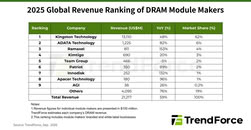
DRAM Module Revenue Surged 59% YoY in 2025 as Crowding-Out Effect Constrained Chip Supply and Drove Prices Higher

According to TrendForce statistics, the global DRAM module market generated $21.2 billion in revenue in 2025, up a strong 59% YoY. Rising prices and concentrated shipments from DRAM module makers in the second half of the year helped drive growth. This marked a significant acceleration from the 7% growth recorded in 2024.

DRAM market conditions changed dramatically between the first and second halves of 2025. In early 2025, some module makers increased their inventories of DDR4 chips in Q2, spurred by tariffs and the end-of-life (EOL) plans of DRAM suppliers for DDR4. They also supplied PC OEMs and other consumer electronics customers that had pulled forward procurement in response to tariffs.
Insyde Software Qualifies Firmware for Arm AGI CPU Platforms

Insyde Software, a worldwide provider of UEFI and OpenBMC firmware for AI Infrastructure, today announced that InsydeH2O UEFI firmware is qualified on Arm AGI CPU reference platforms, giving platform developers a proven, production-ready firmware foundation for next-generation agentic AI data center deployments. In addition, Insyde has readied its production verified Supervyse OPF OpenBMC firmware for Arm AGI CPU-based AI server racks.

This collaboration expands the Arm AGI CPU firmware ecosystem, enabling ODMs, OEMs, and system integrators and CSPs to accelerate platform bring-up with firmware already deployed across millions of devices in cloud, enterprise, and edge environments. Insyde supports the full Arm AGI CPU reference board, delivering UEFI compliance, platform security, and manageability features tuned for high-density AI compute workloads. This builds on the integration of Insyde's firmware with Arm Fixed Virtual Platform, serving customers with early access for evaluations.

AGI Displays Cutting-edge New Memory and Storage Products at Computex 2026

A cleverly-named memory brand, AGI, unveiled its latest PC memory products at the 2026 Computex, along with some prebuilt exhibits. We begin our tour with the AGI microSDXC A2 V30 card that's rated for high endurance applications, such as surveillance cameras and FPV drones, with an assured 30 MB/s write speed. The TF138 Supreme Pro is a Switch-compatible microSDXC UHS-I card that comes in 128 GB and 256 GB capacities, with read speeds of 100 MB/s. Next up, is the RD238, a DDR5 RDIMM that comes in 64 GB and 32 GB per-module densities, and speeds of DDR5-6400 and DDR5-5600, JEDEC specifications.

The CA238 is a DDR5 CAMM2 module offering dual-channel capacities of 32 GB and 64 GB; along with speeds of DDR5-7200 and DDR5-6400. The LC238 is an LPCAMM2 that comes in 16 GB and 32 GB densities, with speeds of LPDDR5-6400 and LPDDR5-7200. The UD858 Turbojet is a gamer-grade PC memory with RGB LED lighting. It comes in 16 GB x2 dual-channel kits, with DDR5-6000 speeds. The company also showcased a prebuilt with a high-speed Dan Da Dan variant of the U858 with DDR5-10000 speeds.

Supermicro Expands Data Center Building Block Solutions Flexibility with Arm-Based Platforms and OCP Systems for Next-Gen AI Infrastructure

Super Micro Computer, Inc. , an AI, Enterprise, Storage, 5G/Edge Total Solution provider, today expanded its Data Center Building Block Solutions (DCBBS) portfolio with new Arm -based server platforms powered by the new Arm AGI CPU, and new Open Compute Project (OCP) ORv3-compliant rack offerings. Supermicro leads the industry with over 20 OCP Inspired systems, which incorporate various OCP technologies and form factors, to simplify open data center deployments.

"Supermicro continues to advance its DCBBS with an expanded portfolio of Arm-based platforms and OCP systems for next-gen AI and HPC," said Charles Liang, president and CEO of Supermicro. "With high-density, liquid-cooled systems and energy-efficient Arm architectures, we enable scalable, flexible data centers that maximize performance-per-watt and accelerate AI adoption across cloud and enterprise environments."

Arm Enters Silicon Business for the First Time with Data Center AGI CPU

Arm has made a significant move stepping into production silicon for the first time in its history with the launch of the Arm AGI CPU, a data center processor designed specifically for agentic AI workloads. For over three decades, Arm has been purely an IP licensing business. With the launch of its AGI CPU series, Arm made a fundamental shift in how the company positions itself in the market. The AGI CPU is built on a 3 nm process, packs up to 136 Neoverse V3 cores, runs at a 300 W TDP, and delivers 6 GB/s of memory bandwidth per core at under 100 ns latency. It supports up to 6 TB per chip and DDR5-8800 speeds. On the I/O side, the chip features 96 PCIe Gen 6 lanes along with CXL 3.0 and AMBA CHI (Coherent Hub Interface) links. Each core handles a dedicated program thread, which Arm says eliminates throttling and idle threads under sustained load.

Specifically important in the data center business, density figures are notable. Air-cooled systems can fit up to 8,160 cores per rack, while liquid-cooled systems push that above 45,000. Data centers are expected to need more than four times the current CPU capacity per gigawatt to keep up, and Arm is arguing that x86 architecture carries too much overhead and complexity for this new class of workload. Arm claims more than 2x performance per rack versus x86, adding that this can translate to potential savings of up to $10 billion per gigawatt of AI data center capacity.

AGI Technology to Debut Ultra-Fast Gen5 SSD and DDR5 at CES 2026

AGI Technology, a leading memory brand from Taiwan, announced that it will participate in CES 2026 from January 6 to 9 in Las Vegas at The Venetian Resort, Level 2, Bellini 2001B, where it will debut its complete lineup of next-generation high-speed storage solutions. Under the theme "Powering What's Next with AGI Innovation," AGI will showcase breakthrough technologies across extreme overclocking, high-speed transmission, and rugged mobile storage to address the surging demands of AI computing, ultra-high-resolution content workflows, and multitask creative environments.

AGI's Next-Generation Storage Portfolio Debuts
Project S10 Gen 5 SSD—6 nm Controller, 11,000 MB/s Performance
  • AGI introduces its new flagship Project S10 Gen 5 SSD featuring TSMC's 6 nm controller, delivering significantly enhanced efficiency and effectively addressing the thermal challenges common in Gen 5 devices under extended heavy workloads. With PCIe Gen 5 x4, the drive reaches speeds of 11,000 MB/s, offering a dramatic bandwidth upgrade over Gen 4. Combined with its low-power controller and high-efficiency cooling module, the S10 provides sustained, stable performance for AI datasets, AAA gaming, and high-resolution rendering.

Intel CTO and AI Chief Sachin Katti Departs for OpenAI

Intel's chief technology and AI officer, senior vice president, and general manager of the Network and Edge Group (NEX)—Sachin Katti—is leaving the company to join OpenAI. He spent four years at Intel and was appointed CTO and AI chief in April, though his tenure in that role was brief. Katti was responsible for guiding Intel's AI strategy and product roadmap, leading the NEX group, and fostering partnerships between Intel Labs, startups, and ecosystems. In the interim, Intel's CEO, Lip-Bu Tan, will assume Katti's responsibilities to facilitate a smooth transition. Tan will now oversee some of the most challenging roles in the semiconductor industry, including managing Intel Foundry, Intel Product, and AI strategy, among other duties.

For Sachin Katti, a new chapter has been opened. He posted on his X account: "Excited for the opportunity to work with @gdb, @sama and the @OpenAI team on building out the compute infrastructure for AGI! Very grateful for the tremendous opportunity and experience at Intel over the last 4 years leading networking, edge computing and AI." This means that he will help with the infrastructure build out for OpenAI, which is now measure in megawatts for all the plans OpenAI has. It is a difficult task to achieve, so we are waiting to see how it manifests.

Microsoft's AI Goal is Humanist Intelligence in Service of People and Humanity

Microsoft's head of AI Mustafa Suleyman made some bold promises in which direction the company's AI research will be headed. "At Microsoft AI, we're working towards Humanist Superintelligence (HSI): incredibly advanced AI capabilities that always work for, in service of, people and humanity more generally," notes the lengthy blog post, adding that "We think of it as systems that are problem-oriented and tend towards the domain specific. Not an unbounded and unlimited entity with high degrees of autonomy - but AI that is carefully calibrated, contextualized, within limits. We want to both explore and prioritize how the most advanced forms of AI can keep humanity in control while at the same time accelerating our path towards tackling our most pressing global challenges."

To achieve these goals, Microsoft has built a team called Microsoft AI (MAI) Superintelligence Team. Using massive amount of resources, combining human intelligence, hardware, software, and various other intelligence forms, Microsoft wants steerable AI systems. However, there is an issue. It appears that no one knows how will a superintelligent system be controlled. As Mustafa Suleyman claims, "No AI developer, no safety researcher, no policy expert, no person I've encountered has a reassuring answer to this question. How do we guarantee it's safe?"

ASUS Launches XA NB3I-E12 AI Server Built with NVIDIA HGX B300

ASUS today announced the shipment of the XA NB3I-E12 AI server, built on the NVIDIA HGX B300 platform. Delivering next-generation AI performance and reliability, XA NB3I-E12 gives enterprises and cloud-service providers (CSPs) early access to cutting-edge computing capabilities for the AI era. Accelerated by eight NVIDIA Blackwell Ultra GPUs and dual Intel Xeon 6 Scalable processors, ASUS XA NB3I-E12 is engineered for intensive AI workloads. With eight NVIDIA ConnectX-8 InfiniBand SuperNICs, five PCIe expansion slots, 32 DIMMs, 10 NVMe drives, and dual 10 Gb LAN, it transforms data into intelligence for real-world automation. The system is ideal for enterprises and CSPs running large language models (LLMs), research institutions and universities performing scientific computing, and the financial and automotive sectors focused on AI model training and inference.

Tight Upstream Supply and Restocking Drive 2024 DRAM Module Revenue Growth of 7%

TrendForce reports that following the completion of inventory digestion in the downstream consumer market concluded at the end of Q4 2023, DRAM suppliers shifted focus towards HBM and server DDR5 products, leading to tighter supply for other DRAM types. This increase in demand pushed overall DRAM prices higher, encouraging module manufacturers to replenish stocks and boost procurement. Consequently, the global DRAM module market achieved USD 13.3 billion in revenue in 2024, a 7% YoY increase that reversed the 28% decline experienced in 2023.

In the latter half of 2024, demand momentum declined due to rising module prices. Module manufacturers struggled to transfer these high chip costs to distribution channels, limiting sales. To stay competitive, some aimed to enhance costs structure by increasing their purchase of cheaper server reball chips.

AGI Technology Launches High-Speed microSD Express Card TF338

To support the new storage standard adopted by Nintendo Switch 2, AGI proudly announces the release of the TF338 microSD Express card. Built on the microSD Express standard and powered by the PCIe Gen 3 x1 interface with NVMe protocol, the TF338 delivers performance far beyond traditional microSD cards—offering up to 800 MB/s read and 700 MB/s write speeds for lightning-fast game loading and data transfer.

Compared to previous UHS-I microSD cards, microSD Express offers more than 4 times faster speeds, approaching SSD-level performance. This makes the TF338 an ideal solution for both high-performance gaming and mobile content creation. The card is backward compatible with UHS-I devices and has passed multiple durability tests—ensuring water, dust, shock, and temperature resistance for stable operation across demanding environments.

AI Gets Agents: ChatGPT Now Has Deep Research with Agentic Capabilities

Today, OpenAI has announced a new ChatGPT feature called "Deep Research," which is capable of performing complex, multi-step research processes entirely on its own. Using so-called agents, which are autonomous bots working on top of the AI model, this feature searches the web and curates all needed information. This agentic behavior was trained on real-world browser usage, accompanied by Python code execution. Deep search, like OpenAI's o1 and o3 models, uses reinforcement learning, which steps back to "think" and creates a chain of thought before delivering users an answer to their question. Depending on the topic, deep research can take 5 to 30 minutes to search the web, crawl through data, and compile it in a reader-friendly manner.

Regarding benchmarks of its performance, OpenAI put out a lot of interesting comparisons and evaluations. Compared to all previous models, deep research gives these models additional context to help AI with more information. Thus, in evaluation benchmarks like Humanity's Last exam, deep research scored 26.6%, whereas o1 and o3-mini scored 9.1 and 13%, respectively. Other evaluations showed a modest improvement, while concrete comparisons were made in UX, business, and medical research. Turning the deep research feature on delivered more information every time, and you can see it for yourself here.

SoftBank Group Acquires Graphcore to Build Next-Generation of AI Compute

Graphcore today announced that the company has been acquired by SoftBank Group Corp. Under the deal, Graphcore becomes a wholly owned subsidiary of SoftBank and will continue to operate under the Graphcore name.

"This is a tremendous endorsement of our team and their ability to build truly transformative AI technologies at scale, as well as a great outcome for our company," said Graphcore co-founder and CEO Nigel Toon. "Demand for AI compute is vast and continues to grow. There remains much to do to improve efficiency, resilience, and computational power to unlock the full potential of AI. In SoftBank, we have a partner that can enable the Graphcore team to redefine the landscape for AI technology."

NVIDIA CEO Jensen Huang: AGI Within Five Years, AI Hallucinations are Solvable

After giving a vivid GTC talk, NVIDIA's CEO Jensen Huang took on a Q&A session with many interesting ideas for debate. One of them is addressing the pressing concerns surrounding AI hallucinations and the future of Artificial General Intelligence (AGI). With a tone of confidence, Huang reassured the tech community that the phenomenon of AI hallucinations—where AI systems generate plausible yet unfounded answers—is a solvable issue. His solution emphasizes the importance of well-researched and accurate data feeding into AI systems to mitigate these occurrences. "The AI shouldn't just answer; it should do research first to determine which of the answers are the best," noted Mr. Huang as he added that for every single question, there should be a rule that makes AI research the answer. This also refers to Retrieval-Augmented Generation (RAG), where LLMs fetch data from external sources, like additional databases, for fact-checking.

Another interesting comment made by the CEO is that the pinnacle of AI evolution—Artificial General Intelligence—is just five years away. Many people working in AI are divided between the AGI timeline. While Mr. Huang predicted five years, some leading researchers like Meta's Yann LeCunn think we are far from the AGI singularity threshold and will be stuck with dog/cat-level AI systems first. AGI has long been a topic of both fascination and apprehension, with debates often revolving around its potential to exceed human intelligence and the ethical implications of such a development. Critics worry about the unpredictability and uncontrollability of AGI once it reaches a certain level of autonomy, raising questions about aligning its objectives with human values and priorities. Timeline-wise, no one knows, and everyone makes their prediction, so time will tell who was right.
Return to Keyword Browsing
Nov 11th, 2026 03:59 CST change timezone

New Forum Posts

Popular Reviews

TPU on YouTube

Controversial News Posts