Tuesday, March 24th 2026

Arm Enters Silicon Business for the First Time with Data Center AGI CPU
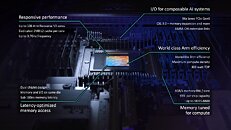
Arm has made a significant move stepping into production silicon for the first time in its history with the launch of the Arm AGI CPU, a data center processor designed specifically for agentic AI workloads. For over three decades, Arm has been purely an IP licensing business. With the launch of its AGI CPU series, Arm made a fundamental shift in how the company positions itself in the market. The AGI CPU is built on a 3 nm process, packs up to 136 Neoverse V3 cores, runs at a 300 W TDP, and delivers 6 GB/s of memory bandwidth per core at under 100 ns latency. It supports up to 6 TB per chip and DDR5-8800 speeds. On the I/O side, the chip features 96 PCIe Gen 6 lanes along with CXL 3.0 and AMBA CHI (Coherent Hub Interface) links. Each core handles a dedicated program thread, which Arm says eliminates throttling and idle threads under sustained load.
Specifically important in the data center business, density figures are notable. Air-cooled systems can fit up to 8,160 cores per rack, while liquid-cooled systems push that above 45,000. Data centers are expected to need more than four times the current CPU capacity per gigawatt to keep up, and Arm is arguing that x86 architecture carries too much overhead and complexity for this new class of workload. Arm claims more than 2x performance per rack versus x86, adding that this can translate to potential savings of up to $10 billion per gigawatt of AI data center capacity.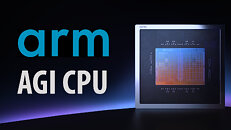
 Meta is the main partner and co-developer, deploying the AGI CPU alongside its own MTIA accelerators for large-scale AI orchestration across its platforms. Beyond Meta, confirmed customers include OpenAI, Cloudflare, Cerebras, Rebellions, SAP, and SK Telecom. On the hardware side, ASRock Rack, Lenovo, Quanta, and Supermicro are building systems around it, with early units available now and broader availability expected in the second half of the year. Ecosystem backing is broad, with over 50 companies involved, including AWS, Google, Microsoft, NVIDIA, Samsung, TSMC, and Micron.
Sources:
arm, arm (blog)
Specifically important in the data center business, density figures are notable. Air-cooled systems can fit up to 8,160 cores per rack, while liquid-cooled systems push that above 45,000. Data centers are expected to need more than four times the current CPU capacity per gigawatt to keep up, and Arm is arguing that x86 architecture carries too much overhead and complexity for this new class of workload. Arm claims more than 2x performance per rack versus x86, adding that this can translate to potential savings of up to $10 billion per gigawatt of AI data center capacity.


12 Comments on Arm Enters Silicon Business for the First Time with Data Center AGI CPU
Even more so in consumer space, sine majority of x86 system sold do not require anything Legacy. That excludes 95% people who frequent this forum. A regural user doesn't need and doesn't care. It's meant to work.
Long ago when ram was measured in the kilobytes the cisc risc difference mattered now it’s meaningless.
Intel and amd are perfectly capable of producing something like this chip, since they do
the day entire existing infrastructures get ported over from x86 over to ARM and features work as intended 1 to 1 with no substantial downsides is years if not over a decade away of continuous contributions, exactly the same as how Linux became such a big part of the world's infrastructure and became that good to use on desktop nowadays
ARM on anything else than mobile devices (which was initially purpose designed for that btw) is still VERY recent, OSes running on ARM aren't exactly aplenty, ARM-capable software are in an even lesser amount and compatibility is still a big issue (see all the Snapdragon laptop APUs, for which Qualcomm decided to just straight up not make Linux drivers for it, won't open source any of their existing code & all 3rd party attempts at getting Linux running on those chips failed... Linux on Apple's M-series chips is working better than that!)*some* people who know what they're talking about have that opinion, doesn't mean a majority does... I for one want to see more ARM devices, mainly because it's just that much more efficient and makes sense in laptops and low power desktops
somehow Microsoft did manage to get something out of whatever think tank is running decisions and got Windows on ARM in production, Linux on ARM has been available for a few years but just like with WoA, that doesn't mean software naturally runs on it, it needs to be built for the architecture and Google got AluminiumOS (android-based, successor to ChromeOS) in the works which is supposed to ship for both x86 & ARM