News Posts matching #AI PRO R9700

Return to Keyword Browsing

Thermaltake Unveils Complete Lineup of AI Workstations and Gaming PCs

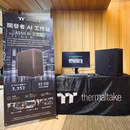
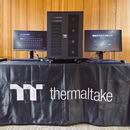
Thermaltake, a leading brand in gaming PCs, AI workstations, and gaming PC components, offering a comprehensive portfolio of PC cases, power supplies, cooling solutions, gaming peripherals, memory, and racing simulators, today announced its complete lineup of AI workstations and gaming PCs. The new lineup includes the A1500 Dual Enterprise Flagship AI Workstation, A750 Professional AI Workstation, A550 Developer AI Workstation, CAPO X Dual AI Gaming PC, and View 380 XL Gaming PC, delivering versatile solutions for enterprise on-premises AI applications, AI developers, content creators, and gamers.

The A1500 Dual enables enterprises to bring large language model (LLM) applications on-premises while running enterprise AI workloads and professional content creation simultaneously. The A750 features a quad-GPU configuration designed for team-based AI development and professional computing, while the A550 allows individual developers and studios to test AI models, generate images, and produce content locally. The CAPO X Dual AI Gaming PC offers two system configurations for pairing AI agents with AI application workloads or gaming with livestreaming tasks, while the View 380 XL Gaming PC balances gaming performance with everyday creative applications. By combining high-wattage power supply technology, advanced cooling solutions, and years of expertise in hardware development, system integration, and testing, Thermaltake continues to expand its portfolio of purpose-built AI workstations and gaming PCs.


Alphacool Launches ES 1-Slot GPU Cooler for Blackwell and Radeon AI PRO GPUs

Alphacool International GmbH, based in Braunschweig, Germany, is a pioneer in the field of PC water-cooling technology. With one of the most comprehensive product portfolios in the industry and more than 20 years of experience, Alphacool is expanding its professional GPU cooling lineup with new high-performance water coolers designed for NVIDIA RTX PRO Blackwell and AMD Radeon AI PRO graphics cards.

The new ES GPU coolers are available for the NVIDIA RTX PRO 4000 Blackwell, RTX PRO 4500 Blackwell, RTX PRO 6000 Blackwell, and AMD Radeon AI PRO R9700.

Gigabyte Accelerates Deskside AI Development with AI TOP 100 B850

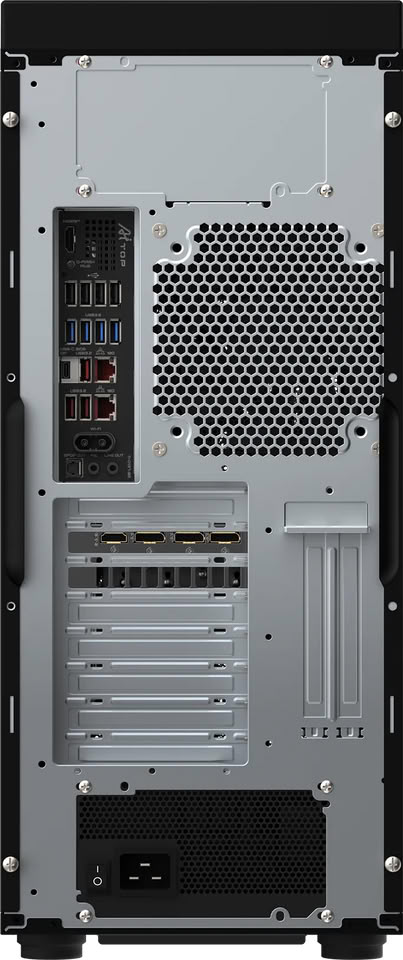
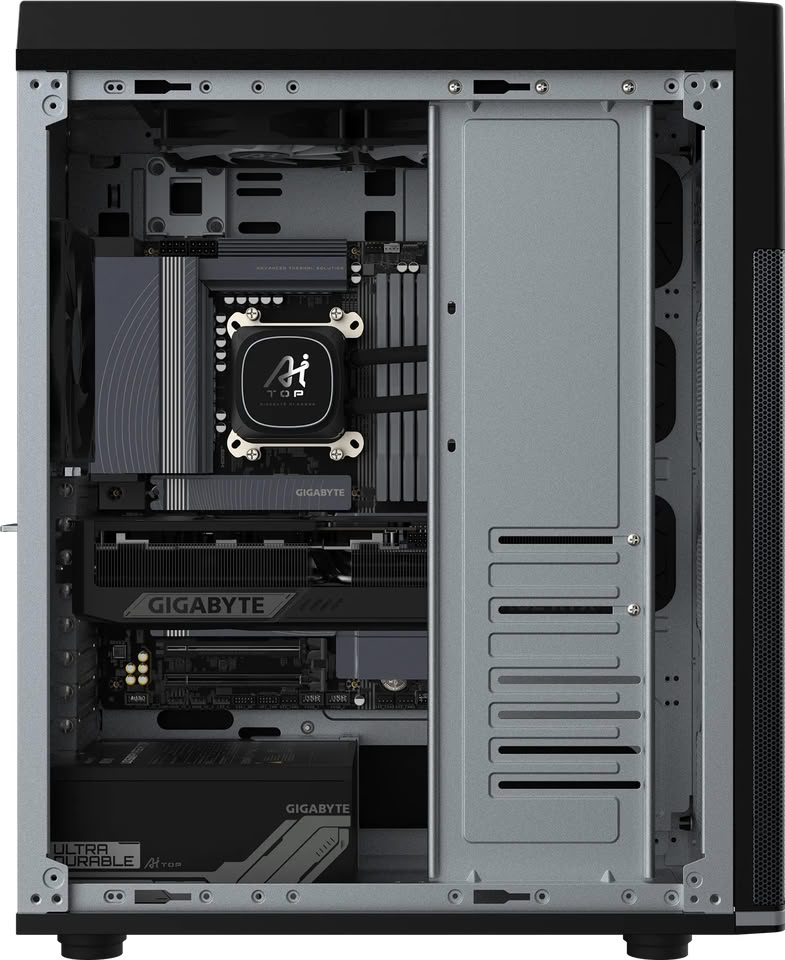
Gigabyte, a global leader in computer hardware, today announced the Gigabyte AI TOP 100 B850, a high-performance desktop engineered to bring workstation-class AI compute directly to the deskside. Designed to reduce cloud dependence and lower the barriers to local deployment, the system enables businesses, developers, and researchers to run advanced AI workloads locally, giving them greater control over sensitive data and AI infrastructure while reducing reliance on cloud and token-based services.

Built for Next-Generation AI Development
At the heart of the Gigabyte AI TOP 100 B850 is the 16-core, 32-thread AMD Ryzen 9 9950X processor, delivering the performance required for modern AI workloads ranging from local LLM fine-tuning and generative AI to deep learning research and agentic AI. The system comes equipped with 128 GB of DDR5 memory and a 2 TB PCIe Gen 4 SSD, providing ample capacity and high-speed access for large datasets, local model storage, and complex development environments.

Gigabyte Expands Its AI TOP Ecosystem with New High-Performance Systems

Gigabyte, the world's leading computer brand, continues to advance its vision of "Create Your Own AI on Your Own Desk" with the expansion of the AI TOP ecosystem at COMPUTEX 2026. More than a single product, AI TOP is a purpose-built local AI ecosystem that combines dedicated hardware and optimized systems to simplify AI development. As AI agents become increasingly capable of executing tasks, automating workflows, and operating continuously, AI TOP provides a scalable foundation for users looking to deploy AI locally.

Expanding the ecosystem is the new AI TOP 100 B850, engineered for demanding AI workloads. Powered by the AMD Ryzen 9 9950X processor and available with either GeForce RTX 5090 or Radeon AI PRO R9700 graphics, the system combines high-performance processing with advanced graphics acceleration for AI computing. With support for up to 128 GB of DDR5-5600 memory and a server-grade 1600 W 80 Plus Platinum power supply, it delivers the stability, scalability, and sustained performance required for advanced AI applications. Every workload runs locally, eliminating cloud dependency while keeping sensitive data under user control.

AMD Sees Agent Computers as the Next Step in AI PCs

AMD has published a guide for running OpenClaw locally on Windows through two distinct hardware paths it calls "RyzenClaw" and "RadeonClaw," both built around its own silicon and designed to keep AI agent workloads off the cloud entirely. The push is part of AMD's broader "Agent Computer" narrative, where it argues that not every AI workload belongs in a data center, people and businesses want control over their data, affordable always-on AI without usage limits, and the confidence that their models are running locally rather than on someone else's infrastructure. The setup runs through WSL2 with LM Studio handling local LLM inference via llama.cpp, and supports Memory.md through local embeddings, no cloud dependency required. AMD says the environment can be configured in under an hour, targeting early adopters and developers experimenting with personal AI agents.

The RyzenClaw path is built around a Ryzen AI Max+ system with 128 GB of unified memory, AMD specifically recommends reserving 96 GB as variable graphics memory for this use case. Running the Qwen 3.5 35B A3B model, that configuration delivers around 45 tokens per second, processes 10,000 input tokens in roughly 19.5 seconds, supports a 260K token context window, and can run up to six agents concurrently. AMD is positioning this as capable of "agent swarm" experimentation on consumer hardware. RadeonClaw takes a different approach, pairing OpenClaw with the Radeon AI PRO R9700, a workstation-class card with 32 GB of VRAM. That setup is considerably faster, around 120 tokens per second with the same model, and 10,000 input tokens processed in about 4.4 seconds. The tradeoff is a smaller 190K token context window and support for only two concurrent agents, compared to six on the Ryzen AI Max+ path.

AMD AIBs Reveal Passively-cooled Radeon AI PRO R9700S & R9600D Custom Cards

Yesterday, AMD quietly introduced enterprise-grade Radeon AI PRO R9700S and R9600D graphics cards. Two reference designs were showcased within a small batch of promotional renders, but the company has not issued a proper press release that covers the launch of passively-cooled professional "RDNA 4" offerings. Following in the footsteps of Team Red's low-key expansion of the Navi 48 GPU-based Radeon AI PRO, involved board partners have discreetly added their own interpretations to official web presences.

Minus grand fanfare, Sapphire's global site has been updated with "RADEON AI PRO R9700S 32 GB Passive" and "RADEON AI PRO R9600D 32 GB Passive" product pages. Frustratingly, the two listings are not easily accessed from the company's main set of menus. The larger card—with dual-slot thickness—bears an understated two-tone matte/gloss aesthetic. The smaller R9600D SKU is a much simpler affair; its black shroud and backplate are sparsely decorated with branding and vague line patterns. Sapphire's two custom designs are equipped with 12V-2x6 power connectors. The Sapphire R9700S Passive SKU spec sheet seems to align with Team Red's reference points for the air/blower-cooled Radeon AI PRO R9700 design—including a 300 W TDP rating, and 256-bit memory interface. Sapphire's custom R9600D card's power consumption is rated at 150 W; also set at reference level.

AMD Unveils Radeon AI PRO R9700S and R9600D GPUs

AMD has officially expanded its Radeon AI PRO R9000 workstation lineup with two new Navi 48-based cards built on the RDNA 4 architecture. The two models are the Radeon AI PRO R9700S and the Radeon AI PRO R9600D. Both models feature 32 GB of GDDR6 memory on a 256-bit interface, delivering a peak memory bandwidth of 640 GB/s. These additions offer a consistent hardware platform for professional customers who require larger frame buffer sizes for compute and visualization tasks.

The Radeon AI PRO R9700S maintains the full Navi 48 configuration with 64 CUs and 4,096 SPs. AMD rates the card at up to 47.8 TeraFLOPS of FP32 performance when the boost clock reaches 2,920 MHz, with a total board power of 300 W. The Radeon AI PRO R9600D, on the other hand, reduces the Navi 48 configuration to 48 active CUs and 3,072 SPs, offering approximately 24.8 TeraFLOPS of FP32 throughput at a boost clock of 2,020 MHz, while targeting a lower 150 W board power.

ASRock Prepares Workstation with Four AMD Radeon AI PRO R9700 Creator GPUs

ASRock is looking to enter the workstation business and capture the lucrative demand for local AI acceleration with its new product lineup. Called GAI4G-R9700, the 4U workstation is a rack-mount or standalone desktop solution that pairs AMD Ryzen Threadripper 9000 series CPUs with four Radeon AI PRO R9700 Creator GPUs. This gives the system a total VRAM capacity of 128 GB from the GPUs alone, which is 32 GB per GPU. For additional capacity, the system can utilize the 2 TB DDR5 capacity housed on the ASRock WRX90 WS EVO motherboard with horizontal CPU and memory placement.

Since ASRock doesn't manufacture CPUs and memory, the company will likely bundle the workstation with four GPUs, leaving users to acquire their own CPU and memory. This is especially tricky to figure out as the massive memory demand could impact final workstation pricing far more than anything else, especially in larger quantities such as 512+ GB. The system supports eight ECC RDIMMs running at 6400 MT/s, in eight-channel configuration (1DPC). The whole system is powered by a single 80 Plus Platinum 2500 W ATX 3.1 power supply.

AMD Radeon AI PRO R9700 GPU Arrives October 27 at $1,299 for Retail

AMD has finally set the retailer date and the price tag for its professional Radeon AI PRO 9000 series graphics cards, suitable for tasks like professional visualization or workstations that can accommodate up to four cards. Set to launch on October 27 for retailers, the flagship Radeon AI PRO R9700 will arrive at $1,299. Previously, AMD focused solely on the OEM and system integrator segment, leaving retailers and individuals building their own workstations for AI and professional visualization workloads without options. The company aimed to launch this GPU for retailers by the end of July, but supply constraints prevented this, as OEMs and system integrators consumed the entire supply.

These Radeon AI PRO R9700 GPU features a 4 nm "Navi 48" GPU, equipped with 64 RDNA 4 compute units, providing 4,096 stream processors and 128 AI accelerators for enhanced matrix operations across various data formats. A key improvement over the RX 9070 XT gaming GPU is the increased memory capacity, now doubled to 32 GB. The memory subsystem includes 20 Gbps GDDR6 across a 256-bit wide interface, delivering 640 GB/s of memory bandwidth, supported by a 64 MB 3rd Gen Infinity Cache. The AMD Radeon AI PRO R9700 achieves up to 191 TeraFLOPS FP16 dense performance and up to 1531 TOPS INT4 sparse performance, all within a power footprint of up to 300 W. The card is packed in dual-slot design with blower-style cooler, so dense multi-GPU configurations can be easily achieved.

Redditor Scores Radeon AI PRO R9700 in Retail for $1220

A Reddit user bought a Radeon AI PRO R9700 graphics card in the retail channel for $1,220. This card was believed to be unavailable in retail, and restricted to the OEM and SI channels, meant to be sold by workstation builders. The card in question is a GIGABYTE Radeon AI PRO R9700 AI TOP, a custom-design board by the company that features a rack-friendly lateral airflow cooling solution that's build in GIGABYTE's distinct silver color scheme the company uses with its AI TOP branded graphics cards, notebooks, mini PCs, and motherboards.

The Radeon AI PRO R9700 is intended by AMD to be an edge AI accelerator, combining the AI acceleration capabilities of the RDNA 4 architecture, with 32 GB of memory, for accelerating AI models with larger parameter counts. It's based on the same 4 nm "Navi 48" silicon as the Radeon RX 9070 XT gaming GPU, which it maxes out, enabling all 64 compute units present on the silicon. The GPU offers a peak INT4 throughput of 1,531 TOPS, and peak FP16 throughput of 95.7 TFLOP/s. GIGABYTE includes access to its in-house AI TOP utility with this card.

XFX Says Radeon AI PRO R9700 to Launch via System Builders

It turns out that while the AMD Radeon AI PRO R9700 graphics card is available through AMD's various AIB (add-in board) partners, these cards will not be available in the DIY retail channel, and instead only be available through system builders—from large workstation OEMs to smaller, noteworthy workstation system integrators. The XFX website mentions that its Radeon AI PRO R9700 graphics card, which is visibly identical to the AMD reference design, is "coming soon to select system builders."

AMD's decision to sell the Radeon AI PRO R9700 through OEMs aligns with the fact that while AIBs are given some leeway to customize their board designs, all of these come with the same workstation-friendly design with a 2-slot lateral airflow cooling solution with 12V-2x6 power connectors located at the tail end, and air intakes and backplate clearances designed to allow for up to four of these cards to be installed next to each other, with sufficient airflow for the cards that are sandwiched. The PRO R9700 is a variant of the Radeon RX 9070 XT gaming GPU that comes with 32 GB of memory, and is intended for a range of use-cases spanning from edge AI acceleration to professional visualization.

AMD Reports Second Quarter 2025 Financial Results

AMD (NASDAQ:AMD) today announced financial results for the second quarter of 2025. Second quarter revenue was a record $7.7 billion, gross margin was 40%, operating loss was $134 million, net income was $872 million and diluted earnings per share was $0.54. On a non-GAAP(*) basis, gross margin was 43%, operating income was $897 million, net income was $781 million and diluted earnings per share was $0.48. As previously announced, our second quarter results were impacted by the U.S. Government's export control on our AMD Instinct MI308 data center GPU products. For the quarter, these restrictions led to approximately $800 million in inventory and related charges. Excluding these charges, non-GAAP gross margin would have been approximately 54%.

"We delivered strong revenue growth in the second quarter led by record server and PC processor sales," said Dr. Lisa Su, AMD Chair and CEO. "We are seeing robust demand across our computing and AI product portfolio and are well positioned to deliver significant growth in the second half of the year, driven by the ramp of our AMD Instinct MI350 series accelerators and ongoing EPYC and Ryzen processor share gains."

Sapphire Intros Rack-friendly Radeon AI PRO R9700 Graphics Card

Sapphire introduced its Radeon AI PRO R9700 professional graphics card. Sapphire's take on the PRO R9700 is very similar to a custom design by ASUS, and comes with a design that favors workstation deployments with up to four of these cards installed next to each other. The card is 26.6 cm in length, strictly 2 slots thick, and 11.1 cm tall, or strictly what constitutes "full height," making it fit for 3U rackmount cases. Helping its enterprise chops are a 12V-2x6 power input located at the tail end of the card instead of on the top; and rear bracket mounting holes that help you secure the card to the chassis using expanders.

The card features a lateral airflow blower-based cooling solution. The PCB and cooler shroud has cutouts on the reverse side of the card, where the backplate is recessed, to help adjacent cards better take in airflow. The Radeon AI PRO R9700 targets both professional visualization and edge AI acceleration use-cases. It is based on a maxed out 4 nm "Navi 48" silicon, just like the desktop Radeon RX 9070 XT, but with double the memory size at 32 GB, so it could accelerate larger LLMs. The GPU offers a peak INT4 throughput of 1,531 TOPS, and peak FP16 throughput of 95.7 TFLOP/s.

ASUS Intros Turbo Radeon AI PRO R9700 Graphics Card

ASUS introduced the Turbo Radeon AI PRO R9700 graphics card. This card targets a multitude of use-cases spanning professional visualization and edge AI acceleration. It is based on the PRO R9700, a spruced up variation of the Radeon RX 9070 XT gaming GPU, which comes with 32 GB of memory to take advantage of the AI acceleration and compute capabilities of RDNA 4 architecture.

The card gets its name from its lateral blower cooling solution that uses a copper baseplate with a phase-change thermal pad, an aluminium channel-type heatsink, and lateral airflow from the blower to keep cool. This design allows the card for a strictly 2-slot thickness. Recessed backplate and fan intakes let you have up to four of these cards installed next to each other in a workstation or server, with minimal airflow obstruction. The card uses a 12V-2x6 power input located at the tail end instead of the top. The card comes with clock speeds of 2920 MHz boost (2350 MHz average clock), and 20 Gbps memory speed. It measures 26.67 cm in length, 11.1 cm in height, and is 2 slots thick. Peak compute figures include 47.8 TFLOP/s FP32, 95.7 TFLOP/s FP16, 1531 AI TOPS INT4, and 766 AI TOPS INT8.

AMD Radeon AI PRO R9700 GPU Arrives on July 23rd

AMD confirmed today that its RDNA 4-based Radeon AI PRO R9700 GPU will reach retail on Wednesday, July 23. Built on the Navi 48 die with a full 32 GB of GDDR6 memory and supporting PCIe 5.0, the R9700 is specifically tuned for lower-precision calculations and demanding AI workloads. According to AMD, it delivers up to 496% faster inference on large transformer models compared to NVIDIA's desktop RTX 5080, while carrying roughly half the price of the forthcoming RTX PRO "Blackwell" series. At launch, the Radeon AI PRO R9700 will only be offered inside turnkey workstations from OEM partners such as Boxx and Velocity Micro. Enthusiasts who wish to install the card themselves can expect standalone boards from ASRock, PowerColor, and other add-in-board vendors later in the Q3. Early listings suggest a price of around $1,250, placing it above the $599 RX 9070 XT yet considerably below competing NVIDIA workstation GPUs. Retailers are already accepting pre-orders.

Designed for AI professionals who require more than what consumer-grade hardware can provide, the Radeon AI PRO R9700 excels at natural language processing, text-to-image generation, generative design, and other high-complexity tasks that rely on large models or memory-intensive pipelines. It's 32 GB of VRAM allows production-scale inference, local fine-tuning, and multi-modal workflows to run entirely on-premises, improving performance, reducing latency, and enhancing data security compared to cloud-based solutions. Full compatibility with AMD's open ROCm 6.3 platform provides developers with access to leading frameworks, including PyTorch, ONNX Runtime, and TensorFlow. This enables AI models to be built, tested, and deployed efficiently on local workstations. The card's compact dual-slot design and blower-style cooler ensure reliable front-to-back airflow in dense multi-GPU configurations, making it simple to expand memory capacity, deploy parallel inference pipelines, and sustain high-throughput AI infrastructure in enterprise environments.

ASRock Intros Radeon AI PRO R9700 Creator Graphics Card

ASRock today introduced the Radeon AI PRO R9700 Creator graphics card. The card is based on the PRO R9700 GPU AMD launched earlier this week, which is targets both the edge AI acceleration and professional visualization markets. The R9700 is based on the 4 nm "Navi 48" silicon, which it maxes out, with all 64 CU being enabled for 4,096 stream processors, 128 AI accelerators, and 64 RT accelerators. A key difference between the RX 9070 XT gaming GPU and the PRO R9700 is memory, with the latter getting 32 GB of it—double the size. This should help with fairly large AI models. The card also uses PCI-Express Gen 5 memory pooling features in workstations with up to four of these.

To make the card capable of exactly this, ASRock designed its PRO R9700 Creator graphics card to have a strictly 2-slot form-factor, with a lateral blower-based cooling solution that has cutouts behind the blower, and clearance of the backplate toward the tail-end, to help with airflow to adjacent cards. The card also implements the 16-pin 12V-2x6 power connector. This is ASRock's second card from this generation to do so, the other being the Radeon RX 9070 XT Taichi. The connector is located at the tail-end of the card, and not the top. This is important, as the card becomes capable of 3U rackmount chassis installations, something not possible with top-oriented power inputs, particularly with the strict cable bending restrictions of 12V-2x6. The card is 27.1 cm long and 11.1 cm tall. Display outputs include four DisplayPort 2.1a.

PowerColor Radeon AI PRO R9700 Card Design Reminiscent of AMD's Reference Renders

Last week, AMD introduced its Radeon AI PRO R9700 32 GB professional graphics card—representing the RDNA 4 generation's first foray into non-gaming territories. The TechPowerUp team encountered board partner variants on the showroom floor, with GIGABYTE and ASRock exhibiting samples with blower-style cooling solutions. At the time, Team Red's reference design was only visible in promotional/artistic renders. According to the company's official product page, this particular model is "not available for purchase." AMD made similar claims during the early days of—related Navi 48 GPU-based—Radeon RX 9070 XT and RX 9070 cards. Months later, Chinese hardware enthusiasts picked up physical "Made-By-AMD" (MBA) examples via murky second hand market channels.

At some point this week, PowerColor's web presences were updated with a semi-familiar sight: an almost direct interpretation of the AMD Radeon AI PRO R9700 reference card. The Taiwanese AIB has removed "AI" and "PRO R9700" text from their variant's shroud design, and applied a customary "PowerColor" logo and symbol sticker onto the lone blower fan's face. VideoCardz believes that pre-announcement renders and specification leaks had caused confusion across insider networks—hence the emergence of "Radeon RX 9070 XT(X) 32 GB" rumors, within the first quarter of 2025. PowerColor did not showcase its pro-grade at the recently concluded Computex trade event—instead, company representatives were tasked with hyping up incoming custom Radeon RX 9060 XT gaming cards, and a mysterious "REVA" prototype. At the time of writing, PowerColor has not issued any Radeon AI PRO R9700-related press material. AMD and manufacturing partners are expected to launch finalized products in July.

AMD's Export-Friendly Radeon AI PRO R9700 GPU Prepares for China Debut

According to the latest rumor mill, AMD is preparing Radeon AI PRO R9700, a new GPU designed specifically for the Chinese market. The new Radeon AI PRO R9700 GPU will feature deliberately handicapped performance parameters that comply with the most recent US export regulations while still supporting the local industry's needs for tasks such as on-device inference and model fine-tuning. To adhere to Washington's restrictions, AMD has reduced the chip's compute throughput to remain below the critical threshold for controlled exports, yet it retains 32 GB of high-bandwidth frame buffer memory and full PCIe Gen 5 connectivity. These specifications are intended to ensure efficient data transfer, and when multiple R9700 cards are deployed together, they can deliver substantial processing capability despite the lower power per card.

This China-specific strategy follows a challenging period for AMD in that region, including an $800 million charge related to its MI308 accelerator after it was blocked under earlier rules. NVIDIA has also suffered, losing an estimated $5.5 billion in revenue when its H20 series was barred, and seeing its Chinese market share drop from roughly 90 percent in 2021 to about 50 percent today. These developments have created an opening for AMD to compete on both price and supply reliability. AMD's approach mirrors NVIDIA's release of a restricted-performance version of its Blackwell-architecture B20 GPU for China. Priced more competitively than previous China-compliant offerings, the Radeon AI PRO R9700 will arrive in the third quarter of 2025 alongside NVIDIA's B20. AMD intends to present its full AI silicon roadmap at the Advancing AI Summit on June 12, positioning the R9700 as a targeted solution for enterprises and research institutions rather than for hyperscale cloud environments.

Latest AMD Linux Radeon Drivers Grants RX 9060 XT & AI PRO R9700 SKU Support

AMD's "Radeon Software for Linux 25.10.1" release notes mention the introduction of support for three important ASIC SKUs: RX 9060 XT, AI PRO R9700, and RX 9070 GRE. Two of these models are still awaiting release; the TechPowerUp team spent time with demonstration samples at the recently concluded Computex 2025 trade show. Coincidentally, the special v25.10.1 update became available on the same day as Team Red's big (May 21) presentation. During that day's proceedings, the company committed themselves to providing ROCm support for freshly unveiled graphics products.

Interestingly, it has taken a number of weeks to get the China market exclusive Radeon RX 9070 GRE 12 GB card up and running under Linux environments. GPU industry watchers are still wondering whether this mid-range option will trickle out to global markets; akin to the staggered trail made by the RDNA 3 generation's Radeon RX 7900 GRE (around early 2024). Team Red's open-source software team has readied support almost two weeks ahead of the launch of Radeon RX 9060 XT 16 GB and 8 GB models. The workstation-grade Radeon AI PRO R9700 32 GB model is expected to arrive at some point in July.
Return to Keyword Browsing
Nov 11th, 2026 03:43 CST change timezone

New Forum Posts

Popular Reviews

TPU on YouTube

Controversial News Posts