News Posts matching #AWS

Return to Keyword Browsing

Server CPU Shipments Projected to Grow Over 40% YoY in 2027, with Arm-Based Products Continuing to Gain Market Share

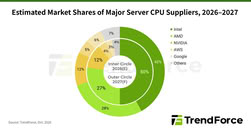
TrendForce's latest AI server industry research indicates that demand for server CPUs has grown steadily since the second half of 2025 as AI server providers actively introduce AI agent applications. Server CPU shipments are projected to increase 31% YoY in 2026.

In 2027, continued growth in AI inference demand and rising adoption of agentic AI services are expected to drive server CPU shipments up by more than 40% YoY, potentially reshaping a market landscape traditionally dominated by x86 processors.

Synopsys and Amazon Announce Strategic, Multi-year IP Agreement for Custom Silicon

Synopsys, Inc. (Nasdaq: SNPS) today announced a strategic agreement with Amazon to accelerate Amazon's custom silicon innovation and advance the development of increasingly complex AI-powered products and cloud infrastructure. The multi-year agreement marks the expansion of Synopsys' silicon IP business to serve increasing demand for application-optimized IP with Amazon as its lead customer.

Amazon continues to build on its leadership and longstanding investment in a broad portfolio of purpose-built chips, including Nitro for cloud security, network and storage, Graviton for general-purpose computing, and Trainium for AI training and inference workloads. Building on more than 15 years of collaboration, the agreement expands Amazon's use of Synopsys' IP to include application-optimized silicon IP. The agreement also expands Amazon's use of Synopsys EDA, simulation and analysis (S&A), and agentic AI technologies. Synopsys and Amazon will work to accelerate multiphysics solutions on Trainium and Graviton.

AWS and NVIDIA to Deliver 2 Million Additional GPUs

Amazon Web Services (AWS), an Amazon.com, Inc. company (NASDAQ: AMZN), and NVIDIA (NASDAQ: NVDA) today announced a major expansion of their strategic collaboration to meet surging global demand for AI infrastructure as demand continues to accelerate. Building on already-rapid customer adoption of NVIDIA-accelerated compute on AWS, the companies plan to deploy 2 million additional NVIDIA GPUs across AWS's global infrastructure and deepen their work together across AI factories, CPUs, networking, open models, data processing and robotics, delivering co-engineered AI solutions that enable customers to accelerate AI development and deployment at unprecedented scale.

AI workloads are scaling at a swift pace, from how models are trained and run, to how data is processed, indexed and used to power intelligent applications. Customers are moving from pilot to production and scaling workloads across agentic AI, scientific discovery, enterprise automation and robotics. They need broader model choice, faster data pipelines and new capabilities for emerging use cases like physical AI. They also need confidence that the underlying infrastructure can keep pace with their own ability to innovate while maintaining the highest level of security and reliability for mission-critical workloads.

AWS Graviton5 Enterprise Processor Pictured

Here are some of the first pictures of the AWS Graviton5, the company's in-house server processor designed by Annapurna Labs, which it developed not just for running its own server infrastructure, but also its AI inferencing infrastructure. The package has four chiplets, each built on the TSMC 3 nm foundry node. It has a total CPU core count of 192, all of which are Arm V3 performance cores with 1 MB of dedicated cache. The package has a 12-channel DDR5 memory interface that supports speeds of up to DDR5-8800 for whole-package memory bandwidth of over 800 GB/s. It also features a 96-lane PCI-Express Gen 6 root complex.

Although a disaggregated chip, AWS designed the Graviton 5 to feature full cache coherency among its chiplets, enabled by its 420 GB/s die-to-die interconnect bandwidth. Each chiplet has a quarter of the package's resources—48 Arm V3 cores, 3-channel DDR5 IMC, and a 24-lane PCIe Gen 6 root complex. AWS is gunning for a 25% performance improvement over the company's AWS G4 instances that are powered by Intel Xeon Scalable "Cascade Lake" or AMD EPYC "Genoa" processors.

AMD EPYC CPUs Reach Record Server Revenue Share of 46.2%

AMD's server CPUs are experiencing significant success, as the company captured nearly half of the server CPU spending in Q1 2026. According to the latest data from Mercury Research, AMD's EPYC CPUs account for 46.2% of total server CPU spending—a new all-time high for AMD's server CPU portfolio, which has become a major success in data centers. Interestingly, this is achieved with only a 27.4% unit share, indicating that while AMD's CPUs may not constitute exactly half of the units sold, they command much higher average selling prices (ASPs) than the competition. This competition is primarily from Intel, the largest CPU vendor. Intel currently holds the majority of units sold at 54.9%, a decrease of 3.4% compared to Q4 2025. We lack data on revenue share for Intel CPUs, but given their majority in unit shipments and AMD's near half share in spending, it can be concluded that the ASP of Intel Xeon server CPUs is lower than that of AMD EPYC.

In the data center, Arm-based designs account for about 17.7% of unit shipments in Q1 2026, meaning nearly one in five CPUs was Arm-based. Whether these were third-party integrations from Ampere or other Arm CPU makers, or in-house CPU designs from companies like Google, AWS, or Microsoft, remains unclear. However, Mercury Research collects extensive data, lending confidence to these figures.

Meta Signs Agreement With AWS to Power Agentic AI on AWS Graviton Chips

Meta has signed an agreement to deploy AWS Graviton processors at scale. The deal marks a significant expansion of a long-standing partnership between the two companies as Meta builds its next generation of AI.

The deployment starts with tens of millions of Graviton cores, with the flexibility to expand as Meta's AI capabilities grow. The deal reflects a shift in how AI infrastructure gets built: while GPUs remain essential for training large models, the rise of agentic AI is creating massive demand for CPU-intensive workloads—real-time reasoning, code generation, search, and orchestrating multi-step tasks. Graviton5 is purpose-built for these workloads, giving Meta the processing power to run them efficiently at scale.

Strong AI Momentum to Drive 24.8% Growth in Foundry Revenue in 2026

TrendForce's latest research on the foundry industry reveals that continued investment in the AI arms race by North American CSPs and AI startups will keep demand for AI processors and supporting ICs strong in 2026. Global foundry revenue is projected to grow 24.8% YoY to approximately US$218.8 billion, with TSMC expected to post the largest increase of around 32% YoY.

Demand for advanced nodes will continue to be driven by AI GPUs from companies such as NVIDIA and AMD. Meanwhile, North American CSPs, including Google, AWS, and Meta, and AI startups such as OpenAI and Groq, are accelerating the development of their own AI chips. Many of these designs are expected to enter volume production and begin shipping in 2026, becoming key drivers for 5/4 nm and more advanced process technologies.

OpenAI and Amazon Announce Strategic Partnership

OpenAI and Amazon (NASDAQ: AMZN) today announced a multi-year strategic partnership to accelerate AI innovation for enterprises, startups, and end consumers around the world. Amazon will also invest $50 billion in OpenAI, starting with an initial $15 billion investment and followed by another $35 billion in the coming months when certain conditions are met.

Partnering to bring new advanced AI capabilities to enterprises worldwide
OpenAI and Amazon are jointly developing a Stateful Runtime Environment powered by OpenAI's models, which will be available through Amazon Bedrock.
Stateful developer environments are the next generation of how frontier models will be used, seamlessly enabling models to access elements like compute, memory, and identity. A Stateful Runtime Environment allows developers to keep context, remember prior work, work across software tools and data sources, and access compute. They're designed to handle ongoing projects and workflows.

Global AI Server Shipments Forecast to Grow Over 28% YoY in 2026, with a Rising Share of ASIC-Based Systems

North American CSPs' continued investments in AI infrastructure are expected to increase global AI server shipments by more than 28% YoY in 2026, according to the latest market research from TrendForce. The rapid growth of AI inference services is boosting demand for general-purpose servers, supporting both replacement and expansion efforts. Consequently, TrendForce predicts that total global server shipments, including AI servers, will accelerate from 2025, with a 12.8% YoY growth in 2026.

The server market from 2024 to 2025 primarily centered on training advanced large language models (LLMs), utilizing AI servers with GPUs and HBM for parallel computing. However, starting in the second half of 2025, the growth of AI agents, LLaMA-based applications, and Copilot upgrades shifted CSP's focus toward inference services as a monetization strategy. AI inference workloads are now deployed not only on dedicated AI server racks but also on general-purpose servers that handle pre- and post-inference computing and storage.

NVIDIA Powers Nearly 72% of Cloud Accelerator Locations, AMD at 5.8%

The cloud accelerator market share study was conducted at UBS bank, one of the leading research hubs and close followers of market trends. According to UBS, NVIDIA commands 71.2% of the cloud accelerator location share, which includes GPUs and other types of ASICs. The study also included AMD, and other ASICs. For the AMD front, the situation is entirely different as the data shows AMD only captures 5.8% of the cloud accelerator location share. The remaining portion is split between ASICs designed by the likes of AWS, Meta, Broadcom, MediaTek, and many others, which command 22.3%.

For NVIDIA, the company has managed to penetrate its GPUs in 258 datacenter locations, serving as cloud GPU providers. This is a significant number considering that some of these customers are ordering tens and even hundreds of thousands of GPUs at once, especially as the demand expands. NVIDIA is still the backbone of the entire AI infrastructure, and even its older GPUs, which include A100 and H100, are capturing a significant part of the GPU cloud market share. As "Blackwell" SKUs, designed for a million GPU scale systems, are scaled, and we enter the "Rubin" era, NVIDIA's lead may only expand.

AWS Introduces Graviton5, Its Most Powerful and Efficient CPU

As cloud workloads continue to grow in complexity and scale, organizations face a persistent challenge: how to simultaneously deliver faster performance, lower costs, and meet sustainability commitments. Traditional approaches often force trade-offs, leaving you to choose between speed and efficiency. To address this need, today we are introducing Graviton5 processors—AWS's most advanced custom chip to date for a broad set of cloud workloads. Graviton5 delivers up to 25% better compute performance than the previous generation while maintaining leading energy efficiency, enabling you to run applications faster, reduce costs, and meet sustainability goals.

Graviton5 delivers measurable business impact
Graviton5-based EC2 M9g instances enable you to process information more efficiently with the highest CPU core density available in Amazon EC2—192 cores in a single package. This efficient design reduces the distance data must travel between cores, cutting inter-core communication latency by up to 33% while increasing bandwidth. Demanding workloads like real-time gaming, high-performance databases, big data analytics, application servers, and Electronic Design Automation (EDA) can now scale up with faster data exchange between processing cores.

Top 10 Most Intelligent Open-source Models Run 10x Faster on NVIDIA Blackwell NVL72

A look under the hood of virtually any frontier model today will reveal a mixture-of-experts (MoE) model architecture that mimics the efficiency of the human brain. Just as the brain activates specific regions based on the task, MoE models divide work among specialized "experts," activating only the relevant ones for every AI token. This results in faster, more efficient token generation without a proportional increase in compute. The industry has already recognized this advantage. On the independent Artificial Analysis (AA) leaderboard, the top 10 most intelligent open-source models use an MoE architecture, including DeepSeek AI's DeepSeek-R1, Moonshot AI's Kimi K2 Thinking, OpenAI's gpt-oss-120B and Mistral AI's Mistral Large 3.

However, scaling MoE models in production while delivering high performance is notoriously difficult. The extreme codesign of NVIDIA GB200 NVL72 systems combines hardware and software optimizations for maximum performance and efficiency, making it practical and straightforward to scale MoE models. The Kimi K2 Thinking MoE model—ranked as the most intelligent open-source model on the AA leaderboard—sees a 10x performance leap on the NVIDIA GB200 NVL72 rack-scale system compared with NVIDIA HGX H200. Building on the performance delivered for the DeepSeek-R1 and Mistral Large 3 MoE models, this breakthrough underscores how MoE is becoming the architecture of choice for frontier models—and why NVIDIA's full-stack inference platform is the key to unlocking its full potential.

AMD & AWS Advancing the Cloud Together, Powered by 5th Gen AMD EPYC Processors

In today's cloud-first economy, enterprises are under growing pressure to achieve more with every workload. Cloud infrastructure is no longer just about scalability; it's about aligning technology with business outcomes. That's why AMD and AWS have forged a powerful collaboration that gives customers the freedom to innovate faster, run smarter, and operate more sustainably across the cloud.

At the center of this collaboration is a shared commitment to performance and choice. Together, AMD and AWS are helping organizations optimize cost, scale AI workloads efficiently, and accelerate innovation across industries—from digital services and financial institutions to manufacturers and public sector agencies. With AMD EPYC processor-powered Amazon EC2 instances, customers gain the flexibility and value to tailor their compute infrastructure to their business needs, whether they're modernizing legacy systems, scaling cloud-native applications, or building AI-driven services.

AWS Releases Trainium3 ASIC to Ease Reliance on NVIDIA Hardware

During its re:Invent conference in Las Vegas, AWS introduced its latest ASIC chip, Trainium3, designed for internal AI workloads and select external customers. This chip delivers 2.52 PetaFLOPS of FP8 compute per chip and increases on-chip memory capacity to 144 GB of HBM3E, with a memory bandwidth of 4.9 TB/s. Trainium3 supports both dense and expert-parallel model topologies and introduces compact data types, MXFP8 and MXFP4, enhancing the balance between memory and compute for real-time, multimodal, and long-context reasoning tasks. The chip is manufactured using TSMC's N3 3 nm node and is now available in Amazon EC2 Trn3 UltraServer instances.

Trn3 UltraServers can scale up to 144 Trainium3 chips in a single server, achieving approximately 362 FP8 PetaFLOPS. These servers can be combined into EC2 UltraClusters 3.0 for larger deployments. A fully equipped UltraServer offers about 20.7 TB of HBM3e memory and around 706 TB/s of aggregate memory bandwidth. It also features the NeuronSwitch-v1 fabric, which doubles the interchip interconnect bandwidth compared to the previous UltraServer. AWS reports significant generational improvements, with up to 4.4x higher performance, 3.9x greater memory bandwidth, and about 4x better performance per watt compared to the Trainium2. Additionally, there are notable enhancements in inference and token efficiency for various Amazon services.

NVIDIA and AWS Expand Full-Stack Partnership

At AWS re:Invent, NVIDIA and Amazon Web Services expanded their strategic collaboration with new technology integrations across interconnect technology, cloud infrastructure, open models and physical AI. As part of this expansion, AWS will support NVIDIA NVLink Fusion—a platform for custom AI infrastructure—for deploying its custom-designed silicon, including next-generation Trainium4 chips for inference and agentic AI model training, Graviton CPUs for a broad range of workloads and the Nitro System virtualization infrastructure.

Using NVIDIA NVLink Fusion, AWS will combine NVIDIA NVLink scale-up interconnect and the NVIDIA MGX rack architecture with AWS custom silicon to increase performance and accelerate time to market for its next-generation cloud-scale AI capabilities. AWS is designing Trainium4 to integrate with NVLink and NVIDIA MGX, the first of a multigenerational collaboration between NVIDIA and AWS for NVLink Fusion. AWS has already deployed MGX racks at scale with NVIDIA GPUs. Integrating NVLink Fusion will allow AWS to further simplify deployment and systems management across its platforms.

Amazon Rolls Out Leo Ultra 1 Gbps Antenna, Enterprise Testing Now Underway

Amazon has shared new hardware and service details for its Leo satellite network (formerly Project Kuiper) as it gets closer to commercial launch. With more than 150 satellites now in orbit, Amazon is launching an enterprise preview program for select customers ahead of a broader rollout in 2026. The highlight is Leo Ultra, Amazon's new enterprise-grade user terminal. The flat-panel phased-array antenna delivers up to 1 Gbps download and 400 Mbps upload, making it the fastest production terminal Amazon has announced. The unit uses custom Amazon silicon and RF processing to reduce latency and support full-duplex operation. The design has no moving parts and is built to handle extreme weather.

Besides Leo Ultra, Amazon will offer two lower service tiers: Leo Nano uses a compact 7-inch antenna delivering download speeds up to 100 Mbps, while Leo Pro uses a standard 11-inch antenna supporting speeds up to 400 Mbps. Amazon is positioning Leo for organizations that operate beyond the reach of terrestrial connectivity, including industrial, government, and remote operations environments. The service supports network management tools, end-to-end encryption and priority support. It also integrates directly with AWS and other private networks bypassing traffic over the public internet.

Amazon Secures $38 Billion Deal to Host OpenAI's NVIDIA GB200/GB300 AI Servers

Amazon Web Services (AWS) and OpenAI have signed a $38 billion deal spanning several years, seven to be more precise, to boost OpenAI's AI operations using AWS's high-end cloud setup. This agreement lets OpenAI use clusters with hundreds of thousands of NVIDIA GB200 and GB300 GPUs, the complete planned capacity is expected to be deployed for use by the end of 2026. These GPUs are set up across Amazon EC2 UltraServers linked by a fast, high-capacity network built to handle both inference and large-scale model training. AWS's previous experience managing clusters exceeding 500,000 chips has been a key factor in OpenAI's decision.

The new infrastructure is expected to serve a range of OpenAI applications, from ChatGPT inference workloads to training next-generation foundation models. OpenAI's move to AWS comes after a series of recent partnerships with NVIDIA, AMD, Microsoft, Broadcom, and Oracle making sure they can tap into a mix of high-end chips and cloud systems. OpenAI CEO Sam Altman stated that the company plans to invest $1.4 trillion to build 30 gigawatts of computing capacity, equivalent to the power consumption of roughly 25 million U.S. households. So far, OpenAI has partnered with NVIDIA for 10 GW, AMD for 6 GW, and Oracle for 4.5 GW of compute capacity, moving steadily toward its stated goal of building a 30 GW AI infrastructure network.

AWS Outage Takes Half of the Internet Down, Services Now Recovering

Amazon Web Services (AWS) outage has just taken down half of the known internet. However, services are now recovering. Just as Monday started on the Pacific Daylight Time (PDT), AWS reported incidents of multiple AWS services being down, with a simple confirmation that "We are investigating increased error rates and latencies for multiple AWS services in the US-EAST-1 Region." Online services like Amazon.com, Alexa, ChatGPT, Epic Games Store, Epic Online Services, social media like Snapchat, and games like Fortnite, have been down since.

A few hours later, AWS confirmed that it had isolated the issue. "We have identified a potential root cause for error rates affecting the DynamoDB APIs in the US-EAST-1 Region," they stated, adding, "This issue also impacts other AWS services in the US-EAST-1 Region. Global services or features that rely on US-EAST-1 endpoints, such as IAM updates and DynamoDB Global tables, may also be experiencing issues. During this time, customers may be unable to create or update Support Cases. We recommend customers continue to retry any failed requests." Subsequently, AWS confirmed that the "underlying DNS issue has been fully mitigated, and most AWS service operations are now succeeding normally."

Update 19:45 UTC: AWS is still experiencing some outage, but full recovery is in progress. The team stated "We continue to observe recovery across all AWS services, and instance launches are succeeding across multiple Availability Zones in the US-EAST-1 Regions."

AMD and AWS Announce Availability of New Amazon EC2 M8a Instances Based on 5th Gen AMD EPYC Processors

AWS has collaborated with AMD as the first major cloud provider to launch instances powered by AMD EPYC CPUs. Since 2018, AWS has launched all generations of EPYC CPUs spanning general purpose, memory-optimized, compute-optimized, burstable, and HPC instance families. Today we're excited to announce the availability of the latest Amazon EC2 general-purpose instance, M8a, powered by 5th Gen AMD EPYC processors. AMD EPYC CPU-powered M8a is a strong fit for general-purpose applications that need balanced compute, memory, and networking. It is ideal for web and application hosting, microservices architectures, and databases where predictable performance and efficient scaling are important.

"AWS has trusted AMD EPYC processors for every generation of their cloud instances," said Dan McNamara, senior vice president and general manager, Server Business, AMD. "With 5th Gen EPYC, we're continuing to increase the performance, efficiency, and scalability customers need to power everything from modern applications to the most demanding workloads—helping them innovate faster in the cloud."

Liquid Cooling to Scale in AI Data Centers, Penetration to Surpass 30% in 2025

TrendForce's latest research on the liquid cooling industry reveals that the rollout of NVIDIA's GB200 NVL72 rack servers in 2025 will accelerate AI data center upgrades, driving liquid cooling adoption from early pilot projects to large-scale deployment. Penetration in AI data centers is projected to surge from 14% in 2024 to 33% in 2025, with continued growth in the following years.

TrendForce notes that power consumption for GPUs and ASIC chips in AI servers has risen sharply. For example, NVIDIA's GB200/GB300 NVL72 systems have a TDP of 130-140 kW per rack, far exceeding the limits of traditional air-cooling systems. This has prompted the early adoption of liquid-to-air (L2A) cooling technologies.

Intel and AWS 8th Gen Amazon EC2 Instances Using Xeon 6 Are Now Available

Intel Xeon 6 processors with P-cores are now powering the new Amazon Elastic Compute Cloud (EC2) R8i and R8I-flex instances, available on AWS, delivering the highest performance and fastest memory bandwidth among comparable Intel processors in the cloud. The new instances reflect years of collaboration between Intel and AWS, bringing advanced silicon innovations and tightly integrated software optimizations to customers seeking scalable, cost-efficient and high-performance cloud infrastructure.

"The launch of the 8th Generation EC2 instances powered by Intel Xeon 6 is a milestone in our collaboration with AWS," said Ronak Singhal, senior fellow at Intel. "Together, we've built an infrastructure that accelerates AI, enhances memory performance, and simplifies deployment - helping customers achieve faster insights and stronger ROI."

Report: Cloud-hosted Desktops Now Cheaper Than Laptops for Businesses?

According to the technology analyst firm, Gartner, we learned this week that hosted desktops, known as Desktop-as-a-Service (DaaS), are now often less expensive to operate than traditional laptops and are expected to become cost-effective for most employees within two years. That could force many enterprises to invest more in DaaS rather than their local PC infrastructure. In its Magic Quadrant for DaaS, Gartner forecasts that by 2027, approximately 20% of workers will use a cloud-hosted machine as their primary workspace, up from around 10% in 2019. The firm also expects DaaS to be cost-effective for approximately 95% of use cases/roles by 2027, compared with roughly 40% in 2019. Gartner cites lower total cost of ownership as a key factor, especially when organizations pair DaaS with light, inexpensive thin-client endpoints. New deployments are increasingly cloud-first, and many firms are choosing hosted solutions over building or expanding on-premises virtual desktop infrastructure. Especially with AI buildout requiring expensive GPUs, it could be more viable for enterprises to use a hosted acceleration when needed, instead of buying expensive hardware for local processing.

The report shows several market leaders and practical questions for IT teams. Microsoft is named the standout vendor for its wide cloud reach, workplace tools, and AI features, though buyers are advised to consider the differences between Windows 365 and Azure Virtual Desktop. Citrix is praised for its strong management and protocol technology, but is warned for offering bundled packages and long subscription terms. Omnissa is recognized for scalable offerings, while some customers worry about global support. AWS earns credit for integrating management tools into Workspaces. Beyond vendor rankings, experts highlight a new use case that could transform desktop strategy. As AI tools and autonomous agents begin to handle routine computer tasks, they will likely need their own optimized virtual workspaces. That raises questions about how those spaces will be designed, secured, and licensed. However, the takeaway is clear: budget planning, procurement, and desktop strategy must adapt to recurring cloud costs, endpoint choices, and a future where both people and software agents coexist in the digital workplace.


Razer & Amazon Web Services Team Up - Revolutionary AI Game Developer Tools Coming Soon

Razer, the leading global lifestyle brand for gamers, today announced the upcoming launch of its innovative AI Game Developer Tools on Amazon Web Services (AWS). This milestone marks a significant leap forward for the company, bringing its powerful development solutions to the cloud to enhance scalability, accessibility, and innovation for millions of game creators worldwide.

With 3.32 billion gamers globally and a market projected to reach $424 billion within the next decade, the gaming industry is evolving at an unprecedented pace. Mobile and cloud gaming are lowering barriers to entry, while AI is transforming virtual worlds into more immersive, intelligent experiences. Razer's AI Game Developer Tools are purpose-built to meet the demands of this dynamic landscape, offering seamless AI integration tailored specifically for game developers and gamers alike. The new tools—Razer Game Assistant, and Razer QA Companion—are part of WYVRN, Razer's next-generation AI-powered gaming ecosystem designed to accelerate and revolutionize game development.

NVIDIA & ServiceNow CEOs Jointly Present "Super Genius" Open-source Apriel Nemotron 15B LLM

ServiceNow is accelerating enterprise AI with a new reasoning model built in partnership with NVIDIA—enabling AI agents that respond in real time, handle complex workflows and scale functions like IT, HR and customer service teams worldwide. Unveiled today at ServiceNow's Knowledge 2025—where NVIDIA CEO and founder Jensen Huang joined ServiceNow chairman and CEO Bill McDermott during his keynote address—Apriel Nemotron 15B is compact, cost-efficient and tuned for action. It's designed to drive the next step forward in enterprise large language models (LLMs).

Apriel Nemotron 15B was developed with NVIDIA NeMo, the open NVIDIA Llama Nemotron Post-Training Dataset and ServiceNow domain-specific data, and was trained on NVIDIA DGX Cloud running on Amazon Web Services (AWS). The news follows the April release of the NVIDIA Llama Nemotron Ultra model, which harnesses the NVIDIA open dataset that ServiceNow used to build its Apriel Nemotron 15B model. Ultra is among the strongest open-source models at reasoning, including scientific reasoning, coding, advanced math and other agentic AI tasks.

Amazon GameLift Streams Empowers Developers to Stream Games to Virtually Any Device

Amazon Web Services (AWS), an Amazon.com, Inc. company, today announced Amazon GameLift Streams, a fully managed capability that enables developers to deliver high-fidelity, low-latency game experiences to players using virtually any device with a browser. Game developers no longer need to spend time and resources modifying their games for streaming or building their own streaming infrastructure. Players around the world can begin playing games in seconds instead of waiting minutes for streams or hours for downloads. Amazon GameLift Streams is a new capability of Amazon GameLift, the AWS service that empowers developers to build and deliver the world's most demanding games. The new streaming capability opens opportunities for developers to deliver new experiences to more players, helping them grow engagement and sales of their games.

"With more than 750 million people playing games running on AWS every month, we have a long history of supporting the industry's game development, content creation, player acquisition, personalization, and more," said Chris Lee, general manager and head of Immersive Technology at AWS. "Amazon GameLift Streams can help the game industry transform billions of everyday devices around the world into gaming machines without rebuilding game code or managing your own infrastructure. For game developers, this creates exciting new revenue and monetization opportunities that weren't possible before."
Return to Keyword Browsing
Nov 17th, 2026 13:08 CST change timezone

New Forum Posts

Popular Reviews

TPU on YouTube

Controversial News Posts